

By Shreya Kamboj
The Twilight of an Empire
In the century following the death of Emperor Aurangzeb in 1707, the once-unrivaled Mughal Empire entered a period of terminal decline. The political and military invasions of the Persian ruler Nadir Shah in 1739 and the Afghan Ahmad Shah Abdali left the imperial capital, Shahjahanabad (Delhi), devastated and its treasury depleted. Gradually, Delhi’s singular status as the political and economic heart of Hindustan began to fade, which signified the passing of the glorious days of the Empire. (Bandyopadhyay 2004)
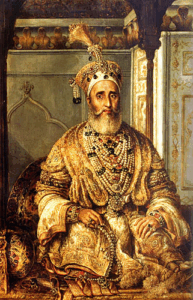
Regardless, the Red Fort remained a potent cultural and intellectual hub. The “Lesser Mughals,” though politically powerless, became significant patrons of the arts, fostering a vibrant “Delhi Renaissance”. The last emperor, Bahadur Shah Zafar, embodied this transformation from a political sovereign to a cultural icon. A noted mystical poet, calligrapher, and patron, Zafar presided over a court that hosted some of the greatest literary figures in modern Indian history, including the poets Ghalib and Zauq. The Red Fort, though effectively a “house of bondage,” was the center of a sophisticated and tolerant Indo-Islamic civilization. (Russell 1860)
This fragile world was shattered by the Revolt of 1857, an event that historian Percival Spear argued merely accelerated a process that was already inevitable. Seeking a symbol of legitimate authority, rebellious sepoys from Meerut marched to Delhi and proclaimed the reluctant, 82-year-old Zafar as their leader. Unwillingly, he became the figurehead of an uprising he suspected was doomed. The eventual crushing of the revolt by the British led to the sack of Delhi and the end of the Mughal dynasty. This culmination set the stage for the final, humiliating act: the trial of the last Mughal emperor in his own ancestral palace for rebellion and treason. (Spear 1937)
The Unwilling Face of Rebellion
The 1857 Uprising was ignited by long-simmering grievances and a religiously charged trigger: the infamous greased cartridges for the new Enfield rifle, which sepoys believed were coated in cow and pig fat. On the morning of May 11, 1857, this simmering resentment exploded into action. Around three hundred mutinous sepoys from Meerut clattered across Delhi’s Bridge of Boats, burned the Toll House, and killed the British telegraph manager on his way to repair the line. They were soon joined by freed convicts and local Gujars, and together they rampaged through the city, massacring every Christian they could find. Their destination was the Red Fort, the symbolic heart of a faded empire.
The rebels gathered beneath the emperor’s private apartments, the Saman Burj, calling for the 82-year-old Bahadur Shah Zafar. Their proclamation was clear: “we have come from Meerut after killing all the Englishmen there, because they asked us to bite bullets… coated with the fat of cows and pigs. This has corrupted the faith of Hindus and Muslims alike”. By securing the blessing of the aged emperor – a man still seen by many Indians, both Hindu and Muslim, as their “rightful Lord” – the sepoys instantly transformed their mutiny into a full-scale rebellion against British rule. Zafar, a poet and mystic, was horrified by the violence and their insolence. His initial response was to admonish them, declaring, “I did not call for you; you have acted very wickedly”. However, he was powerless, surrounded by a “chaotic and officerless army” that threatened, “unless you, the King, join us, we are all dead men”. With little choice, Zafar gave his reluctant blessing, becoming the unwilling figurehead of a revolt he suspected was doomed. (Dalrymple 2006)
The rebel camp was immediately plagued by internal divisions and a near-total breakdown of order. As the city descended into a ruin and riot, Zafar’s ambitious son, Mirza Mughal, was appointed Commander-in-Chief but struggled to control the fractious regiments who looted the city’s bankers and terrorized its citizens. The later arrival of the more effective General Bakht Khan from Bareilly brought much-needed military direction but also deepened the factionalism, as his brusque manner and hard-line religious views alienated other rebel leaders and many in the royal court. (Gupta 1981) (Spear 1951)
The Fall of Delhi and the Fate of the Emperor
The initial British military response to the Uprising was marked by incompetence and delay. Commanders in Meerut failed to pursue the mutineers, while the Commander-in-Chief dallied for days in Simla. This inaction allowed the rebellion to spread. In stark contrast, officials in the Punjab, like the ruthless John Nicholson, acted with brutal efficiency, organizing a “Moveable Column” that swept through the province, disarming regiments and hanging mutineers without trial. By early June, the Delhi Field Force had established itself on the Ridge overlooking the city, but found themselves besieged by a vastly superior rebel force. Life on the Ridge was a living hell of heat, cholera, and constant attack, and the frustrated British troops took to burning villages and hanging locals indiscriminately. (Spear 1951) (Dalrymple 2006) (Gupta 1981)
The final assault began on September 14, 1857, after a massive siege train arrived from the Punjab. Following the dramatic blowing of the Kashmiri Gate, British columns fought their way into the city, meeting ferocious resistance. Once inside, the soldiers, “mad and excited,” unleashed an orgy of violence. A general massacre of the male population was ordered, with one officer, Edward Vibart, describing the scenes as “literally murder” as his regiment was ordered “to shoot every soul”. Entire neighborhoods were cleared; in one area, Kucha Chelan, some 1,400 citizens were cut down. The city was then systematically plundered by official Prize Agents. When the British finally took the Red Fort, Delhi was a desolate, silent “city of the dead”. (Dalrymple 2006) (Vibart 1857)
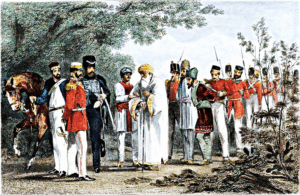
Realizing the cause was lost, Zafar slipped out of the Red Fort and took refuge in Humayun’s Tomb. The task of his capture fell to Captain William Hodson, the audacious chief of intelligence. Through Zafar’s treacherous relative Mirza Ilahe Bakhsh, Hodson negotiated the Emperor’s surrender, offering to spare his life – a promise made without official authority. On September 21st, the aged Emperor emerged and was led captive back to the city. The following day, Hodson returned for the princes who had led the rebellion: Mirza Mughal, Mirza Khizr Sultan, and Mirza Abu Bakr. After they surrendered, Hodson took them towards the city, halted them at the Khuni Darwaza (Bloody Gate), forced them to strip naked, and shot all three dead at point-blank range with his revolver. “I am not cruel,” he later wrote, “but I confess I did enjoy the opportunity of ridding the earth of these wretches”. (Hodson 1860)
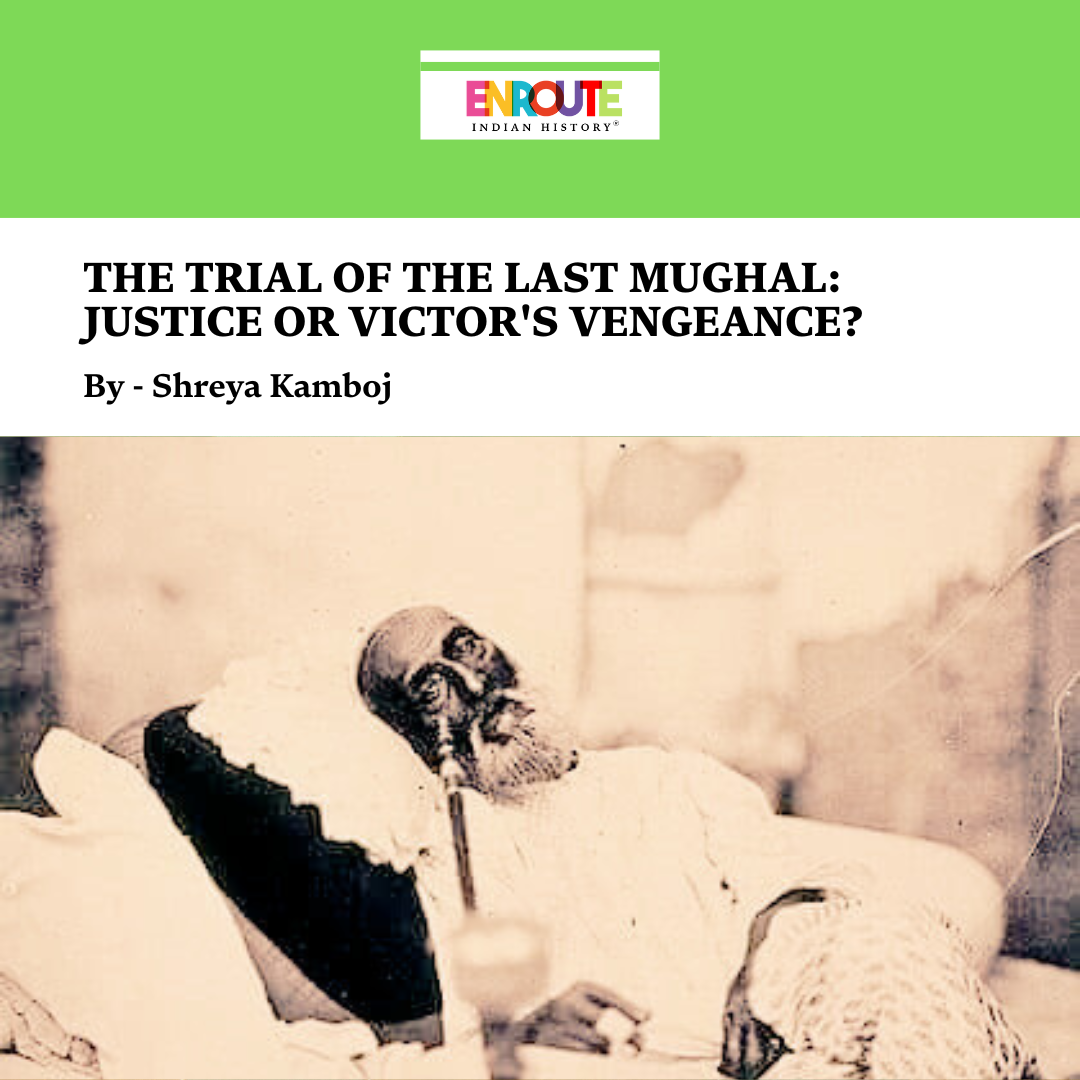
Zafar’s subsequent treatment was a study in calculated humiliation. He was imprisoned in a “small, dirty, low room” within his wife’s haveli and treated, according to one officer, “like a beast in a cage”. British soldiers and officers would come to stare and mock him, with one boasting of pulling his beard. He was denied his doctor and other basic dignities. When the Times correspondent William Howard Russell visited, he saw a “dim, wandering-eyed, dreamy old man,” a “broken-down old man” lying on a tattered coverlet. When informed of his sons’ executions, Zafar was too shocked to react. Stripped of all honor, the last Mughal emperor was now a powerless captive, awaiting his final fate. (Campbell 1893) (Russell 1860)
A Questionable Trial and a Helpless Defense
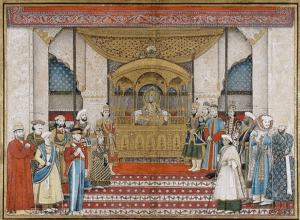
In a final act of imperial humiliation, the trial of Bahadur Shah Zafar began on January 27, 1858, in a place that once symbolized the zenith of Mughal power: the Diwan-i-Khas, or Hall of Private Audience, within his own Red Fort. The once-resplendent hall was now a makeshift British courtroom where the frail 82-year-old emperor was brought before a military commission to answer charges of rebellion, treason, and murder. The trial was a carefully constructed political spectacle, designed not just to punish a monarch but to legally dismantle his sovereignty and legitimize the formal imposition of British Crown Rule in India. (Haldar 2025) (Dalrymple 2006)
The prosecution, led by Major F.J. Harriott, meticulously re-categorized the emperor as a mere “subject” and “pensioner of the British Government” to make the charge of treason legally plausible. Harriott’s narrative, delivered over two days, depicted the Uprising not as a complex rebellion with varied causes but as a widespread Islamic conspiracy with Zafar at its center. He argued that “to Musalman intrigues and Mahommedan conspiracy we may mainly attribute the dreadful calamities of the year 1857,” portraying the emperor as the “leading chief of the rebels”. This deliberately ignored the fact that the rebellion was initiated by and largely composed of high-caste Hindu sepoys, conveniently framing it as a war of “Mahommedan fanaticism”. (Dalrymple 2006) (Haldar 20205)
The legality of the trial was fundamentally flawed. The East India Company’s authority to govern had been legally derived from the Mughal Emperor; until 1833, the Company’s own seal acknowledged itself as the Mughal’s vassal. From this perspective, a strong case could be made that it was the Company, not Zafar, that was the rebel guilty of treason against its feudal superior. This crucial contradiction was never addressed by the court. Instead, the trial aimed to retrospectively fix the legal subjecthood of Bahadur Shah Zafar within the British Empire, thereby legitimizing its own claim to sovereignty.
Zafar’s defense, submitted in a written statement, was one of utter helplessness. He claimed he had been a prisoner of the sepoys from the moment they arrived: “All that has been done was done by that rebellious army. I was in their power, what could I do?… I was helpless, and constrained by my fears, I did whatever they required; otherwise they would have immediately killed me”. This plea was ironically supported by the star witness for the prosecution: Hakim Ahsanullah Khan, Zafar’s most trusted confidant, who, in a staggering act of betrayal, gave evidence against his master in return for his own pardon. Throughout the two-month trial, the aged Zafar appeared listless and detached, often dozing or amusing himself “with a scarf, which he would twist and untwist around his head like a playful child”. (Dalrymple 2006)
The Verdict and the Exile
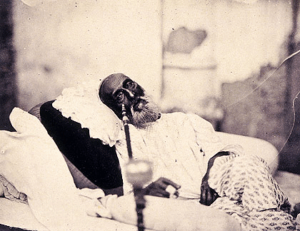
The trial of Bahadur Shah Zafar concluded on March 9, 1858, with an outcome that was never in doubt. The military commission found the emperor “guilty of all and every part of the charges preferred against him”. Normally, such a verdict would have resulted in the “penalty of death as a traitor and a felon”. However, because Captain Hodson had guaranteed Zafar’s life during his surrender, he was instead sentenced to be transported into exile for the remainder of his days. The trial and verdict served a crucial purpose: they legally deposed the Mughal sovereign, fundamentally restructuring the colonial order and shifting the “locus of sovereign authority within the Indian subcontinent from the Mughal emperor to the British Crown”.
After a seven-month delay, Zafar began his journey into exile. At 4 a.m. on October 7, 1858, the last Mughal emperor left his ancestral city of Delhi on a bullock cart, accompanied by his wife Zinat Mahal and his two remaining sons. The party traveled down the Grand Trunk Road and then by steamer down the Ganges, eventually reaching Rangoon, Burma. There, Zafar and his family were confined to a small, four-room wooden house surrounded by a high palisade, a short distance from the Shwe Dagon Pagoda.
His final years were spent in “listless apathy,” with his jailer, Captain Davies, reporting that the old man showed “considerable indifference to all but eternal affairs”. Denied pen and paper, Zafar reportedly wrote verses on the walls with a burned stick, expressing the deep despair of his exile:
My life now gives no ray of light, I bring no solace to heart or eye; Out of dust to dust again, Of no use to anyone am I.
Delhi was once a paradise, Where Love held sway and reigned; But its charm lies ravished now, and only ruins remain.
Lagta nahin hai dil mera ujde dayar mein Kis ki bani hai aalam-e-na-paedar mein
My heart no longer finds solace in this ruined land. Who has ever felt fulfilled in this transient world?
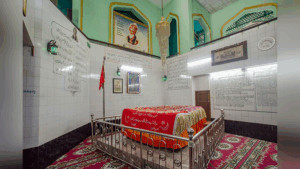
Zafar’s health steadily declined, and he died at 5 a.m. on Friday, November 7, 1862, at the age of eighty-seven. The British ensured his passing was as discreet as possible. He was buried that same afternoon in an unmarked grave at the back of his prison enclosure, until it was discovered in 1991. Captain Davies wrote to his superiors with satisfaction, “no vestige will remain to distinguish where the last of the Great Moghuls rests”. The death of Zafar, followed by the Government of India Act of 1858, which transferred power from the East India Company to the Crown, marked the definitive end of the 350-year-old Mughal dynasty and the formal consolidation of the British Empire in India. Zafar’s most famous and poignant couplet, written in captivity, became an epitaph for his tragic fate and the loss of his beloved homeland:
Kitna hai bad-naseeb ‘Zafar’ dafn ke liye Do gaz zamin bhi na mili ku-e-yar mein
How unfortunate is Zafar! For his burial, Not even two yards of land were to be had in the land of his beloved.
Bibiography
1. Ball, Charles. (1858–9) ‘The History of the Indian Mutiny’. vol. 2.
2. Campbell, G. (1893). ‘Memoirs of my Indian Career’. Vol 1. Macmillan.
3. Dalrymple, W. (2006). ‘The Last Mughal’. Bloomsbury.
4. Haldar, S. (2025). ‘Taking Sovereignty to Court: An Inquiry into the Trial of Bahadur Shah Zafar’. University of Chicago.
5. Hodson, W.S.R. (1860). ‘Twelve Years’ of a Soldier’s Life in India’. Boston: Ticknor and Fields.
6. Gupta, Narayani. (1981). “Delhi between two empires, 1803-1931 : society, government and urban growth’. Delhi : Oxford University Press.
7. Oriental and India Office Collections, British Library, Vibart Papers, Eur Mss 135/19, Vibart to his Uncle Gordon, 22 September 1857.
8. Proceedings on the Trial of Muhammad Bahadur Shah, Titular King of Delhi, before a Military Commission, upon a charge of Rebellion, Treason and Murder, held at Delhi, on the 27th Day of January 1858, and following days London, 1859
9. Russell, W.H. (1860). ‘My Diary in India’. London. vol. 1 & 2.
10. Spear, P. (1951). ‘Twilight of the Mughuls’. Cambridge at the University Press.
11. Spear, P. (1937). ‘Delhi: A Historical Sketch’. Humphrey Milford: Oxford University Press.
12. Vibart, E. (1898). ‘The Sepoy Munity’. London.