

-: by Ayush Tripathi
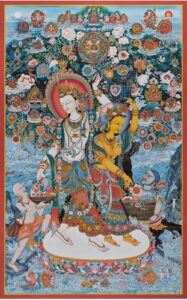
Paubha depicting Chintamani Lokeshvara with his consort Tara, painted by artist Lok Chitrakar [Source: Simrik Atelier]
The origin of the word ‘Paubha’ is a small linguistic exploration that traces the movement of artistic traditions across different languages and cultures. The term is from Newar or Nepal Bhasa, the Tibeto-Burman language of the indigenous Newar people of the Kathmandu Valley. In Newar language, it is commonly spelled as pauva, with variations such as paubhā, pauba and paubā. Newar pauva directly adapts the Sanskrit word paṭa, meaning ‘cloth,’ ‘woven fabric,’ ‘picture painted on cloth,’ or ‘banner.’ The Sanskrit paṭa comes from the Proto-Indo-European root ‘pet-’ or ‘pat-’, meaning ‘to spread out’ or ‘to fly.’ This root meaning, ‘that which is spread out,’ perfectly describes the Paubha as a stretched piece of cotton cloth prepared for painting.
In classical Sanskrit literature, the term paṭacitra (paṭa + citra, meaning ‘variegated’ or ‘picture’) refers to painted cloth scrolls used by traveling storytellers (paṭua or paṭakāra). These storytellers went through Indian villages, displaying paintings that illustrated the stories of gods and heroes while narrating the associated myths. The tradition of paṭacitra, still present in a limited form in West Bengal and Odisha, parallels the Newar Paubha, although the two diverged long ago. The Indian paṭacitra became mostly narrative and popular, while the Newar Paubha developed in a temple-based and tantric-liturgical direction. In Newar texts, the most commonly used Sanskrit terms are paṭa alone, or the phrases citrapaṭa (‘picture cloth’) and devatāpaṭa (‘deity painting on cloth’), found in Malla-period Sanskrit inscriptions that commissioned paintings, in ritual manuals, and in the colophons of surviving Paubhas.
In Tibetan, the Paubha tradition is identified as bal po’i ras bris (‘Newar painting on cloth’). Here, bal po refers to ‘Newar/Nepali person,’ ras means ‘cloth’ (specifically woven cotton), and bris means ‘painted.’ This Tibetan name clearly marks the ethnic and geographic roots of the tradition as Newar. The Tibetans consistently maintained this attribution during the medieval period of cultural exchange. The Tibetan term for the painting tradition developed in Tibet under Newar influence is thang ka (romanized as thangka), which literally means ‘flat thing,’ coming from thang (‘flat,’ ‘open’) and ka (a nominalizing function). The journey from Sanskrit paṭa to Newar pauva to Tibetan thangka thus reflects the physical transformation of the art form across the Himalayas. The Newar painter named his work after its material (the cloth), the Sanskrit tradition named it after its visual nature (the picture on cloth), and the Tibetan tradition named it after its flatness. Each naming system reveals a different aspect of the cultural understanding of the object.
Chitrakar of Newar society : Artists who created Paubha
The Newar term for the painter, Pun or Put, has been analyzed by linguists in various ways. The most accepted origin connects it to Sanskrit putrikā-kāra (‘maker of small images’), reflecting the initial specialization of the Chitrakar caste in creating clay festival images and small votive items before the established Paubha tradition developed. An alternative connection relates it to the Sanskrit word puṇya (‘merit,’ ‘virtue,’ ‘auspiciousness’), interpreting Pun as ‘the one who generates merit’ through sacred art. This folk etymology, regardless of its linguistic accuracy, captures the tradition’s self-awareness. The caste’s formal Sanskrit designation, Chitrakāra (‘one who makes images’ or ‘image-maker,’ from citra, ‘variegated picture,’ and kāra, ‘maker’), consistently appears in Sanskrit inscriptions, legal documents, and texts referring to the caste from outside the community.
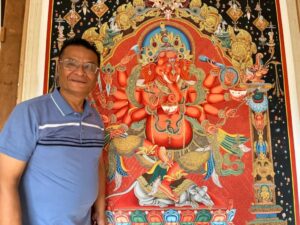
Renowned Paubha artist Lok Chitrakar with his art piece ‘Maharakta Ganapati’ [Source: Simrik Atelier]
To reach the highest level of Chitrakar training, a painter must be authorized to paint the faces of key deities. This requires not just technical skill but also a specific form of meditation known as devatā-yoga or deity yoga. Before painting the face of Tārā, Avalokiteśvara, or Vajrayoginī, the accomplished Chitrakar master typically spends time meditating. He visualizes himself as the deity, adopting the deity’s form, color, ornaments, and divine gaze in his imaginative space. From this internal identification, he ‘looks out’ from the deity’s perspective on the canvas. The brushstroke that creates the deity’s eye is understood as made not by a human hand approximating a divine form, but by the deity’s own visual energy, expressed through the artist’s trained hand on the prepared cotton surface. This is why the face, especially the eyes, of a great Paubha can seem to possess a living quality. Viewers from different eras and cultures often feel as if they are being observed, rather than just looking. In this case, they are correct.
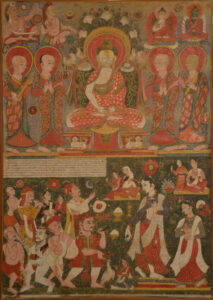
Patan-style Paubha commemorating the death of Pandita Vanaratna (1384-1468)[Source: Rubin Museum of Himalayan Art]
Within the Paubha tradition, art historians and scholars have identified distinct workshop lineages (silpa-parampara) whose works show different stylistic, iconographic, and technical features. The Patan tradition, focused on the important Buddhist monastic institutions (baha) in Lalitpur, especially the Uku Baha (Hiranya Varna Mahavihara or Golden Temple), is known for its delicate lines, cooler jewel-like colors, precise iconographic detail, and a subtle treatment of divine faces that evokes a serene inwardness seen rarely in the broader tradition. The best Patan Chitrakar workshops, like the Prajapati lineage, the Ratna lineage, and the Chitrakar families of Mangal Bazar, have maintained ongoing ties with the Vajracarya priestly community, ensuring their iconographic knowledge is regularly checked against living traditions.
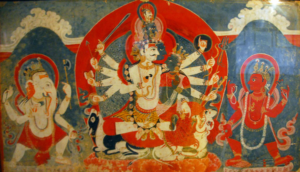
Bhaktapur-style Paubha depicting Shiva accompanied by his consort Parvati and children Ganesha and Kartikeya [Source: Nepal National Art Gallery]
The Bhaktapur tradition focuses more on decorative patterns. Its color palette leans toward warmer amber yellows and richer reds. The compositions often emphasize elaborate architectural framing around the central deity. Bhaktapur workshops display a unique style for landscape backgrounds, depicting rock formations in a more schematic, calligraphic way.
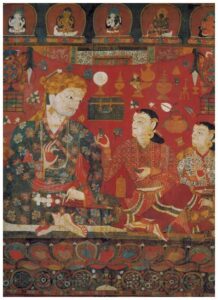
Paubha depicting Gagansim and his two wives Ashayani Laxmi and Jivatana, circa 1470, by Kathmandu’s Chitrakar Adyayaraja Pun and Udrayama Pun[Source: Himalayan Art Resources]
The Kathmandu tradition, linked to the royal atelier at Hanuman Dhoka and Chitrakar families in city neighborhoods like Asan, Indrachowk and Kilagal, shows bolder and higher-contrast colors. This tradition leans toward more expansive compositions and uses heavier primary outlines. It is especially known for large-scale festival paintings where bold simplification is more effective than fine detail.
The main measurement system used in Paubha painting is the tala system. The tala measures the distance from the hairline to the base of the chin of the principal deity in a painting. From this single measurement, all other bodily proportions are derived. The highest category of divine being is proportioned at eight talas (astatala). The head is one tala, the neck is one-quarter tala, the torso from neck to navel is two talas, the lower torso from navel to the base of the groin is two talas, the thighs are two talas, and the lower leg is one and three-quarters talas, with the foot being one-quarter tala. Medium-ranking deities and subsidiary Bodhisattvas are proportioned at seven talas (saptamana). Minor deities, attendant figures, and human beings in narrative scenes are proportioned at six or five talas; this reduced proportion signifies their lower divine status. The face itself is divided into three equal horizontal zones: the forehead, the middle zone from eyebrows to base of the nose, and the lower zone from the base of the nose to the chin. The width of one eye is one-third of the total face width at eye level; the distance between the eyes equals the width of one eye. These specifications, learned through years of practice, allow an experienced Chitrakar to proportion a divine face of any size consistently, using only a knotted cord or a bamboo ruler.
One of the most important yet least studied aspects of the Chitrakar tradition is the tacca. The tacca are pattern books kept by Chitrakar workshops, serving as reference standards for proportioning, compositional arrangement, and iconometric details of deity forms. The term tacca, meaning ‘template’ or ‘traced model’, refers to collections of folded or rolled sketches on paper or birch bark. These sketches depict canonical forms of deities outlined with proportion grids marked upon them. These are not finished artworks, but working documents; tools for painters, similar to the sinopia underdrawings in Italian fresco practice. The tacca tradition is closely connected to the broader system of silpasastra knowledge that informs Paubha iconography. Key silpasastra texts like the Manasara, the Visvakarmaprakasa, the Silparatna and for Buddhist subjects specifically, Abhayakaragupta’s Nispannayogavali, provide the verbal instructions that inform the tacca sketches. However, the tacca are not simply mechanical translations of these verbal instructions into visual form; they reflect the interpretive choices made by generations of Chitrakar masters. These decisions include how to represent what the texts describe, shaped by a long tradition of seeing and painting divine forms.
The traditional Paubha palette uses only mineral pigments from natural sources. This choice is technical, theological, and symbolic. Mineral pigments last longer than organic dyes; they do not fade significantly even after centuries of exposure to incense smoke, lamp oil vapors, and the varying humidity of the Valley’s climate. The reds in the palette come from cinnabar and red ochre. Yellow is mainly from orpiment and yellow ochre. Green comes from malachite and additional verdigris. The deep blue seen in the best classical Paubha paintings is not sourced from any mineral found in Nepal. White is made from white lead or kaolin. Outlines are made with lamp black, which is carbon black derived from the incomplete burning of sesame oil or ghee.
Blue is the most symbolically significant and logistically challenging color. Azurite is the primary blue used in most compositions, while lapis lazuli is saved for the most important sections in top commissions. This brilliant blue mineral was quarried, processed, and traded along routes that passed through major Central Asian centers, across the Hindu Kush, through the Gangetic plain of India, and up trade routes to Nepal. Following slightly different routes, the same mineral found its way to Renaissance Europe, where artists like Giotto, Fra Angelico, and Vermeer used it. A Paubha painting of Tārā in Patan and a Madonna by Raphael in Rome may thus share the same geological source for their intense blue.
Preparing the cotton cloth (vastra-bhumika) is one of the most demanding and ritually significant steps in creating a Paubha. This process starts with selecting a medium-weight, plain-woven fabric that has a tight, even weave. The cloth is washed in clean water to get rid of any sizing added during weaving, then thoroughly dried and stretched on a wooden frame using cotton thread through the selvage edges. The stretching is done while the cloth is still slightly damp, ensuring even tension as it dries. The ground preparation (lepana) involves applying multiple thin coats. The traditional mix includes chalk powder or kaolin combined with hide glue, made by boiling scraps of goat or ox skin until a clear adhesive forms, in a ratio of about three parts chalk to one part glue by weight. This mix is diluted with more water for a consistency slightly thicker than whole milk. Usually, three to five coats are applied for quality work. After the final coat has dried, the surface is burnished with a smooth stone, typically river-polished quartzite or agate, in firm circular motions. Burnishing compresses the surface into a denser, smoother layer, allowing fine brush marks without feathering, while also giving a slight shine that enhances the brightness of the pigments.
Gold (kancana or suvarna) serves multiple purposes. It is a precious material that honors the divine, a reflective surface suggesting the supernatural light of divine forms, and a medium for refined decorative artwork. Two main methods of applying gold are used. Shell gold (suvarna-salka) is created by grinding very thin gold leaf with honey or gum arabic in a mussel shell until it turns into a fine powder. This powder is then mixed with a weak glue and applied with a brush. This technique allows painters to draw in gold with the same control as any other pigment. It produces fine gold lines for ornamental jewelry patterns, the veins of decorative lotus petals, and intricate scrollwork in architectural frames. Gold leaf application (suvarna-patraka) involves sticking beaten gold leaf, thin sheets made by hammering between animal membranes, to prepared areas on the painting surface. This is burnished with a polished agate stone to create a mirror-like shine. A third technique, punched and incised gold work (mukuta-utkirna karya), creates patterns on the gold surfaces by pressing or incising with fine tools, resulting in a play of reflection and shadow that gives the gold areas a nearly three-dimensional look under light.
The most important tool for a Paubha painter is the brush (tuli or tulika). Mastery of the brush is a key technical achievement for the Chitrakar in training. Traditional Paubha brushes are made by attaching three to twelve animal hairs, depending on the size of the brush, to a bamboo or wooden handle. The finest brushes use hairs from the tail of the Himalayan yellow-nape weasel (nakula, Mustela kathiah) or the tail of a squirrel (kathika), which provide an ideal mix of spring and flexibility. Medium brushes use cat hair (marjara-roma), while broader brushes use stiff bristles from wild boars or softer hairs from goats. The way hairs are bound to the handle with fine silk thread influences the brush’s performance. A loose binding causes an irregular brush tip, while a tight binding restricts the hairs from responding to the painter’s pressure.
The basic vocabulary of Paubha draughtsmanship consists of specific line types, each created by a unique combination of brush pressure, speed, and angle. The iron-wire line (ayasa-sutra-rekha) produces a perfectly even line used for outlining figure forms and architectural details. It requires maintaining a consistent brush angle of about thirty degrees and moving it at even speed. The hair-fine tapering line (kesa-rekha) is for hair locks, fine drapery folds, and ornamental details. It starts fine, swells slightly with increased pressure, then tapers back to a fine point. The hook-and-release stroke (ankusa-rekha) creates the characteristic scrollwork and foliate patterns in decorative fields, like curling lotus-stem patterns and cloud scrolls. The wash stroke (vartika) is a broad, quick movement of a loaded brush across a large area for flat color fields. The stipple stroke (bindu-rekha) creates texture with tiny closely spaced dots made by the brush tip touching and lifting immediately.
The painting process in a Paubha follows a strict order that is both practical and ritualistic: (1) a compositional sketch or transfer from tacca using red ochre or charcoal for underdrawing; (2) applying the background color; (3) painting the architectural frame, throne, and halo; (4) blocking in the main color areas of the figure; (5) modeling body areas with gradual color transitions; (6) applying gold, both leaf and shell gold, to ornamentation; (7) detailing subsidiary figures, landscape elements, and narrative scenes; (8) final line work to reinforce and clarify all outlines with fresh lamp black; (9) adding fine white highlights for the sheen of divine skin, silk drapery, and polished metal; (10) painting the central deity’s face; and (11) painting the eyes. This sequence, practiced until automatic, is passed down through apprenticeships and reflects the Chitrakar tradition’s accumulated wisdom in procedural form.
When creating a Paubha, the face of the central deity is the last feature to be completed. The Chitrakar painter works from the outside in, starting with the deep-toned background, then the architectural frame, followed by the throne and halo, then the body, hands, ornaments, and drapery of the deity. Only when everything else is complete does he use his finest brush, made from a few hairs of mongoose, cat, or squirrel, to paint the face. The eyes are the final strokes of all. This sequence reflects a deep theological belief: once the gaze of the deity is painted, the piece transforms from a mere arrangement of pigments into a living divine presence. The painter must avoid unintentionally ‘awakening’ the deity before the body, throne, halo, and full devotional context are set to receive that gaze. After the eyes are painted, the artist traditionally covers them with a silk cloth immediately. The formal ‘opening of the eyes’ (mikhā chāyekegu or cakṣu-dāna) takes place only during the following pratiṣṭhā consecration ceremony, when a Vajrācārya priest removes the cloth. This moment holds great theological significance: creating a god’s gaze is a profound act that is too significant for the artist to take on alone.
One notable aspect of the Paubha tradition is the relationship between the Malla kings of Kathmandu and the large reclining Vishnu statue at Budhanilkantha. This monumental seventh-century stone sculpture shows Vishnu lying on the cosmic serpent Ananta-Shesha in a stone water tank. The Malla kings were forbidden, due to a divine instruction linked to a vision received by King Pratap Malla in the seventeenth century, from visiting or viewing the Budhanilkantha image at all. This ban arose because the king’s divine identity was considered identical to that of the reclining Vishnu. A god cannot look at himself, as it would create a conflict that would cancel out both figures. Practically, this meant the royal court required a Paubha painting of the Budhanilkantha Vishnu for the palace. This way, the king could pay personal devotion to Vishnu without visiting the shrine. The Paubha served as a substitute for a god who could not worship his own image, highlighting the Newar view of the Paubha as a true and living divine presence, not just a representation.
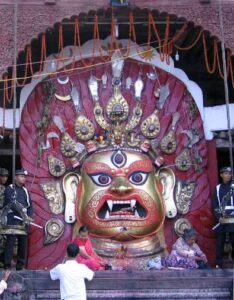
Mask of Sweta Bhairava at Durbar Square during Indra Jatra [Source: Wikimedia Commons]
The most impressive application of the Paubha tradition is not in the personal devotional paintings that adorn temple niches and family shrines, but in the grand festival paintings displayed during major Newar celebrations. In September, during Indra Jātrā, large Paubha paintings hang from the façades of temples and palaces in Kathmandu’s Hanuman Dhoka square. This transforms the city’s oldest public space into an outdoor sacred gallery. Some of these festival Paubhas are four or five meters tall. Even more extraordinary are the Paubhas used in processions. The chariots of the Living Kumārī, Kumāra/Skanda, and Ganeśa all feature specific Paubha paintings that travel through the streets of old Kathmandu during the festival. In this context, a Paubha is not a fixed object but a mobile sacred presence or a god in motion.
The earliest surviving paintings assignable to the Paubha tradition display strong connections to the art of the Pala dynasty of Bengal and Bihar, that are visible in the treatment of throne-back designs (the paired-fish or matsya-yugma motif), the proportioning of figures (following Pala conventions of approximately one-to-seven head-to-body ratio), and the palette (particularly the use of deep blue as a dominant tonality with deep reds set against it in high chromatic contrast). Strong, clear outlines of uniform weight applied in lamp black, flat unmodulated color fields without volumetric modeling, relatively simple compositional organization, and a face type with large ‘fish-shaped’ eyes characterize this period. The stylistic connections between this early Paubha style and the contemporary art of eastern India reflect the intense scholarly and artistic exchange between the Kathmandu Valley and the great Buddhist institutions of Nalanda, Vikramashila, Odantapuri, and Somapura; a traffic facilitated by the Valley’s position on the main trade route between the Indian subcontinent and Tibet.
The early Malla era sees the gradual development of a distinctly Newar visual idiom: increasing elaboration of subsidiary figures and narrative detail; development of more sophisticated architectural framing; introduction of landscape elements as background features; and refinement of the Newar face type toward the distinctive almond-eyed, high-cheekboned, and warmly luminous facial form of the classical period. The pigment palette shows significant development, with more sophisticated graduated color transitions replacing the pure flat fields of the earlier period.
The century and a half between approximately 1380 and 1530 CE represents the classical period, the era in which all formal characteristics that define the tradition at its most sophisticated were established, codified, and brought to their highest refinement. This period corresponds to the reign of Jayasthiti Malla (r. 1382–1395), Yaksha Malla (r. 1428–1480), and their successors, whose competitive patronage created the conditions for sustained artistic flourishing across all three Malla capitals. The classical style is characterized by: jewel-like intensity of color with pigments applied in multiple thin layers over a brilliant white ground; highly refined linear draughtsmanship; sophisticated compositional organization that can accommodate dozens of subsidiary figures without sacrificing devotional clarity; elaborate treatment of architectural framing and ornamental detail; and the distinctive handling of the paradisiacal landscape setting (sukhavatii) that frames the central divine presence.
In the seventeenth century, the reigns of Siddhinarasimha Malla of Patan (r. 1619–1661), Pratap Malla of Kathmandu (r. 1641–1674) and Jitamitra Malla of Bhaktapur (r. 1673–1696) saw the most intense period of inter-city artistic competition in Newar history. Pratap Malla, who personally tested candidate painters by requiring them to produce a sample divine face from memory and who is credited in oral tradition with numerous direct interventions in artistic programs, may be the most enthusiastically engaged royal patron of Paubha painting in the historical record. Chinese artistic conventions, particularly landscape conventions from Song and Yuan dynasty painting, began to infiltrate the Paubha tradition in this period through the medium of Tibetan painting, which had already synthesized Newar and Chinese conventions in the preceding centuries.
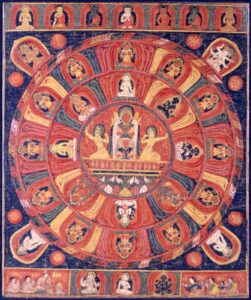
Paubha depicting Surya Mandala with Surya in the middle, the remaining eight grahas/planets occupy the first layer of lotus petals surrounding the central circle. On the second layer of lotus petals are the 12 solar deities known as Adityas ( each of whom is associated with a specific month in the year). Two bodhisattvas, white Manjushri and red Avalokiteshvara, flank the five cosmic Buddhas sitting on the top. On the bottom, the goddess white Tara is accompanied by the dark blue Mahakala and the elephant-headed god Ganesha. (from 16th century A.D.) [Source: Wikimedia Commons]
Certain types of Paubha paintings are, by their nature, never ‘finished’ in the usual sense. The grand Navagraha (Nine Planet) paintings and the intricate cosmological maṇḍalas used in some Newar Buddhist monastery rituals are continually active ritual tools. Their power is sustained not by being complete, but by ongoing ritual use. A Paubha involved in the daily pūjā of a temple or monastery shrine gathers, over generations, layers of devotional use: the smoke from countless butter lamps, the dust from innumerable grains of incense, and the fingerprints of many devotees. This buildup is not a sign of deterioration; it is a visible record of the painting’s devotional journey, a material testament to the countless moments where the deity has been approached through the painted surface. A darkened, smoke-stained, and often-touched painting is, from the traditional Newar perspective, a far more valuable object than a pristine, newly painted one that has never been used for worship.
During the painting of a Paubha, particularly during the rendering of the central deity’s face, the Chitrakar painter is required to observe strict restrictions: abstention from meat, fish, onion, garlic, and other foods classified as rajasic or tamasic; sexual abstinence (brahmacharya) for the duration of the project; avoidance of contact with persons in states of ritual impurity (menstruating women, persons in the death-mourning period, persons who have recently attended a funeral); morning bathing and the recitation of specific mantras before sitting down to paint; and the maintaining of a devotional attitude (bhakti-bhava) during the actual work, sometimes expressed through continuous mental recitation of the mantra of the deity being depicted. A painter who enters a period of family impurity following a death must abandon his work for the full duration of the mourning period, from eleven to forty-five days in the Newar system, depending on the caste and relationship to the deceased. To paint a sacred image while in a state of ashaucha (ritual impurity) is a grave offense against the deity, one that can render the completed painting ritually ineffective and bring misfortune on the painter and family.
Among the oral traditions of the Chitrakar community, the most notable is the founding legend of the caste. The first Chitrakar master was summoned by a deity, identified variously as Vishnu, Manjushri, or Kumari. He was given the divine task of creating images of the gods to provide human beings with visible forms to approach the divine. Another significant legend involves the painter Kula Chitrakar, credited with establishing key Paubha iconographic conventions. According to the story, just before finishing a Taleju painting, with only the goddess’s face left, Kula Chitrakar dreamed of the goddess revealing her true face. She instructed him to paint the face he saw in the dream, rather than the conventional one. This painting was believed to be supernaturally perfect, radiating divine presence so strongly that the king ordered a curtain to cover it, which could only be removed during specific rituals. This legend explains the Newar custom of covering certain especially potent Paubhas, a practice that continues in several Valley temples today.
A Paubha painting serves as both a visual image and a theological text. It communicates, to an informed viewer, a detailed account of reality, the cosmos, divine power, and the path from suffering to liberation. Every element in a Paubha composition carries significance: the position and posture of figures, the color of deities, the objects held, the expressions on faces, the animals associated with the deities, the direction each figure faces, and the overall geometric structure. Learning to read a Paubha fully is like mastering a complete symbolic language.
Most Paubha paintings follow a hierarchical mandala structure, organizing the pictorial field around a central deity (mukhya devata). This deity’s superior status is shown through its central placement, larger size compared to other figures, and the intricate throne, aureole, and ornamental frame. The throne itself symbolizes complexity. The lotus throne (padmasana) signifies the emergence of purity from impurity, as the lotus blooms unstained above muddy waters, representing divine nature in the impure conditions of existence. The lion throne (simhasana) is reserved for deities of royal stature. The double-lotus throne (padma-yantra) is meant for the highest Buddhas and Bodhisattvas.
Pantheon of Deities in Paubha Art
Ajima or Ashtamatrika
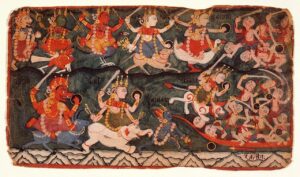
Paubha depicting Ajima or Ashtamatrika goddesses in battle against the demon Raktabija, 18th century folio from a Devi Mahatmya [Source: Wikimedia Commons]
Among the most distinctive deities in Paubha painting are the Ajima goddesses (from Newari ajima, ‘grandmother’) and the Ashtamatrika (Eight Mother Goddesses). They form the protective feminine divine framework that organizes Newar city life. The Ashtamatrika or the Eight Mothers are: Brahmayani (four faces and four arms holding a rosary, water pot, lotus, and book, seated on a goose); Maheshvari (three eyes, four arms holding a trident, damaru, skull cup, and rosary, with bull Nandi as her vehicle); Kumari (depicted as a young girl holding a spear and a cock, with a peacock as her vehicle; she is explicitly linked to the Living Kumari institution); Vaishnavi (four arms holding a discus, conch, club, and lotus, with Garuda as her vehicle); Varahi (boar-faced, holding a cup and club, with buffalo as her vehicle); Indrani (holding a thunderbolt, lotus, and elephant goad, with the elephant Airavata as her vehicle); Chamunda (the oldest and most terrifying, shown as a skeletal figure with sunken eyes and collapsed cheeks, sitting on a corpse, holding a skull cup, curved knife, and noose, with an owl or jackal as her vehicle); and Mahalakshmi (the most benevolent, with four arms holding a lotus, abhaya-mudra, varada-mudra, and water pot, seated on a lion). In Paubha painting, the Ashtamatrika appear both individually and in their circular arrangement, reflecting the Newar understanding of the city as a sacred space protected by the collective power of these eight feminine divine principles. The Newar Ajima Hariti, shown as a plump and smiling deity surrounded by children, holding a pomegranate (symbolizing fertility and domestic abundance), represents the dual nature of a being who was once a demoness (yakshini). She consumed children until the Buddha transformed her, changing her appetite from devouring to protecting.
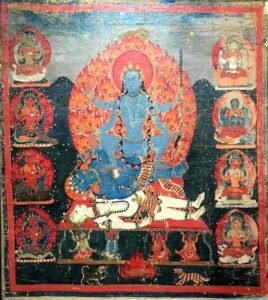
Paubha depicting Ashtamatrika goddesses flanked around Goddess Kali in union with Lord Shiva [Source: Lost Arts of Nepal]
Siddhilakshmi: Guardian of Malla Dynasty
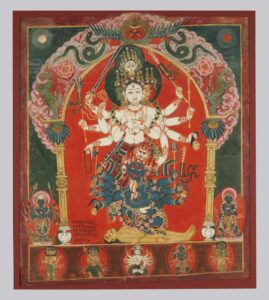
Paubha depicting Siddhilakshmi, from 17th century A.D. [Source: Himalayan Art Resources]
Siddhi Lakshmi, known as ‘The Goddess Who Bestows Magical Accomplishments and Prosperity,’ is one of the most complex and visually unique deities in the Paubha repertoire. Her iconography is particularly Newar, as she is not widely worshipped outside the Kathmandu Valley. Her most notable representation is the monumental Siddhi Lakshmi temple at Bhaktapur’s Tachapal Tol (Dattatraya Square), built by King Bhupatindra Malla in the early eighteenth century. The temple features erotic wood carvings that are some of the most explicit examples of tantric decoration in the Valley. Siddhi Lakshmi represents a blend of the Lakshmi tradition (the goddess of beauty, prosperity, and good fortune, who is Vishnu’s consort) and the Shakti tradition of transformative divine feminine power.
This creates a goddess who symbolizes not just prosperity but also the siddhi (magical accomplishments) achieved through the highest Tantric practices. In Paubha painting, Siddhi Lakshmi is depicted as an eighteen-armed (some texts say twelve or ten arms) goddess with a golden or dark red complexion.
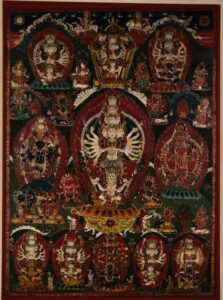
Paubha depicting Siddhilakshmi [dated 1796 C.E. by inscription][Source: Rubin Museum of Himalayan Art]
She stands in the samapada (feet together) posture on a lotus throne supported by smaller figures, asserting her position at the top of a cosmic hierarchy. Her many arms hold a mix of objects: a sword (khadga), a skull cup (kapala) filled with blood, a trident (trishula), a noose (pasha), a lotus (padma), a bow and arrow, a conch shell (shankha), a bell (ghanta), a mirror, a water pot (kalasha), a fire vessel, a wish-fulfilling gem (cintamani), a rosary (akshamala), a skull-topped staff (khatvanga), the varada-mudra (gesture of bestowing gifts) and the abhaya-mudra (gesture of fearlessness). Her face typically features three eyes. The third eye located between and above the brows shows her divine vision beyond ordinary perception.
In some Paubha representations, she is accompanied by lions or lion-headed attendants, and in the most detailed versions, she appears within a mandala of subsidiary deities arranged according to the specific Siddhi Lakshmi sadhana text used by the commissioning Vajracharya. Her presence in Bhaktapur’s royal temple complex emphasizes her connection to royal authority and the divine support of the Malla throne. In the Valley’s complex spiritual structure, she legitimizes and empowers the king, serving as a tantric counterpart to the more widely known Taleju, whose blessing the king also seeks.
Vishnu : Preserver Of The Cosmic Order
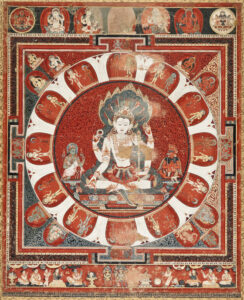
Paubha depicting Vishnu Mandala [Source: Wikimedia Commons]
Vishnu, worshipped in the Kathmandu Valley as Changu Narayan, Budhanilkantha and in his Vaikuntha form, is one of the most frequently depicted deities in Paubha painting. The standard Chaturbhuja Vishnu has four arms, each holding an object with specific mythological significance. The sudarshana cakra (spinning discus) represents cosmic time and justice. The shankha (conch shell) serves as a divine announcement device: when blown, it produces the primordial sound ‘Aum’(ॐ). In Paubha art, it is always held to the left and slightly forward, as if the deity is about to blow it, signifying potential proclamation and divine readiness. The padma (lotus) symbolizes the creative force that sustains the world; from Vishnu’s navel grows the cosmic lotus that bears Brahma, the creator. The kaumodaki gada (club) symbolizes protection and punishment. Vishnu’s dark-blue complexion (meghavarna, cloud-color) conveys an overarching cosmological narrative. These are the colors of the primordial cosmic waters he sleeps upon in his Anantashayana form. The Anantashayana scene, where Vishnu reclines on the cosmic serpent Shesha across the primordial ocean, stands out as a notable composition in the Paubha tradition. The serpent Ananta (‘Infinite’) shelters Vishnu’s head with its multiple cobra-hoods, symbolizing cosmic infinity rather than a threat. Brahma’s emergence from Vishnu’s navel on a long lotus stem signifies the rise of creative consciousness (rajas) from the foundation of preserving consciousness (sattva).
Shiva : God of all Gods
Shiva’s portrayal in Paubha painting centers around the core paradox of the god: he is both the supreme ascetic and a passionate lover, the deity of destruction and of rebirth. His white complexion, a color signifying snow, cremation ash, the moon and pure light, carries all these contradictions at once. Bhairava, Shiva’s terrifying form associated with time, death, and radical change, has eight main forms (Ashtabhairava) worshipped throughout the Kathmandu Valley. Each is enshrined in a specific location that contributes to the city’s sacred geography.
Bhairava
Kala Bhairava (Black Bhairava) is shown with twelve arms extended in arcs, each wielding a specific weapon or tool: the trident (trishula), curved knife (kartrika), skull cup (kapala), sword (khadga), noose (pasha), thunderbolt (vajra), skull-topped staff (khatvanga), fire torch, axe, drum (damaru), the severed head of Brahma’s fifth head which Shiva beheaded in anger for Brahma’s vice and a lotus flower. His garland of fifty freshly severed human heads represents the fifty letters of the Sanskrit alphabet, the basis of all language and reality. Standing on a prostrate human figure (Shava), symbolizing absolute inertness upon which Bhairava’s dynamic energy erupts. The theological meaning of his frightening appearance does not promote violence. Bhairava embodies the terror of radical truth: his weapons cut through illusions, and his fire represents the wisdom that burns away attachment. Sweta Bhairava (White Bhairava), enshrined behind a gilded screen at Hanuman Dhoka and visible to the public only during Indra Jatra, has a white complexion that conveys fear through absolute purity. Akasha Bhairava (Sky Bhairava) has a blue complexion representing the infinite sky. Yama Bhairava is linked to the south and the god Yama; Pachali Bhairava is connected to water and the purification of the dead. Each form is depicted in Paubha painting with distinct color differentiations, arrangements of weapon-bearing hands, and specific deities or animals accompanying Bhairava.
Guhyakali: Dark Hidden Goddess
Guhyakali (‘The Secret Kali’ or ‘The Hidden Dark Goddess’) is one of the most powerful deities in the Newar tantric tradition. Guhya means secret, hidden or esoteric and Kali is the dark goddess of time and death. Her complete iconographic form and accompanying sadhana (meditation practice) are only available to initiated practitioners. The images created in Paubha painting are also tightly controlled within the tradition. The word guhya (secret) in her name highlights her place in the esoteric tier of the Newar divine hierarchy. This tier contains deities whose full iconographic form is seen as dangerous for those who are uninitiated. Worshiping these deities requires specific tantric initiation (diksha or abhisheka).
In Paubha painting, Guhyakali appears as a goddess with a terrifying appearance and a black or very dark blue complexion. This blackness symbolizes unlimited space, the void before creation, and the ultimate nature of mind (rigpa or prajna) that is free from all elaboration. She usually has multiple heads; ten, twelve, or more in more detailed representations arranged in a pyramidal formation. Each head shows a different emotional state, from fierce anger to mild determination. Her many arms, twelve, eighteen, or more; extend outward dynamically, holding specific wrathful items such as the curved knife (kartrika), skull cup (kapala), trident (trishula), skull-topped staff (khatvanga), noose (pasha), sword (khadga), severed head, lightning bolt (vajra), bell (ghanta) and flaming torch. She stands in a fierce dance posture (tandava) on a platform of prostrate divine and demonic figures.
This dance does not celebrate but serves as a terrifying transformative force that dissolves all fixed structures, ego-constructs, and conventional categories that ordinary consciousness uses to understand reality. Serpents wind around her body, signifying her mastery over death and time since the serpent renews itself by shedding its skin. Her wild, unbound hair streams in all directions, showing that she exists beyond social norms and the codes of ‘civilized’ behavior that help ordinary consciousness cope with the unfiltered reality.
The worship of Guhyakali is especially strong in the prominent guthi institutions of the Newar community, which are hereditary social-ritual organizations that maintain the most esoteric practices. Her Paubha images are secured in the most restricted areas of temple treasuries.
Ganesha: Remover of Obstacles
Ganesha, the elephant-headed deity and son of Shiva and Parvati, appears in various forms within the Paubha tradition. The standard image shows him as a cheerful, pot-bellied divine child with a broken tusk, which carries significant meaning. He broke this tusk and used it as a stylus to write the Mahabharata at sage Vyasa’s dictation when his writing reed broke. This act of self-sacrifice in pursuit of sacred knowledge makes his broken tusk a symbol of literary creation and the willingness to sacrifice personal completeness to preserve wisdom. In his usual depiction, his four arms hold a wood apple or citron (jambuphal, his favorite food), the broken tusk, a noose (pasha, guiding devotees towards their goals) and an elephant goad (ankusha, to direct and control).
The Heramba form of Ganesha is one of the distinct Himalayan variations. It shows him with five elephant heads (panchamu-kha), riding a lion (simhavahana) instead of the typical rat. This form features ten arms, which hold a battle axe, sword, noose, elephant goad, lotus, bowl of modaka sweets, skull (kapala), trident, rosary (akshamala) and the broken tusk. The five heads symbolize the five directions, asserting his protective sovereignty, while the lion as a vehicle marks him as a god of heroic strength. Heramba specifically protects devotees during genuine danger, invoked when challenges are not simple inconveniences but significant threats. The Nritya Ganesha (dancing Ganesha) appears in a dynamic dance posture within a ring of flames, taking part in Shiva’s cosmic dance rather than merely overseeing beginnings. The Uddanda Ganapati stands with a fierce appearance, particularly linked to the tantric traditions of the Valley.
Annapurna: Goddess of Nourishment
Annapurna, ‘She Who Is Full of Food’ or ‘The Giver of Food and Nourishment’ (Anna means ‘food,’ and Purna means ‘full’ or ‘complete’), is honored throughout the Kathmandu Valley in both her Hindu and syncretic Buddhist-Hindu forms. She is one of the most beloved goddesses among the Newar people. The name itself has a dual meaning central to her iconographic identity: anna refers both to physical food (the rice and grains that sustain life) and to the spiritual nourishment of teaching and wisdom. Annapurna ensures that no one in her realm goes hungry while also nourishing the spiritual seeker with dharmic knowledge. In the Himalayan context, her name also recalls the Annapurna Range visible from the Kathmandu Valley on clear days, the ‘Full of Food’ mountain that looms above the western horizon of the Valley’s sacred landscape.
Annapurna has eight arms, three lotus eyes, and a gentle smile. Her youthful face looks radiant and calm, signifying her charm. Despite her serene demeanor, she wears a garland of freshly served, blood-dripping, eerily lifelike asura heads strung together with chain. With her first pair of hands in front of her heart, her right hand holds her skull cup, while her left index finger and thumb create the gesture of granting refuge. In her second pair of hands, she makes the varada mudra of supreme generosity, holding a golden dorje and a ritual bell. With her fourth pair of hands, she brandishes a fiery sword and a shield, along with a set of scriptures.
Devi Annapurna sits in a relaxed pose atop the massive coils of a naga-serpent. This symbolizes her control over the Eight Great Nagarajas or serpent kings, who can cause drought, disease, and famine. A bright wish-granting jewel crowns the writhing, fiery naga-serpent, which spews flames from its fanged and forked tongue. The fire mixes with the furious sea, representing the catastrophic and serene blend in this thangka painting.
Panchabuddha : The Five Buddhas
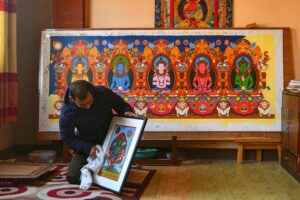 Paubha depicting Panchabuddha (Five Buddhas) behind the Newar artist Ujay Bajracharya holding the Paubha portrait of Green Tara [Source: AFP]
The Panchabuddha or Five Buddhas, includes Vairocana, Akshobhya, Ratnasambhava, Amitabha, and Amoghasiddhi. These figures form the core theological framework of Vajrayana Buddhism. Their portrayal in Paubha painting is the most important subject within the Buddhist Paubha tradition. Each Buddha symbolizes not just a unique personality but also a specific aspect of one enlightened consciousness, marked by direction, color, element, emotional poison (klesha) and wisdom. Vairocana, who is white and found at the center, represents space, has ignorance as his klesha and embodies the wisdom of the dharma-realm. He is shown with the dharmacakra-mudra, where both hands are raised to chest level, forming connected circles with thumbs and index fingers. Akshobhya, deep blue and positioned in the east, represents water and has hatred as his klesha. He is depicted with the bhumisparsha-mudra, which is the earth-touching gesture, rendered in a profound lapis lazuli blue. Ratnasambhava, golden yellow and located in the south, symbolizes earth and has pride as his klesha. He shows the varada-mudra, which denotes a gift-bestowing gesture. Amitabha, red and positioned in the west, represents fire and has desire as his klesha. With the dhyana-mudra, where both hands rest palm-upward in his lap, he is the most beloved of the Five Buddhas, closely linked to the Pure Land paradise of Sukhavati. Amoghasiddhi, green and located in the north, symbolizes air and has jealousy as his klesha. He is depicted with the abhaya-mudra, representing the gesture of fearlessness. In intricate Paubha mandala compositions showing all Five Buddhas in their rightful places, the five colored figures create a striking visual arrangement. Positioned as white at the center, blue to the east, yellow to the south, red to the west, and green to the north, this arrangement visually conveys the complete Vajrayana understanding of enlightened consciousness.
Buddha : Enlightened one who turned the Dharma wheel
The historical Buddha Shakyamuni is shown in Paubha painting in two key contexts: as a solitary devotional image and as the focal point of narrative cycles. Iconometric conventions define every important physical detail. The ushnisha, a cranial bump, is shown as a slight rounded swelling above the hairline. His elongated earlobes reflect the heavy gold earrings worn by Siddhartha during his time as a prince before renouncing his royal life. The urna, a circle of white hair between his eyebrows, is represented by a small dot of white paint or a tiny circle of gold leaf. Dipankara, known as the ‘Lamp-Lighter,’ is the Buddha from the previous cosmic age. He is portrayed as an elderly seated Buddha holding a lamp in his left hand, with his right hand raised in the abhaya-mudra. His most significant narrative moment in Paubha painting is when he recognizes the future Shakyamuni in the form of young Sumedha. Sumedha spread his long hair on muddy ground to protect Dipankara’s feet, demonstrating supreme devotion that inspired Dipankara’s prophecy of Sumedha’s future Buddhahood.
Maitreya, referred to as the ‘Friendly One,’ is the Buddha of the future cosmic age. He is shown in the bhadrasana posture, indicating readiness to rise and teach. Holding a nagakeshara flower and a small stupa, his complexion is a golden-orange hue, reminiscent of a future dawn. The Medicine Buddha Bhaisajyaguru has a deep lapis lazuli blue complexion. He holds the myrobalan fruit (Terminalia chebula) in his right hand while in the varada-mudra. This small yellow-orange fruit, known for its remarkable medicinal properties, is depicted in fine gold or warm ochre against the blue of his skin, creating one of the most beautiful details in the entire Paubha tradition.
Jambhala : Bodhisattva of Wealth
Jambhala, the Buddhist deity of wealth and abundance, holds a role in the Newar Buddhist tradition similar to that of the Hindu Kubera. He is known as the custodian of material riches, ensuring that practitioners have the resources needed for spiritual practice, such as food, shelter, and the relief from material worries necessary for effective meditation. His name comes from the Sanskrit word jambhara, which means ‘lemon’ or ‘citron.’ This fruit is a distinctive iconographic feature: Jambhala is always seen holding a lemon in one hand, and in some portrayals, the lemon is depicted dripping with wealth, with jewels and gold coins flowing from it. In the Newar tradition, Jambhala appears in five main forms that correspond to the five Buddha families and their associated colors: Yellow Jambhala, White Jambhala, Black Jambhala, Red Jambhala and Green Jambhala. Yellow Jambhala, the most common version in the Newar Paubha tradition, is shown as a stout, pot-bellied figure with a golden-yellow complexion. He is seated in a relaxed posture, akin to a prosperous merchant, rather than in a formal meditation position. His right hand holds the lemon, which can also be identified as a myrobalan fruit, while his left hand holds the mongoose. This weasel-like creature spews jewels from its mouth in both Kubera and Jambhala iconography, symbolizing the seemingly effortless generation of wealth for those blessed by the wealth deity. In Jambhala paintings, the mongoose appears with its mouth open, and jewels, coins, and precious gems cascade from it. The finest Paubha examples depict these gems in proper colors: red for rubies, blue for sapphires, green for emeralds, and white for pearls, all contrasting with the gold background of the deity’s form. Black Jambhala is depicted standing on a lotus supported by a corpse, with a snake curled around his wrist. He holds a skull cup filled with treasure in his left hand, suggesting that even death and the dead are under his influence, and that his riches include the spiritual merit gained over many lifetimes.
Kurukulla : The Red Tara
Kurukulla, the Red Tara and the goddess of enchantment, power, and allure, represents the feminine divine in its most dynamic and commanding form. She is depicted with a red complexion, which connects her to Amitabha and symbolizes the transformation of desire into wisdom, an ideal hue for a goddess of fascination. Kurukulla has four arms. She holds a bow and arrow made of red lotus flowers, representing love and attraction, akin to the bow of Kamadeva, the Hindu god of love. Additionally, she carries a noose to bind and an elephant goad to control and direct. Dancing in the alidha posture on a prostrate figure, her expression combines serenity and power, while her flowing red garments suggest dynamic movement. The bow and arrow made of red lotus flowers are among the most distinctive details in the entire Paubha repertoire. The bow appears as a lotus stem and flower arrangement, a symbolism that reflects purity from which true attraction arises. The arrow, also made of a lotus stem and flower, is shown aimed but not shot. This indicates that Kurukulla’s power of attraction is in an active state of readiness rather than passive potential. Kurukulla is the Tara form most associated with the ‘magnetizing’ type of tantric practice, which aims to attract positive circumstances and favorable conditions. Her Paubha images are specifically commissioned for practitioners involved in these rituals.
Avalokiteshvara : Bodhisattva of Infinite Compassion
A Paubha depicting Avalokiteshvara with eight arms and ten heads at the centre of the mandala, with Amitabha seated directly
No Buddhist deity has a larger or more varied presence in Paubha painting than Avalokiteshvara, the Bodhisattva of infinite compassion. Avalokiteshvara’s name reflects his nature: ‘The Lord Who Hears the Sounds of the world’s suffering.’ He is the Bodhisattva who perceives and responds to the cries of all suffering beings. In the Newar tradition, one significant form is Amoghapasha Lokeshvara, the Infallible Noose Lord. He appears with an orange or red complexion and eight arms, including the pasha, or noose—not the noose of execution, but a lasso used to pull a drowning person to safety. The Sahasrabhuja, or Thousand-Armed Avalokiteshvara, stands in the center of the composition, displaying 1,000 arms arranged in organized arcs. Each hand holds one of the forty emblems listed in the Karandavyuha Sutra, including the willow branch, white lotus, blue lotus, vase of pure water, white fly whisk, sun disc, moon disc, bow and arrow, purple lotus, golden bell, and thirty more items, each with its own function for liberation.
Hari Hari Hari Vahana is a composite form of Avalokiteshvara. He is shown sitting above Vishnu, Garuḍa (Vishnu’s vehicle), a white lion (Lokeshvara’s vehicle), and the great Nāgarāja, or serpent-king, Takshaka. The Sanskrit term Hari often describes Viṣṇu (Nārāyaṇa) but can also refer to an animal, like a lion or bird. So, the name Hari Hari Hari Vahana literally means ‘Lion (hari), Garuḍa (hari), Viṣṇu (hari), mount or vehicle (vahana) of Lokeshvara.’ This composite form represents the position that the compassionate enlightened mind (bodhicitta, represented by Avalokiteshvara) is the highest principle that goes beyond all divine powers, bringing together Hindu deities in a structure where compassion is paramount.
Manjushree : Bodhisattva of Wisdom
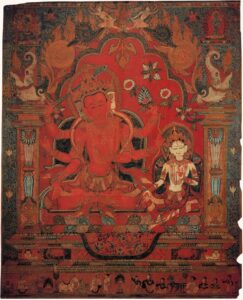
Paubha art (1409 C.E.) depicting Manjushree’s esoteric form Manjuvajra and his consort Vajradhatishvari, by Kesaraja Chitrakar (first known artist after 12th century Arniko) [Source: Himalayan Art Resources]
Manjushri, the Bodhisattva of wisdom and the mythological founder of the Kathmandu Valley, holds the prajnakhadga, or sword of wisdom, as a brilliant flaming sword. Its blade is gold or silver, and the flames shine in bright orange-red against the blue sky. This sword represents liberating clarity; wisdom cuts through delusion like a sharp blade through rope, freeing the mind instantly.
Tara : Mother Of Liberation
The vast Tara tradition in Paubha painting ranges from the commonly depicted forms to the complete Twenty-One Taras (Ekavimshatitatara) and other special forms. Green Tara (Shyamatara) is shown in lalitasana with her right foot extended, symbolizing her quick response. She is poised to act, with one foot already moving toward the devotee in need. Her emerald-green complexion (representing active compassion) and the blue lotus (utpala) she holds form one of the most vibrant and devotionally charged compositions in Paubha art. White Tara (Sitatara) has seven eyes; two on her face, one on her forehead, and one on each palm and foot, representing her all-seeing compassion. The eyes on her palms and feet require exceptional skill to paint; each must be tiny yet detailed. Kurukulla (the Red Tara), Bhrikuti (the Yellow Tara with a furrowed brow), and Ekajati (the fierce Blue-Black Tara with one eye, one breast, one tooth, and one braid of hair) complete the major Tara forms in the Paubha tradition.
Vajrayogini : Dakini Of All Buddhas
Vajrayogini, the red-complexioned, naked dancing goddess of enlightened female awareness, holds a kartri, or curved knife, in her right hand. This knife cuts away all conceptual thoughts and ego-grasping. In her left hand, she carries a kapala (skull cup) containing the elixir of liberation. Her nakedness is not meant to be erotic; instead, it expresses the Vajrayana doctrine of non-conceptual awareness, free from the ‘clothing’ of conventional thought.
Chakrasamvara & His Consort Vajravarahi
The Chakrasamvara yab-yum (father-mother) composition shows the male deity (Chakrasamvara, who represents skillful means) in union with the female deity (Vajravarahi, symbolizing the wisdom of emptiness). This depiction does not show sexual activity, but rather illustrates the key metaphysical relationship in Vajrayana philosophy: the inseparability of compassionate actions and the wisdom of emptiness.
Hevajra : Embodiment of Fearlessness
Hevajra has sixteen arms, eight faces, and unique sixteen skull cups, each containing a different symbolic being (eight animals in the right-hand cups and eight directional deities in the left-hand cups). He represents the most complex single-figure composition in the entire Paubha repertoire.
Vasundhara
Vasudhara, ‘She Who Bears the Stream of Wealth,’ is depicted with a golden-yellow complexion and six arms, holding a sheaf of grain, a water pot (kalasha), a book of scripture (pustaka, indicating that true abundance includes wisdom), a jewel (cintamani), a coral rosary, and the varada-mudra. Streams of grain, jewels, and gold coins flow from her open palms, visually representing her role as the giver of material wealth. Her warm, serene generosity expressed in her face, makes her the most accessible and beloved Buddhist goddess in the Newar community. Many merchants and farmers commission images of her.
The Vasudhara Mandala, organized around the wealth goddess with her six attendant goddesses and sixteen offering deities, is among the most frequently commissioned mandala subjects for lay patronage as its production marks occasions of commercial success, agricultural abundance, or family prosperity. The mandala paintings used specifically for initiation (abhisheka) ceremonies, in which the geometric precision of the mandala’s construction is most stringently enforced ( since the initiation’s ritual efficacy depends on the mandala’s structural integrity) represent the highest technical challenge within the Paubha tradition and are produced only by masters of the most advanced training and initiatory authorization.
Newar Stupas In Paubha Art
The great stupas (Newari: caitya) of the Kathmandu Valley are the monumental domed reliquary structures that mark the most sacred points in the Valley’s Buddhist sacred geography, that appear in Paubha painting in two principal contexts: as subsidiary decorative elements within the architectural framing of devotional paintings (where miniature caitya forms are painted as part of the temple-facade or shrine-canopy structures that frame the central deity), and as the primary subject of specific Paubha compositions in which the stupa itself is the devotional focus. The four great stupas of the Valley; namely Svayambhunath, Boudhanath, Chabahil, and Patan’s Ashoka Stupas, appear in Paubha painting with specific iconographic characteristics that allow them to be identified as particular historical monuments rather than generic stupa forms.
Svayambhunath (the ‘Self-Arisen’ stupa, located on the hill west of Kathmandu) is the most sacred Buddhist monument in the Kathmandu Valley and one of the oldest Buddhist structures in the Himalayan world. In Paubha depictions, Svayambhunath is rendered with its characteristic features: the large hemispherical dome (anda) rising from a multi-tiered base (medhi) decorated with a sequence of small niches containing Buddha images and offering lamps; the square harmika above the dome, on each side of which are painted the great Eyes of Wisdom (prajnacakshus). These elongated, all-seeing eyes that gaze outward in the four cardinal directions, have become the most immediately recognizable symbol of Newar Buddhist culture worldwide. Above the harmika, the tapering thirteen-ringed spire (yashti) represents the thirteen stages of the spiritual path and at the very apex, the golden parasol (chhatra) of enlightenment. The Eyes of Svayambhunath, simultaneously tender and all-knowing, simultaneously personal and cosmic, are the most powerful and emotionally resonant sacred image in the entire Newar visual tradition, and their rendering in Paubha painting requires particular care: the specific shape of the eye (elongated, with a slight upward curve at the outer corner suggesting a quality of infinite, compassionate attention), the treatment of the iris (large, dark, with a quality of luminous depth), and the curvilinear mark below each eye (sometimes identified as a nose, sometimes as the number ‘1’ in a Newari script, symbolizing the unity of all phenomena or the single path of spiritual liberation) must all be rendered with great precision to capture the specific quality of presence that makes the Svayambhunath eyes recognizable across their many visual contexts.
To understand the impact of Paubha painting on Tibetan Buddhist art, one must first understand the deep structural logic of this relationship that was not merely commercial or diplomatic but was rooted in shared religious culture, mutual spiritual need, and a complex web of doctrinal, institutional and personal ties that stretched from the seventh century CE through the seventeenth and beyond. The spiritual logic of the Newar-Tibetan exchange was rooted in a shared Vajrayana doctrinal framework. Both the Newar Buddhist tradition and the Tibetan Buddhist traditions that developed from approximately the ninth century CE (particularly following the great persecution of Buddhism under the Tibetan king Langdarma, c. 838–841 CE, which temporarily disrupted the Tibetan institutional tradition and made Newar and Indian models even more critical in the reconstruction of Tibetan Buddhist culture) understood the canonical correctness of sacred images as a matter of the highest religious importance. The exchange operated simultaneously at multiple levels: the movement of sacred texts from Indian and Newar scholars to Tibetan translators; the movement of artists and craftsmen from the Valley to Tibet; the movement of Tibetan pilgrims, scholars, and hierarchs to the Valley; the flow of precious materials (including the lapis lazuli, gold, and other pigment materials used in both traditions) along the trans-Himalayan trade routes; and the direct commissioning of Newar-made sacred objects for use in Tibetan religious contexts.
The Himalayan Legacy: Paubha’s Impact on Tibetan Buddhist Art
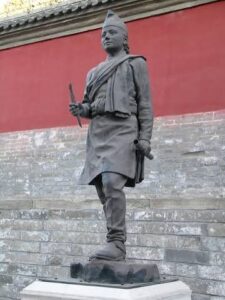
Statue of Araniko at the Miaoying Temple, Beijing [Source: Wikimedia Commons]
Arniko (Araniko in Tibetan sources, Anige in Chinese, 1244–1306 CE) was sent to Tibet in 1261 CE as part of a group of craftsmen sent by the king of Nepal at the request of Phakpa Lama. He was brought to the Mongol court in Beijing in 1262 CE and appointed superintendent of all artisans in the realm in 1273 CE. His most notable surviving work is the White Stupa (Baitasi) at Miaoying Temple in Beijing (1271–1279 CE). This stupa is the largest in China and still stands today. It translates the Newar stupa design into the scale of Chinese imperial architecture.
The Yuan dynastic history (Yuanshi, compiled 1370 CE) includes his official biography, making him one of the few pre-modern Newar artists with a documented life in the records of a great power. The biography notes that when Arniko first arrived at the Mongol court, he was given an ancient Chinese Buddha image that had been poorly repaired and was asked to identify the flaws. Arniko determined the period, original style, and technique of the original painting just by looking at it. This established his reputation not only as a craftsman but as someone with deep art knowledge.
One significant school of Tibetan Buddhist painting that directly comes from the Newar Paubha tradition is the Beri (dpe ris) style. This term is used in Tibetan art-historical writings to describe a major painting style that dominated Central Tibetan religious art from about the late twelfth to the early fifteenth century. It is the most direct and ongoing expression of Newar artistic influence in Tibet.
The Tibetan term dpe ris (sometimes written as ‘peri’ or ‘beri’) roughly means ‘the exemplary painting style’ or ‘the model painting tradition.’ This name is meaningful. Tibetan art texts use it to describe the style that served as the standard reference, the ‘model’ or ‘exemplary’ tradition, against which other Tibetan styles were judged. The fact that the main Central Tibetan painting style of the medieval period was named for its model-providing nature shows that it drew its authority from a pre-existing tradition of sacred image-making outside Tibet, specifically the Newar Paubha tradition.
The Beri style has distinct features that set it apart from earlier western Himalayan painting traditions (like Tabo, Alchi and Nako) and later Central Tibetan styles, especially the Karma Gadri tradition that emerged in the fifteenth and sixteenth centuries under the influence of Chinese painting. Key characteristics of the Beri style include a color palette filled with rich mineral blues (azurite and lapis lazuli), deep cinnabar reds, and bright malachite greens. Gold was used extensively for outlines, decorative details, and throne and halo decoration. This palette closely resembles the classical Newar Paubha palette. The facial type of serene (shanta) deities is unmistakably Newar, featuring characteristic almond-shaped eyes, a slightly high-bridged nose, a full lower lip, and a particular way of modeling the cheeks that gives a luminous, forward-directed presence. The arrangement of subsidiary figures around the central deity follows the mandala principle typical of the Newar Paubha tradition. Additionally, the treatment of the architectural throne canopy and palace frame closely resembles the elaborate temple-facade architecture shown in contemporary Newar Paubha paintings.
The origins of the Beri style in Tibet can be traced back to the early phases of the Second Diffusion of Buddhism (phyi dar). This was a period of Buddhist revival that began in the late tenth century after the disruption caused by the Langdarma persecution. The earliest documented examples of the Beri style in Central Tibet are linked to the Kadam school, founded by Dromtonpa (1005–1064 CE) based on the teachings of Atisha Dipamkara Shrijñana (982–1054 CE), and to the major monastery complexes of Reting (founded 1057 CE, north of Lhasa) and Sangphu Neutok (founded 1073 CE, southwest of Lhasa). Atisha, who spent time in the Kathmandu Valley while traveling from eastern India to Tibet around 1040 CE, is noted in Tibetan sources as being deeply impressed by the quality of Newar sacred art. The Kadam school’s use of Newar iconographic standards as the reference for its artistic work set a precedent followed by the Sakya, Kagyu, and (to a lesser extent) Nyingma schools in the next century.
The rise of the Karma Gadri (Tibetan: karma sgar bris, ‘the encampment painting style of the Karma Kagyu school’) in the late fifteenth and early sixteenth centuries marks a significant change in the Beri style. This was the point when the Newar-based conventions that had dominated Central Tibetan painting were fundamentally changed by the influence of Chinese artistic conventions, especially the landscape styles of the Chinese Southern Song academy tradition. The Karma Gadri style is traditionally credited to the painter Namkha Tashi (c. 1400–1470 CE), the court painter of the Karmapa. He is believed to have traveled to China and studied Chinese painting methods before applying what he learned to Tibetan Buddhist art. Whether this account is entirely true or contains some legendary aspects, the result is clear. From the late fifteenth century, Tibetan thangka painting in the Karma Kagyu tradition saw a remarkable enrichment of its landscape imagery. It featured misty mountains fading into blue-grey haze, delicately rendered trees showing individual leaves, and birds flying across cloudy skies. These elements are entirely missing from the Beri style and clearly stem from Chinese landscape conventions.
The key point about the Paubha’s legacy within this change is that the Karma Gadri style did not abandon the Beri/Newar foundations. Instead, it layered Chinese landscape conventions on top of an iconometric, compositional, and figural tradition that remained fundamentally Newar in character. The way figures of deities are portrayed; facial type, throne conventions, proportion system and mandala organization, still reflects the Newar inheritance beneath the Chinese-influenced surface. It’s like a language: the Karma Gadri style enhanced the Beri vocabulary with Chinese loan-words (landscape conventions) while using the Beri grammar (Newar compositional structure and iconometric principles). This continuity of Newar influence within what seems to be a radically changed Tibetan style is the most important and often overlooked aspect of the Paubha tradition’s lasting impact on Tibetan Buddhist art.
The great Kumbum stupa (meaning ‘One Hundred Thousand Images,’ due to the approximately 100,000 sacred images, painted and sculpted inside) at Gyantse, built between around 1414 and 1427 CE under the patronage of Rinpungpa ruler Rabten Kunzang Phakpa, stands as the most ambitious single monument of the Beri style. It is one of the greatest architectural achievements in the history of Himalayan Buddhism. The Gyantse Kumbum consists of a multi-storied stupa with more than seventy chapels arranged on different levels. Each chapel contains intricate painted designs covering the walls, floors, and ceilings in a complete iconographic scheme based on the cosmological system of the Kalacakra tantra. The total painted area of the Gyantse Kumbum, which took about a decade to finish and involved hundreds of painters, is estimated to be over 2,000 square meters. This makes it one of the largest continuous religious painting projects in the history of Asian art.
The Gyantse Kumbum paintings are significant for understanding the Beri style and its Newar roots. David Jackson discusses this in his book, A History of Tibetan Painting (Vienna, 1996). Amy Heller also explores it in Tibetan Art (Milan, 1999). Both scholars see the Gyantse paintings as marking a transitional phase in the Beri style. This phase is when Newar-derived styles, which had influenced Central Tibetan painting for three centuries, began to take in Chinese art without losing the basic Newar structure.
The five chapels on the third level of the Gyantse Kumbum are dedicated to the Five Buddhas in their directional positions. These chapels provide a clear example of how the Beri style addresses this classic subject. Each of the five Buddhas appears against a background of the appropriate color: white for Vairocana in the center, blue for Akshobhya in the east, yellow for Ratnasambhava in the south, red for Amitabha in the west, and green for Amoghasiddhi in the north. Their thrones, hand gestures, and decoration closely follow Newar Paubha conventions. Meanwhile, the landscapes in the upper and lower sections show the typical ‘axe-cut’ rock formations and ‘raindrop’ texture techniques influenced by Chinese Song dynasty painting. This blending of Newar structure and Chinese landscape techniques within a single monument, both executed with great skill, perfectly captures the hybrid quality of the mature Beri style.
Additionally, the Gyantse Kumbum holds vital evidence of how the Beri style handled uniquely Tibetan subjects—subjects that do not exist in the Newar Paubha tradition, requiring Beri painters to develop them within a Tibetan context. The portraits of Tibetan Buddhist lineage masters (siddha portraits) that appear in the smaller registers of various Gyantse chapels show Tibetan monks and masters in seated meditation. They wear the wine-colored robes of the Tibetan monastic tradition and display unique individual characteristics, which goes beyond the idealized faces found in deity paintings. These portraits represent a purely Tibetan addition to the Beri tradition, highlighting the Tibetan Buddhist community’s interest in portraying its historical founders and masters to convey lineage identity and authority.
Certain iconographic forms have clear connections from the Newar Paubha tradition through to the Beri and later Tibetan thangka traditions. Green Tara’s lalitasana posture, with her right foot extended, comes from lineages linked to Atisha, who spent time in the Kathmandu Valley. The earliest surviving Tibetan thangka images reflect this so precisely that they argue for direct Newar influences or Newar artists working in Tibet. A mid-thirteenth-century Sakya monastery painting of Amoghapasha Lokeshvara shows the deity in a form nearly identical to the Newar Paubha style, suggesting a clear lineage from a Newar model. The complex iconography of Vajrabhairava exhibiting thirty-four arms, nine heads, sixteen legs trampling eight animals and eight deities, follows established Newar practices before appearing in Tibetan art. The Beri style’s approach to the Hevajra mandala shows a direct link to the Newar Paubha Hevajra tradition, particularly in how the sixteen skull cups are arranged. The specific iconography, such as eight animals in the right cups and eight directional deities in the left cups, is so distinctive that its accurate replication across cultures implies direct transmission of Newar patterns or involvement of Newar painters in Tibetan workshops.
Besides the art-related evidence, historical sources provide rich details about the social and institutional links between Newar and Tibetan communities that facilitated artistic exchange over the years. The presence of the Newar trading community in Tibet is recorded in the seventeenth-century diary of a Newar merchant, saved partly by Baburam Acharya and studied by scholars like Kamal P. Malla and Anne Vergati Stahl. Newar merchants, especially from the Uray caste who specialized in trade across the Himalayas, established permanent residences, known as Nepal mandala or ‘Newar quarter,’ in key Tibetan trading centers like Lhasa, Shigatse, Sakya, and Gyantse. These Newar trading posts served as more than commercial entities. They acted as cultural embassies housing shrines with Newar-made Paubha paintings as the primary devotional pieces, employing Newar priests (Vajracharya) to conduct traditional rituals, and generating local demand for Newar sacred art. This demand was met by a steady flow of painted images and artists moving from the Valley to Tibetan areas.
Tibetan records of pilgrimages to the Kathmandu Valley reveal another layer of these social connections. Tibetan Buddhist pilgrims have traveled to the Valley in large numbers since at least the eleventh century. They visited notable stupas like Svayambhunath and Boudhanath, and the Pashupatinath temple, which both Hindu and Buddhist traditions revere. They also frequented the important Newar Buddhist bahas, where various transmission lineages were preserved. The biographical accounts of nearly every significant Tibetan Buddhist master from the eleventh to the seventeenth centuries mention at least one period of study or pilgrimage in the Kathmandu Valley. This reflects the Valley’s role as a vital source of the Indian Buddhist textual and artistic traditions that Tibet aimed to preserve. These pilgrimages focused not only on texts or teachings; Tibetan pilgrims who came to the Valley’s significant shrines and monasteries witnessed Newar Paubha paintings in use during rituals. They understood their artistic conventions through shared Vajrayana teachings and returned to Tibet with a greater appreciation for Newar standards in sacred art, which influenced and supported their patronage of the Beri style in their own monasteries and royal courts.
Bibliography
Levy, Robert I. Mesocosm: Hinduism and the Organization of a Traditional Newar City in Nepal. Berkeley: University of California Press, 1990.
Linrothe, Rob. Holy Madness: Portraits of Tantric Siddhas. New York: Rubin Museum of Art / Chicago: Serindia, 2006.
Linrothe, Rob, and Jeff Watt, eds. Demonic Divine: Himalayan Art and Beyond. New York: Rubin Museum of Art / Chicago: Serindia, 2004.
Lo Bue, Erberto F., and Franco Ricca. Gyantse Revisited. Florence: Olschki, 1990.
Malla, Kamal P. The Linguistics of Nepal and Its Neighbours. New Delhi: Heritage Publishers, 1989.
Mcdonald, Alexander W. Religion et culture sous les Malla (Nepal). Paris: Ecole Francaise d’Extreme-Orient, 1975.
Pal, Pratapaditya. The Art of Nepal: A Catalogue of the Los Angeles County Museum of Art Collection. Los Angeles: LACMA / Berkeley: University of California Press, 1985.
Pal, Pratapaditya. Himalayas: An Aesthetic Adventure. Chicago: Art Institute of Chicago, 2003.
Pal, Pratapaditya. The Sensuous Immortals: A Selection of Sculptures from the Pan-Asian Collection. Los Angeles: Los Angeles County Museum of Art, 1977.
Rawson, Philip. The Art of Tantra. London: Thames and Hudson, 1973.
Rhie, Marylin M., and Robert A.F. Thurman. Wisdom and Compassion: The Sacred Art of Tibet. New York: Abrams / Tibet House, 1991.
Slusser, Mary Shepherd. Nepal Mandala: A Cultural Study of the Kathmandu Valley. 2 vols. (text and plates). Princeton: Princeton University Press, 1982.
Snellgrove, David L. Indo-Tibetan Buddhism: Indian Buddhists and Their Tibetan Successors. 2 vols. Boston: Shambhala, 1987.
Stoddard, Heather. Early Sino-Tibetan Art. Warminster: Aris and Phillips, 1975.
Tachikawa, Musashi, S. Mori, and N. Kitagawa. A Study of the Nispannayogavali. Nagoya: Nagoya University Press, 1983.
Tucci, Giuseppe. Tibetan Painted Scrolls. 3 vols. Rome: Libreria dello Stato, 1949. Facsimile reprint Bangkok: SDI, 1999.
Tucci, Giuseppe. The Religions of Tibet. Translated by Geoffrey Samuel. Berkeley: University of California Press, 1980.
Vajracharya, Gautam V. The Nepalese Caturmahakaya: Historical and Stylistic Development of Avalokitesvara. PhD dissertation, University of Wisconsin-Madison, 1977.
Watt, Jeff, and Elizabeth Hammer, eds. The Nepalese Legacy in Tibetan Painting. New York: Rubin Museum of Art, 2011.
Bangdel, Dina. ‘Paubha Paintings in the Pratapaditya Pal Collection: Form, Iconography, and Ritual.’ Artibus Asiae 59, nos. 1/2 (1999): 5–56.
Bangdel, Lain S. ‘The Early Paintings of Nepal.’ Contributions to Nepalese Studies 12, no. 1 (1984): 1–48.
Bazin, Louis. ‘The Newar Artists and Their Contribution to the Development of Tibetan Painting.’ In Tibet and Her Neighbours, edited by A. McKay. London: Hansjorg Mayer, 2003, pp. 45–62.
Debreczeny, Karl. ‘Sino-Tibetan Artistic Synthesis in the Fifteenth Century.’ In The Arts of Tibet: Papers from the Tenth Seminar of the International Association for Tibetan Studies, Oxford, 2003. Edited by Rob Linrothe. Leiden: Brill, 2007, pp. 183–224.
Heller, Amy. ‘Early Himalayan Art in a Cross-Cultural Context.’ In The Arts of Tibet, edited by Rob Linrothe. Leiden: Brill, 2007, pp. 47–76.
Heller, Amy. ‘The Eight-Lobed Bodhisattva from Western Tibet: Art-Historical Problems and Iconographic Evidence.’ Orientations 25, no. 6 (1994): 30–37.
Huntington, John C. ‘A Re-examination of the Earliest Pala Manuscripts.’ Orientations 21, no. 7 (July 1990): 54–64.
Klimburg-Salter, Deborah E. ‘A Conceptual Framework for the Historical Study of Early Tibetan Buddhist Art.’ In Proceedings of the 5th Seminar of the International Association for Tibetan Studies, Narita 1989. Edited by S. Ihara and Z. Yamaguchi. 2 vols. Narita: Naritasan Shinshoji, 1992. Vol. 1, pp. 355–77.
Kreijger, Hugo. ‘Nepalese Paintings from the National Archives of Nepal.’ Asiatische Studien/Etudes Asiatiques 50, no. 4 (1996): 903–930.
Losty, J.P. ‘The Pala Art of Vikramashila and the Kathmandu Valley.’ In South Asian Archaeology 1979, edited by H. Hartel. Berlin: Dietrich Reimer Verlag, 1981, pp. 447–462.
Singer, Jane Casey. ‘Gold and Lapis Lazuli: Tibetan Painting in the Twelfth Century.’ Artibus Asiae 52, nos. 1/2 (1992): 5–36.
Singer, Jane Casey. ‘Painting in Central Tibet, ca. 950–1400.’ Artibus Asiae 54, nos. 3/4 (1994): 225–243.
Stoddard, Heather. ‘Buddhist Paintings from Dungkar.’ Artibus Asiae 56, nos. 1/2 (1996): 79–116.
Vergati, Anne. ‘Devis et Devatas: les deesses dans le Bouddhisme newar.’ Arts Asiatiques 39 (1984): 57–67.
Vergati, Anne. ‘The Paubha: Sacred Painting of Nepal.’ Artibus Asiae 54, nos. 3/4 (1994): 245–267.
Vitali, Roberto. ‘The Role of Clan-Based Polities in the History of Western Tibet.’ In The History of Tibet, edited by Alex McKay. 3 vols. London: RoutledgeCurzon, 2003. Vol. 1, pp. 213–61.
Aris, Michael. Bhutan: The Early History of a Himalayan Kingdom. Warminster: Aris and Phillips, 1979.
Beer, Robert. The Handbook of Tibetan Buddhist Symbols. Chicago: Serindia Publications, 2003.
Beer, Robert. The Tibetan Art of Healing. London: Serindia Publications, 1999.
Bangdel, Dina. Manifestations of Manjushri: Arts of Enlightenment. Kathmandu: Rolex Awards for Enterprise, 2004.
Bryant, Barry. The Wheel of Time Sand Mandala: Visual Scripture of Tibetan Buddhism. San Francisco: Harper San Francisco, 1992.
Dehejia, Vidya. Discourse in Early Buddhist Art: Visual Narratives of India. New Delhi: Munshiram Manoharlal, 1997.
Fisher, Robert E. Art of Tibet. London: Thames and Hudson, 1997.
Heller, Amy. Tibetan Art: Tracing the Development of Spiritual Ideals and Art in Tibet, 600–2000 A.D. Milan: Jaca Book, 1999.
Jackson, David P. A History of Tibetan Painting: The Great Tibetan Painters and Their Traditions. Wiener Studien zur Tibetologie und Buddhismuskunde, Heft 35. Vienna: Verlag der Osterreichischen Akademie der Wissenschaften, 1996.
Jackson, David P., and Janice A. Jackson. Tibetan Thangka Painting: Methods and Materials. London: Serindia Publications, 1984. 2nd ed., 1988.
Klimburg-Salter, Deborah E. Tabo: A Lamp for the Kingdom. Early Indo-Tibetan Buddhist Art in the Western Himalaya. Milan: Skira, 1997.
Abhayakaragupta. Nishpannayogavali. Edited by Benoytosh Bhattacharyya. Gaekwad’s Oriental Series, no. 109. Baroda: Oriental Institute, 1949.
Asanga. Mahayanasamgraha. Translated by Etienne Lamotte. Louvain: Institut Orientaliste, 1938–39.
Bhasapravancakaranika of Jayaprakash Malla. Edited by Dhanavajra Vajracharya. Kathmandu: Itihas Samshodhan Mandal, 1985.
Deb ther sngon po (Blue Annals) of Go Lotsawa Zhonnu Pal (rGyal sras Gzhon nu dpal, 1392–1481). Translated by George N. Roerich. 2 vols. Calcutta: Royal Asiatic Society of Bengal, Monograph Series, nos. 7–8, 1949–53. Reprint Delhi: Motilal Banarsidass, 1979.
Dpag bsam ljon bzang of Sumpa Khenpo Yeshe Paljor (Sum pa mkhan po Ye shes dpal ‘byor, 1704–1788). Sarnath: Pleasure of Elegant Sayings Press, 1965.
Gopalarajavamlsavali (Chronicle of the Gopala Kings). Edited by Dhanavajra Vajracharya and Kamal P. Malla. Nepal Research Centre Publications, no. 9. Wiesbaden: Franz Steiner Verlag, 1985.
Karandavyuha Sutra. Sanskrit text edited by P. L. Vaidya. Buddhist Sanskrit Texts, no. 17. Darbhanga: Mithila Institute, 1961.
Lalitavistara. Translated by Gwendolyn Bays. 2 vols. Emeryville, CA: Dharma Publishing, 1983.
Manasara: A Treatise on Hindu Architecture. Translated with an English commentary by Prasanna Kumar Acharya. Manasara Series, vol. IV. London: Oxford University Press, 1934. Reprint Delhi: Munshiram Manoharlal, 1980.
Mkhas pa’i dga’ ston (Feast for Scholars) of Pawo Tsuglag Trengwa (dPa’ bo gTsug lag phreng ba, 1504–1566). 2 vols. New Delhi: International Academy of Indian Culture, 1962.
Ngorchen Kunga Zangpo (Ngor chen Kun dga’ bzang po). Collected Works (gSung ‘bum). 17 vols. Dehra Dun: Sakya Centre, 1983.
Nispannayogavali of Abhayakaragupta. See Abhayakaragupta above.
Sakya Pandita Kunga Gyaltsen (Sa skya Pandita Kun dga’ rgyal mtshan). sDOM gsum rab dbye (Clear Differentiation of the Three Vows). Translated by Jared Rhoton. Albany: State University of New York Press, 2002.
Silparatna of Srikumara. Edited by T. Ganapati Sastri. 2 vols. Trivandrum Sanskrit Series, nos. 75, 98. Trivandrum: Government Press, 1922–29.
Svayambhu Purana. Sanskrit text edited with Newari translation and English summary by Alexander W. Macdonald and Anne Vergati Stahl. Paris: Mouton, 1979.
Vishnudharmottara Purana, Part III (Chitrasutram). Translated by Stella Kramrisch. Calcutta: Calcutta University Press, 1928. Reprint New Delhi: Munshiram Manoharlal, 1975.
Xiu zhen mi lu (Secret Records of the Cultivation of Authenticity). Cited in Heather Stoddard, Early Sino-Tibetan Art. Warminster: Aris and Phillips, 1975, pp. 43–45.
Yuan Shi (History of the Yuan Dynasty). Compiled under the supervision of Song Lian et al. Beijing: Zhonghua Shuju, 1976. Biography of Anige (Arniko) in vol. 203, pp. 4525–30.