
by:- Ayush Tripathi
Abstract
“Come, the pung is calling — the moon has opened its full eye over Kangla,
and five nights of colour will not wait for the hesitant heart.”
— Traditional Thabal Chongba opening verse
When the full moon of Lamta (February-March) rises over the Imphal valley, the hills of Manipur are already in bloom. The Pang-gong or Palash (scientific name: Butea monosperma) trees, known as the flame of the forest , have opened their deep orange-red flowers along every hillside and riverbank, as if the land itself is getting ready for the colorful display to come. The air is filled with the smell of dry straw and fresh grass, along with the wood smoke from bonfires at the neighborhood crossroads, the scent of Abir powder and fermented rice. From every leikai or community quarter, comes the sound of the pung drum, the key instrument in Manipuri ceremonial life, setting the rhythm for the Thabal Chongba circle dances that will unfold for five consecutive moonlit nights. This is Yaoshang, the season where Manipur’s heart beats most visibly.
History: How Yaoshang Became What It Is
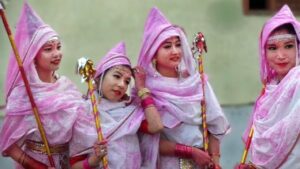
Brajamai [Source: Mamiroi Films]
To describe Yaoshang as simply ‘Manipur’s Holi’ is both accurate and inadequate. It is accurate because the festival is highly important in the Manipuri Vaishnava tradition, which celebrates Lord Krishna’s spring play—the same cosmic Holi celebrated every year in Vrindavan’s groves with Radha and the gopis. It is inadequate because Yaoshang has its own unique identity. It is a five-day celebration filled with rituals, music, storytelling, devotional poetry, communal dances and festive food that has no exact match anywhere else in India. For three centuries, a rich cultural life has blended Gaudiya Vaishnava beliefs, native Meitei folk traditions and the distinct characteristics of a valley community surrounded by hills. This blend creates a celebration that is both ancient and modern, sacred and joyful, devotional and deeply human.
Vaishnavism was already making progress in Manipur. King Khagemba (r. 1597–1652) had received the sacred idol of Govindajee from Bengal and placed it within the royal palace grounds. The turning point came under King Pamheiba (r. 1709–1748), who, around 1717 CE, was influenced by the Bengali Gaudiya Vaishnava teacher Shantidas Gosai. With Pamheiba’s support, Gaudiya Vaishnavism quickly spread through Meitei society, as noted by Gangumei Kabui in his book History of Manipur (1991).
Between the initiation into Vaishnavism under Pamheiba and the formal construction of the current Govindajee temple, Maharaja Bhagyachandra (also known as Jai Singh) and Ningthou Ching-Thang Khomba (r. 1763–1798), significantly influenced the devotional culture that defines Yaoshang today. The story of the Govindajiu idol’s origin, recorded in the Cheitharol Kumbaba (the royal chronicle of Manipur) and through oral tradition, is one of the most remarkable tales in the religious history of northeastern India.
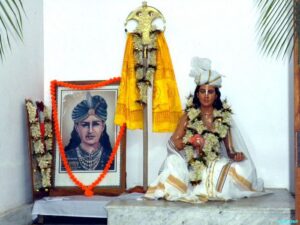
Shrine of Rajarshi Bhagyachandra [Source: E-Pao]
Bhagyachandra had been forced from his throne by a Burmese invasion and lived in exile at the court of the Ahom king of Assam. In his desperate situation, he prayed to Lord Krishna for help. According to the Cheitharol Kumbaba and the traditions noted in M. Kirti Singh’s Religious Developments in Manipur in the 18th and 19th Centuries (1984), the Lord appeared to Bhagyachandra in a dream and gave him clear instructions. He had to face the challenge from the Ahom king, which involved battling a rogue elephant. He succeeded because the Lord was present in the form of a jackfruit tree in the arena. After reclaiming his kingdom, he was to carve the Lord’s image from a specific ancient jackfruit tree on Kaina Hill, a small hillock 29 kilometers from the capital. The dream also detailed the complete choreography of the Ras Lila dance that should be performed in the Lord’s honor, including the unique costume which is the Potloi skirt or layered circular skirt, worn by the gopi-dancers.
Bhagyachandra regained his throne in 1773, established his capital at Bishnupur, and began carving the idol from the Kaina jackfruit tree in 1776. The carving, done by master craftsman Sapam Laxman under the guidance of Wanghei Pandit Angom Gopiram (the Pacha Hanchapa), took three years. The finished idol stands 3 feet 11 inches tall. On the full moon day of Hiyang Hiren in November 1779, a date noted in the Cheitharol Kumbaba, the idol was consecrated in the palace temple at Imphal, marking the first Ras Lila performance. Bhagyachandra’s daughter, Shija Lailoibi, played Radha in this inaugural event. Seven images were carved from the same jackfruit tree and distributed to temples across Manipur and Assam, with the primary image becoming the main deity of what would later be known as the Govindajiu temple.
The king asked his Guru Swarupanand to work with all the renowned dance experts in Manipur to adjust the local performance tradition (the Jagai-Nin-Thaag Purang) for the Ras Lila. This directive formalized the mixed character of the Govindajiu devotional tradition, which draws from both Sanskrit theological text (the Srimad Bhagavatam) and indigenous Meitei movement and aesthetic terms. From this combination emerged what is now recognized worldwide as the Manipuri classical dance tradition, with the Ras Lila as its sacred peak.
At the heart of Gaudiya Vaishnavism is the concept of bhakti-rasa. This idea states that loving devotion to the divine is a form of spiritual experience, and that the emotions tied to divine love, such as longing, separation, reunion and joy; are its essence. The tradition’s strong focus on the stories of Krishna’s life in Vrindavan, especially his spring Holi play with Radha and the gopis, naturally connected it to the seasonal celebration of spring. As M. Kirti Singh points out in Religion and Culture of Manipur (1980), the Holi season, recognized across the Gaudiya Vaishnava community as Krishna’s most joyful spring play, became the time for what the Meiteis refer to as Yaoshang.
What gives Yaoshang its unique flavor is the deep root of native Meitei traditions that have developed over three centuries. Instead of replacing existing Meitei spring customs, the Vaishnava festival framework absorbed these traditions and added new religious meaning to practices already embedded in Meitei life: the seasonal bonfire, the spring dance of young men and women in the moonlight, and the children’s procession. Saroj Nalini Parratt, in The Religion of Manipur (1980), emphasizes that this integration was a creative effort by the Meitei community—a true blending where both indigenous and Vaishnava influences come together and enrich one another.
Preparations: Days Before the Full Moon
The preparation of Yaoshang starts days before the full moon night. In each leikai, young men construct the Yaoshang hut, which is a bamboo frame about three to five feet tall, thatched with dry straw and adorned with seasonal flowers, especially the bright orange palash blossoms. In some communities, small clay figurines representing spirits are placed inside the hut. Households prepare special foods for the festival by soaking chak-hao black rice ahead of time, gathering fresh vegetables, and decorating both the Vaishnava household shrine and the Sanamahi shrine at the western wall with fresh flowers, seasonal fruits, and new lamps.
Day One Evening: Yaosang Mei Thaba — The Lighting of the Sacred Fire
On the evening of the full moon, the festival kicks off with Yaoshang Mei Thaba. A small idol or image of Lord Chaitanya Mahaprabhu, the founder of the Gaudiya tradition, is placed inside the Yaoshang hut. His birth anniversary, celebrated on Phalguna Purnima, coincides with Yaoshang. He is honored in Manipuri Vaishnavism as a combination of both Krishna and Radha. Devotees gather around the hut for kirtan singing and offerings. At dusk, once all the rituals are done, the image of Chaitanya is carefully taken out of the hut, and the hut is set on fire. Chants of ‘He Hari’ and ‘Hari Bol’ fill the air as the flames rise. The burning symbolizes the greatness of Vishnu in his avatars, similar in purpose to Holika Dahan across India, but unique in its Meitei Vaishnava form. The ash from the burnt hut is regarded as highly auspicious. Devotees collect it and apply it on their foreheads; it is also used at the entrances of homes. In some communities, fire from the communal bonfire is taken in small pots to household Sanamahi shrines, linking the public purifying flame to the private sacred hearth and adding depth to the bonfire’s significance.
Nakatheng: The Children’s Morning Procession
On the first and second mornings of Yaoshang, children from each leikai form lively groups and go door to door collecting donations, a practice known as Nakatheng. The children chant traditional requests using set verses that blend blessing, playful demand, and improvised entertainment. The donations are pooled together to finance Thabal Chongba events, hire musicians, and support neighborhood charity. Ethnographic studies by Kh. Kunjabihari Singh show that Nakatheng is a remnant of redistributive economic traditions that come alive during seasonal festivities—a way to mobilize surplus for community celebration. Children also block roads with ropes to gather donations from passers-by. This approved festive act adds to the carnival atmosphere of the morning.
Day Two: Pichkari Numit — The Day of Colours and Sankirtana
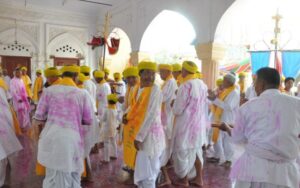
Pichkari Numit [Source: E-Pao]
The second day of Yaoshang is officially called Pichkari Numit, or the day of the water syringe. It marks the beginning of the festival’s colorful play. However, the day begins with devotion before turning into a carnival. In the morning and afternoon, local Sankirtana bands, which include Vaishnavite elders and community groups trained for the Yaoshang season by ritual elders, perform Pala Eshei at temples and from house to house. This tradition of devotional singing is known as Holi Pala Esheishakpa, and it has a unique social rule attached: any Sankirtana band that misses their performance at the Shri Govindajiu temple on Pichkari Numit is traditionally barred from performing at private homes for the rest of the festival. This rule emphasizes the temple’s importance as the center of community festival activities.
As the day continues, the color play takes over the streets and courtyards. People smear abir, or colored powder, on each other’s faces in a ceremony called Aberteinaba. Children spray each other with water from pichkari water guns. All social hierarchies of age and status temporarily disappear in the joyful celebration of color. The Vaishnava theological significance of this play—participation in the divine Holi of Vrindavan, the sacred color game of Krishna and the gopis—adds a heartfelt devotional aspect to the lively atmosphere.
Thabal Chongba: Dancing in the Light of the Full Moon
If the bonfire is the ritual heart of Yaoshang, Thabal Chongba, which means ‘dancing in the moonlight,’ represents its soul. This circular group dance takes place on all five nights of the festival in open areas, temple courtyards, and large communal spaces of each leikai. Participants, young men and women, form concentric circles, holding hands or interlocking fingers, spinning to the beat of the pung drum, kartal cymbals, and the harmonium, guided by call-and-response folk singing from a lead singer in the center.
What makes Thabal Chongba particularly noteworthy is its blend of genders. Meitei social life outside the festival usually features significant gender segregation. However, the festival creates a space where young people can mingle freely, something that is not allowed the rest of the year. Manipuri culture historians, including G. J. Phurailatpam Singh, suggest that this dance form’s circular structure, mixed-gender participation, moonlit context, and accompanying folk songs of desire imply a pre-Vaishnava origin. The Gaudiya influence gave it a theological frame: Krishna’s divine dance with the gopis in Vrindavan became the sacred model for the communal dance on the leikai grounds.
Married women and older girls host their own Thabal Chongba events known as Mou Thabal or Leishabi Chakchanaba, usually on the third day. These gatherings have become a vital part of the Yaoshang calendar. Women’s circles develop their own song collections and emotional tones—songs that evoke memory, young love, and reflections on how life has changed over the years.
Thabal Chongba Eshei: The Folk Songs of the Dance Circle
The folk songs sung during Thabal Chongba represent the largest and most culturally significant body of music in the Yaoshang tradition. They blend elements from both the classical Vaishnava kirtan tradition and the secular folk song (eshei) tradition. This music is maintained by the community and constantly renewed through improvisation. The songs follow a call-and-response format: a lead singer starts each verse, and the gathered dancers respond with the chorus. A skilled Thabal Chongba singer is an important figure in the community. They must read the crowd’s mood, pick verses that fit the night’s emotional tone, and improvise when needed.
The chaoba eshei, or calling songs directed at a beloved seen across the circle, are the most cherished type of Thabal Chongba music. They capture the main emotional experience of the festival: the beloved is close enough to see, but social rules prevent direct approach. The calling song allows for the expression of this beautiful distance.
Example : Chaoba Eshei
Ei nungaibra, ngamba chaoba —
Thabal thoiduna ei tana i-ma?
Sanabi loinaba phouoibi-gi —
Adum machang amai loutana.
(Approximate translation: ‘My beloved, I call with longing — are you the phouoibi goddess come in moonlit form? Like the moon that will not show its face — just once, turn and look at me.’)
This chaoba eshei includes the figure of Phouoibi, the Meitei goddess of grain and beauty, which adds depth to the feelings of desire by linking them to the indigenous mythological tradition that briefly reveals divine beauty. As noted by E. Nilakanta Singh in his documentation of the Meitei folk song tradition, this blend of indigenous mythology within the Vaishnava context is a defining aspect of Thabal Chongba songs.
Another major category of songs celebrates the full moon night itself, viewing the Lamda purnima moon as a divine witness to the dancers’ joy and as a comfort for the festival’s short duration.
Example : Thabal Eshei
Thabal khurumda leibi iragee —
Khonglan pibi nungsiba lana.
Yaoshang nakshi mamang thongduna —
Eigi pumnamak thangdre ama.
(Approximate translation: ‘In the moonlight that fills the courtyard — with steps that the night teaches us. Before Yaoshang’s last morning comes — let us dance once more together, just once.’)
The recurring theme of the approaching end — ‘before the last morning comes’ — gives these moonlit songs a unique blend of joy mixed with loss. This quality resonates with the Sanskrit aesthetic concept of karuna, which adds depth to the dominant srngara. Arambam Samarendra points out in his critical essays on Manipuri aesthetics that this dual emotional register is a hallmark of the festival.
Holi Kirtan Eshei (Devotional Holi Songs)
A third main category is distinctly devotional. These songs call upon the divine Holi of Vrindavan and place the human Thabal Chongba within the spiritual framework of Krishna’s spring play.
Example : Holi Kirtan Eshei
Kanhai Keli Vrindavana —
Radha matung thabal chongna.
Abir gulal phirep thabidi —
Mani Manipure Holi kana.
(Approximate translation: ‘Kanhai plays in Vrindavan — with Radha too he dances in moonlight. Abir and gulal flying through the air — this is Holi in our jewel Manipur.’)
These devotional songs clearly claim that the festival taking place in the Imphal valley is a genuine participation in the divine play, not just a human imitation. The Gaudiya Vaishnava belief holds that sincere devotional participation in Krishna’s lila is spiritually transformative. This perspective gives the singing of these songs a true devotional quality rather than treating them as mere entertainment.
Nungaigi Eshei (Songs of the Inner Heart)
The nungaigi eshei are songs that express feelings that are hard to articulate in everyday life. The festival’s atmosphere allows for this kind of emotional expression. These songs are among the most beloved by participants and frequently quoted in Manipuri literature.
Example : Nungaigi Eshei
Malem mangi thabal yamna —
Eigi nungshibi amuk lanba.
Yaoshang loidre adum yaokhre —
Nungaigi eshei thamnaba.
(Approximate translation: ‘The moonlight of this world is so beautiful — yet I search for one particular face. Yaoshang will pass and that face will be gone — let me sing the song of my inner heart once more.’)
- K. Jhaljit Singh, in A History of Manipuri Literature (1992), points out that these nungaigi eshei form a tradition of lyric poetry in oral form. They possess a sophistication and emotional clarity that rivals the written lyric traditions of the classical period and have influenced modern written Manipuri poetry.
Khubak Eshei: Women’s Songs of Festival Preparation
The khubak eshei are rhythmic songs traditionally sung by women while grinding grain. They have specific versions for Yaoshang, sung in the days leading up to and during the festival. While preparing festival foods, these songs reflect Yaoshang themes in a more personal and domestic way: the anticipation of Thabal Chongba nights and memories of past festivals, with mothers recalling their years of dancing.
Example : Khubak Eshei
Chak-hao amubi lungthoidaba —
Yaoshang nakshi chongbi kana.
Nupida wahang, macha wahang —
Thabal phumit nungshig laklure.
(Approximate translation: ‘As the black rice is soaked in water — the Yaoshang night is drawing near. For the daughters, for their mothers too — the heart leaps at the thought of the dance.’)
Shumang Leela : Manipuri Courtyard Theatre
Alongside the Thabal Chongba dance, the Shumang Leela, a traditional outdoor theater form showcasing episodes from Krishna’s life, is performed during Yaoshang. Shumang Leela groups perform in open courtyards and fields, attracting large neighborhood crowds for shows that range from comedic to deeply devotional. The Shumang Leela repertoire related to Yaoshang focuses on scenes from Krishna’s life in Vrindavan, including childhood adventures and color play with Radha and the gopis. This makes the theatrical performances an approachable communal retelling of the same divine stories depicted in a more elevated classical form during the Ras Lila at the Govindajiu temple.
Brajamai Procession and Halankar: The Closing Ceremony of Yaoshang
The final ceremony of Yaoshang, the Brajamai procession and the Halankar rite, occurs on the fifth day, or in some interpretations, the sixth day. Its main location is the Govindajiu temple. A complete description of this ceremony is provided in the next section on the temple rituals.
On the morning of the final day of Yaoshang, a group of young women leaves the Bijay Govindajiu Temple at Sagolband Mantri Leikai and walks through the streets to the Shri Govindajiu Temple at Wangkhei in Imphal East. These women, dressed in traditional Manipuri Vaishnav festival attire — phanek (traditional sarong), innafi (shawl), and festival jewellery — are known as the Brajamai. The name means ‘Mothers (or Women) of Braja,’ connecting them to the women of Braja-Vrindavan, the birthplace and home of Lord Krishna.
The procession is accompanied by Nat Sankirtana singers and musicians, making the journey between the temples a lively kirtan — a devotional performance that attracts local residents and transforms the ordinary streets of Imphal into the sacred landscape of Vrindavan. As the procession progresses, the participants sing Holi kirtans related to the end of the spring festival. The atmosphere is both solemn and joyful, filled with a bittersweet emotion stemming from the awareness of endings, which defines the last hours of Yaoshang.
At the Govindajiu temple, the Brajamai perform the Halankar ceremony — a dance-drama that re-enacts a cherished episode from Krishna’s spring stories. The central scene shows the Brajamais chasing the Brajagopis (the cowherd women of Braja) with sticks after the gopis tease them. This scene highlights the playful reversal of authority that characterizes Holi mythology. The usual decorum of Vrindavan is turned upside down by the spring festival’s merriment, and the village women joyfully chase each other, reenacting the divine mischief initiated by Krishna.
Once the Halankar dance-drama reaches its peak, the ceremony wraps up with a final burst of colors. The Brajamais and the gathered devotees drench each other with abir and colored water in a grand celebration of color, marking both the festival’s ending and its jubilant spirit. The Yaoshang festival formally concludes with this splash of color at the feet of the Govindajiu temple — finishing as it should: in joy, in color, and in the presence of the Lord celebrated over the five days.
Kaina : Pilgrimage to Sacred Hillock
One of the most distinctive features of the Govindajiu temple’s Ras Lila tradition during Yaoshang is bringing the idol of Govindajiu to the sacred hillock of Kaina for the performance. Kaina, located 29 kilometers from Imphal on the Imphal-Yairipok road, is where the jackfruit tree used to carve the Govindajiu idol was originally taken. This hill is considered one of the most sacred sites in Meitei Vaishnavism — the earthly source of the deity’s physical form. The Ras Lila performed there during the festival not only has a devotional character but also resembles a pilgrimage. Devotees travel to Kaina to witness the performance in the very place that inspired the Lord’s image, forming a connection between the Imphal temple and the natural setting of divine revelation.
Ras Lila at the Temple: The Sacred Dance of Yaoshang
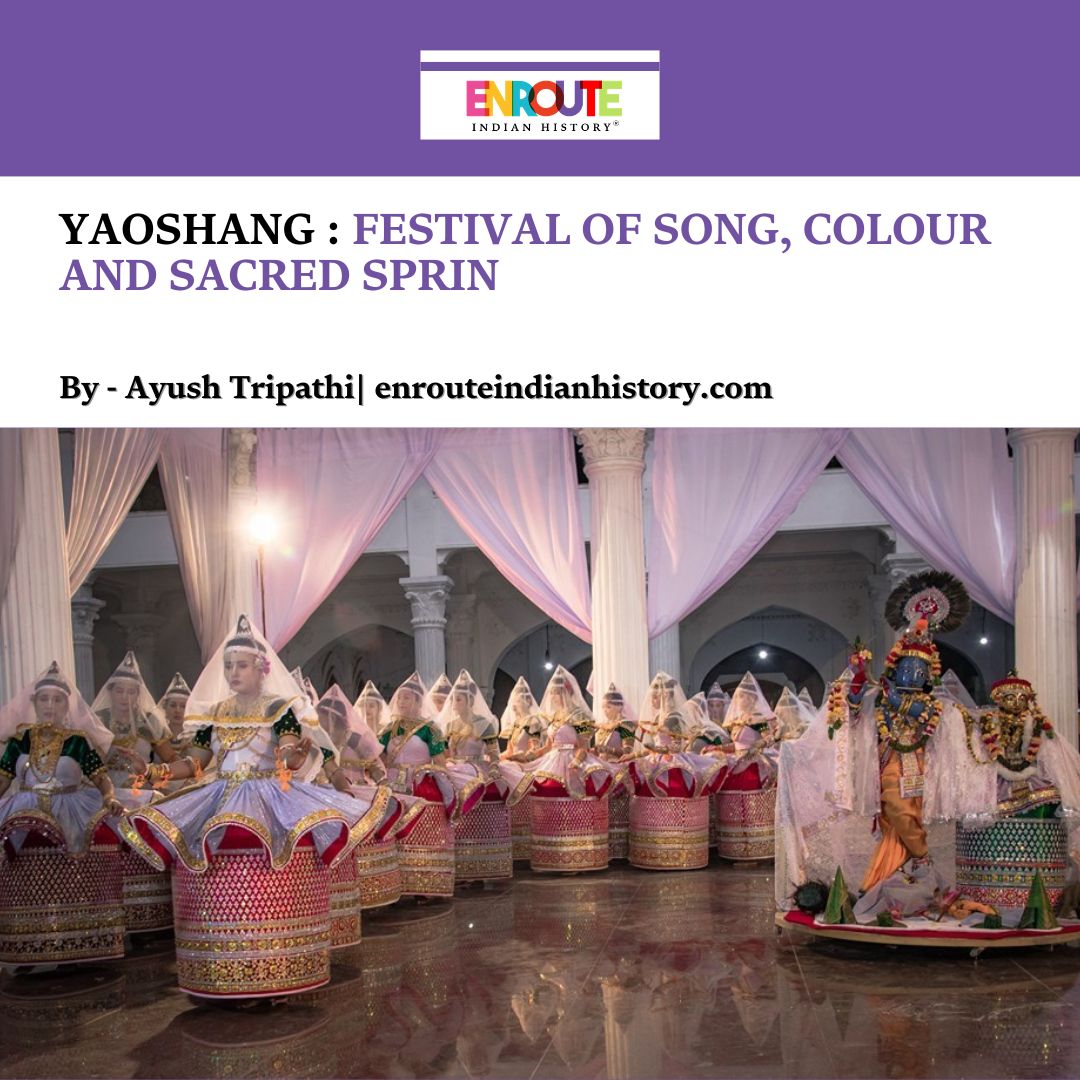
The Maharaas Leela composition, created by Maharaja Bhagyachandra for Shri Govindajiu in 1779, serves as the foundational text for the Govindajiu Ras Lila tradition. Based directly on the Rasa Panchadhyaya of the Srimad Bhagavatam (Tenth Canto, Chapters 29–33), the composition organizes the sequence of the Ras Lila performance and outlines the Sanskrit and Meitei texts to be recited and sung at each step. The Yaoshang Ras Lila involves a large group of gopis — female dancers dressed in the traditional potloi costume, which features a multi-layered circular skirt made from stiffened fabric, long-sleeved blouses, elaborate jewellery, headdresses, and unique Manipuri dance makeup. The gopis dance in a large circle around the idol of Govindajiu, using movements inspired by Manipuri classical dance — the gentle, gliding footwork, intricate hand gestures (mudra), and expressive eye movements (dristi). Their dance reflects the various emotional states described in the Rasa Panchadhyaya: longing, joy, ecstatic union, the pain of Krishna’s absence, and the final happiness of reunion.
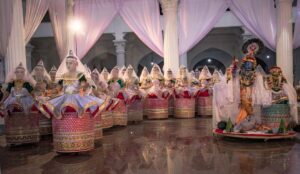
Ras Leela [Source: Indian Express]
The Incredible India documentation of the Govindajiu temple highlights: “Ras Lila casts a spell of unmatched enchantment upon the temple grounds. Here, amid nature’s serene beauty, gopis in stunning traditional attire swirl and twirl in ecstatic devotion around the temple’s sanctum, their movements a graceful tribute to divine love and unity.” The performance is accompanied by live Nat Sankirtana music — pung drums, kartal, and devotional singing — which provides both a rhythmic base and a narrative of the Ras Panchadhyaya story.
The indigenous Meitei traditions of Sanamahism enrich Yaoshang, not as competing religions but as cultural sources. The usual Meitei household has both a Sanamahi shrine and a Vaishnava devotional area during the festival, with offerings made at both as aspects of the same celebration. The bonfire of Yaosang Mei Thaba holds both its Vaishnava meaning as a purifying fire for Holi and a connection to Sanamahi’s sacred hearth flame.
Indigenous Traditions and the Festival’s Folk Roots
In Meitei folk stories, no figure is more tied to the feelings of Yaoshang than Phouoibi, the local goddess of grain, abundance and beauty. The tales of Phouoibi, found in the Puya manuscripts and oral records collected by E. Nilakanta Singh, tell of a beauty so strong it blurs the line between human and divine. In the Thabal Chongba tradition, phouoibi stands as the highest compliment for a beloved seen in the dance, someone whose beauty transcends ordinary understanding and makes the world seem more vibrant.
The spiritual connection between Phouoibi and Radha, both symbols of divine feminine beauty and linked to sacred romance, allows the Meitei creative imagination to connect them in a way that enriches the festival’s devotion. The beloved seen across the moonlit circle is both the phouoibi of local tradition and the Radha-like grace found in Vaishnava thought. Both interpretations coexist harmoniously.
The Culinary World of Yaoshang
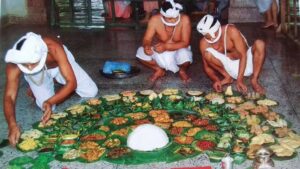
Photo credits: Jiban Ningthouja
Chak-Hao Amubi Kheer
No dish is more closely associated with Yaoshang than chak-hao amubi kheer, the slow-cooked rice pudding made from Manipur’s unique black glutinous rice. Chak-hao Amubi, which means ‘black sticky rice,’ has deep black-purple outer bran layers rich in anthocyanins. As the rice absorbs and cooks in milk, these pigments seep out, turning the liquid a striking violet-purple, one of the most visually distinctive colors in Manipuri festival food. The grain’s Geographical Indication status, officially recognized by the Government of India in 2020, acknowledges its unique significance as a product of the Manipuri valley ecology.
- K. Binodini Devi (1922–2011), a Padma Shri recipient and Sahitya Akademi Award winner, brings a woman’s perspective to Yaoshang. She has danced in the Thabal Chongba circle, made chak-hao kheer with her mother, and watched her daughters prepare for the festival dance. Her novel Boro Saheb Ongbi Sanatombi (1976) features beautiful and socially nuanced festival scenes. In her memoir, Binodini: My Story (Meitei original 1988; English translation by Thiem Sanajaoba, Katha, New Delhi, 2006), she offers celebrated reflections on childhood Yaoshang memories. She describes soaking black rice, the rhythms of pounding pestles in preparation for dance, and her mother’s songs of anticipation. These passages resonate deeply, connecting with Manipuri women’s literary tradition.
Preparation starts the evening before the festival. The chak-hao is washed multiple times and soaked overnight in cold water. The soaking water turns a deep grape-purple. This process begins the slow release of the grain’s color and flavor. On the festival morning, the soaked rice is cooked slowly in whole milk, ideally from local valley cows. It is stirred continuously to prevent scorching in the heavy pan. Sugar or sometimes jaggery, which adds a caramel touch, and green cardamom pods are added near the end of cooking. Raisins, slivered almonds, or dried coconut are folded in as a finishing touch. The result, after an hour or more over the fire, is a thick, glowing pudding that captures the darkness of bonfire night and the brightness of the full moon. It is served warm or chilled. Arambam Samarendra’s poems refer to this color as a fundamental image of Yaoshang, something no description can fully capture.
Chak-Hao Gula (Spherical Black Rice Sweets)
Alongside the kheer, another chak-hao dish has its own loyal Yaoshang fans: chak-hao gula, described by the Incredible India documentation as ‘spherical black rice sweets.’ These are balls of sweetened black rice, where the cooked chak-hao is combined with jaggery or sugar and rolled into compact spheres, sometimes coated in desiccated coconut or sesame seeds. They are denser and more portable than the kheer, making them ideal for sharing. They are perfect for Nakatheng children who come collecting, for communal feast plates, and for street vendors throughout the festival. Their vivid purple-black color against the white coconut coating makes them festive, much like the abir powder and palash blossoms that add color to the celebration.
Chak-Hao Poireiton Phirni (Aromatic Black Rice Phirni)
A third beloved chak-hao dish during the festival is the phirni, which has a smoother, creamier texture than the kheer. In this version, the black rice is ground into a coarse flour before cooking, resulting in a pudding that’s finer and more custard-like. Food writer and Manipuri cuisine expert Pushpita Aheibam describes Chak-hao Poireiton phirni, particularly highlighting its aromatic quality. The black rice variety has a subtle floral aroma that the finely ground phirni expresses more than the whole-grain kheer. Chilled in earthen pots and served in small bowls or banana-leaf cups, phirni stands out as one of the most refined sweets in the Yaoshang menu, blending the rustic tradition of rice pudding with the sophisticated style of North Indian phirni through the unique Manipuri medium of chak-hao.
Cheng Matum (Sweet Rice Flour Delicacy)
Cheng Matum is a traditional Manipuri sweet snack made from rice flour. It is coarser and more rustic than pitha, shaped into small rounds or finger-length logs, then roasted or shallow-fried until slightly crispy outside. Sweetened with jaggery and sometimes flavored with sesame or dried coconut, cheng matum offers a satisfying textural contrast with its crunchy exterior and chewy interior. As Pushpita Aheibam points out, traditional sweets made from rice products and jaggery are vital to the religious ceremonies and festivals of Manipuris. Cheng matum is particularly significant during Yaoshang, often shared among households and given to Nakatheng children along with other treats.
Kabok (Puffed Rice Treat)
Kabok, puffed rice sometimes sweetened with jaggery or palm sugar syrup, is the simplest and most widely enjoyed sweet of the festival. It is affordable, easily shared, loved by children, and available from vendors throughout the five days. In its sweetened form, similar to laai or murmura laddoo found in other Indian traditions, kabok is shaped into balls or small cakes that hold their form while remaining light and airy. It can also be enjoyed plain, eaten by the handful, or mixed into other dishes. The puffed-rice vendor is a familiar figure at Yaoshang, with their baskets of kabok contributing a warm, slightly smoky aroma amid the colorful festivities and the sounds of pung drums.
Keli Metpa and Morok Metpa (Chutneys of the Festival Table)
No Yaoshang thali is complete without chutneys. Morok metpa, the signature Meitei chutney made from roasted green chilies and fermented fish (ngari), is pounded with fresh herbs into a rough, flavorful paste. This chutney is seen on nearly every Manipuri table during the festival. Its heat and strong flavor cut through the richness of the kheer and the starchiness of rice dishes, providing the essential contrast in Meitei meals. Keli metpa, a milder and herbier version, and alu kangmet (mashed boiled potato with fried red chili) are common accompaniments. They offer the full range of Meitei condiment flavors, from intense heat to gentle earthiness.
Yu (Traditional Rice Beer)
Yu, the locally brewed fermented rice beer of the Meitei tradition, plays a complex role in the drink culture of Yaoshang. Made from steamed glutinous rice fermented with a natural starter (called marcha or hamei), yu ranges from mildly alcoholic and slightly sweet when fresh to stronger and more fermented when aged. The Vaishnava tradition formally forbids alcohol, so many households, especially those with strong Vaishnava beliefs, avoid Yu during the festival. However, in households that also follow Sanamahist practices and during the more relaxed atmosphere of the festival, Yu might be consumed discreetly as part of the celebration. When shared during Yaoshang in Sanamahist households, yu is often first offered at the Sanamahi shrine before being enjoyed by family members, connecting the drink to the sacred aspects of the festival.
Chak-Hao Chaa (Black Rice Tea)
One of the most unique drinks during Yaoshang is chak-hao chaa, a hot beverage made from Manipuri black rice. The rice is dry-roasted until fragrant, then steeped in hot water, sometimes with a small amount of real tea leaves or fresh ginger. This creates a warm, slightly nutty, and mildly sweet drink with the distinct violet-red color of the chak-hao grain. A food writer from the restaurant Rosang in Delhi recalls being ‘floored’ by the chak-hao chaa at a Yaoshang food festival, noting its surprising flavor for what is essentially a grain infusion. It is served in small earthen cups or regular chai glasses throughout the festival, warming the hands of those preparing for Nakatheng and post-Thabal Chongba dancers alike.
Bibliography and Scholarly Sources
Primary Historical and Temple Sources
- Cheitharol Kumbaba [The Royal Chronicle of Manipur]. Compiled from multiple Meitei manuscripts. Edited edition: Manipur State Archives, Imphal. Records the 1779 consecration of the Govindajiu idol, the first Ras Lila performance, the 1846 temple founding, and the 1876 reconsecration.
- Bhagyachandra, Maharaja (Ching-Thang Khomba). Maharaas Leela (1779 AD). Liturgical composition dedicated to Shri Govindajiu, based on the Rasa Panchadhyaya of the Srimad Bhagavatam. Documentation: All India Radio Sangeet archive (see archive.org/details/dli.akashvani.sangeet.29). Performed by rasdhari M. Kaminikumar Singh and Ph. Iboton Singh.
- Srimad Bhagavatam, Tenth Canto, Chapters 29–33 (Rasa Panchadhyaya). The primary Sanskrit theological text recited and sung during the Govindajiu Ras Lila and forming the narrative foundation of the Yaoshang devotional programme.
- Gita Govinda (12th century CE). Sanskrit devotional poem central to Gaudiya Vaishnava aesthetics; texts from this poem are sung in Nat Sankirtana Holi kirtan performances during Yaoshang.
Ethnography and Religious Studies
- Hodson, T. C. The Meitheis. London: David Nutt, 1908. Reprint: New Delhi: B. R. Publishing Corporation, 1975.
- Parratt, Saroj Nalini Arambam. The Religion of Manipur: Beliefs, Rituals and Historical Development. Calcutta: Firma KLM Private Limited, 1980.
- Parratt, John, and Saroj Nalini Parratt. The Pleasing of the Gods: Meitei Lai Haraoba. New Delhi: Vikas Publishing House, 1997.
- Singh, M. Kirti. Religion and Culture of Manipur. Delhi: Manas Publications, 1980.
- Singh, M. Kirti. Religious Developments in Manipur in the 18th and 19th Centuries. Imphal: Manipur State Kala Akademi, 1984.
History
- Kabui, Gangumei. History of Manipur, Volume I: Pre-colonial Period. New Delhi: National Publishing House, 1991.
- Singh, L. Joychandra. The Lost Kingdom: A Socio-political History of Manipur 1891–1950. Imphal: Singhka Okram, 1992.
Literature and Literary History
- Singh, R. K. Jhaljit. A History of Manipuri Literature. Imphal: Manipur Sahitya Parishad, 1992.
- Devi, M. K. Binodini. Boro Saheb Ongbi Sanatombi. Imphal: Manipuri original, 1976.
- Devi, M. K. Binodini. Binodini: My Story and Other Stories. Trans. Thiem Sanajaoba. New Delhi: Katha, 2006.
- Ngangom, Robin S., and Kynpham Sing Nongkynrih, eds. Dancing Earth: An Anthology of Poetry from Northeast India. New Delhi: Penguin Books, 2009.
- Literary journal, Imphal. Archives contain Yaoshang poetry by Arambam Samarendra, R. K. Elangbam, Kh. Chaoba Singh, and others.
Folklore and Oral Tradition
- Singh, E. Nilakanta. Folklorists of Manipur. Imphal: Publication Board Manipur. Documentation of Thabal Chongba eshei, khubak eshei, chaoba eshei, and Phouoibi narrative tradition.
- Singh, Kh. Kunjabihari. Studies on Meitei Clan Traditions and Festival Anthropology. Various publications, Manipuri Studies series, Imphal.
Music and Performance
- Cleuziou, Regine. Ethnomusicological studies on Nat Sankirtana. Various journals including Asian Music and Ethnomusicology.
- Singh, G. J. Phurailatpam. Studies on Pung Cholom and Meitei Folk Traditions. Manipur University and JNMDA, Imphal.
- Nomination File: Nat Sankirtana, Ritual Singing, Drumming and Dancing of Manipur. Inscribed 2013. Available: ich.unesco.org.