

Adorned in Gore and Gold : Why the Mahavidyas Wear Death as Jewelry—and Gold as Immortality
- December 10, 2025
By Ramyani Banerjee
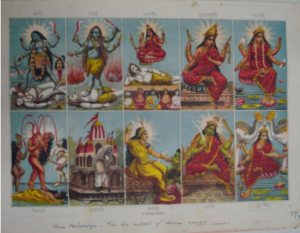
All of the Ten Madavidyas. ca. 1885
(At Top, from left to right:- Kali, Tara, Shodashi, Bhuvaneshwari and Bhairavi
At Bottom, from left to right:- Chhinnamsta, Dhumavati, Bagalamukhi, Matangi and Kamala )
Publisher: Calcutta Art Studio. Chromolithograph. https://www.britishmuseum.org/collection/object/A_2003-1022-0-37
Who are the Dasa Mahavidyas?
Enter a bustling marketplace in Kolkata, and you will still come across many calendars featuring the striking, vivid images of the Dasa Mahavidyas. With fierce gazes, blood-red tongues, skulls and bones, or shimmering gold jewelry— they defy the confines of gentle beauty, modesty, or order. The Dasa Mahavidyas—Kali, Tara, Shodashi (Tripurasundari), Bhuvaneshwari, Bhairavi, Chhinnamasta, Dhumavati, Bagalamukhi, Matangi, and Kamala—form this powerful ensemble. They flourish in contradictions, and through deep philosophical tenets, they are often considered by their ardent devotees as living jewels—adorned with raw and metaphorical symbols of death and transformation. When I first encountered the Mahavidyas, I was captivated by how wildly they diverge from the tranquil, benevolent deities that fill the mainstream Hindu pantheon.
Tantricism or Tantrism, which arose as a bold counter-current to the Vedic tradition around the 9th century CE, finds its most vivid expression in the Mahavidyas—ten dazzling facets of a single, powerful, unfathomable truth: the Divine Mother. All of them are venerated as a unique and powerful manifestation of the cosmic energy of this universe. Yet, in stark contrast to the gentle images of Brahmanical gods and goddesses, their iconographies revel in what most of us instinctively dread: Death.
Here, blood, skulls, corpses, and demons are not mere embellishments but the very heart of their metaphorical symbolism. According to David Kinsley, the Mantramahodadhih text refers to sadhana being performed on a corpse, or in places where a corpse was recently buried or cremated. Naturally, it can be unsettling to think of these practices as part of a sacred tradition. And in mainstream Brahmanical practices, such rituals are considered as really transgressive, and therefore seen as a serious breach of social norms— especially when linked to such terrifying-looking female deities. In Tantric religions, however, the cremation ground is considered very important. It is viewed as a threshold, where fears are exposed and shown to be temporary. Meditating there, among burning pyres, means facing what is forbidden to understand that everything, no matter how disturbing or impure, is ultimately purified by Shakti, the universal cosmic power.
The Dasa Mahavidyas embody an ordeal that is as much psychological as mythic. They emerge in various frightening forms, putting even the most powerful male gods to tests. Their grotesque visages are not merely cruel but represent the cosmic dissolution or pralaya—where the universe is consumed so that a new creation can be reborn. This is their paradoxical beauty: they compel us to relinquish mortal attachments, urging the sacrifice of what is withered within us, so that our deeper, divine nature may surface. What appears destructive is ultimately purifying. The demons they vanquish are not just from mythological battlefields, but the persistent, destructive cycles of our own minds. Witnessing their ferocity is a reminder that true consciousness exists beyond fear, decay, and death itself.
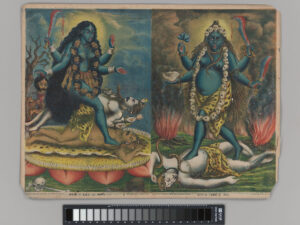
Kali and Tara, Calcutta Art Studio, circa. 1885-90.
Accessed September 11, 2024. Source: https://www.metmuseum.org/art/collection/search/786756
Embracing the Macabre: Skulls, Blood, and Severed Limbs
Upon first encountering the Mahavidyas, it is difficult not to feel both unsettled and captivated at the same time. The Brihat Tantrasara (16th century) is one of the most important texts focusing on the iconography of the Goddesses, particularly in her most fearsome forms, such as Kali, Tara, or Bhairavi; who “always live in the crematory,” holding a cup of “wine and meat,” and a “freshly cut human head” while “smiling and eating rotten meat.”
Among these deities, Goddesses Kali and Tara—often referred to as “sisters” in Tantric traditions due to their similar appearance—are likely the most recognized and widely honoured Mahavidyas. With girdles of severed arms, blood-stained sword in their hands (Kharga), bone jewelry, and mundamala (a garland of severed human skulls or heads) adorning their bodies, both of them usually appear as nude or partially clothed deities. Scholar Rachel Fell McDermott reminds us that Kali’s ornaments or her macabre aesthetics represent more than just horror; they stand for language, action, and deep philosophical metaphors, whose meanings have been translated into her jewelry. Bhairavi, whose name itself means “the terrifying one,” similarly wears skull necklaces and belts made from severed limbs and bones.
Yet, nothing truly readies you for Chhinnamasta—the goddess who remains unparalleled, even among this fearsome assembly of deities. She appears nude, holding her severed head high above, with three streams of blood shooting out: two to feed her attendants and one to sustain herself. Her bold, fearsome iconography—skull necklaces around neck and a jeweled headpiece on her severed head—merge gore and divine grandeur together.
Here, you’ll find that Serpent jewelry is a common feature among these goddesses. The reason for this is that Kundalini, the dormant energy believed to lie coiled at the base of the spine, is portrayed as a serpent in Tantric traditions. As described in Brihat Tantrasara, these adornments symbolize a unique sexual-spiritual union, where the serpents reflect awakened energies, channeling both desire and transcendence, as essential to Tantric liberation. The Dasamahavidyas like Kali, Tara, and Chinnamasta contain the most stunning representations of this surge of spiritual awakening. Then comes Dhumavati; where the fact that she is devoid of any jewelry makes a statement— as if she were a gloomy, deadly emptiness into which all ornamentation vanishes.
These macabre “jewels” are not simply intended to instill fear; in Tantric texts, the severed head and blood are of paramount significance. It is important to keep in mind that the fundamental tenet of the vamachara, or “left-hand,” Tantric rites is the significance of human sacrifice and blood. These texts hold that the ego, consciousness, and the center of existence are all represented by the head—- which is the essence of life. These goddesses are associated with the confines of human identity and the annihilation of the ego. By featuring severed heads or skulls, the Dasamahavidya iconographies highlight the necessity of transcending the ego for the cause of spiritual enlightenment and liberation.
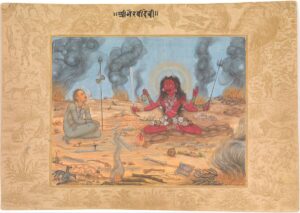
Goddess Bhairavi in Smashana (place of cremation), sitting on the body of a decomposing corpse. Shiva appears here as a form of devotee. Mughal period artwork. Circa. 1630-35.
Accessed September 11, 2024. Source: https://www.metmuseum.org/art/collection/search/457743
Splendor Amidst the Gore: The Other Mahavidyas
When you stand before the Mahavidyas—as a viewer, you realize that all of them are not cloaked in gore and blood. Some emerge instead in an altogether different radiance. The other goddesses— Tripurasundari (Shodashi), Bhuvaneshwari, Bagalamukhi, Matangi, and Kamala—shine in gold, encrusted with pearls, lotuses and regal ornaments. Their jeweled presence unsettles its paradox: it is not terror alone that defines the Tantric feminine, but an equally commanding elegance.
Chhinnamasta, yet again, is perhaps the most striking. She is a goddess who has severed her own head, yet her torso and forehead gleams with gold, her beauty defiantly coexisting with gore. Matangi, sister to Bhairavi in her ferocious wisdom, wears the same contradiction—her garlands of gunja seeds and rich jewelry glow against the skull bowl in her hand. These forms embody paradox: ferocity crowned with elegance. On the other hand, Tripurasundari, also called Shodashi, is regal and queenly, her iconography is decorated with a golden crown, pearls, and gem-studded ornaments. She is less the ascetic terror and more the sovereign beauty of creation. Similarly, Bhuvaneshwari, “Mistress of the Worlds,” wears a crescent diadem and gemmed crown, her lotus garlands radiating cosmic sovereignty. Bagalamukhi, distinguished by her turmeric-gold attire and ornaments, manifests a dazzling palette of yellow-gold as her jewel code. Finally, Kamala, identified with goddess Lakshmi, sits on a lotus, showered by four elephants, her jeweled ornaments signaling abundance, fertility, and auspiciousness.
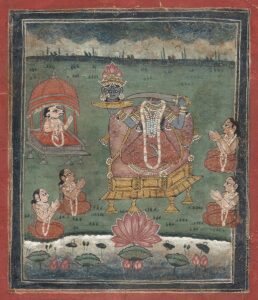
Goddess Chinnamasta, Bundi School, Rajasthan, India, ca. 1775.
This is one of those rare paintings where Chinnamasta is depicted in a very benign form, adorned with
gems, jewelry and sitting on a golden throne. Available at: Wikimedia Commons
(Source: https://commons.wikimedia.org/wiki/File:Bundi_painting_Chinnamasta.jpg
accessed 5 September 2025).
Here, gold is not merely a decoration but a theological statement. Gold, unlike other metals, does not tarnish. Its incorruptible and imperishable nature becomes a powerful emblem of the goddess’s spirit — eternal, unyielding, and beyond decay. David Kinsley observes that Tripurasundari is consistently portrayed as “resplendent with golden ornaments, pearls, and jewels,” embodying prosperity, beauty, and order. Kamala’s richness in jewels symbolizes both the spiritual abundance of Shakti and her material prosperity. N. N. Bhattacharyya notes that this gold is equated with immortality and supreme knowledge in Tantric ritual, its brilliance embodying the fire principle (Agni) and solar effulgence. Bagalamukhi’s golden radiance thus becomes not ornament but weapon, immobilizing her enemies with dazzling power.
On the other hand, pearls, born from the depths of the ocean, are prized in Tantric symbolism for their association with purity and hidden knowledge (Guhya Vidya). The Shakti Sangama Tantra describe pearls as lunar jewels, directly linked to the moon (chandra), that governs mind, emotions, and feminine energy (Shakti). The lotus, on the other hand, is one of the most enduring emblems of transcendence throughout Indic traditions. Both the blue lotus and the red lotus keep appearing as jewellery motifs in Dasamahavidya art. The cool tone of Blue Lotus (Nilotpala / Nilakamala) represents detachment from worldly desires, serenity, and the unfolding of higher consciousness. Red Lotus (Raktotpala) is the symbol of passion and creative power whose vibrant hue is linked with blood, fertility, and the generative energy of the cosmos. Therefore, adorning the Dasamahavidyas, the interplay of gold, pearls, and lotuses captures a delicate equilibrium—where aesthetic splendor meets profound symbolism.
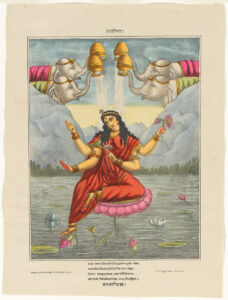
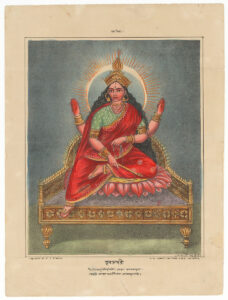
(Left) Goddess Kamala/Kamalatmika ca. 1880–85, Calcutta.
(Right) Goddess Bhuvaneshvari, ca. 1880–85, Calcutta.
Designed and published by The Hindu Art Studio. Lithograph. The Met Collection.
Accessed September 5, 2025. https://www.metmuseum.org/art/collection/search/849497
Conclusion:
The stark contrast between macabre ornaments and beautiful adornments is not accidental but deliberate. As jewels, bone and skull garlands symbolize impermanence, mortality, and dissolution of ego, while gold and pearl ornaments signify permanence, auspiciousness, purity and immortality. Together, they embody the paradoxical truth of Tantric cosmology: death and life, decay and radiance, horror and grace can coexist as inseparable realities of existence. By wearing gold and gems, they remind devotees of the eternal radiance of Shakti, the indestructible ground of being that underlies all impermanence. In this sense, the goddesses are not contradictory but complementary, encompassing the full spectrum of existence. Severed heads cease to be grotesque when worn as necklaces by Kali; they become sacred emblems of transcendence. Similarly, gold transcends worldly wealth when worn by Bhuvaneshwari or Kamala.
Of course, for modern audiences, these Tantric iconographies remain provocative, violent, even unsettling. And that is precisely the point. Because they offer profound insights into how human beings grapple with mortality and impermanence. The jewels of the Dasamahavidyas—whether skulls or gold and pearls—embody the radical vision of Tantra, which refuses to separate purity from impurity, beauty from horror, life from death. Instead, it insists that Shakti, the divine feminine, contains all contradictions within herself. So, their jewels are not simply adornments but revelations—signs that transcendence lies not in fleeing from life’s terrors, but in adorning them, transforming them, and embracing them as facets of the divine.
REFERENCES:
1. Agamavagisha, K. (1996) Brihat-Tantrasara. Edited by Sri Rasik Mohan Chattopadhyay. Calcutta: Navabharata Publishers, pp. 505–509, 561–563.
2. Bhattacharyya, N.N. (2007) History of the Tantric Religion: A Historical, Ritualistic, and Philosophical Study. 2nd rev. edn. New Delhi: Manohar.
3. Chakravarti, C. (1999) The Tantras: Studies in their Religion and Influence. Calcutta: Punthi Pustak, pp. 66–67.
4. Das, P. (2019) ‘Depiction and role of women in Tantric art – The Sakti Cult’, Muse India: The Literary e-Journal, 87, pp. 3–8. ISSN: 0975-1815. Available at: https://museindia.com/Home/ViewContentData?arttype=feature&issid=87&menuid=8510 (Accessed: 4 September 2025).
5. Humes, C.A. and McDermott, R.F. (eds.) (2009) Breaking Boundaries with the Goddess: New Directions in the Study of Shaktism: Essays in Honour of Narendra Nath Bhattacharya. New Delhi: Manohar Publishers & Distributors, p. 138.
6. Kinsley, D.R. (1975) ‘Freedom from death in the worship of Kali’, Numen, 22(3), pp. 183–207. doi:10.2307/3269544.
7. Kinsley, D.R. (1998) Tantric Visions of the Divine Feminine: The Ten Mahavidyas. 1st edn. New Delhi: Motilal Banarsidass, pp. 9–12.
8. Kinsley, D.R. (1998) ‘Tara, Chinnamasta and the Mahavidyas’, in Hindu Goddesses: Visions of the Divine Feminine in the Hindu Religious Tradition. New Delhi: Motilal Banarsidass, pp. 161–177.
9. McDermott, R.F. & Kripal, J.J. (2003) Encountering Kali: In the Margins, at the Center, in the West. Berkeley: University of California Press. pp. 34-39
10. Rao, S. (2012) ‘Dasha Mahavidya – Part One – Introduction’, sreenivasarao’s blogs, 5 October. Available at: https://sreenivasaraos.com/2012/10/05/dasha-mahavidya-part-one-introduction/ (Accessed: 6 September 2025).
11. Samdarshi, P. (2014) ‘The concept of goddesses in Buddhist Tantra traditions’, The Delhi University Journal of the Humanities & the Social Sciences, 1. Available at: https://journals.du.ac.in/humsoc/pdf/8DU-journal.pdf (Accessed: 5 September 2025).
12. Shin, J.-E., 2018. Change, continuity and complexity: The Mahavidyas in Eastern Indian Shakta traditions. New Delhi: Manohar.