


By Shreya Kamboj
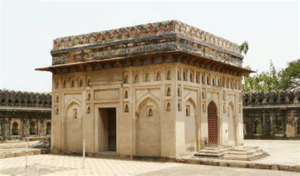
Among the many Delhi monuments that dot the capital’s historic landscape, few are as enigmatic and evocative as the Jamali-Kamali tomb in Mehrauli. Often referred to as the ‘Jewel Box of Delhi’, the ‘Gay Taj Mahal’, or the ‘Forgotten Lovers’ Tomb’, this 16th-century site defies easy categorization. It houses the mortal remains of the celebrated Sufi poet Shaikh Jamali Kamboh and his elusive companion Kamali. Were they master and disciple? Friends? Or lovers entwined in life and death? Their shared grave offers no answers but evokes plenty of questions. As Madhavi Menon notes in ‘Infinite Variety: A History of Desire in India,’ sites like Jamali-Kamali seduce us into recognizing forms of queerness that history often erases or renders illegible. This essay excavates queerness – in forms spiritual, poetic, and architectural, by reading the monument as a living palimpsest of same-sex love in India.
Who Were Jamali and Kamali?
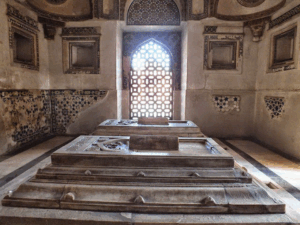
Shaikh Jamali Kamboh, also known as Jalal and later by the pen name ‘Jamali’ (meaning ‘beauty’), was a 16th-century poet who lived through the Lodi and early Mughal period. He was an avid traveler who, at some point, made Qutb Sahib (Mehrauli) his home where he also tutored Sultan Sikandar Lodi and later composed panegyrics for Babur and his successor Humayun. (Zaweed, 2015). He was known by the title Khusrau-i Sani (Khusrau the Second) and ‘Indian Parrot’. Apart from these, his tomb contains the engraved chronogram Khusrau-i Hind buda, ‘He was the Sun of India’ or ‘He was the Khusrau of India’. He died in 1536 during Humayun’s Gujarat campaign and was buried in the tomb he had constructed for himself in 1528-29.
Kamali, on the other hand, remains an enigmatic figure. There are no historical records clearly identifying his relationship with Jamali, but their shared tomb has prompted scholars and oral traditions to posit a deep emotional bond. Scholars are skeptical whether Kamali was even his real name or adopted because it rhymed with that of Jamali’s. One theory even states that it was his poems that Jamali took credit for. (Zaweel, 2015) Another theory states that they were siblings, given the rhyming names that were given by their parents intentionally.
However, this is rendered implausible by scholars as the name ‘Jamali’ was adopted later in life. Others state that Kamali might have been his disciple, a friend, a fellow poet, or his wife. An irrefutable fact, however, is that both were men because the pen boxes constructed on their graves were traditionally meant for male saints who wrote the words of wisdom during their lifetime. Menon also notes that the graves housing women were given flat roofs to denote the paper upon which the pen writes. The combination of features like a flat roof from outwards – a dome from within, and pen boxes on graves make it an androgynous structure. The oral traditions have thus devised another theory where Jamali and Kamali have been positioned as homosexual lovers. This urban legend has been further developed by an American author named Karen Chase in her work ‘Jamali-Kamali: A Tale of Passion in Mughal India’. According to Zaweel, however, this ‘fascinating story’ “comes from her imagination, not from real facts”. Likewise, many other historians also refute any association with homosexuality.
The Homoerotic Language of Sufi Devotion
More recent researchers, especially those studying Gender and Sexuality like Menon, while accepting that one cannot know for certain about the nature of their relationship, also do not completely rule out the possibility of homosexual associations. As Menon states “what remains important for us to consider is the nature of a love between two men that was intense enough to warrant burial side by side.” She also draws attention to the nature of the Sufi literary tradition, where desire for the divine is often expressed through the metaphor of the beloved. The boundary between spiritual yearning and sensual affection is designed to be porous. Sufi poetry frequently codes the divine beloved as male, not only due to the gender-neutral nature of Persian (in which much of Indian Sufi poetry was written) but also because masculinity occupied the symbolic space of divine authority and spiritual intimacy. In the works of Amir Khusrau, Bulleh Shah, and Shah Hussain, we encounter male devotees calling themselves brides, yoginis, and beloveds of their male spiritual guides.
Amir Khusro, one of the most luminous Sufi poets, writes of Nizamuddin Auliya in sensuous idioms. In the qawwali “Chhap tilak sab chheeni,” the speaker loses his identity through a lover’s glance, a common Sufi motif wherein the ego is annihilated through ishq (love). Similarly, Bulleh Shah’s verses for Shah Inayat are charged with a potent eros: “Today my beloved Inayat will come to my bed,” a line that merges mystic surrender with unmistakably erotic intimacy. This eroticism is not merely symbolic or metaphoric. Instead, it is fundamental to how desire operates within Sufi cosmology: dissolving distinctions between male and female, lover and beloved, self and other. Sufi mysticism, Menon argues, makes no attempt to sever the spiritual from the erotic as it understands them as interpenetrating and often indistinguishable forces. Jamali’s words ‘My restlessness, for love of you, has passed all bounds; yet still I hope / you will have pity on my lack of calm!’ may equally speak to God or his partner Kamali. (Menon, 2018)
This conceptual framework allows us to better understand the tomb of Jamali and Kamali. Rather than interpret the tomb through a heteronormative or even strictly romantic lens, Menon urges us to see it as a shrine to “dargah desire”, a term she coins to describe the erotic mysticism embedded in South Asian Sufi practice. This kind of desire, she explains, is not the Western “love that dare not speak its name.” Instead, it is the annihilation of desire as self – fana, the loss of individual identity in the presence of divine or beloved unity. This is especially significant given that Indian traditions have historically lacked a rigid vocabulary of sexual identity.
The tomb’s current status – closed to the public – also reflects a contemporary discomfort with its openness. As Menon notes, the structure is not even formally designated as a dargah, perhaps to avoid devotional attention that might expose its ambiguous intimacy. Yet in older times, the tiled courtyard outside likely hosted sama gatherings and qawwalis, indicating that it once functioned as a vibrant Sufi site. What we now see is a sanitized, bureaucratized version of a once-living space of devotion and possibly subversive affection.
The Architecture of Jamali-Kamali
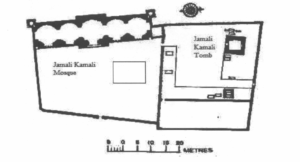
Next to a beautifully balanced mosque, the Jamali-Kamali tomb stands with a quiet and simple look that hides the rich beauty inside. Made of red sandstone with touches of white marble, the tomb seems plain at first. Its flat roof, unlike the domes typical of Mughal design, introduces a quiet defiance of architectural norms. The entrance remains sensibly locked for most of the year, and one must peer through the intricately perforated jalis to catch fragmented glimpses of its stunning interior.
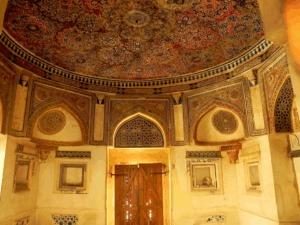
Inside, the tomb is like a hidden jewel box. The ceiling, although flat from the outside, is adorned within by a faux dome richly decorated in painted arabesques of blue, red, and gold that create a striking illusion of height and depth. The interior walls are lined with incised plasterwork and encaustic tile inlay, especially around the mihrab, squinches, and doorways. Each panel carries distinct geometric patterns, emphasizing the balance between structure and ornament.
Conclusion
The tomb of Jamali-Kamali resists easy definition, much like the relationship it memorializes. It stands at the intersection of poetry and architecture, devotion and desire, memory and mystery. Whether Jamali and Kamali were lovers, saints, disciples, or all of these at once, their resting place becomes a powerful symbol of the layered histories India often buries beneath silence or ambiguity. Madhavi Menon poignantly observes, “Two men are buried together, and their songs speak of intense same-sex love. But equally they speak of an intense longing for God.” This duality, between earthly affection and divine yearning, lies at the heart of Sufi mysticism and is etched into the very architecture of the tomb.
References
· Chase, Karen. 2014. ‘JAMALI and KAMALI in History’. Available at https://blog.bestamericanpoetry.com. (Accessed on 20 June 2025)
· “Jamali Kamali Mosque and Tomb”. In Commonwealth Games-2010: Conservation, Restoration and Upgradation of Public Amenities at Protected Monuments. Available at Archaeological Survey of India. (Accessed on 20 June 2025)
· Menon, Madhavi. 2018. “Dargahs” in Infinite Variety: A History of Desire in India. Speaking Tiger Publishing Private Limited.
· Peck, Lucy. 2005. “Delhi – A Thousand Years of Building”. Delhi: Roli Books
· Zaweel, Salim. 2015. “Medieval Monuments of Mehrauli: Reality and Myth.” Proceedings of the Indian History Congress, Vol. 76, pp. 748-758.