

By Ashutosh Pandey
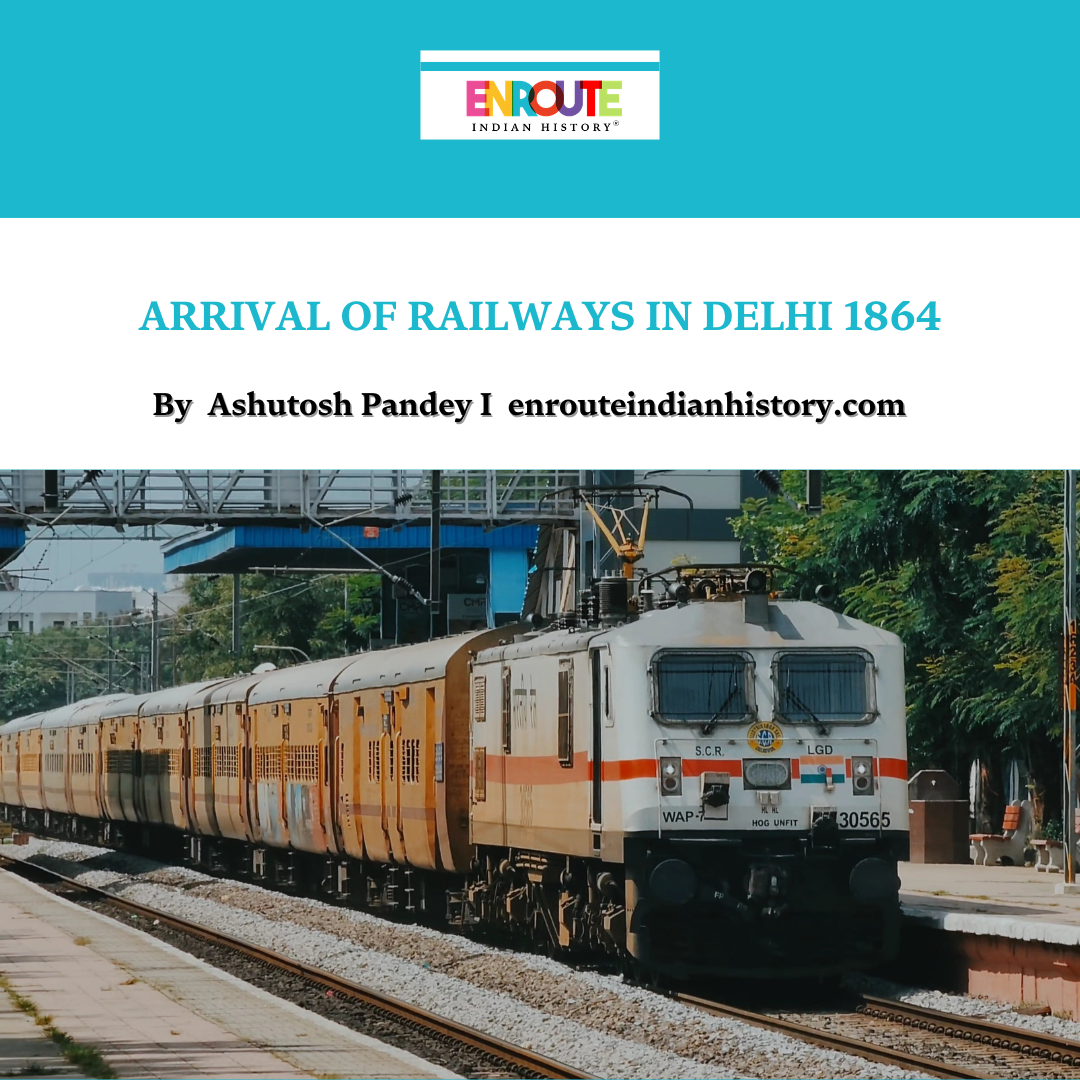
The year was 1864 and the city of Shahjahanabad wrapped in its red sandstone walls and the fragrance of Mughal legacy heard a sound it had never heard before. The year of 1864 marked a new dawn in the history of Delhi, high pitched metallic cry of a machine that later known to be as train surprized the people in old city of Delhi (Shahjahanabad).As the steam curled over yamuna bridge ,train like an iron serpent rolled into Delhi ,bearing not only passengers and goods but also a promise of a new age .In that moment of history , old capitals of emperors met new engine of modernity.
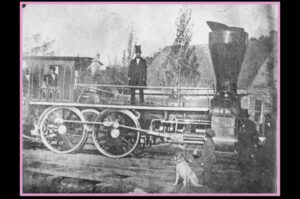
The arrival of the railways in India was one of the most transformative events of 19th century,as everyone know that the first train had run a decade earlier in 1853 from Bombay to Thane.This line of railway heralded the beginning of Industrial revolution in East and with time British stretched the line of railways to Delhi also,British have realized that railways were more than just a tool of travel ,they used railway as an instrument of control,commerce and command.Delhi’s first railway line was part of the grand network laid by the East Indian Railway who were linking Calcutta to Delhi i.e. the journey from Howrah to Delhi.
Foundation of first Railway station
The first railway station of Delhi was not far from the walled city,connecting the Mughal capital to the expanding British frontier,The station later evolved as Old Delhi railway station . The early plans of the station were drawn under the British engineers George Turnbull & Robert Maitland Brereton.They designed it for functional simplicity : wide platforms for loading & unloading of goods,brick arches for ventilation,sturdy iron girders for heavy locomotives,etc. Its purpose was to serve the empire rather than aesthetics.
Over time as Delhi grew into the imperial capital of British India,the station architecture evolved into the familiar red sandstone fortress mirroring the Mughal heritage that surrounded it.This stylistic shift was deliberate,it was a symbolic gesture by the British to blend the colonial modernity with local motifs asserting dominance while borrowing Delhi’s own grandeur.
Connecting Shahjahanabad to country
Before the arrival of railways Shahjahanabad was a city of narrow lanes,camel caravans and the rhythmic clatter of bullock carts.Its connection with the outside world was slow and seasonal , bounded by limitations of roads and rivers ,which railways changed overnight.The line that reached Delhi in 1864 cut through Yamuna eastern bank crossed the river on an iron bridge , and entered near Sabzi Mandi.It connected the Mughal heartland to the industrial nerve of Calcutta and soon after to the ports of Bombay via the Grand Trunk route.This meant that for the first , Delhi was no longer a city apart from the world ,it was a node in a vast imperial network.The train brought with them goods,ideas and people.Traders from Lahore could not reach Delhi in a day.Postal services became faster , and administrative efficiency soared.Pilgrims and soldiers alike shared compartments that cut across caste and class lines.Ironically what began as a British attempt at uniformity gave birth to India’s first taste of social mobility – both literal and symbolic.
Why British brought railways
The British didn’t build the railways out of benevolence .The shiny steel lines that ran through Delhi’s soil were laid primarily for economic exploitation and imperial convenience. Every mile of railways laid in India served larger economic machinery of the British Empire.Through the railways raw material from the interior like Cotton,Bombay, and Madras.In return ,British manufactured goods flowed back into Indian markets,undercutting local artisans and dismantling traditional industries.The iron road thus became one way street for wealth,drawing resources out of India while flooding its bazaar with foreign goods.Delhi’s strategically located in northern India was the keystone in network. It stood at the crossroads of trade routes linking Punjab ,united provinces and Bengal.The city began to become a central depot for the movements of goods , military supplies and revenue officials.The railways also made it easier to enforce taxation and land revenue systems helping the British penetrate deeper into rural economies that had previously been autonomous.
The British claimed that railway would “ unite the country & uplift the natives “ but in reality the benefits were sharply divided .While the empire the profits as India paid in Displacement, dependency and lost industries. Yet history has its own paradoxes ,the same railway that drained India’s wealth would later carry revolutionaries,pamphlets and freedom songs and it became lifeline of an awakening nation.
Architecture
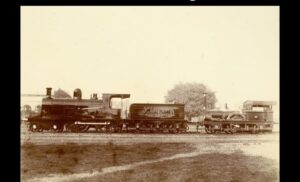
By the 20th century, Old Delhi Station had acquired its now iconic architectural character, featuring an Arched gateway, battlemented tower, and red brick walls inspired by the Mughal fort aesthetic. The fusion of the old and new was not accidental; the British sought to create an infrastructure that appeared both native and imperial, blending familiarity with authority. Inside the structure, the design was engineered for efficiency, and the high ceilings allowed heat to escape during Delhi’s sweltering summers. Large platforms accommodated long trains arriving from Calcutta and Lahore. The iron trusses and columns were imported from Britain, shipped to India through Calcutta’s docks, and assembled on site, which is another example of technological dependency. And then around the station, new settlements began to grow . Workshops, warehouses, and railway colonies emerged, shaping the early industrial geography of the city. The hum of steam and the clang of the steel slowly replaced the chants and bells of the old bazaar. Delhi was changing not just in architecture but in rhythm.
Evolution with time
After 1864, Delhi’s railway network grew rapidly,by late 19th century the city has become the meeting point of several major lines connecting it with Lahore in the northwest , Bombay in the southwest and Calcutta in the east.This web of connection transformed Delhi into one of the India’s most important railway junctions.When the British decided to shift their imperial capital; from Calcutta to Delhi in 1911 it was partly because of the connectivity.The railways had made Delhi not only accessible but also administratively strategic.In 1920s as construction began for new Delhi , a new railway station was planned to complement the grand avenues of Lutyen’s city.The New Delhi Railway Station inaugurated in 1926 symbolized the transition from the old walled city to the modern colonial capital .Yet the old Delhi station remained a bustling centre serving the market and neighborhoods of shahjahanabad , the railway was not merely a transport system , it was the backbone of the city’s urban growth.
The arrival of the railways in Delhi in 1864 was more than a technological milestone , it was a cultural and historical turning point. It connected the imperial capital of Mughals with the industrial ambitions of the British and in doing so it rewrote Delhi’s destiny.The iron tracks that cut across the plains of northern India brought with them the pulse of modernity, linking the past with the future.
From the fort-like station of 1864 to today’s sprawling Old Delhi and New Delhi junctions and further to the sleek Delhi’s Metro that now runs beneath the same soil,the story of Delhi’s railway mirrors the story of India itself. A nation that transformed colonial infrastructure into instruments of progress and pride, the whistle that first echoed through Shahjahanabad more than 160 years ago still resonates not just in the railway yards of old Delhi but in the very heartbeat of a city that has always been and will always remain on the move.
Bibliography
1. East India Railway Company. Reports on the Progress of the East Indian Railway, 1853–1870. London: British Parliamentary Papers, 1871.
2. Government of India, Public Works Department. Plans and Reports of the Delhi Railway Station and the Bridge over the Yamuna. Calcutta: Superintendent of Government Printing, 1865.
3.Satya, Laxman D. Colonial Delhi: Imperial Designs and Urban Transformations, 1857–1911. New Delhi: Cambridge University Press, 2014.
4.Thorner, Daniel. Investment in Empire: British Railways and Economic Development of India, 1845–1940. Philadelphia: University of Pennsylvania Press, 1950.
5.Goswami, Manu. Producing India: From Colonial Economy to National Space. Chicago: University of Chicago Press, 2004.
6.Kerr, Ian J. “Colonial Railways and the British Raj.” Modern Asian Studies 34, no. 3 (2000): 513–537.
7.Gupta, Narayani. “Railways, Urban Growth, and Colonial Politics in Delhi.” Indian Economic and Social History Review 15, no. 4 (1978): 421–447.