

By Anukriti Upreti
Ashmounds, the mysterious archaeological remains of South India, behold fascinating local stories and interpretations of the archaeologists. These large deposits of stratified burned cow dung and other organic matter have been primarily found in Gulbarga, Raichur, Bellary and Chitradurga districts of Northern Karnataka, and Kurnool and Anantapur regions of Andhra Pradesh. Some references like the accounts of Cavelly Venkata Lutchmia, assistant of the first Surveyor General of India, Colonel Colin Mackenzie suggest that Mackenzie, in the early 19th century, discovered two such mounds in the ‘Chittledroog country’ called Budigunta and Budibetta. These mounds were regarded as graves of demons by the locals (Allchin, 1962) later, this mystery drew attention from many archaeologists and became a much debated theme of Neolithic culture in South India.
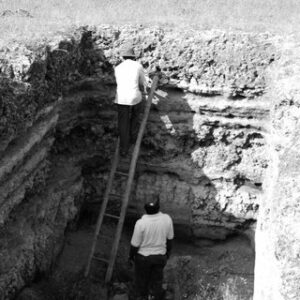
Ashmound at Palavoy. Image courtesy Researchgate.net
Early theories around Ashmounds
Archaeologists conducted scientific analyses of the mounds, till 1843, there were several theories already prevalent regarding the ash: as a fossil substance, as an ancient kankar more or less calcined and semi-vitrified, and as a volcanic or limestone slag. (Allchin, 1962). In 1843, Thomas John Newbold made his observations and found in the excavation at Kupgal mounds, rude pottery, bones and spheroid rubbing-stone of green diorite which confirmed that the mounds were man-made, thereby challenging earlier theories of natural ash deposition. In this way, the discovery significantly changed our understanding of the mounds.
In 1872, when Robert Bruce Foote visited Budikanama, he supported Newbold’s suggestions and after studying different mounds he proposed that the mounds suggest close connections with the Neolithic settlements. Regarding the nature of ash and its deposits, he argued that it was burnt cow- dung which developed due to what he called the Zariba process. This theory was proven by the chemical analyses of the remains however, the mystery of Ashmounds continued and the biggest question was about their origin and periodization.
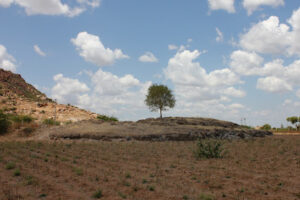
Ashmound at Kappagallu. Image courtesy, Karnatakatravel.blogspot
Later theories regarding the Ashmounds
Later, Frank Raymond Allchin gave Cattle-Pen Hypothesis. Allchin conducted extensive studies, including an excavation at Utnur, and concluded that the mounds were intentionally burnt cattle-pens of the Neolithic people, likely as part of an annual fertility ceremony. He later modified this to suggest they might also have been centers for domesticating wild cattle. Allchin’s work is crucial as it was the first attempt to scientifically document the stratigraphy of the mounds which gave us an entire life-cycle of the mound. He found the cattle-hoof impressions in Utnur, which supported his hypothesis of cattle rearing in these regions and its association with the neolithic culture, which was cattle-centered and not agrarian in the Deccan. He also observed that fires occurred repeatedly in the same localities which suggests that they were intentional or else the locals would have developed a mechanism to deal with the accidental fire.
Rami Reddy made some interesting points based on his study of the Ashmounds of Palavoy in Anantapur district of Andhra Pradesh in 1966. At the base he found the Mesolithic cultural assemblage of blades and flakes of chert, this was followed by a sterile layer and then came the Neolithic remains of tools and pottery. Interestingly, this is followed by some indication of neolithic and iron age where an iron nail, ring and ore is found thus he concluded that ash layers which are dome- shaped structures served as ovens for iron ore smelting and the mounds thus belong to the iron age. In 1973, K Paddaya studied Shorapur Doab and other districts like Raichur and Bellary and highlighted three recurrent features that were previously overlooked, which includes the location of the site as these sites are consistently located near reliable water sources, such as perennial pools in streams. They are surrounded by open areas and these open areas contain Neolithic habitation debris, including pottery, stone tools (blade tools, querns, rubberstones), and animal bones. These features led him to conclude that they were ‘Neolithic habitation sites containing ash formations’ and some of them were permanent in origin.
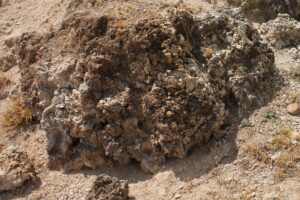
Ashmound at Kappagallu. Image courtesy, Karnatakatravel.blogspot
Challenging Allchin’s cattle pen theory, Paddaya argues that the height and step-like structure of many mounds would make them impractical for penning animals. He proposed some new interpretations and suggested that the ashmound sites were regular, often permanent, pastoral settlements. Neolithic communities lived there with their cattle herds and the cattle dung was cleared from the living and penning areas. The dung was piled at a common spot within or near the settlement to maintain hygiene; due to the limited need for manure in a predominantly pastoral economy, the accumulated dung was periodically burned. He also suggested that this burning was intentional, serving both practical purposes and ceremonial functions related to a fertility cult, as Allchin suggested. (Paddaya, 1973) Moreover, some of the larger ashmound sites may have functioned as periodic congregation centers, similar to modern cattle fairs which would have facilitated the exchange of goods, information, and livestock, contributing to the cultural uniformity of Southern Neolithic culture.
Recent Symbolic Interpretations: Boivin and Beyond
Later, in 2004, Nicole Boivin advocated a return to Allchin’s perspective and emphasised on looking at the mounds from symbolic, ritual and cosmological framework rather than the just economic and functional framework. She based her study on Kudatini and Toranagallu, and argued that looking at the east- west axiality tied to solar movements provides fresh insights on the ritualistic importance of the mounds as twice a year, the sun sets directly behind Toranagallu when viewed from Kudatini (late April and late August/September). She also proposed a continuity of this ritual burning in later Iron Age customs and Hindu rituals. Thus she points out that neolithic stands for fire, transformation and alteration of landscape.
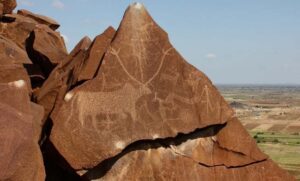
Animal motifs from Neolithic site at Bellary, Karnataka. Image courtesy, The Federal.
In her later work Boivin tried to understand the Ashmounds in a larger context of the nature of the Southern Neolithic. She argued that Ashmounds were not only created at the beginning of the Neolithic, which has been proposed by earlier studies, rather they were created throughout the Neolithic period and later continued. In Sannarachamma, Hiregudda, Watgal, Kurugodu and Velpumudugu the practices which began ashmound creation waned with time, however the settlement continued and later became more sedentary. However, in sites like Budihal the practices continued and the mounds remained exposed which later attracted archaeologists. The domestication of cattle is also suggested by rock art images from the Southern Neolithic sites, most of them depict Zebu which also held certain ritualistic symbolic importance. Cattle also dominate the assemblages of terracotta figurines found at Southern Neolithic sites, most of which depict animals of one sort or another. (Boivin et al 2006) She emphasised upon Allchin’s theory of use of ash (vibhuti) as a ritualistic symbol in many parts of the subcontinent even today. Thus, this research suggested that Ashmounds were sites of communal ritual, consumption and exchange. This is evident from the site of Budihal where re-analysis of the site stratigraphy and radiocarbon dates suggests that the ashmound at the site largely predates the Neolithic settlement and K. Paddaya’s finding of the butchering floor in the region also indicates that the ritual associated with butchering also led to the development of Ashmounds.
This is how the hypotheses around the Ashmounds developed over time. The mounds which were earlier considered mythical remains have opened new avenues of research around the South Indian Neolithic cultures. In recent times, new scientific dating methods have helped researchers significantly in reconstructing the unknown past of the Ashmounds. However, several questions about their significance and functions remained unanswered which is a field of further research and analysis.
References:
- Dales, G. F., & Allchin, F. R. (1964). Neolithic Cattle-Keepers of South India: A study of the Deccan ashmounds. Journal of the American Oriental Society, 84(1), 93. https://doi.org/10.2307/597078
2. Paddayya, K. (1991). THE ASHMOUNDS OF SOUTH INDIA : FRESH EVIDENCE AND POSSIBLE IMPLICATIONS. Bulletin of the Deccan College Research Institute, 51/52, 573–626. http://www.jstor.org/stable/42930442
3. Boivin N. Landscape and Cosmology in the South Indian Neolithic: New Perspectives on the Deccan Ashmounds. Cambridge Archaeological Journal. 2004;14(2):235-257. doi:10.1017/S0959774304000150
4. Boivin, N., Fuller, D., Korisettar, R., & Petraglia, M. (2007). First farmers in South India: the role of internal processes and external influences in the emergence and transformation of south India’s earliest settled societies. American Laundry Digest, 52(9), 29–30. http://www.homepages.ucl.ac.uk/%7Etcrndfu/web_project/docs/Boivin,%20Fuller%20Kori&%20P.pdf