
By Anukriti Upreti
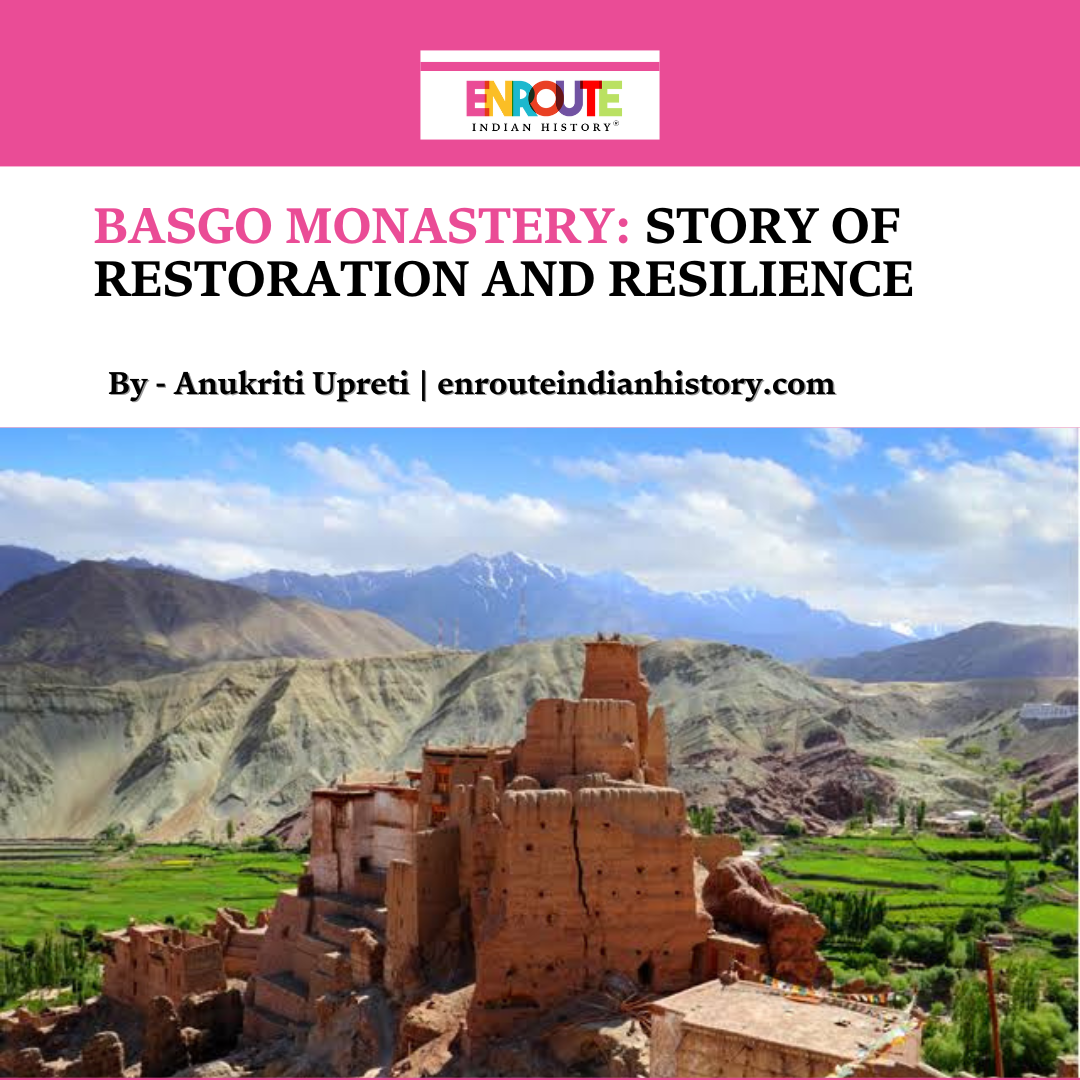
Basgo Gompa, or Basgo Monastery, is a great specimen of archaeological restoration programs conducted by locals. It is a Buddhist monastery in Basgo village in the Leh district of Ladakh, approximately 35–40 km west of Leh town, located right of the Leh-Kargil-Srinagar highway. Historically, the region has served as a trading junction for ancient trading routes, such as the silk route and Kashmir. The valley of Basgo is surrounded by many cliffs and mountains, including the holy hill of Ngang Pa. Within a radius of two kilometres, one encounters the remains of an ancient fort, three temples with beautiful paintings, ruins of a royal palace, animal stables, residence of ministers and nobility, and a large number of chortens (stupa) of varied shapes, size and antiquity (sahapedia, 2016). However, once the capital of Ladakh, Basgo, saw a decline when the capital was shifted to Leh in the 16th and 17th centuries. Furthermore, the Dogra rule led to plunder and destruction in the 19th century. The temples fell into ruins and the idols remained scattered.
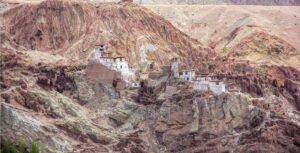
Basgo Monastery standing on the fragile hills of Leh. Image Courtesy: discoverlehladakh.in
Composition of the site
The site has various secular and religious structures. The religious structures include Stupas called chortens, a group of stupas belonging to the 13th to the 14th century, occupying a small outcrop close to the approach road leading to the fort complex (Sahapedia,2016) There is also a stepped Stupa at the east end of the village, which is said to have been constructed by Rinchen Zangpo, a translator of Buddhist text into Tibetan, during the spread of Buddhism. There are plug holes and remnants of clay relief roundels that served as halos for sculptures. (Sahapedia, 2016) According to a study conducted by Christian Luczantis, these plug holes suggest the presence of a Vajradhatumandala or diamond realm
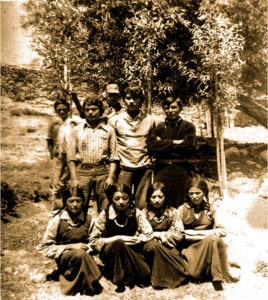
Members of Youth Dramatic Club. Image courtesy: Sahapedia
The most spectacular structures of the region include the three Maityrey temples including Chamba Lhakhang, Chamba Serzang and Cham Chung temple. Chamba Lhakhang, is the largest among the three, it is situated in the highest point of the citadel and houses a massive idol of Maitreya Budha. The structure changed over time, and the eastern chambers collapsed in the 1970s and were then restored in the 1980s by the Basgo Welfare Committee. The second temple is Chamba Serznag, situated slightly lower in proximity to the royal palace. Its guarded pathways and narrow passage connecting to the palace suggest that it was restricted to the royal family. The golden Buddha statue is iconic in the temple which is also mentioned in the Ladakhi chronicles. The third temple is Cham Chung, whose structure resembles that of Balti or a Central Asian mosque with a conical roof above the central square structure. There is a statue of the Buddha seated crossed legged facing northward. The paintings and statues of Buddha found in these temples tell us about the cultural interactions and rising influence of the Central Tibetan monastic orders in Ladakh in the fifteenth century.
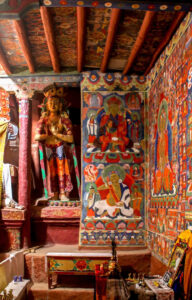
Attendant Avalokitesvara of Chamba Lhakhang, with Guru Padmasambhava and Mila ras pa on the adjoining section of the wall. (Image Courtesy: Sanjay Dhar, Sahapedia), Notice the use of gold paint and gold leaf to make the paintings attractive.
Restoration of the Monastery
In the early 1970s, the structures came under threat as the hill on which their foundations rested began to erode. In 1975, when Ladakh was opened to foreigners, a group of youngsters formed the Youth Dramatic Club and started performing plays based on the tales of Jataka. Through these plays, they not only spread traditional Ladakhi practices, but also collected funds for the restoration of the temples of Basgo. They also went ahead and focused on education, healthcare, and agricultural development of the region. The activities of the Youth Dramatic Club inspired youngsters to establish the Basgo Welfare Committee with the objective of preserving the art, culture, and tradition of the region.
Dr. Lobsang Jamspal, a scholar of Tibetan languages and Buddhist philosophy, and a highly respected person from the village provided guidance for restoration. Under his guidance, the first restoration of a chorten (stupa) and mane (prayer hall) took place at Basgo. He also helped with various fundraising programs. In his article on the images of Maitreya Bhuddha he writes, “The magnificent ruins of the ancient royal castles of Ladakh stand on the eastern cliffs, in the central portion of the valley. Among these ruins one finds three temples to the bodhisattva Maitreya, the future Buddha. In these temples there are many priceless images, beautiful murals, and sacred manuscripts of the Kanjur and Tanjur produced by highly skilled artisans and craftsmen and consecrated by holy persons many centuries ago.” ( Jamspal, n.d. )
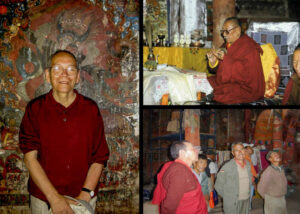
DR.Jamspal with other members Image Courtesy: Sahapedia
The group faced many challenges in the restoration process, including rough and eroded topography. The hill on which all these structures rest is very fragile and the path that connects the area to the local villages is buried under the debris, making transportation difficult, and the constant problem of water seepage has destroyed many places of the site, including cham chung. Moreover, the group constantly faced a lack of funds for carrying out such a massive restoration program. To solve this problem, applications to the World Monument Fund list of the most endangered heritage sites were filed, which initially failed to meet the criterion. “[But later] in 2002, The Namgyal Institute for Research in Ladakhi Art and Culture (NIRLAC) partnered with BWC, with assistance from INTACH for preparing a professional, technical project report to help with the nomination to the WMF list, and also for additional fund raising.” (Sahapedia, 2016). As a result, the monastery was registered twice on the list, which helped to gain more funds for the restoration process.
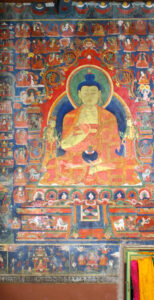
Restored Wall Painting from Chamba Lakhang, Image Courtesy: Sahapedia.
Restoring the wall paintings and murals was again a challenging task. As a few parts of the painted plastered wall remained while the whole painting was destroyed owing to water seepage, the painting was first consolidated, and then the gaps were filled accordingly. This task was delicate and painstaking as Sanjay Dhar, one of the art conservationists who has worked in the conservation process writes, “All these areas were vulnerable to vibrations and activity during the building conservation. Therefore, emergency treatment of the paintings was carried out to ensure that during structural restoration no further damage occurred”.
Another small grant from UNESCO helped with the conservation of cham-chung wall paintings. The project was completed in 2005 and has gained national and international importance over time. An interesting aspect of the entire restoration story is the involvement of the local population in the process. This emphasizes the cultural and emotional connection with the landscape, which is important for restoration. Thus, shaping various restoration projects of the future.
References:
1. Sahapedia. (2016). Basgo: The Conservation Story | Sahapedia. [online] Available at: https://www.sahapedia.org/basgo-the-conservation-story [Accessed 28 Oct. 2025].
2. Basgo Gompa (Maitreya Temples). (2025). Basgo Gompa (Maitreya Temples). [online] Available at: https://www.wmf.org/projects/basgo-gompa-maitreya-temples [Accessed 28 Oct. 2025].
3. Jamspal L. The Five Royal Patrons and Three Maitreya Images In Basgo.
4. Sahapedia. (2016). Basgo: The Remains of a Royal Precinct | Sahapedia. [online] Available at: https://www.sahapedia.org/basgo-the-remains-of-royal-precinct.
5. Discover Leh Ladakh. (2020). Basgo Monastery – Discover Leh Ladakh. [online] Available at: https://discoverlehladakh.in/basgo-monastery.htm?srsltid=AfmBOoqvMWbanNgjC7qxeA5sNa5NYjPK97mA43kk_SJFFFMQciXM9h0h [Accessed 28 Oct. 2025].