
By Anukriti Upreti
Bastar Dussehara is a 75 days long festival celebrated in the Ashwin month of the Hindu calendar (September–October). This festival does not celebrate the killing of Ravana; rather, it is celebrated to worship the local goddess Danteshwari. The festival is interesting not only because of its long duration but also because it brings together various tribal and pan-Hindu traditions. The festival was started by Kakatiya ruler Maharaja Purushottam Dev in the 15th century (1408 C.E.). It is believed that the King went on a pilgrimage to Puri with gold and gifts, and Lord Jagannath was pleased and titled him rath pati or head of Rath and asked the priest to give him the sacred Chariot used in the rath yatra of Puri. The legend says that the Rath was magnificent, having 16 wheels, and the king found it difficult to carry it; thus, it was broken into parts, and the king reached his capital, Bade Dongar. Since then, the festival has been celebrated as Dussehara. Until the 17th century, the festival was celebrated in Bade Dongar. During Maharaja Dalpat Deo’s reign (1721-1775) Bastar’s capital was shifted to Jagdalpur, then called Jagtuguda, and the center for celebration also got shifted.
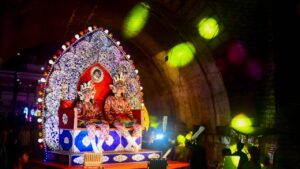
Bastar Dussehra, Jagdalpur, Chhattisgarh. Image courtesy Hindustan times.
Festival rituals and arrangements
As previously mentioned, this festival holds a prominent position among the people of Bastar. In earlier times, it was a way of accumulating resources, engaging with people, and showing gratitude towards the local deity. During the Kaktiya rule the heads of Pargana manjhis used to gather resources for the worship ‘The Manjhis would collect rice, varieties of pulses, salt, turmeric, oil, animals for sacrifice etc. calling it ‘dussehra bokda mangni chaur’’ (Kriti, n.d.)
The festival begins with the Paat Jatra ritual on the Hareli Amavasya. In this ritual, forests and woods are worshipped. The chariot is made only of Sal and Tinsa wood, the wheels are made of Tinsa, while the body is made of Sal wood. A piece of wood called Thurrule Kotla is worshipped, and sacrifices are made. Traditionally, wood is brought from the Bilori forests, and the Mogri fish is sacrificed. ‘During the ritual on August 11, 2018, five Mangur fish, one egg, and one goat were sacrificed. The ritual ends when the making of the chariot starts and a nail is hammered into the wood’ (Kriti, n.d.) This is followed by the Deri Gadhai ritual. It marks the beginning of an auspicious journey; the people of Biringpal village bring two Sal logs, approximately ten feet in height, to the Sirhsar Bhawan near the Raj Mahal. These logs are then worshiped and smeared with haldi, kumkum, and chandan paste, and a white cloth is tied to the logs.
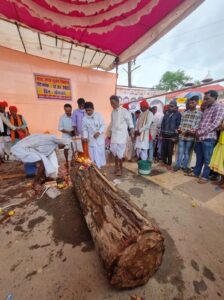
Paat Jatra Ritual, Image courtesy bastardussehra.com
Another ritual associated with the festival is the Kachingadi. In this ritual, we find a perfect combination of state religion (Hinduism) and the local practices of tribals. The local goddess of the Mahar (Harijan) community is worshipped and asked for her approval for the festival. It is believed that a girl child from the Mirgan community is possessed by the goddess, and once the goddess arrives in her body, she is laid down on a hammock of bell thorns and asked for her permission to start the Dussehara. An interesting ritual which started just a few decades ago, in 1914 by a devotee is Jogi baithai. In this ritual, a pit is established at the center of the Sirhsar Bhawan, and the Jogi sits here for penance on the very first day of the Navratra. ‘During these nine days neither does the jogi eat or drink nor does he urinate or defecate’ ( Kriti, n.d.).
During the second and 7th day of Navratra, the old chariot with four wheels, called the flower chariot, is taken around the city. On the tenth day, the new chariot with twelve wheels begins its journey. At midnight of Ashtami, offerings are made to the goddess. The Nisha Jatra starts and ends at the Nisha Jatra temple in Itwari Bajar. ‘The goddess is offered eleven male goats, Mangur fish, and varieties of pumpkin to make her happy. Two male goats are sacrificed at the Mavli temple, two at the Singh Dwar in Rajmahal, and one at the temple of Goddess Kali. (Kriti, n.d.)
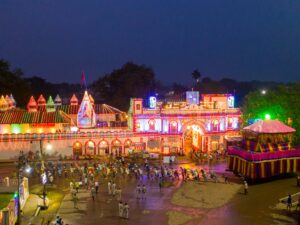
Maa Danteshwari temple. Image courtesy bastardussehra.com
There are other rituals which are celebrated in the course of the festival like, bhitar raini and bahar raini ritual, Mavli Parghav and Muriya Darbar which makes the festival interesting for someone interested in the history of religion and state. These rituals suggest how the Kakatiyas assimilated local traditions into their religious practices to establish their rule politically, socially, and culturally among the tribal people of Bastar. The Muriya Darbar is particularly interesting; the first one was held on March 8, 1876, in which the authorities were honored for organizing the Dussehara. In this ritual, the manjhis interact with the king and tell him about the issues of the villages, and the king also shares new agendas and laws with them. This tradition shows how the realm of devotion, religion, and rituals was never far from politics and administration.
The festival which integrates religion and politics
An interesting thing about the Danteshwari goddess and this festival is that the goddess is not a native goddess but is still revered by all the people living in the region with such enthusiasm. The goddess Danteshwari was worshipped by the Kakatiyas. One legend says that when Ahmed Shah attacked Warangal, the goddess came to Kakatiya ruler Aman Deo and asked him to go to Bastar. She told him that she would accompany him, but he should not look back. The king continued walking until he heard the sound of her anklets. At the riverbed, the sound stopped, and the King looked back. The Goddess asked him to stop and converted herself into a stone idol. Another story connects the goddess with Shaktism and says that the tooth (dant) of sati fell here, making it one of the shakti peethas.
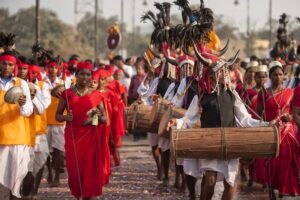
Bastar Dussehra celebrations. Image courtesy bastardussehra.com
As the goddess held such great importance for the Kakatiyas and the subjects they were ruling, mainly constituted of tribes believing in animism, it was a challenge for the rulers to establish a link with the people. Thus, the local gods and goddesses of the tribes were mixed with Kakatiya traditions, and Bastar Dussehara served this purpose as D. N. Majumdar termed it as an example of cultural symbiosis. The ritual of salt distribution before pata jatra highlights such an attempt, as the king is considered the palak protector of the people; he used to touch the salt, which was then distributed in the villages through manjhis. The idea behind this is that salt symbolizes loyalty, and someone who eats the King’s salt thus becomes his loyal subject. The division of labour we see in the organisation of Dussehara also suggests how labour was organised by the king as Saoras made the chariot, Lohars made iron nails and bars required for the chariot, Chakras supervised the work, Khatis supervised the pooja, Gadbas were the bearers of Raja’s palanquin, Jogi comes from Halba community and many other works were well distributed among different groups of people and different villages.
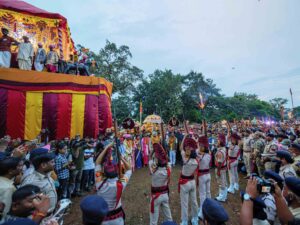
Image courtesy Image courtesy bastardussehra.com
Many things have changed after independence with the development of a new political structure and governance. Today, MLAs and officials take part in many of these rituals, and Bastar Dussehra has become a major tourism industry for the state government. Many rituals have changed, but many are still followed with the same rigor as before. However, this begs the question: can we really argue that there is a single festival called Bastar Dussehara? I think we cannot because of the numerous rituals followed during these 75 days, the gods revered, and the community that participates, including the person carrying a years-old lineage of kingship to modern-day MLAs, have multiple stories and multiple temporalities; thus, this festival can be termed a mosaic of histories, cultures, and spaces!
References:
1. Roy, Rajesh and Vijay (2019). Bastar Dussehra: A Unique Cultural Heritage.
2. Bastar Dussehra. (2025). Bastar Dussehra: A Unique Cultural Celebration in Jagdalpur. [online] Available at: https://bastardussehra.com/ [Accessed 29 Sep. 2025].
3. Sahapedia. (2018). Bastaria Dussehra: A Coming Together of Deities |Sahapedia. [online] Available at: https://www.sahapedia.org/bastaria-dussehra-coming-together-of-deities.
4. utsav.gov.in. (n.d.). Bastar Dussehra – Jagdalpur , Chhattisgarh. [online] Available at: https://utsav.gov.in/view-event/bastar-dussehra-jagdalpur-chhattisgarh-1