
By Prishnika Mazumdar
The beats of Bihu dance are known to people across the country. The dhol, a type of drum and the pepa, which is a buffalo-horn pipe, can make the shiest among us sway to its beat. The Sattriya Nritya that emerged in the 15th-century Vaishnavite monasteries finds a place among the eight classical dance forms of India. Assam is among the largest producers of Muga silk in the world. For Muga silk, the state also received the Geographical Indication (GI) tag in 2007 (Assam Government, n.d.). Besides these relatively popular traditions, there are many more that constitute the rich cultural heritage of Assam. Assamese culture is an amalgamation of diverse traditions, rituals, practices and religions that evolved through a long assimilative process. Important contributors to such diversity are the cultural practices and folk traditions of the many tribes that inhabit Assam. Among the tribes, the most numerous are the Bodo people, whose culture is strongly influenced by their religion; Bathouism.
The Bodo People
The 2011 census noted that Hinduism is practised by the majority of people in Assam. It constitutes about 61.47% of the population. Other religions practised in the state include Islam, Christianity, Buddhism, Jainism, etcetera. Bathouism is one of those religions that is often lost in this ‘etcetera.’ Bathouism is considered to be the original religious belief of the Bodo people (Sarmah, 2019). Although there are Bodos who practice other religions.
The Bodos are a tribe of the plains. They speak the Bodo language of the Sino-Tibetan speech family and form a section of the Tibeto-Burman people who are predominant in the Northeastern region of India (Basumatary, 2021). Bodo, as a term, was used for the first time in 1846 by B.H. Hodgson, with ethnological connotations to refer to the Meches, the Bodo-speaking people of Darjeeling. Over the years, it has become an umbrella expression to refer to the different branches of the Bodo language group. They speak similar dialects with local peculiarities across different regions where they are found (Basumatary, 2021).
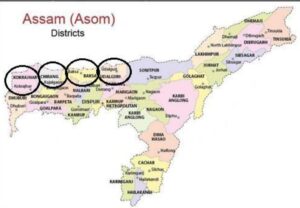
Most Bodo people are found in Assam, but they are scattered across Tripura, Meghalaya, West Bengal and other regions. They are primarily found in the Brahmaputra Valley of Assam, with significant concentrations in the districts that comprise the Bodo Territorial Region (BTC), which includes Kokrajhar, Baksa, Udalguri, and Chirang districts (Basumatary, 2021).
Various social, spiritual, cultural, and historical influences have shaped the practices of the Bodos. An impact of these influences is observed particularly in the formation of varied branches within Bathouism. As a result, we have Bibar Bathou, Bwli Bathou, Moni Bathou, Aroj Bathou, Sonathon Bathou and others. Despite such variations, some core principles have remained intact. Their society is mostly led by men. The man is usually the head of the family and owns property. Bodo people live in a close and organised community. They work together, help each other, and celebrate together, like fishing, farming, and festivals (Roy, 2024).
Bathouism: Deities and Their Symbolism
Moidera gabo odal gudiyao mancia gabo bathou gudiyao
An old Bodo saying roughly meaning, “the elephant cries under the Odal tree. The Bodos pray at the altar of Bathou” (Choudhury et al., 2023).
This proverb brings out the connection of the Bodo people with nature. For the many differences that exist between humans and animals, some similarities have persisted. Just as the elephant, generally considered a symbol of strength, bows before the Odal tree, humans, too, worship elements of nature. The Bodos are worshippers of nature. There are animistic elements in Bathouism. They worship the five elements of nature, which are Ha or earth, Doi or water, Bar or air, Or, that is fire and Nokhrang, that is ether. Bathou Burai is the custodian of these five elements. Bathou Burai is also the supreme deity worshipped by the Bodos. For them, their supreme deity is omnipotent, omniscient, omnipresent and almighty.
Bodos worship the sijou plant, scientifically known as Euphorbia Splendens. In the language of the Bodos, Si means the soul, and Jou means the supreme. Therefore, the plant is worshipped as a symbol of Bathou Burai. The Sijou plant is a type of cactus, which makes it resilient. For this reason, it is considered to be a symbol of the immortality of the supreme soul. The plant, in the form that it is worshipped, has five ridges and five depressions, representative of the five elements that we have spoken about (Sarmah, 2019).
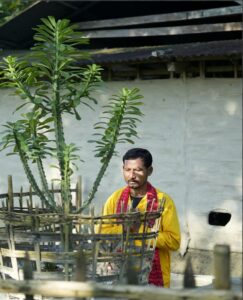
The number five seems to hold great symbolic importance. The Bodos also use a fruit called ou-tenga, scientifically called Dillenia Indica, which generally has five ridges. The Bodos play the siphung during their prayers, which is a long bamboo flute with five holes. The altar on which deities are worshipped also has five knots of bamboo strips (Roy, 2024). It is on this elevated altar where Sijou is planted. The altar is then surrounded with a bamboo fencing of eighteen pairs of posts. These eighteen pairs represent the eighteen lesser gods in the religion. Other than their supreme god, the Bodos also worship gods and goddesses such as Bura Ailong, Bura Khaiji, Khoila, Rajputhur, Raj Khandra, Agrang, Ali Bura, Manasao, Jaman, Bagh Raja, Bas Muti, Aidibaoli, Chaudri and others. Mainao, who is their chief goddess, is worshipped for the protection of crops and prosperity. She is also the companion of Bathou Burai (Sarmah, 2019). This informs us that the beliefs of Bathouism are polytheistic, they are nature worshippers, but they do not practice idolatry.
The Evolution of Bathou Beliefs
Bai Rambo gailiya, Ajodhyao gailiyya
A Bathou proverb meaning, “Lord Rama and Ayodhya, where he ruled, are gone” (Choudhury et al., 2023). This one talks about the impermanence of life. The most permanent of structures collapse, the most revered are forgotten and how life still keeps going. Just as much as this proverb informs us about the wisdom of the Bodos, it also tells us about the close contact that they had with other religions, such as Hinduism, in the case of this proverb. Such interactions came with implications over time.
The 19th and 20th centuries marked a turning point for Bathouism. The introduction of and interaction with other religions disrupted the coherence of traditional Bodo religious life. Christianity, for example, entered through missionary efforts that offered religious conversion and introduced education and healthcare. This attracted many Bodos disillusioned by the backwardness of traditional rituals like animal sacrifice and jou or rice beer consumption (Bargayary & Narzary, 2022). The conversion of Bodos was accelerated by the social stigma placed on their customs by upper-caste Hindus. This led to marginalisation and acted as a psychological push towards more organised religions.
Brahma Dharma, introduced by Gurudev Kalicharan Brahma in the early 20th century, was especially influential among the Bodos. It provided a structured monotheistic system and a moral code that appealed to a section of the Bodos who sought spiritual reform and social upliftment without entirely giving up on their ethnic identity (Bargayary & Narzary, 2022). Kalicharan’s movement was particularly effective in introducing scriptural knowledge and purifying rituals, such as the Hum Yajna, which brought thousands together under a shared religious cause. Over time, Brahma Dharma became a major competing force to Bathouism and inspired further fragmentation of religious identity within Bodo society.
In response to these transformations and threats to tradition, the latter half of the 20th century saw a resurgence of interest in reviving Bathouism. A crucial development was the founding of organised bodies like the Sadou Asom Bathou Mahasangha in 1958 and the Dularai Bathou Mahasabha in 1992, which sought to institutionalise Bathou practices, remove elements considered crude (such as animal sacrifice). The intention was to align the religion with modern sensibilities (Bargayary & Narzary, 2022). These organisations introduced written scriptures, hymn books like Gwthar Mwikhun in 1990, and even constructed temples called Thansali, akin to churches or mosques, to give Bathouism a formal space (Barmahalia, 2012).
Modern reforms within Bathouism have also seen the replacement of traditional religious specialists such as Douri and Doudini with trained priests and organised prayer groups. New rituals involving offerings of flowers, fruits, and prasads have replaced the earlier practice of sacrifices. This informs us of adaptations under the influence of Hinduism and modern religious aesthetics (Barmahalia, 2012).
In tracing the evolution of Bathouism, we find a religion that has a rich tradition and one that has evolved within the changing cultural and spiritual situations of Assam. Rooted in the worship of nature and ancestral spirits, Bathouism has served as a system of beliefs and as an expression of the Bodo people’s relationship with nature. Yet, as encounters with dominant religions and modern sensibilities intensified, Bathouism made some amendments, gaining institutional coherence and recognition. Whether Bathouism remains a folk religion, evolves into an institutionalised faith, or becomes something else altogether, it will continue to reflect the evolving identity of the Bodo people.
References
1. Assam Government (n.d.) About us. Government of Assam. Available at: https://assam.gov.in/about-us/391 (Accessed: 24 July 2025).
2. Barmahalia, F. (2012) ‘Revivalism of Bathouism among the Bodos’, IOSR Journal of Humanities and Social Science, 1(5), pp. 42–45.
3. Bargayary, N. and Narzary, B.C. (2022) ‘Evolution of Bathouism’, Journal of Education: Rabindra Bharati University, 23(1), pp. 381–389.
4. Basumatary, B.K. (2021) ‘Origin of Bodo – A Historical Overview’, Journal of Emerging Technologies and Innovative Research (JETIR), 8(2), February. Available at: https://www.jetir.org/view?paper=JETIR2102177 (Accessed: 26 July 2025).
5. Choudhury, S., et al. (2023) ‘Understanding Bodo society through Batra Bhao (Proverb) from North East India’, Academia.edu. Available at: https://www.academia.edu/117118091/Understanding_BODO_society_through_BATRA_BHAO_Proverb_from_North_East_India (Accessed: 25 July 2025).
6. Roy, P. (2024) ‘Influence of Bathouism in the Development of Social Values’, Educational Administration: Theory and Practice, 30(5), pp. 11556–11560. ISSN: 2148-2403. doi:10.53555/kuey.v30i5.4968.
7. Sarmah, S.K. (2019) ‘Religion and its Reflection on the Culture of the Bodos of Assam’, Asian Resonance, 8(4), pp. 68–72. e-ISSN: 2349-9443. Available at: https://www.socialresearchfoundation.com (Accessed: 26 July 2025).
Image Sources
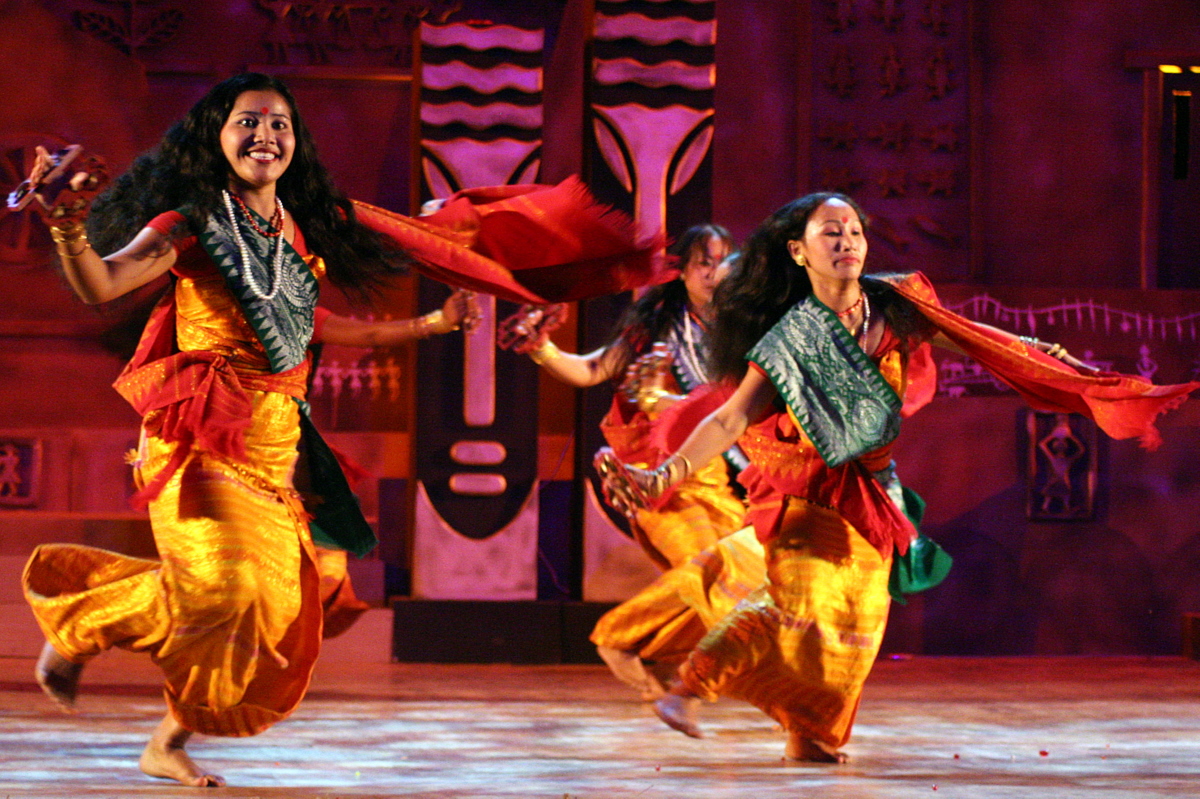
1. Bodo women dance in their traditional attire. (2011) Wikimedia Commons. Available at: https://upload.wikimedia.org/wikipedia/commons/3/3e/Bodo_Girls_performing_Bardoi_Sikhla_Dance.jpg (Accessed: 26 July 2025).
2. Circled areas showing the districts of highest concentration of Bodo people. (2017) Chapter 2: Demography and Settlement Pattern, Tezpur University Repository. Available at: http://agnee.tezu.ernet.in:8082/jspui/bitstream/1994/1442/9/09_chapter%202.pdf (Accessed: 26 July 2025).
3. The Sijou plant encircled by bamboo fencing. Vyas, S. (2024) Divine Rhythm of Bodoland in Assam, Outlook Traveller, 26 March. Available at: https://www.outlooktraveller.com/experiences/heritage/rhythm-divine (Accessed: 26 July 2025).