
P. Sanjay
The trees that preserve the story of a million years, from the day it sprouted to the day it turned to a stone. The National Fossil Wood Park at Tiruvakkarai, located in Tamil Nadu’s Villupuram District, is a geological marvel that offers a window into Earth’s prehistoric period.
The petrified tree trunks, which dates back to 20 million years, lie scattered in the whole region, preserved as silent witnesses to the prehistoric world. The remains stand important in understanding the flora of the region and also useful in determining climate change. The fossils present here belong to the Mio-Pliocene age, taking us to that era.
It is located approximately 35 kilometers to the west of Puducherry and just 1 kilometer to the east of Thiruvakkarai village, the park can be reached by road from Tindivanam. It covers an area of 247 acres, the park features over 200 fossilized tree trunks which can be divided into nine separate enclosures, although only a part of the area is accessible to visitors. The discovery of these fossilized woods was first recorded by naturalist M. Sonneret in 1781, establishing Thiruvakkarai as one of the earliest known fossil locations in India.
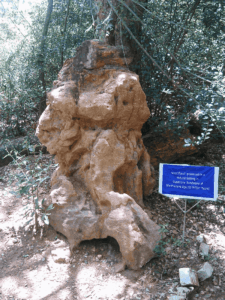
A wood fossil preserved in Cuddalore lime stone , Source(Wikimedia Commons)
The fossilized woods located in Tiruvakkarai are found within the Cuddalore Sandstone Formation, which is a Tertiary (Mio-Pliocene) sedimentary layer along the eastern coast of South India. So it can be said that the sandstone formation first took place and then the fossils were formed. The ancient river system that once travelled across these areas led to the creation of these rocks. It is thought that around 20 million years ago, a huge flood brought all the woods from the old forest area. It was buried by sediments, as these trunks experienced petrification, transforming from organic material into stone as their cellular structures were substituted with silica. This led to the eventual formation of wood fossils that we witness in this region.
Petrification is a rare and complex process. For the Tiruvakkarai fossils, the process of silicification takes place which involves the gradual replacement of wood tissues by minerals, mainly silica, as groundwater percolates through the sediment layers. The preservation process allows one to distinguish features such as annual rings and, in some cases, finer cellular structures, making scientific study both possible and fruitful.
The evidence of the wood being carried away in flood is supported by how fossil trunks lack roots, bark, and branches, supporting the theory that these trees did not grow at the site but were transported before fossilization. The range of preservation of the fossils helps Paleobotanists to work upon the important aspects of it, studying the characteristics of the flora, ecology and climate before million years.
Gymnosperms and Angiosperms both are found at Thiruvakkara suggesting the diversity of flora. The ecology must have been through drastic changes but some trunks have been provisionally linked to modern plant families such as even species resembling the present-day tamarind. The size of the trunks, some over 3 to 15 meters long and up to 5 meters in girth attests to the stature of the ancient forests that once flourished in South India. Research into these fossils offers critical information about regional paleogeography, climate evolution, and the processes responsible for fossilization. The park’s open-air “museum” format allows for direct observation and ongoing scientific study, not just by professionals but also by students and enthusiasts.
The Fossil park has been recognized as a National Geo-heritage Monument, the park has been under the stewardship of the Geological Survey of India since 1957. Several enclosures and protective measures have been implemented to shield the fossils from natural erosion, vandalism, and encroaching development. However, pressures from nearby quarrying, environmental changes, and unregulated tourism remain a threat, underscoring the need for vigilant management. Efforts to promote public awareness and scientific engagement are ongoing, with educational signage, guided tours, and community outreach forming part of the park’s mission.
Tiruvakkarai is not just a geological site, it is also embedded in local culture and belief. The nearby Chandramouliswarar temple and village shrines are objects of pilgrimage, with local legends sometimes attributing the fossilized trunks to the remains of asuras (demons), “slain” by goddess Kali. Such stories, while mythological, add a valuable sociocultural layer, illuminating how people interpret and relate to Earth’s deep history. It’s also about how society sees objects that seem to be a mystery without the proper knowledge and associate them with divinity.
Visitors to the park experience a walk into deep time, observing tree trunks that look remarkably like freshly fallen wood but are, in reality, solid stone. The visitor area, though a fraction of the total park, features open-air exhibits, interpretive posters, and the chance to see the annual rings and texture of fossil wood up close. The accessible setting provides a platform for education about paleobotany, geology, and the broader significance of earth science heritage. The park’s unique natural beauty also makes it a locus for eco-tourism, helping foster public appreciation for conservation and scientific discovery. Despite robust conservation steps, threats remain. Unregulated stone quarries, weathering, and human disturbance endanger the fossil record. Continued scientific study and increased funding for preservation efforts are essential, as is responsible tourism guided by environmental ethics.
The potential for new discoveries, both taxonomic and geological, remains high. Multidisciplinary research, integrating paleobotany, sedimentology, and geochemistry, will help refine our understanding of the site and broader paleoenvironments of southern India.
The National Fossil Wood Park at Tiruvakkarai is a priceless heritage site, preserving an ancient forest in stone and telling the story of Earth’s vast ages. It is not only a treasure trove for geologists and paleobotanists but also a powerful reminder to society of the importance of conservation, scientific research, and respect for natural history. As pressures mount on such heritage, it is incumbent on all as stewards, scientific, governmental, and public to ensure that this window into prehistory remains open for generations to come.
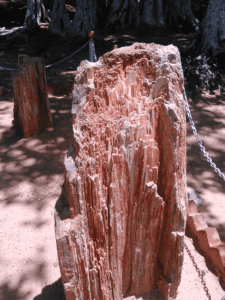
Broken part of a petrified tree, where the structure of the tree is visible. Source (Wikimedia Commons)
References
Subramanian, K. S., M. Renganathan, and B. Kanishkan. “Fossil Wood in Tertiary Cuddalore Sandstones near Tiruvakkarai, South Arcot District, Tamil Nadu.” Journal Geological Society of India 50.2 (1997): 231-234.