

By Tehreem Asad
Since time immemorial, flowers have been seen as a paradigm of beauty in nature. Across cultures and historical periods, artists have regarded them as some of the most dependable muses. This was also the case of 17th-century India, where Mughal miniature paintings were reaching their zenith. During the reign of the Emperor Jahangir, floral imagery emerged as a distinct sub-genre. Paintings from this period often featured elaborately ornamented margins, with a single flower carefully rendered to occupy an entire page. The depictions were naturalistic and highly detailed. Among the most accomplished artists of the Mughal court was Ustad Mansur, who produced numerous such paintings.
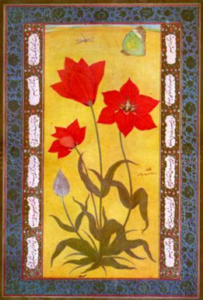
Tulip by Mansur, c. 1621
(Source: https://en.wikipedia.org/wiki/Ustad_Mansur#/media/File:Mansurtulip.jpg)
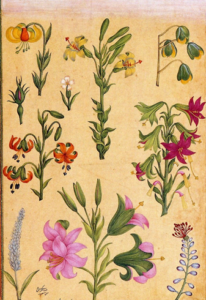
Lilies, signed Mansur, c. 1610
(Source:https://www.baghehind.com/post/adorned-like-a-meadow-flowers-in-17th-century-mughal-albums)
In the 18th century, however, the artistic representation of flowers took a new direction entirely with the expansion of the East India Company’s control in India. As more and more British officials settled in India, they encountered the distinct flora, fauna, and cultural features of the subcontinent. By and by, they sought to document their encounters with foreign scenery and to assemble visual records for personal collections. This exercise was not just motivated by fascination with the unfamiliar, but also stemmed from the fact that Company officials believed that systematic recording of the natural resources was necessary to understand the region. This would facilitate the use and exploitation of these natural resources, further aiding the political expansion of the Company.
Company Style Paintings:
It was within this context that the Company School of Art, or Kapani Kalam, emerged. While the patronage and stylistic preferences shifted, Company paintings remained connected to earlier artistic traditions through the continuity of the artists themselves. These painters had earlier associations with the Mughal court (or other regional courts) and were trained in established miniature traditions. With the decline of Mughal patronage, they turned to new employers for support. Since the requirements of Company officials were completely different from those of the Mughal rulers, there was a shift in the depiction of flowers from naturalistic artistry to scientifically accurate tools of emerging colonial control.
The Company School paintings can be described as a hybrid artistic tradition of Indian miniature techniques and Western naturalist styles. Although initially European painters were commissioned for painting Indian flora, fauna, cities, monuments, and landscapes, these painters were eventually replaced by local Indian painters. The style emerged across different administrative hubs controlled by the East India Company. In Bengal, Calcutta and Murshidabad became major centres for such commissions. Company painting found strongholds in Delhi, Lucknow, and Benares in the north, just as Madras, Tanjore, the Coromandel Coast, Pondicherry, and Malabar became arenas of artistic patronage in South India. The artists typically worked on imported European paper, creating the subjects with watercolours on a monochromatic background. In contrast to Mughal miniatures, the artists added a sense of three-dimensionality by using Western linear perspective and tonal shading.
DEPICTION OF FLORA IN COMPANY PAINTINGS
From the 18th century, Europe experienced an increase in interest in the natural world. Any new knowledge of biodiversity was fascinating and important for the development of the subject. During this time, the British officials began to initiate the creation of extensive botanical gardens in India. This period also saw a growing demand among botanists for reliable and precise visual documentation of newly introduced plants. This led to botanists hiring local artists to create botanical illustrations since they were easily available and an economical option. Two very important qualities were demanded by the European patrons, specifically in paintings of flowers and plants, viz., precision and accuracy. These botanical studies were, thus, created under the close guidance of the European patrons.
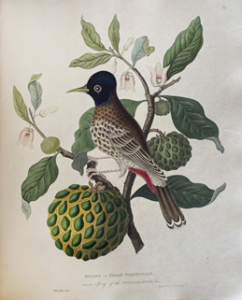
‘Bulbul on a sprig of the Custard Apple Tree’ from the book ‘Oriental Memoirs’
(Courtesy: https://sarmaya.in/spotlight/the-art-science-of-indian-botanicals/)
Several officials commissioned botanical illustrations as part of their scientific work. Among the earliest was William Roxburgh (1751 – 1815), a Scottish botanist often regarded as the ‘father of Indian botany’. During his postings in Samalkot and Calcutta Botanic Garden, he commissioned a total of 2542 botanical studies. Not much is known about the artists that Roxburgh employed for the task of creating these botanical prints. However, the process by which these prints were created included the following steps: a rough sketch of the plant was made, then a stain of colour was applied, followed by the application of darker layers of colour. Finally, intricate details were added, completing the process. Roxburgh is believed to have commissioned around 2,500 botanical paintings in total. Many of these contributed to his major publications, including ‘Plants of the Coast of Coromandel’ (1795) and ‘Flora Indica’ (1824).
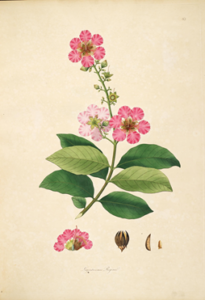
Illustration from the ‘Plants of the Coast of Coromandel’ (1795)
(Courtesy: https://commons.wikimedia.org/wiki/File:18th_century_illustration_flora_of_the_coast_of_Coromandel_Coast_India_Plants_Fruits_Flowers_%2824%29.jpg)
The works ‘Tentamen Florae Nepalensis Illustratae’ (published 1824-26) and ‘Plantae Asiaticae Rariores’ (published 1830–1832) by Nathaniel Wallich (1786 – 1854) also relied on botanical drawings prepared by Indian artists like Vishnu Prasad and Gorachaud.
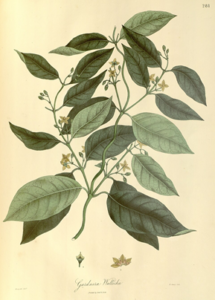
Gardneria ovata from Nathaniel Wallich’s ‘Plantae Asiaticae Rariores’, by artist Rungiah
(Courtesy:https://commons.wikimedia.org/wiki/File:Strobilanthes_walkeri_Govindoo.jpg)
Another surgeon, James Kerr (1737–1782), commissioned the creation of more than 600 paintings, meant to serve as scientific illustrations depicting plants that could be used for medical or commercial purposes.
Surgeon-botanist Robert Wight (1796-1872) contributed significantly to the documentation of flora in South India. He introduced lithographs into Indian botanical illustrations. His major publications, ‘Illustrations of Indian Botany’ and ‘Icones Plantarum Indiae Orientalis’, acknowledge the contributions of two Indian illustrators, Rungiah and Govindoo. Together, the two artists produced more than 4,000 botanical drawings, of which 1,445 were published.
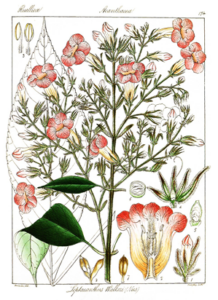
Illustration of Strobilanthes walkeri from ‘Spicilegium Neilgherrense’, by artist Govindoo
(Courtesy:https://commons.wikimedia.org/wiki/File:Strobilanthes_walkeri_Govindoo.jpg)
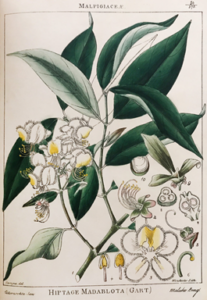
Illustration of Hiptage Madablota, attributed to artist ‘Rungia’ in the book ‘Indian Botany’ by Robert Wright
(Courtesy:https://sarmaya.in/spotlight/the-art-science-of-indian-botanicals/)
Apart from scientific documentation, these paintings were a part of the personal collections of rich Europeans and Company officials. Lady Mary Impey was one of the first English patrons in Calcutta. She was fascinated by the indigenous plants and animals present in the region and hired three Indian artists from Patna, Shaykh Zayn-al-Din, Bhawani Das, and Ram Das, to produce paintings for her personal collection. Between 1777 and 1782, the three artists produced more than 300 paintings for the Impey Album, consisting of various species of flora and fauna. Similarly, Lord Wellesley, the Governor-General of India from 1798 to 1805, commissioned the Wellesley Albums, which have over 2,660 Company paintings documenting natural history and plant specimens.
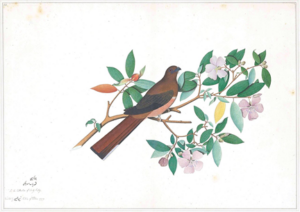
Harpactes erythrocephalus female on a Melastome, by artist Shaykh Zayn-al-Din
(Courtesy:https://commons.wikimedia.org/wiki/File:Female_Trogon_shaykh_zayn_al-din_calcutta_india_1779.jpg)
Besides these personages, Indian artists found several other eager patrons among a wider circle of European collectors, connoisseurs, and officials. Over time, the Company artists created paintings for affluent Indian nobles and patrons, much in the same way as they did for their European employers.
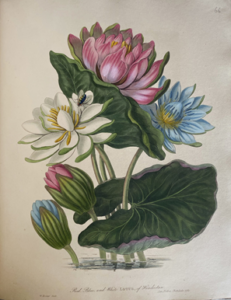
‘Red, Blue and White Lotus of Hindostan’ from ‘Oriental Memoirs’ by James Forbes
(Courtesy:https://sarmaya.in/spotlight/the-art-science-of-indian-botanicals/)
Very little is known about the artists who produced these paintings. Most works remain unsigned, and only a small number of painters can be identified by name. Nevertheless, certain patterns can be ascertained. In north India, artists employed by figures such as James Kerr and Mary Impey had often previously worked in royal courts before seeking patronage under British officials. This situation differed in other regions, where artists came from somewhat different social backgrounds. Many appear to have belonged to established art or craft traditions, acquiring their skills through inheritance or apprenticeship. The artists engaged by William Roxburgh, for example, were chintz painters. In Madras and Tamil Nadu, artists working for botanists largely came from the Thanjavur school and were composed mainly of Telugu-speaking Raju and Naidu artists who had migrated south following the decline of the Vijayanagara Empire.
DECLINE
By the 1840s, the Company’s style of paintings declined. This was brought about by several factors, such as the introduction of cameras in India during this time, which was a much faster and more accurate alternative to hand-painted illustrations. By 1855, the British Court had reportedly asked to stop the employment of artists and draughtsmen to produce imitations of commercial products. favouring photographs instead. Moreover, the style itself lost its original distinct character due to its standardised and repetitive production for several decades.
The botanical paintings of early colonial India provided a reorientation in the purposes that images were made to serve. The works of artists from the Company Style of paintings operated at the intersection of aesthetics, science, and administration. The painters, through their works, showed both technical versatility and an ability to adapt inherited skills to new intellectual frameworks. Although many of these artists remain unknown, their labour formed a bridge between local expertise and emerging global systems of botanical knowledge. In acknowledging their role, it becomes possible to view these paintings not merely as instruments of empire but as artworks that were shaped by new demands, adaptation, and craftsmanship.
BIBLIOGRAPHY:
1. Bhowmik, Ritwij. “Company Painting as Hybrid Style: On Europeanism in Indian Art.” Okzidentalismen: Projektionen Und Reflexionen Des Westens in Kunst, Ästhetik Und Kultur, edited by Birgit Mersmann and Hauke Ohls, 1st ed., transcript Verlag, 2023, pp. 211–38.
2. Edwards, Phyllis I., et al. A Selection of Late 18th & Early 19th Century Indian Botanical Paintings: Recording the Indigenous and Introduced Flora of the Subcontinent. Hunt Institute for Botanical Documentation, 1980.
3. https://heritagecollections.parliament.uk/stories/indian-botanical-art/
4. https://madrascourier.com/insight/why-european-colonialists-employed-indian-artists-to-document-botanical-specimens/
5. https://www.metmuseum.org/essays/company-painting-in-nineteenth-century-india
6. https://dagworld.com/company-paintings.html
7. https://sarmaya.in/spotlight/the-art-science-of-indian-botanicals/
8. https://homegrown.co.in/homegrown-voices/from-mughal-miniatures-to-now-the-living-legacy-of-indian-botanical-art