

By Ashutosh Pandey
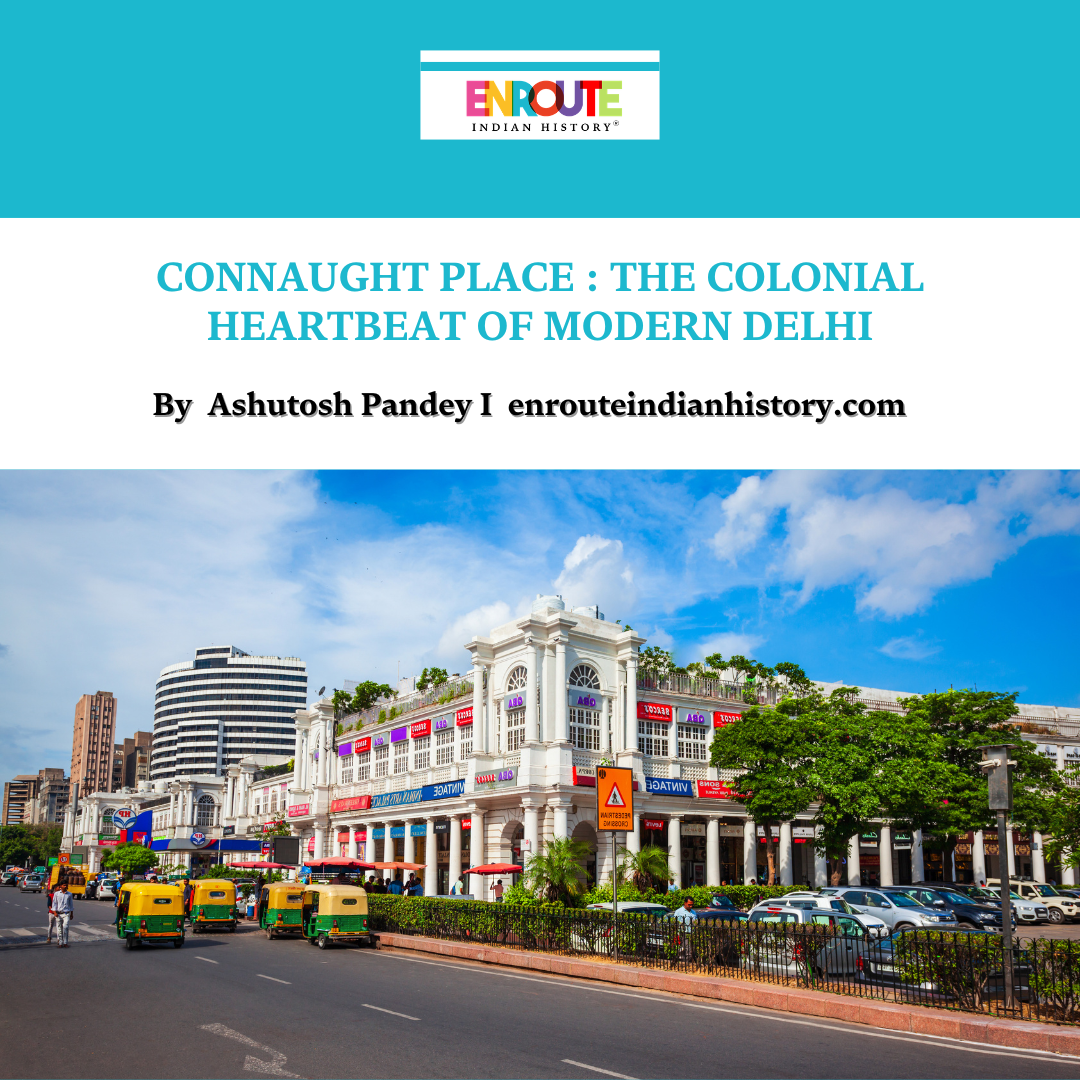
Few places in India capture the blend of colonial grandeur and modern dynamism as vividly as Connaught Place, or simply CP. Nestled in the heart of New Delhi, it stands as a grand symbol of colonial urban planning and commercial vitality. Named after Prince Arthur, Duke of Connaught and Strathearn—the third son of Queen Victoria—the Duke himself laid the foundation stone for New Delhi during his visit in 1911, an event that later inspired the name of this market. CP is viewed not only as a commercial or social hub but also as a living monument to the vision that shaped the heart of Delhi. It represents the journey of the city from the imperial capital of the British Raj to the vibrant heart of independent India.
Origins of a Vision
When the British decided to shift their capital to Delhi in 1911, they envisioned a city that would symbolize power, order, and authority. At the core of this new capital, they required a central business and shopping district—a space that would serve both as a commercial hub and as a social meeting point for the elite. This vision became the blueprint for what we now know as Connaught Place.
Who Built It
The development of CP was part of the larger project to construct New Delhi, led by two British architects—Sir Edwin Lutyens and Sir Herbert Baker—who were primarily responsible for designing the government and residential zones of the city, including Rashtrapati Bhavan, Parliament House, and India Gate.
The task of designing Connaught Place was initially assigned to architect W.H. Nicholls, who laid out an outline plan for the area. However, after he left India in 1917, the project was handed over to Robert Tor Russell, then Chief Architect of the Public Works Department (PWD) of Delhi. Russell finalized the plan and played a significant role in shaping the face of New Delhi. Apart from CP, he also designed several important buildings of the British Raj, including the Eastern and Western Courts, the Chelmsford Club, and Teen Murti House—originally the residence of the Commander-in-Chief of the British Indian Army, later home to India’s first Prime Minister, Pandit Jawaharlal Nehru.
When It Was Built
Construction of Connaught Place began in 1929 and took approximately four years to complete. It was built by employing both Indian craftsmen and British engineers. The area where CP stands today was once a thickly wooded region known as Madhoganj, inhabited by villagers who were later relocated to nearby areas to make way for the new commercial hub.
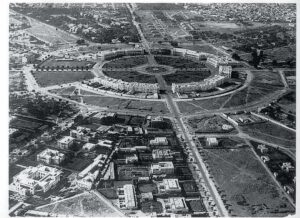
CP was completed between 1929 and 1934 as part of the larger development of New Delhi, which officially became the capital of British India in 1931. The city’s plan was meticulously laid out, featuring a central axis connecting key government buildings with monumental avenues radiating outward. During this period, the area transformed from rugged terrain dotted with kikar trees and wildlife into a formally planned commercial ring.
Driven by the urgency of building a grand imperial capital, the British envisioned CP as a commercial and entertainment district—an integral part of their urban plan. In its early years, CP was frequented by British elites and Indian aristocracy. It hosted the city’s first luxury stores, restaurants, and cinema halls. Over time, as the British departed and Delhi expanded, CP evolved into a hub for people from all walks of life—a place where heritage and modernity coexisted harmoniously.
Architecture
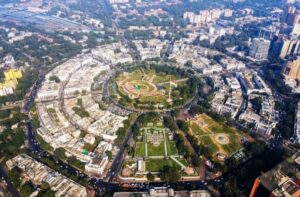
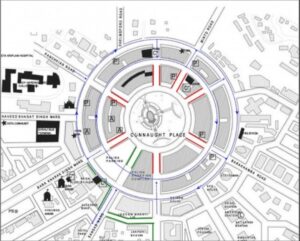
The architecture of Connaught Place is one of its most defining features and the primary reason it continues to be admired nearly a century after its construction. The market was designed in the Georgian Neo-Classical style, inspired by the architecture of the Royal Crescent in Bath, England. Its layout consists of two concentric circles—the Inner Circle (Rajiv Chowk) and the Outer Circle (Indira Chowk)—connected by seven radial roads extending outward like the spokes of a wheel.
The circular design was deliberate and symbolic, ensuring easy access from all sides, a sense of symmetry, and an open, airy environment—quite different from the congested markets of Old Delhi. The entire complex was built using reinforced concrete, a relatively new technique at that time, which provided both strength and architectural finesse. The white colonnaded façade, uniform across all blocks, gives Connaught Place its distinctive charm.
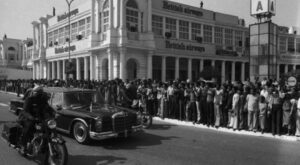
The buildings are characterized by colonnaded walkways, archways, high ceilings, and symmetrical facades. This Neo-Classical style reflects a blend of European elegance and Indian practicality. The wide corridors were designed to offer shade and shelter from Delhi’s extreme weather, while open courtyards ensured proper ventilation. Each block of Connaught Place was designed to have commercial shops on the ground floor and offices or residences above. The uniform design lends a sense of visual harmony, even though each building serves a different purpose.
The choice of white paint was intentional—symbolizing cleanliness and order while reflecting heat during Delhi’s sweltering summers. The stone and plaster used in construction were locally sourced, and Indian craftsmanship flourished under British architectural supervision. Russell’s plan emphasized symmetry and proportion—values central to Georgian architecture. Every archway, column, and balcony was built according to precise mathematical ratios, ensuring that the entire market appears balanced and aesthetically consistent even today.
Transformation Over the Decades
Connaught Place began as an elite shopping destination during the colonial era. British brands like Galway’s, Hamilton’s, Wengers, and Regal Cinema defined its high-class image. Regal Cinema, opened in 1932, was one of Delhi’s first theatres and served as a cultural landmark.
After independence, Connaught Place began to evolve. Many British-owned establishments shut down or were replaced by Indian businesses. Gradually, CP became the center of India’s urban commercial life, housing banks, corporate offices, restaurants, bookstores, and showrooms.
In the 1960s and 1970s, CP became synonymous with Delhi’s modern identity. Coffee houses such as the Indian Coffee House became meeting points for intellectuals, journalists, and artists. Even today, Connaught Place remains a favorite destination for students, professionals, and tourists alike.
Today, CP stands as one of the most expensive commercial real estate locations in India and ranks among the top ten globally. The circular market now houses global brands, restaurants, banks, and corporate offices. Despite competition from modern malls and digital commerce, Connaught Place continues to thrive because of its historical significance, architectural beauty, and central location. The Delhi Metro has made it even more accessible—Rajiv Chowk Metro Station, located beneath Connaught Place, is among the busiest metro stations in Asia.
conclusion
Connaught Place remains one of Delhi’s most iconic landmarks—a living relic of the city’s colonial past and a thriving symbol of its modern spirit. Built between 1929 and 1934 by Robert Tor Russell in Georgian Neo-Classical style inspired by the Royal Crescent at Bath, CP continues to enchant visitors with its architectural symmetry, historic aura, and cultural vibrancy.
What began as an elite British marketplace has transformed into a democratic urban space that welcomes everyone—from students sipping coffee to businessmen sealing deals, from tourists taking photos to artists sketching under its colonnades.
Connaught Place is not just the physical center of Delhi but also the city’s emotional heart—where history, commerce, and life converge every single day.
Bibliography
1. The Tribune (India). “So, who built CP? It Wasn’t Lutyens.” Published 18 September 2016.
Available at: https://www.tribuneindia.com/news/archive/kaleidoscope/so-who-built-cp-it-wasn-t-lutyens-170023
2. The Indian Express. “Connaught Place: Vehicle-Free City Planners, Heritage Experts Give Thumbs Up.” Published 4 January 2017.
Available at: https://indianexpress.com/article/cities/delhi/connaught-place-vehicle-free-city-planners-heritage-experts-give-thumbs-up-4461998/
3. Economic Times. “Delhi Turns 100: Transition of a Chaotic, Charismatic, Restless, Relentless Metropolis.” Published 25 December 2011.
Available at: https://economictimes.indiatimes.com/news/politics-and-nation/delhi-turns-100-transition-of-a-chaotic-charismatic-restless-relentless-metropolis/articleshow/11057383.cms
4. India Map (Tourism and Heritage Portal). “Connaught Place.”
Available at: https://indiamap.com/places/connaught-place/
5. Media India Group. “Connaught Place: Delhi’s Timeless Circle Blending Past and Present.” Published 2022.
Available at: https://mediaindia.eu/society/connaught-place-delhis-timeless-circle-blending-past-and-present/
6. Asian Age. “A Walker’s Paradise That Transformed into a Commercial Hub.” Published 31 January 2017.
Available at: https://www.asianage.com/metros/delhi/310117/a-walkers-paradise-that-transformed-into-a-commercial-hub.html
7. Indian Mirror. “Connaught Place Market.”
Available at: https://www.indianmirror.com/tourism/indian-bazaars/Connaught-Place.html
8. Delhi Government – SRDC (Shahjahanabad Redevelopment Corporation). “Delhi 1900–2000: A Century of Urban Change.”
Available at: https://srdc.delhi.gov.in/en/srdc/1900-2000