
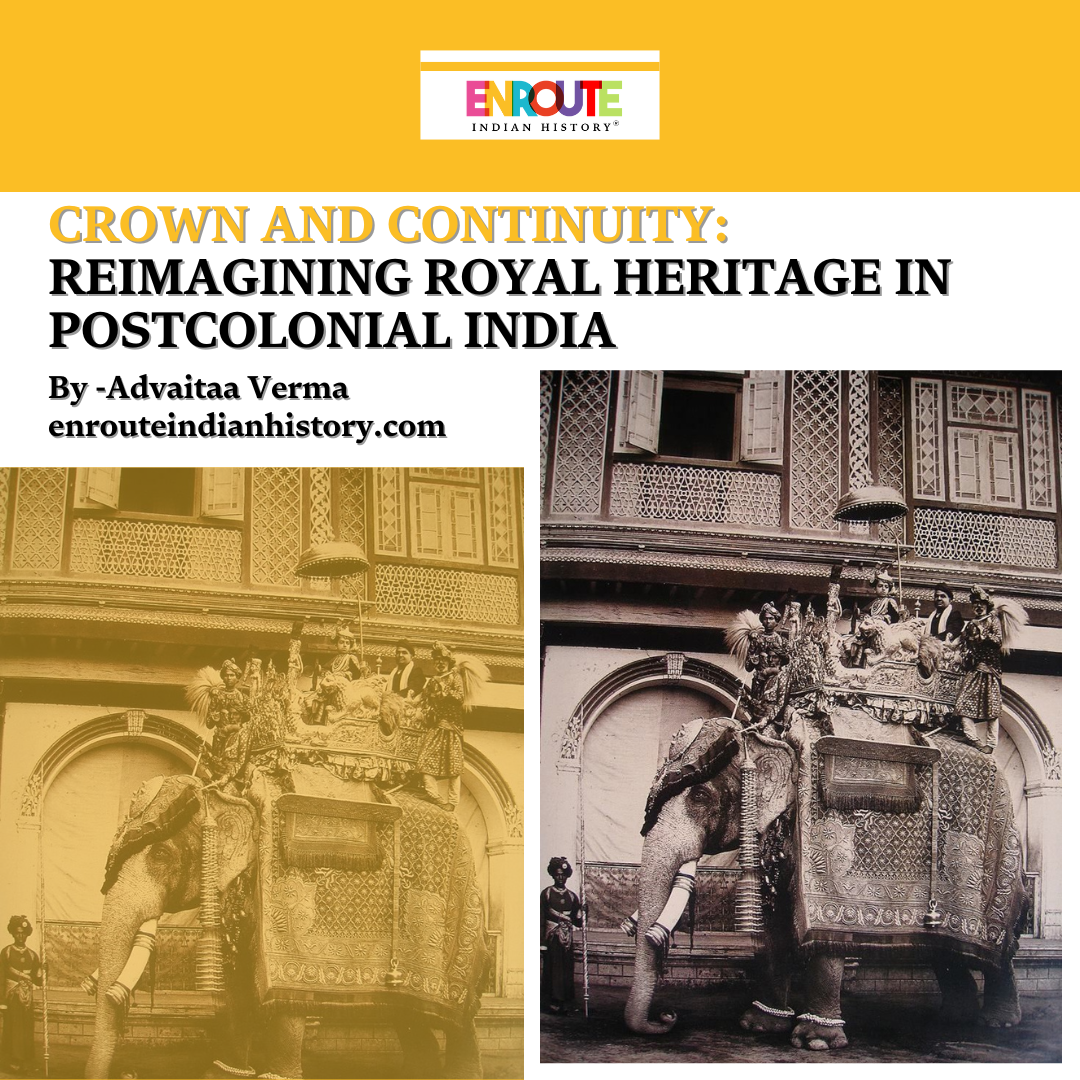
By Advaitaa Verma
Heritage in Indian context is a complex concept woven from the threads of monarchy, colonial encounter, and postcolonial nation-building. Heritage conservation in post-colonial societies often unfolds at the intersection of memory, economics, and identity (Nilson & Thorell, 2018). Royal palaces, in particular, straddle this cultural and historical divide, serving simultaneously as icons of forgotten princely states and as evolving, contemporary spaces. Among these, the Lakshmi Vilas Palace in Vadodara stands out, not just for its sheer scale or architectural grandeur, but for its persistence as a living, functional estate still inhabited and administered by its original royal custodians (Kumar, 2009). Built in 1890 by Maharaja Sayajirao Gaekwad III of the Maratha Gaekwad dynasty, the palace was a deliberate articulation of modernity, status, and vision, featuring Indo-Saracenic design with European technological innovations. This palace is a bold symbol of how Indian royalty sought to negotiate power, identity, and aesthetics in the light of colonial rule (Jigyasu, 2018).
In the post-independence era, the royal palaces faced existential threat of redundancy. the custodianship of monumental estates such as the Lakshmi Vilas Palace is fraught with financial and logistical challenges. Unlike state-protected monuments, private palaces must generate their own revenue streams to sustain their grand scale and historical significance (Guha-Thakurta, 2004). This paper argues that the slow revival of the Lakshmi Vilas Palace is emblematic of a broader trend among Indian royals who employ hybrid economic models to preserve their ancestral estates. Through a qualitative and historical analysis of events, partnerships, and commercial adaptations, this article illuminates the strategies used by the Gaekwads to keep this palatial legacy alive.
Historical Context and Architectural Significance
The Lakshmi Vilas Palace was conceived as a modern royal residence, unique in its incorporation of European amenities and Indian aesthetics. Designed by Major Charles Mant and completed by Robert Chisholm, the palace features ornate mosaics, Venetian-styled colonnades, and a massive Durbar Hall with a Venetian mosaic floor and stained glass windows. The estate includes not only the main palace but also several subsidiary buildings such as the Moti Baug Palace, Maharaja Fateh Singh Museum, and a private golf course, each contributing to the spatial and cultural vastness of the complex. In the post-independence era, the palace, like many such royal estates across India, faced the existential threat of redundancy. The dissolution of princely states, the abolition of privy purses in 1971, and the economic liberalization of the 1990s all altered the socio-economic landscape in which such vast estates existed (Jigyasu, 2018).
Tourism and Curated Heritage
One of the key strategies employed by the Gaekwad family is the partial opening of the palace to the public, turning the residence into a museum (Guha-Thakurta, 2004). While the family still resides in parts of the palace, others have been converted into heritage attractions. The Maharaja
Fateh Singh Museum, which houses a remarkable collection of paintings by Raja Ravi Varma and European masters, functions both as a cultural archive and a tourist draw. This museum helps in understanding the working of royal families in the modern times. Guided tours, carefully restricted to certain areas, have been introduced to generate revenue while preserving the sanctity of private quarters. Tour packages are augmented by multimedia experiences and curated exhibitions that narrate the palace’s history in a way that resonates with contemporary audiences. According to the Gujarat Tourism Department, the Lakshmi Vilas Palace is one of the top tourist attractions in Vadodara, drawing thousands of visitors annually
(Jigyasu, 2018).
Events and Commercial Use
The palace grounds have been leveraged as a premium venue for cultural, corporate, and private events. Weddings, in particular, have become a significant source of income. The palace has hosted several high-profile weddings and private events, transforming its sprawling courtyards and gardens into opulent settings for celebrations (Kumar, 2009). One notable example is the 2014 wedding of Yuvaraj Samarjitsinh Gaekwad's daughter, which drew national media attention and showcased how the palace serves as a backdrop for elite Indian society. The palace’s Durbar Hall and the adjacent gardens have also been rented for film shoots like Satyaprem ki Katha, brand launches, and fashion photography. Moreover, the palace has been used for classical music festivals, including the VadFest (Vadodara International Arts & Culture Festival), which has featured performances by notable dignitaries such as Zakir Hussain and Pt. Shivkumar Sharma. These events not only reinforce the cultural gravitas of the palace but also introduce it to younger and international audiences.
One of the most entertaining and interesting events for which the palace grounds have been used even today is for Navaratri. The heritage garba is organized on the Moti Baug ground; this 9 -da festival is important as it provides economic stability for the palace, also helps in supporting the
local business. During this, many renowned singers and foreigners join along with the royal family members.
Sports Sponsorship and Community Engagement
One of the most distinctive aspects of the palace’s revival is its engagement with sports, particularly cricket and golf. Yuvaraj Samarjitsinh Gaekwad, the current custodian of the palace and a former Ranji Trophy cricketer, has played a pivotal role in this dimension. He owns the Baroda Cricket Association’s Moti Baug Cricket Ground, located within the palace premises, which serves as a training venue for the Baroda cricket team and hosts domestic matches. The Lakshmi Vilas Palace Golf Club, originally established for the royal family’s leisure, has been revamped into a semi-public golf course, drawing enthusiasts from across Gujarat. The golf club not only provides recurring income but also aligns the palace with luxury tourism trends. The palace also organizes golf competitions for adults and children.
Samarjitsinh Gaekwad has also entered into sponsorship agreements and patronized local sports events to foster community goodwill and increase visibility. For example, the Baroda Football Academy and youth golf camps have received support from the palace’s sports initiatives, blending royal patronage with grassroots development.
However, the royal palace is involved in many social initiatives like supporting women and local businesses such as textiles and community events like Heritage Garba. They are also associated with supporting the LGBTQI-run cafes. One such example is the Gazra Cafe which is led by transgenders.
Challenges and Future Trajectories
Despite these multi-pronged efforts, the revival of the Lakshmi Vilas Palace is not without challenges. The sheer scale of the estate, with its expansive gardens, intricately designed halls, and heritage structures, demands continuous investment in conservation far beyond routine maintenance (Jigyasu, 2018). Maintenance costs remain exorbitant particularly for structural restoration and climate control in museum areas. The balancing act between exclusivity and accessibility in heritage commercialization requires careful curation (Nilson & Thorell, 2018). Furthermore, there is the delicate balance of allowing public access while preserving the sanctity and privacy of the royal residence. These dilemmas are amplified by a broader philosophical debate: should such palaces serve purely as commercial entities or continue as symbols of cultural stewardship and living history?
Going forward, the Gaekwads are exploring more immersive and sustainable models, such as heritage stays in satellite buildings, augmented reality tours, and academic partnerships for research and conservation and also enable deeper archaeological and architectural studies. There are also plans to digitize the palace archives, including photographs, paintings, and royal correspondence, to facilitate research and online engagement.
Conclusion
The Lakshmi Vilas Palace is more than a relic of princely India; it is a dynamic site where marble meets memory, and traditional dialogues with commerce. Its survival and continued relevance are neither accidental nor inevitable—they are the result of carefully calibrated decisions by the Gaekwad family, who have chosen to navigate the complex demands of preservation, public engagement, and economic sustainability with remarkable agility. Unlike many royal estates in India that have been either surrendered to state control or transformed into purely commercial ventures. The Lakshmi Vilas Palace represents a hybrid model: one that retains its identity as a private royal residence while actively participating in Vadodara’s cultural, social, and economic life.
The story of the Lakshmi Vilas Palace is one of continuity amid change. It illustrates how memory can be mobilized not just to preserve the past but to invigorate the present and inspire the future (Kumar, 2009). In its marble colonnades and sun-dappled courtyards, the palace tells the story of a city, a dynasty, and a nation still learning how to honor its past while embracing the imperatives of a modern, inclusive society. As such, the Lakshmi Vilas Palace stands not just as an architectural marvel, but as a case study in the sustainable and dignified revival of royal heritage in postcolonial India.
References
Guha-Thakurta, T., 2004. Monuments, Objects, Histories: Institutions of art in colonial and post- colonial India. Columbia University Press.
Jigyasu, N., 2018. Alternative Modernity of the Princely states-Evaluating the Architecture of Sayajirao Gaekwad of Baroda. Creative Space, 5(2), pp.59-70.
Kumar, R.B., 2009. Indian heritage tourism: Challenges of identification and preservation.
International Journal of Hospitality and Tourism Systems, 2(1), p.120.
Nilson, T. and Thorell, K., 2018. Cultural heritage preservation: The past, the present and the future.
Sheeba, J. and Dhas, J.T.M., 2018. A study of Indo-Saracenic architectural heritage.
International Journal of Pure and Applied Mathematics, 118(22), pp.1737-1742.