

By Prishnika Mazumdar
The key markers of Neolithic culture are the domestication of animals and the cultivation of plants. This meant increased food security, and it demanded more refined tools than those previously used. People began to use polished stone tools and axes called celts. The beginning of the Neolithic, however, did not necessarily mean the end of hunting animals or gathering plant foods (Singh, 2008). Therefore, we can say that the progression from one period into the next was not always linear; often, several cultures coexisted, spatially and temporally. This is an important feature of the Indian Neolithic, broadly dated between 7000 BCE to 1000 BCE, where cultures did not develop at the same time, they did not end simultaneously, and regional variations remain. Among these, the region of Northeastern India has remained underexplored with great potential for Neolithic research (Hazarika, 2013-14). Herein, we will focus our energies on the site of Daojali Hading in Assam in the context of the Northeastern Neolithic.
The Northeastern Neolithic
The northeastern states of India, which include Assam, Arunachal Pradesh, Meghalaya, Tripura, Manipur, Nagaland, and Mizoram (now Sikkim as well), are promising in terms of archaeological discoveries from the Neolithic culture. However, despite the abundance of surface finds, particularly in the Garo, Cachar, and Naga Hills, the region remains under-explored and lacks sufficient excavated sites and absolute dates. This makes the limited excavations that have taken place even more significant for understanding early human activity in this area (Singh, 2008).
Sarutaru, excavated by Prof. S.N. Rao between 1971-74, is located about 25 kilometres southeast of Guwahati. Excavations here unearthed shouldered celts and round-butted axes, along with handmade pottery in shades of brown, buff, and grey, some bearing cord impressions. However, the Neolithic phase at this site may not be as early as once thought; it might even date to the early centuries of the Common Era (Singh, 2008).
Although Nagaland has yielded Neolithic tools and handmade grey pottery at various locations, none of the sites have been formally excavated. In Manipur, the site of Napchik, excavated in 1985 by Dr. Okram Kumar Singh, is important for its early thermoluminescence date of 1650 ± 350 BCE for cord-marked handmade pottery. Other tools recovered here include stone choppers, scrapers, flakes, a blade-edged knife, grinding stones, and polished celts (Singh, 2008).
Meghalaya also has multiple finds of Neolithic tools across different locations. Limited excavations at Selbalgiri and Pynthorlangthen have added to our knowledge. Pynthorlangthen, in particular, revealed a 1-meter-thick Neolithic layer, interpreted as a tool manufacturing site, with discoveries of adzes, axes, chisels, points, blades, and scrapers (Singh, 2008).
It is important to note that not all sites producing Neolithic-type tools and pottery are as early in date as their inclusion in the Neolithic culture might suggest. Some, like the Kanai Gaon Reserve in Dibrugarh district, have yielded dates as late as the 6th century CE. To understand the chronological and cultural development of the Neolithic and Neolithic-Chalcolithic phases in this region, more excavations and scientifically obtained dates are needed (Singh, 2008). Among the Neolithic sites of Northeast, perhaps the most well-known site is that of Daojali Hading, it is, however, not without complications.
Daojali Hading
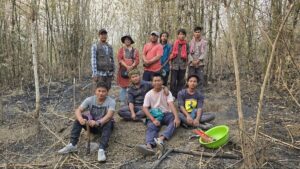
Recently, a team led by Shring Dao Langthasa and Bhubanjoy Langthasa of the North Cachar Hills Autonomous Council’s (NCHAC) Department of Archaeology surveyed Daojali Hading. This survey led to the discovery of a furnace and iron slag, indicating metallurgical activities. This discovery is significant because Neolithic cultures are generally not associated with metal implements (Karmakar, 2025). Many questions about the placement of Daojali Hading within Neolithic culture have come alive again. This should remind us about the complications of categorisation while we assess the features of Daojali Hading as a Neolithic site.
The site is located on the ridge of tertiary sandstone and shale, rising to the height of 1,500 feet. As a result of heavy rainfall, the region had been covered by a thick growth of bamboo and long grass interspersed with trees, which covered the site as a heavy blanket of vegetation (Sharma, 1967). In the early 1960s, when the hilltop was accidentally exposed as a result of the construction of the Lumding-Haflong road, its neolithic significance was realised. Between 1961-62, the site was excavated by Tarun Chandra Sharma and Mohan Chandra Goswami (Karmakar, 2025).
The excavations carried out here revealed for the first time the stratigraphical position of Neolithic culture in the Northeastern region. In 1961, excavators opened a trench, and in 1963, four more standardised trenches, labelled B, C, D, and E, were dug into undisturbed portions of the Daojali Hading mound. These excavations revealed both ceramic fragments and stone tools. The site, which contains a cultural deposit about 1.5 metres deep, revealed three stratigraphic layers:
1. Layer I consisted of dark, loose soil with a thickness of 20–30 cm, but no archaeological materials were found here, making it an archaeologically sterile layer.
2. Layer II was about 75 cm thick, composed of dark grey soil on the upper side and light grey below. This layer was archaeologically rich, yielding various stone tools and pottery fragments.
3. Layer III was made up of compact yellowish-brown soil, approximately 45 cm thick (Hazarika, 2017).
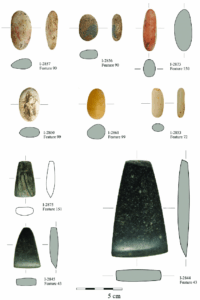
In 1966, T.C. Sharma examined stone artefacts from both the excavation and materials found on the surface and road cuts at the site. The finds included 32 edged tools, 22 grinding stones, 4 querns, 6 mullers, 11 quartzite pebbles, and pieces of fossilised wood. The tools were made from locally sourced raw materials such as shale, sandstone, quartzite, and fossil wood. Shale and fossil wood were primarily used for making edged implements, while sandstone served for manufacturing grinding stones, whetstones, and querns. The artefacts found on the surface and from road-cut areas showed a comparable material composition. The edged tools were created through a combination of flaking and grinding techniques (Hazarika, 2017).
Pottery of Daojali Hading
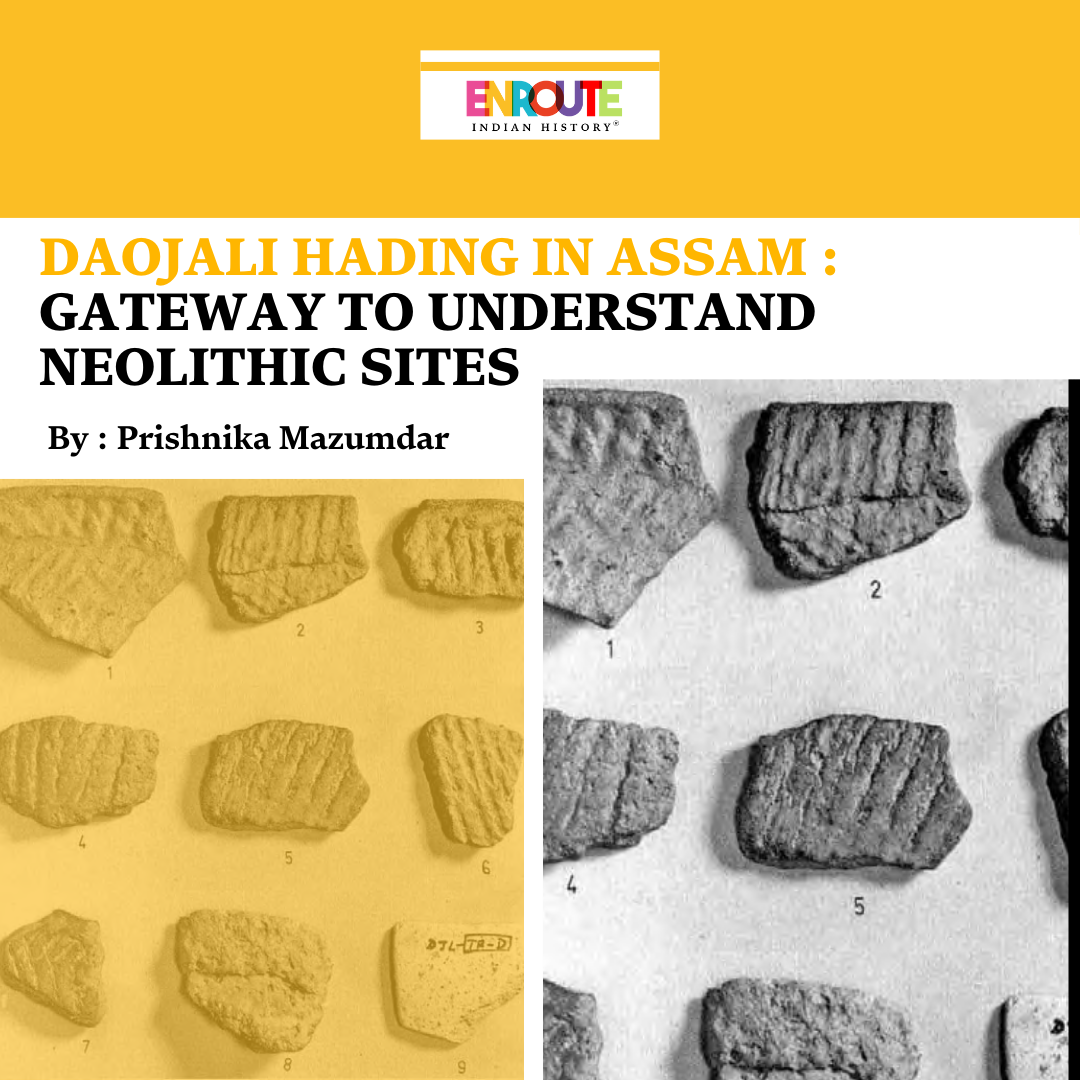
The pottery discovered at Daojali Hading was all fragmentary, with no complete vessels or reconstructable profiles. Even then, the sherds were in sufficient quantity and diversity to allow for classification into four main types:
1. cord-marked pottery
2. incised pottery
3. stamped pottery
4. plain fine red ware (Sharma, 1967)
Of these, cord-marked pottery was the most abundant. These pots were made from coarse, impure clay that had been heavily tempered with large particles of quartz and sandstone. The outer surfaces bore impressions created by cord-wrapped paddles, with patterns consisting of parallel grooves or impressions made by twisted cords. The method of manufacturing these vessels involved hand modelling, often using the coil or ring-building technique, followed by shaping and compacting the walls with a beater and pad. The inner surfaces still bore the marks of the soft pad or the potter’s hand used to support the wall during beating (Sharma, 1967).
The incised pottery was decorated with geometric patterns such as herringbone and cross-hatching, carved into the clay before firing. The stamped pottery appeared to have been formed by beating with rough wooden slats, lacking cord or engraved designs. In contrast, the plain red ware was more refined, made from well-prepared clay, and probably shaped on a rudimentary turntable, if not a true potter’s wheel. This ware differed markedly from the others in terms of both technique and finish, which implies either a separate tradition or a more specialised function (Sharma, 1967).
Across all types, the pottery was imperfectly fired, often showing a dark core that indicates a low-temperature open firing process using wood and dried grass, such methods are still employed by some tribal groups in the region today. The absence of burnishing or applied slips reinforces the utilitarian nature of most of these vessels, although the presence of iron deposits mimicking a slip finish on some sherds adds an interesting dimension to their surface treatment (Sharma, 1967).
Of particular importance is the cultural significance of the cord-marked pottery. Such ceramics are widely found in eastern and Southeast Asia, often in association with polished stone tools. The pottery from Daojali Hading, therefore, aligns the site with an eastern Asiatic Neolithic tradition. This implies possible cultural contacts or parallel development with areas as far east as China and Southeast Asia. While the plain red ware remains less well understood, Sharma suggests that it may relate to the Yang Shao culture of the Yellow River valley, possibly pointing towards cultural influences reaching into Assam from China via intermediate zones like Szechwan (Sharma, 1967).

The Neolithic culture of Northeastern India holds an important and unique place in the subcontinent’s Neolithic setting. Unlike the more intensively studied Neolithic cultures of the Ganges Valley or South India, the Northeastern region remains largely underexplored. What makes this region especially important is the combination of its archaeological potential and its location at the crossroads of India and Southeast Asia, which opens possibilities for understanding cross-cultural interactions during the Neolithic period. The site of Daojali Hading, located in Assam’s North Cachar Hills, is particularly significant because it provides the first clear stratigraphic context for Neolithic life in the area. Yet, despite the promising leads, the Northeastern Neolithic is not properly dated, and the pieces of evidence are fragmentary. Many tools across the region have been found as surface scatters, and few sites have been properly excavated. As a result, while the finds at Daojali Hading hint at an interconnected eastern and Southeastern Neolithic cultural complex in Asia, the region’s full cultural trajectory is somewhat unclear. Ongoing excavations, research and recent discoveries at already excavated sites are changing our understanding of this culture in the Northeast. The final word on the Neolithic culture of the Northeastern region has not been spoken, further research is crucial for enhancing our understanding of the matter.
References
Karmakar, R (2025) ‘Neolithic habitation found in Assam’s Dima Hasao’, The Hindu, 1 June. Available at: https://www.thehindu.com/news/national/assam/neolithic-habitation-found-in-assams-dima-hasao/article69641093.ece (Accessed: 6 June 2025).
Singh, U. (2008) A History of Ancient and Early Medieval India: From the Stone Age to the 12th Century. 1st edn. New Delhi: Pearson Education.
Sharma, T.C. (1967) ‘A Note on the Neolithic Pottery of Assam’, Man, 2(1), pp. 126–128.
Hazarika, M. (2013–14) ‘Prehistory and Archaeology of Northeast India: Recent Perspectives on the origin of pottery and agriculture’, Puratattva, 43, pp. 134–142.
Hazarika, M. (2017) Prehistory and Archaeology of Northeast India: Multidisciplinary Investigation in an Archaeological Terra Incognita. New Delhi: Oxford University Press.
Image Sources
ResearchGate (2017) Representative image of Neolithic tools. Available at: https://www.researchgate.net/figure/Traditional-Neolithic-tools-like-small-hammer-or-smoothing-stones-and-stone-adzes-from_fig5_316738263 (Accessed: 31 August 2025).
The Hindu (2015) Team that found evidence of metallurgical activities in Daojali Hading. Available at: https://www.thehindu.com/news/national/assam/neolithic-habitation-found-in-assams-dima-hasao/article69641093.ece (Accessed: 31 August 2025).
Sharma, T.C. (1967) Neolithic pottery from Daojali Hading, ‘A note on the Neolithic Pottery of Assam’. Man, 2(1), pp. 126–128.