
RAVNEET KAUR
“Ibrahim ko got pita dev guru Ganapati mata pavitra sarsuti’’ (trans. Ibrahim, whose father is guru Ganapati and mother the pure Saraswati), so says the Kitab-i-Nauras as it opens. While the difficult to translate Pem Nem makes use of plenty of wordplay, such as “shah jal bal bal pal tal mal”. Though the literary and linguistic makeup abounds, the paintings that correspond to these two texts of the ‘Adil Shahi Court from the sixteenth and seventeenth centuries make a curious and highly rewarding case of Bijapuri Painting, in particular and Deccani Painting at large. The visual imagery, textual references and the resulting synthesis of these texts exemplify the high point of the Bijapuri Painting.
THE DECCAN SULTANATES
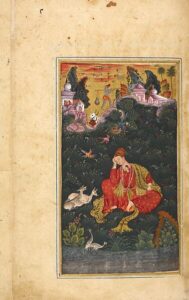
Figure I: Shah Ji in search of Mah Ji, wandering through the Countryside. Manuscript of the Pem Nem (The Laws of Love). Bijapur. c. 1509-91. The Metropolitan Museum of Art. (https://www.metmuseum.org/art/collection/search/454781)
The Deccan is the south-central region of the Indian Peninsula. After the Delhi Sultanate had established itself in the north, it annexed the northern half of the Deccan Plateau. As a result, there was an infusion of cosmopolitan Persian culture in the Deccan. Later on, the Amirs (commanders) rebelled against the Sultanate and the Bahmani Kingdom was founded in 1347 over Northern Deccan and the Vijayanagar kingdom over the Southern half. The rulers of both states used the epithets of ‘Sultans’, which Richard M. Eaton (2011) identifies as “conscious adoption of the Delhi Sultanate’s Persianized model of kingship”.
The next in line of inspirational fountainheads was the – Timurid Culture. Sultan Firuz Shah Bahmani, a great admirer of Timur, constructed Firuzabad and transplanted Timurid architecture in the Deccan. Gradually, Timurid notions, statecraft ideals and aesthetic sensibilities. This was accompanied by the arrival of Ghariban (“westerners”) from the Arab and Persian worlds in the 15th-16th centuries. A major reason for this was the Deccan’s severed relations with North India, and so Eaton argues that it looked overseas for “civil and military talent”.
The steady arrival and consequent higher position and prestige accorded to the Westerners would give rise to what is called the Western-Deccani Conflict, wherein the Deccanis refer to the Muslims born in the Deccan. This hastened the disintegration of the Bahmani Kingdom. By the 1520s, five successor states emerged in the Deccan – the Imad Shahi Sultans of Berar in the North, the Nizam Shahi Sultans of Ahmadnagar in the North-West, the Qutub Shahi Sultans of Golconda in the East, the Barid Shahi Sultans of Bidar in the Centre and the Adil Shahi Sultans of Bijapur in the West. From 1565 to the 1680s, the Sultans enjoyed the period of what is known as the Deccan’s Golden Age until the Mughal conquests of the Deccan by Aurangzeb (r. 1658-1707).
CULTURAL AMALGAM
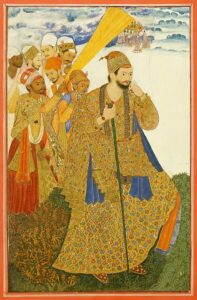
Figure II: The Procession of Sultan Ibrahim ‘Adil Shah II. Bijapur. c. 1595. The Metropolitan Museum of Art. (https://www.metmuseum.org/art/collection/search/454818)
The Deccan has been described as a melting pot due to its amalgam, absorption, and integration of various cultural elements, religious traditions and peoples. Starting from the absorption of Chalukya elements from the Kalyana Chalukyas (r. 974-1190) of the Deccan to the influence of Central Asian and Persio-Islamic traditions, there’s hardly an end to it.
Several people were integrated into the Sultanates, such as Maratha and Telugu warrior elites in the armies of the Sultans, Brahmins and non-Brahmin service castes in bureaucratic services, and other overseas peoples like the Ethiopians (Habshis) as military slaves and Portuguese Conquistadors, who engaged with Deccanis as merchants, mercenaries and missionaries. Moreover, there was constant cultural back and forth with Vijayanagara in terms of art, architecture and dress. The sixteenth century also saw close ties between the Deccani Sultanates and the Iranian Safavids.
Linguistic amalgamation is a major feature of these cultural confluences. Dakhni – a form of vernacular Urdu emerged in the 14th-15th centuries and had its own body of literature by the 16th Century. Meanwhile, the Qutub Shahis and the Golconda Sultanate incorporated Telugu, while the Bijapuri Sultans made use of Marathi in their administrative accounts. Eaton writes that all of this contributed to “making the Deccan one of the most dynamic, diverse and cosmopolitan societies in the early modern world”
THE FOLIOS OF KITAB-I-NAURAS
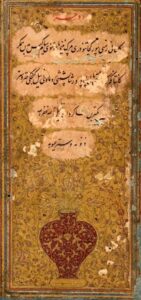
Figure III: Colophon Page of the Kitab-i-Nauras with Vase illumination. Bijapur. c. 1618. Google Art and Culture. (https://share.google/tL5yHmIKVGgYK17JS)
The Kitab-i-Nauras is a 16th-century collection of fifty-nine devotional songs and seventeen couplets attributed to Sultan Ibrahim ‘Adil Shah II (r. 1580-1627) of Bijapur. It is the earliest musical work in Dakhni Urdu and is based on the Rasa theory of Indian aesthetics about the nine “juices” or essences. Ibrahim II is noted as a patron of music and arts and for his unorthodoxy. Moreover, he is credited with ushering in Bijapur’s golden age in the field of visual arts.
The most noted copy of the text is the imperial manuscript, which is discussed here, known for its heavy illumination. The illumination is marked as “of remarkably high quality and distinctive character” and is done in gold with very fine drawing in black, along with gold sprinkled borders. The Colophon page (Figure III) of the text has a flowering vase motif, which Haidar (2011) terms as the “most original and influential motifs of Deccani illumination, that of a flowering vase covered in springing arabesques in red and gold”. The arabesque vase is a recurring motif and has parallels in Bijapur wall paintings, such as the blue Arabesque vase at Asar Mahal, Bijapur.
The folios contains various motifs such as – tiny birds, animals, fish and Chinese clouds. These include foxes, ducks, cranes, crested fowl, herons and woodpeckers. Amongst trees and plants are palm trees, reeds, prunus, irises and Turkman-style blossoms. The flora is certainly influenced by the Persian Timurid style and the wider world of Islamic painting.
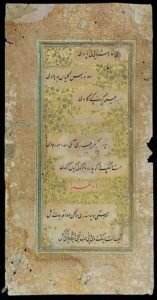
Figure IV: Folios of the Kitab-i-Nauras. Khalilullah Butshikan, Calligrapher. c. 1618. Bijapur. The Metropolitan Museum of Art. (https://www.metmuseum.org/art/collection/search/458846)
BIJAPURI PAINTING
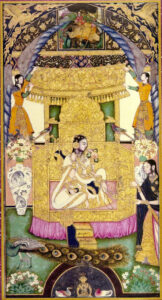
Figure V: Goddess Saraswati enthroned by Farrukh Hussain. c. 1604. Bijapur. Wikipedia Commons. (Saraswati Enthroned – Wikipedia https://share.google/d3KVu49tgHbbNthZ4)
The imperial folios of the Kitab-i-Nauras do not contain any painting, but several paintings of the court bear direct relation to the text and songs of the work. The most important amongst these is the painting of Goddess Saraswati (Figure V). The text is dedicated to Goddess Saraswati, Prophet Muhammad and the renowned Deccani Sufi saint Gesu Daraz. The dedication, Song 53 and Song 37, which refers to the Goddess as a “fully blossomed white flower”, has a corresponding painting by Maulana Farrukh Hussain. Saraswati, the goddess of music and learning, is painted in white, symbolising purity and is seated on an ornate golden-walled throne in hexagonal shape. In her arms, she is holding a book, a conch, a Veena and a lotus. Haidar notes that she is painted like a Deccani princess – the jewellery is of Southern India, like the round gold disks in her hair.
The other elements in the painting are – the Peacock, large vases with foxes on them, the attendant, flowers, ducks and two Persianate angels. Furthermore, the top framed section has a portrait of a man riding an elephant. This is identified as the Sultan Ibrahim himself, seated on his favourite elephant, Atash Khan, and his mate Chanchal. The collation of different elements is the most significant theme here. Haidar comments that the “hybridity of references and styles from Hindu and Islamic spheres, combined with the Sultan’s own presence …. His elephants and the highly personalised textual reference to Kitab-i-Nauras show Farrukh Hussain’s masterful visualisation of the idealised version of self, state and culture that Ibrahim espoused”.
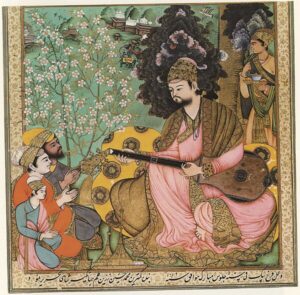
Figure VI: Sultan Ibrahim ‘Adil Shah II playing the Tambur by Farrukh Hussain. c. 1595-1600. Bijapur. The Metropolitan Museum of Art. (https://www.metmuseum.org/art/collection/search/454791)
Some fabulous examples of the court paintings are Ibrahim’s portraits. In Figure II, Ibrahim is dressed in an ornamented dress and is wearing strands of rudraksha beads, which are associated with the Shaivite tradition. The second portrait, Figure VI , is crucial as it is drawn from Song 56, which describes Ibrahim as follows – “In one hand he has a musical instrument … he is robed in saffron-coloured dress, his teeth are black, the nails are painted red”. The painting shows him playing his favourite instrument – the Tambur – named as Moti Khan, and with red nails, while he is surrounded by courtiers or admirers. Robert Skelton speculates that the colouring of nails may be related to musicians or music in some way or the other. Importantly, in both paintings, the Sultan is outside, and the Palace is a miniature in the background, a detail which has significant value in the Pem Nem illustrations.
PEM NEM: A SUFI ROMANCE
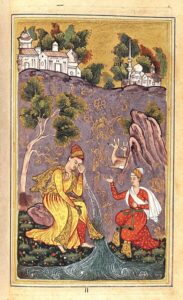
Figure VII: Shah Ji weeps a stream of tears. Manuscript of the Pem Nem (The Laws of Love). Bijapur. 1509-91. The Metropolitan Museum of Art. (https://www.metmuseum.org/art/collection/search/454781)
The Pem Nem, the “Rules of Love”, is an illustrated Sufi romance of the Adil Shahi court by Hasan Manjhu Khalji, who adopted the pen name of Hans. Written in Dakhni Urdu, it is
masnavi in the genre of Prem Marg, the path of love, of Sufism. The text is dated between 1591 and 1604 and contains thirty-four illustrations.
The narrative is a love story of Shah Ji and Mah Ji, the male and female protagonists, respectively. Through a tortoise, who shows them the picture of the other, the two fall in love. Consequently, Shah Ji, the prince of Kuldip, sets out on an arduous journey to find Mah Ji, who lives on the island of Sangaldip. Upon meeting her, Shah Ji faints but later believes that the real Mah Ji is just a reflection of her image, which resides in his heart and leaves her behind. Both lovers then suffer an intense period of longing and separation. Finally, Shah Ji realises his mistake and goes back; the two are reunited and ultimately married.
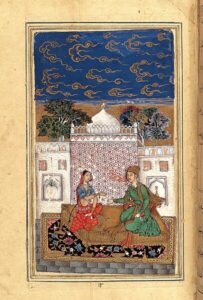
Figure VIII: Golden Spray or flame coming out of Shah Ji’s mouth as he speaks to Mah Ji. Manuscript of the Pem Nem (The Laws of Love). Bijapur. 1509-91. The Metropolitan Museum of Art. (https://www.metmuseum.org/art/collection/search/454781)
The thirty-four paintings are done in ink, opaque water colour, gold and silver on paper. The paintings are also not directly painted on the manuscript’s folios but on separate pieces of paper and then pasted together. These are held to be done by three artists, known as Hand A, Hand B and Hand C, and thus multiple inconsistencies and artistic variations can be observed, for example, in the depictions of main characters.
The most crucial aspect of these paintings is the – visual metaphors. The major motif or metaphor is Mah Ji’s face peeking out of Shah Ji’s heart (all figures of the Pem Nem) which is the visual embodiment of the central theme of the story. Deborah Hutton notes that “the idea of the lover’s heart being attached to an image of the beloved is a fairly common sentiment in Prem Marg literature, but it is rarely, if ever, visually depicted, underscoring the innovative quality of the Pem Nem’s images”. Other metaphors include Shah Ji fainting upon the first sight of his beloved, a flame or “golden spray” coming out of Shah Ji’s mouth as he speaks to Mah Ji (Figure VIII), Shah Ji crying a stream of tears believing Mah Ji is only a reflection of the image on his heart (Figure VII) and flames rising out of Mah Ji as she pines for her beloved during the festival of Holi (Figure IX). These metaphors are a commonality in verses as a necessity for evoking images in the mind of the reader, but such visual depictions are certainly rare, innovative and ingenious.
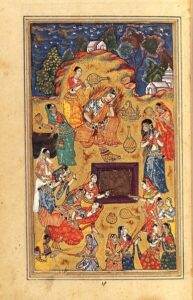
Figure IX: Mah Ji is inflamed by her longing from Shah Ji while the Court ladies play Holi. Manuscript of the Pem Nem (The Laws of Love). Bijapur. 1509-91. The Metropolitan Museum of Art. (https://www.metmuseum.org/art/collection/search/454781)
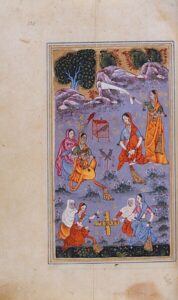
The second feature is the infusion of Sufi themes through exterior and interior. Three stages of ishq (love) – longing, proximity and intimacy can be seen as the paintings progress. The initial paintings (Figure I) of Shah Ji’s journey are sparse landscapes with the Palace in the background, symbolising his destination. The Palace, the token of proximity, is where the lovers meet. When they separate, Shah Ji again wanders here and there and significantly, Mah Ji, with her court ladies, upon separation, retreats to the garden and outside (Figures IX and X). The final union again takes place in the Palace. Herein, the Palace and later on the Bridal Palanquin and the Canopy (Figures XI and XII) become places of intimacy. The move from open landscapes and outer spaces to confined inner spaces symbolises the Sufi’s inward journey.
c13490-58 2.tif
Figure X: Mah Ji during her separation, playing games and attending to birds with her Court Ladies. Manuscript of the Pem Nem (The Laws of Love). Bijapur. 1509-91. The Metropolitan Museum of Art. (https://www.metmuseum.org/art/collection/search/454781)
Hutton concludes that the “mixture” of “sophisticated approach to, and understanding of. Visual representations” of the Sufi themes and the lack of technical execution, such as in painting unified facial features of the main characters shows three purposes – firstly, to “visually denote” the emotions as felt by the protagonists; secondly to reflect the stages of a Sufi journey and; thirdly to “link the masnavi directly to the courtly lives of the intended viewers” as is evidenced through the use of Bijapuri dress and architecture.
Questions are also raised regarding the intended audience of the romance. Evidently, the paintings focus on courtly life, especially that of women, and an equal number of paintings are populated by women. David Matthews notes that the language used is “rustic” and questions whether it was composed for the court, then “what sort of audience would have read or listened to such obscure lines?” Hutton speculates that this form of Dakhni, which contained a large number of words from local dialects, might be the language used by the royal harem and thus the visual weightage of women’s lives at court. The other speculation is that all of it might be a reflection of the larger feminine emphasis in Deccani culture at the said time period.
VISUAL VOCABULARY, SYNCRETICISM AND TWO-WAY TRAFFIC
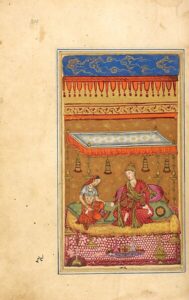
Figure XI: Shah Ji and Mah Ji hold hands. Manuscript of the Pem Nem (The Laws of Love). Bijapur. 1509-91. The Metropolitan Museum of Art. (https://www.metmuseum.org/art/collection/search/454781)
As noticed, Bijapuri painting is bold and rich in colour and highly ornamented with a mix of fantastical elements. Lush landscapes, oversized flowers, pairs of animals and longing lovers are some of the recurring themes. Bijapuri painting is also known for its use of golden floral and arabesque patterns, complex landscapes and detailed ornamentation. Renowned art historian Basil Gray notes that Bijapur was attached to the South Indian tradition and that this gave the “Adil Shahs its distinctly baroque character, full curves and rich jewellery instead of the angular forms and rather turgid colouring of the [Mughal School]”. Further ahead, palaces and gardens, unlike hunting scenes, are the subjects of the Bijapur school. Scholars argue that with the Mughal conquests of the Deccan, over time, the Deccani paintings became muted in colour tones, and more naturalistic and came closer to the Mughal miniature tradition.
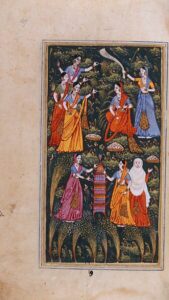
The cultural amalgam of the Deccan has clearly translated into the visual vocabulary of the paintings. Syncretism and eclecticism – as evidenced from Ibrahim II’s portraits, the painting of Goddess Saraswati, Shah Ji meeting a Yogini and Mah Ji and her court ladies celebrating the Hindu festivals of Holi and Diwali – are results of the cultural confluence of the Deccan. This can be viewed even in the minor details, such as the costumes, which are a blend of Southern Indian elements and Persian and Central Asian fashions.
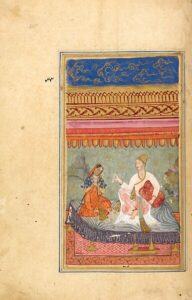
Figure XII: Newly married Shah Ji and Mah Ji sitting under a canopy. Manuscript of the Pem Nem (The Laws of Love). Bijapur. 1509-91. The Metropolitan Museum of Art. (https://www.metmuseum.org/art/collection/search/454781)
Overton (2016) cautions against the “risks of scholarly veneration” regarding Ibrahim II as a patron and the labels of “otherworldliness, leisure and mystery”, often applied to Deccani paintings. Rightly, more or so, she argues for “[Ibrahim II] as but one link in a long chain of intercultural production, rather than the singular source of inspiration” and once again directs our attention to the synthesis happening in the Deccan.
On the other hand, she notes that portable Bijapuri art such as “books, calligraphies, paintings, bejewelled items, metalwork, textiles” certainly entered Safavid collections, whether as diplomatic gifts or endowments to religious institutions”. This underscores the fact that while a synthesis was taking place in the Deccan due to the inflow of overseas influences, it was, in essence, only one-way traffic. Several Deccanis and Ghariban travelled back to the Safavid realms and other places, permanently or temporarily, as merchants and diplomats. This leads us to the paramount question that – what power and influence did they exert? The two-way traffic is yet to be unpacked.
c13490-57.tif
Figure XIII: Mah Ji and the Court Ladies celebrating the festival of Diwali. Manuscript of the Pem Nem (The Laws of Love). Bijapur. 1509-91. The Metropolitan Museum of Art. (https://www.metmuseum.org/art/collection/search/454781)
BIBLIOGRAPHY & REFERENCES:
1.Eaton, Richard M. “A Social and Historical Introduction to the Deccan, 1323-1687”. Sultans of the South: Arts of India’s Deccan Courts, 1323-1687, edited by Navina Najat Haidar and Marika Sardar. 2011. The Metropolitan Museum of Art, New York.
2. Haidar, Navina Najat. “The Kitab-i-Nauras: Key to Bijapur’s Golden Age”. Sultans of the South: Arts of India’s Deccan Courts, 1323-1687, edited by Navina Najat Haidar and Marika Sardar. 2011. The Metropolitan Museum of Art, New York.
3. Hutton, Deborah. “The Pem Nem: A Sixteenth-Century Illustrated Romance from Bijapur”. Sultans of the South: Arts of India’s Deccan Courts, 1323-1687, edited by Navina Najat Haidar and Marika Sardar. 2011. The Metropolitan Museum of Art, New York.
4. Overton, Keelan. “Book Culture, Royal Libraries and Persianate Painting in Bijapur, Circa 1580-1630”. Muqarnas: An Annual on the Visual Cultures of the Islamic World, edited by Gülru Necipoğlu. 2016. Brill. Volume 33.
5. Gray, Basil. “Deccani Paintings: The School of Bijapur.” The Burlington Magazine for Connoisseurs, Vol. 73, No. 425 (Aug., 1938), pp. 74-77 (4 pages). (https://www.jstor.org/stable/867457)
6. Deccani Manuscript Painting. Map Academy. (Deccani Manuscript Painting – MAP Academy)
7. Skelton, Robert. “Documents for the Study of Painting at Bijapur in the Late Sixteenth and Early Seventeenth Centuries”. Asia Asiatiques, Vol. 5, No. 2 (1958), pp. 97-125 (30 pages). (https://www.jstor.org/stable/43485254)
PICTURE CREDITS
1.Figure I: Shah Ji in search of Mah Ji, wandering through the Countryside. Manuscript of the Pem Nem (The Laws of Love). Bijapur. c. 1509-91. The Metropolitan Museum of Art. (https://www.metmuseum.org/art/collection/search/454781)
2. Figure II: The Procession of Sultan Ibrahim ‘Adil Shah II. Bijapur. c. 1595. The Metropolitan Museum of Art. (https://www.metmuseum.org/art/collection/search/454818)
3. Figure III: Colophon Page of the Kitab-i-Nauras with Vase illumination. Bijapur. c. 1618. Google Art and Culture. (https://share.google/tL5yHmIKVGgYK17JS)
4. Figure IV: Folios of the Kitab-i-Nauras. Khalilullah Butshikan, Calligrapher. c. 1618. Bijapur. The Metropolitan Museum of Art. (https://www.metmuseum.org/art/collection/search/458846)
5. Figure V: Goddess Saraswati enthroned by Farrukh Hussain. c. 1604. Bijapur. Wikipedia Commons. (Saraswati Enthroned – Wikipedia https://share.google/d3KVu49tgHbbNthZ4)
6. Figure VI: Sultan Ibrahim ‘Adil Shah II playing the Tambur by Farrukh Hussain. c. 1595-1600. Bijapur. The Metropolitan Museum of Art. (https://www.metmuseum.org/art/collection/search/454791)
7. Figure VII: Shah Ji weeps a stream of tears. Manuscript of the Pem Nem (The Laws of Love). Bijapur. 1509-91. The Metropolitan Museum of Art. (https://www.metmuseum.org/art/collection/search/454781)
8. Figure VIII: Golden Spray or flame coming out of Shah Ji’s mouth as he speaks to Mah Ji. Manuscript of the Pem Nem (The Laws of Love). Bijapur. 1509-91. The Metropolitan Museum of Art. (https://www.metmuseum.org/art/collection/search/454781)
9. Figure IX: Mah Ji is inflamed by her longing from Shah Ji while the Court ladies play Holi. Manuscript of the Pem Nem (The Laws of Love). Bijapur. 1509-91. The Metropolitan Museum of Art. (https://www.metmuseum.org/art/collection/search/454781)
10. Figure X: Mah Ji during her separation, playing games and attending to birds with her Court Ladies. Manuscript of the Pem Nem (The Laws of Love). Bijapur. 1509-91. The Metropolitan Museum of Art. (https://www.metmuseum.org/art/collection/search/454781)
11. Figure XI: Shah Ji and Mah Ji hold hands. Manuscript of the Pem Nem (The Laws of Love). Bijapur. 1509-91. The Metropolitan Museum of Art. (https://www.metmuseum.org/art/collection/search/454781)
12. Figure XII: Newly married Shah Ji and Mah Ji sitting under a canopy. Manuscript of the Pem Nem (The Laws of Love). Bijapur. 1509-91. The Metropolitan Museum of Art. (https://www.metmuseum.org/art/collection/search/454781)
13. Figure XIII: Mah Ji and the Court Ladies celebrating the festival of Diwali. Manuscript of the Pem Nem (The Laws of Love). Bijapur. 1509-91. The Metropolitan Museum of Art. (https://www.metmuseum.org/art/collection/search/454781)