

By Tehreem Asad
The essence of Delhi is difficult to recreate anywhere else. This, of course, can be an argument for any place that is as beloved by its people as Delhi is. Yet, one can almost feel all the different elements of the city harmonising together to form experiences that are so unique to the spirit of Delhi that they inherently shape the lives of its inhabitants. In fact, the idea of Delhi has been praised so extensively in literature and the local culture that it provokes a desire in people to feel, navigate, and make sense of the good and the bad Delhi has to offer. These quirks of Delhi (and Dilliwalas) create a fancy among artists and storytellers to capture the city at its most authentic state.
Bollywood Films have played a vital role in making Delhi a familiar space. There are some experiences of Delhi that can only be felt within the city. These films try to capture specificities of the city that people living here know very closely, allowing the audience to observe the recognisable details of everyday life. The lives of the characters are so completely woven into this environment that it would be difficult to imagine the story taking place anywhere else. Several movies give peculiarities of Delhi a voice in the central narrative. Not only that, there are different functions served by the city too; it acts as a place of shelter, relief, and retreat, but also one of conflict and imbalances. It is a place where one can be stuck, but also one where people find hope and yearn to go back to.
DELHI AS A HOME:
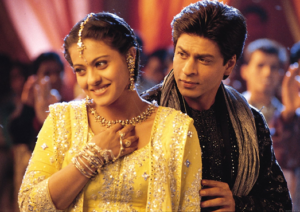
Everyone remembers the unforgettable character of Anjali in Kabhi Khushi Kabhie Gham…(2001) and her preoccupation with and yearning for her home in Chandni Chowk when she moves to London following her marriage with Rahul. Her attachment to Chandni Chowk was owed to the warmth and coziness of a home, which perhaps her abode in London was not able to provide to her. Here, the characterisation of Delhi as a home, full of safety, comfort, memories, and belongingness, sets it apart from other places, which may be equally as good in every other aspect, but fall short when it comes to providing the solace of home. Although it is important to mention here that none of the scenes from the film were actually shot in Delhi, it ends up establishing a quite important aspect of living in Delhi, which is the incessant love for the city and the enjoyment of living here.
A scene from the song ‘Yeh Ladka Hai Allah’ from Kabhi Khushi Kabhie Gham…
(Courtsey:https://upperstall.com/film/kabhi-khushi-kabhie-gham/#google_vignette)
In the film Delhi-6 (2009), Roshan is an NRI whose only connection to Delhi, initially, is that his family had lived in this area once. However, the more time he spends in the place, he makes it a space of his own. Delhi-6 familiarised not just Roshan, but also the audience that had never seen Delhi with the streets of old Delhi, landmarks like the Jama Masjid, and customarily performed traditions like Ramayana performances, Kaboortarbaazi, and kite flying, among others. Delhi-6 attempts to capture the genuineness of the experience of living in old Delhi.
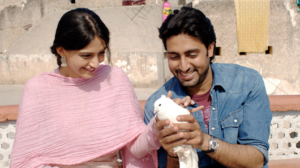
A scene from Delhi-6 (Courtsey:https://www.netflix.com/title/70113306 )
Sometimes, home is also ridden with chaos. This chaos manifests itself regularly, but especially before a big event, such as a wedding. Monsoon Wedding (2001) is centred around the event of Aditi Verma’s marriage and captures a realistic depiction of the frenzy and disorder one can imagine before a wedding. The story revolves around a well-off family residing in Delhi, and navigates through issues like gender, values and culture, sexual abuse and class disparity. The unpredictable Delhi monsoon mirrors the bedlam that the Verma family is experiencing simultaneously. Delhi provides a lively and colourful backdrop to the messy Punjabi wedding preparations, and, of course, the wedding itself.
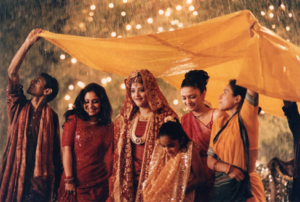
Aditi’s Wedding from Monsoon Wedding (courtesy:https://www.wunc.org/2023-05-09/youre-invited-to-monsoon-wedding-a-musical-nearly-15-years-in-the-making )
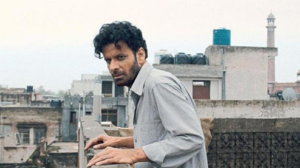
But home is not a place of comfort for everyone. Gali Guleiyan (2017) shows a departure in the portrayal of home, from a place of relief and solace to a place of distress. With the decline in his health and psychological condition, the protagonist Khuddoos struggles to navigate through the streets of his own neighbourhood. The familiar becomes entirely alien to him, and the resulting confusion is expressed through a labyrinth-like depiction of the streets of old Delhi. The roads of old Delhi are difficult to steer if one is unacquainted with them, and this quality is exaggerated to show how Khuddoos is stuck in his own home as he is in his past.
DELHI AS A REFUGE:
Home is not the only location that takes a position of centrality in the films. Although home is a place of comfort, there are several restrictions and responsibilities that come with home life. In fact, a lot of characters can only find peace when they are away from home. They find refuge in places where there is acceptance, freedom, and a reduction of control. They are sometimes able to find love, sometimes themselves, and other times opportunities that are unavailable to them because of their lives at home. Characters can express themselves unobstructedly as they move away from rigid obligations and towards an opportunity at liberation.
Chashme Buddoor (1981) follows the story of three students of Delhi University living in a modest barsaati in Delhi’s Defense Colony. The three roommates find considerable freedom away from their respective homes in their accommodation in Delhi. Omi and Jomo spend their time in either the hopeless pursuit of finding love or, in the true fashion of college students, idling away. The three can almost always be seen either with a cigarette in hand or buying cigarettes at the paan shop run by Lallan Miyan. Romance between Siddharth and Neha can be seen unfolding in different locations across Lutyens’ Delhi, like the iconic cafe in the Talkatora Garden. The film also features several other memorable locations and monuments. For instance, the climax of the movie is shot at the Tughlaqabad Fort.
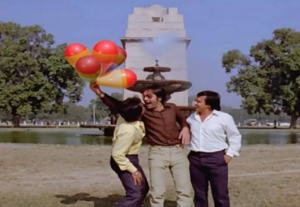
Opening scene from the song ‘Pyaar Lagawat Pranay Mohabbat’ from Chashme Buddoor, shot at India Gate, Delhi (Courtesy:https://zikredilli.com/f/delhi-summers-hindi-cinema-chashme-buddoor-1981)
Since Delhi is known for its historical monuments, it is not uncommon to see them being featured in movies shot in Delhi. They become backgrounds for the development of friendships, young love, and the social lives of our characters. Monuments like the Qutub Minar can be seen in films like Tere Ghar Ke Saamne (1963), Cheeni Kum (2007), and Rocky Aur Rani Ki Prem Kahani (2023). In the film Rockstar (2011), Hazrat Nizamuddin Dargah becomes a place of refuge for the heartbroken protagonist, who finds a sanctuary and inspiration in the Dargah. Lodhi Gardens, Agrasen Ki Baoli, Humayun’s Tomb, Red Fort, Chandni Chowk, and several other monuments can be seen as prominent backdrops (often for romantic scenes) in several films. But their function is not just limited to intimate or light-hearted scenes; they are also places of protestation and political activism. Monuments like India Gate or Jantar Mantar symbolise social action, where activism takes a central stage in the narrative, and the demand for social justice is raised. This expression of public dissent and advocacy taking place at India Gate in films is exemplified by films such as No One Killed Jessica (2011) and Rang De Basanti (2006), and at Jantar Mantar by films like Chakravyuh (2012).
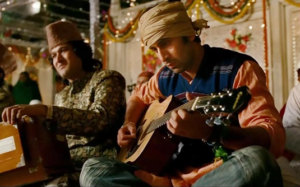
A scene from the song ‘Kun Faya Kun’ from Rockstar (Courtesy:https://www.koimoi.com/bollywood-news/rockstars-kun-faya-kun-transports-you-to-another-world-this-visual-representation-is-all-the-mondaymotivation-we-need-today/ )
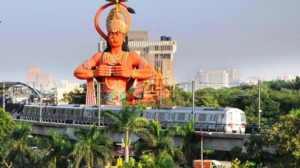
Another structure important to the everyday life of Delhi residents utilised by Bollywood films is the Delhi Metro. Millions of people travel through the Delhi Metro weekly, making it India’s busiest metro rail system. Post-2005, Delhi Metro became an important addition to the most films shot in Delhi. Most people would recognise the shot of the Delhi Metro crossing the Hanuman Mandir statue at Karol Bagh, popularised by Hindi films. Bewafaa (2005) became the first film to ever shoot inside the Delhi Metro, and several others like Black and White (2008), Dev D (2009), Love Aaj Kal (2009), Paa (2009), Jannat-2 (2012), PK (2014), Fitoor (2016), and Mom (2017) followed. The Metro scenes are often associated with connectivity, mobility, adventure, or simply the act of getting away from one’s problems. For instance, in Delhi-6, Bittu uses the metro to commute and travel away from her family, where she can work towards achieving her dreams.
DEPICTION OF DELHI AS A PERSON:
To state the obvious, Delhi is Delhi not just because of its picturesque locations conducive to filmmaking but also the lived reality of the city, which makes it different from other regions. Naturally, Delhi wouldn’t have been of as much interest to filmmakers if it weren’t for its people. Its history, traditions, landscape, and multicultural existence make for a unique lifestyle. Delhi also shapes the lives of its people through the encounters that are exclusive to this place, some of them good, but some of them bad and almost peculiar.
Numerous memorable characters in Bollywood movies have a distinct ‘Delhi flavour’ to them. However, the desire to produce an authentic Dilliwala character has resulted in a relatively stereotypical portrayal of Delhi people. For instance, the markers of the typical ‘middle-class’ Delhiite characters [as seen in films like Khosla Ka Ghosla (2006), Fukrey (2013), Rajma Chawal (2018), and many others] is exemplified by their language, which is a blend of Hindi, Punjabi, and English and quirks like being loud, outspoken, foul-mouthed, and brash. Cinema is a wonderful way to acquaint oneself with the world. This also means that it holds the power to create perceptions of people and places and actively shapes the way a city is imagined and remembered. Bad and stereotypical portrayal of Delhi people, thus, does not do justice to the myriad of lives that people live here.
CONCLUSION:
The reciprocal relationship between characters and their spatial environment adds an important dimension to stories. This is especially true for a city like Delhi, which is an important character in itself for several Bollywood films. Through Bollywood films, one gets to experience the good, the bad, but most importantly, the familiar aspects of Delhi. These films try to capture Delhi through its small and recognizable details. However, it is also important to understand that a distinction between reality and creative imagination can only be made out by people who have access to the spaces shown in films. A vision propagated by cinema builds or changes the perception of the audience about a place, for the better or for the worse.
BIBLIOGRAPHY:
1.Singh, Rupinder, and Sneha Singh. ‘The ‘Movement-Image’ of the City: Cinema as The Operative Image in The Lived Reality of a City.’ Future is Urban: Livability, Resilience & Resource Conservation, 1st Edition, Routledge, 2023.
2. https://enrouteindianhistory.com/bollywoods-affair-with-delhi-heritage-love-and-rebellion/
3. Publication, T. JP RC. ‘MOBILITIES ON SCREEN: DELHI METRO IN BOLLYWOOD (2005-2017).’ Trans Stellar Journals, 2021.
4. https://www.scoopwhoop.com/entertainment/bollywood-has-ruined-delhis-reputation/
5. https://urbandesignlab.in/the-city-and-cinema-portrayal-of-delhi-india/#:~:text=It%20was%20only%20in%202000’s,and%20pubs%20with%20white%20women.