

By Tehreem Asad
Throughout the 1840s and 1850s, India saw an increase in the existence of printing presses. This led to an increased production of works of literature, poetry collections, translations, literary commentaries and so on. Another area that benefited from the developments in the printing press was that of newspapers. Although the tradition of newswriting existed in India even before British rule, this period saw a rise in printed newspapers, both in English and in regional languages. The emergence of the vernacular press gave a chance for the local community to voice its opinions and concerns. The Dehli Urdu Akhbar was established in the 19th century, right at the cusp of the outbreak of the revolt of 1857. This was Delhi’s first vernacular newspaper, written in a local language and intended for the native audience. It pioneered Urdu journalism in Delhi. The newspaper carried with it elements of earlier traditions as well as introduced several new dimensions. Despite its short-lived existence, the Dehli Urdu Akhbar managed to contribute significantly to the cause of the revolt and exemplified active resistance through journalism.
EARLIER TRADITIONS OF NEWSWRITING
The tradition of producing handwritten Persian newsletters has existed since the time of Mughal Emperor Akbar. These akhbarat facilitated the communication between the imperial and the regional courts. There existed newswriters who compiled the information on occurrences such as the daily proceedings of the Emperor and details from the letters of imperial envoys and read them out publicly during the durbar. A great deal of importance was given to the information regarding the Emperor. This tradition of the akhbarat continued well into the 19th century and was used both by the Indian and the British rulers.
The first English newspaper was founded in Bengal in the latter decades of the 18th century. Those who worked for the newspaper made an effort to give a voice to the public opinion and, if need arose, criticised the policies of the government. In the 19th century, several newspapers in vernacular languages were established, including in Bengali (1818) and Gujarati (1822). Newspapers like A’ina-e-Sikandar and Sultanu’l Akhbar were some of the first printed newspapers in Persian. Although they were published from Calcutta, they provided information about the developments in Delhi, especially those pertaining to the Emperor. Thus, these newspapers also had readership in Delhi. In 1833, the first newspaper from Delhi was founded by H. Hope, called the Delhi Gazette, which mainly catered to a British audience. However, it is in the Delhi Gazette, some scholars feel, that we get the preliminary design of the Dehli Urdu Akhbar.
DEHLI URDU AKHBAR:
The Dehli Urdu Akhbar was Delhi’s first Urdu weekly newspaper. The earliest reference to the newspaper comes from 1837, and the oldest known surviving copy of it dates from 1840. Traditionally, Maulvi Muhammad Baqar is recognised as the founder of the newspaper. Maulvi Muhammad Baqar is the father of the prominent writer and scholar Muhammad Husain Azad.
He was a scholar who was well versed in Persian, Arabic, Urdu and even English. He worked at the Delhi college as a Persian language teacher and later also worked as a sarishta-dar in the revenue department for the British administration under Charles Metcalfe. According to eminent journalist and writer Gurbachan Das Chandan, Baqar bought a litho press in 1834, which prompted the establishment of the Dehli Urdu Akhbar in 1836-7. Historian Margrit Pernau argues that there are no references to Baqar’s association with Dehli Urdu Akhbar before the 1850s, and it would not have been possible for him to buy a press in 1834. Nonetheless, Baqar’s most important contribution to the newspaper was his role as the muhtamim (manager) and editor of Dehli Urdu Akhbar during the revolt of 1857.
The Dehli Urdu Akhbar was printed weekly on four pages of 12×8 inches and issued every Saturday. The price of the monthly subscription was 2 rupees, which was quite expensive by the standards of that time, thus, only being accessible for the elites. However, the number of copies sold does not reflect the actual number of consumers. The Akhbar must have been circulated between families and friends. News from different newspapers was compiled and read out to the public by some. This indicates that the readership of the Akhbar was much larger in reality and that the news in the Akhbar must have reached even those who could not read. The news provided in the Dehli Urdu Akhbar was obtained from other newspapers that were produced in Urdu and English, as well as government gazettes. Apart from this, correspondents wrote to the editor providing information from different regions. G.D. Chandan suggested that Maulvi Baqar had established a guest house of sorts for travellers and traders, who would relay information about other regions. There are also incidents in the Akhbar that recount the first-hand accounts of Maulvi Muhammad Baqar himself, indicating that direct observations of editors may have also been used as a source of information.
The contents of the Dehli Urdu Akhbar addressed a wide range of topics. Reports on authority included news on both the imperial court and the Emperor, covered in the column designated ‘Huzoor-e-Wala’, and on the operations of the East India Company, Company Resident, and its officials. Events from the life of the Emperor, royal weddings, hunting trips of the emperor, festivals like Eid, Muharram, Ram Leela, and Phool Walon Ki Sair were reported, which in a way reflected a continuation of the tradition of the handwritten Persian Akhbarat.
The Akhbar sought to reflect the sentiments of Delhi’s general population. The editors viewed the newspaper as a means to convey public opinion to the government, typically following news with commentary or solutions. It reported, discussed, and sometimes even criticised government orders, British policies, and Mughal court affairs. For example, it denounced issues like the Indian elite holding low-paying jobs, rising prices, and high taxes. News on crime and police administration was also shared. Corruption among British officials, the imperial court, and policemen was condemned, though the police sometimes received praise for dispensing justice. In contrast to its critical assessment of officials, the Akhbar always adopted a polite, respectful tone toward the Mughal Emperor, sparing him from fault-finding.
Apart from local and administrative news, the Akhbar also presented observations on the prevailing weather conditions. The letters to the editor were included in the copies, and so was poetry. In fact, the paper also published some of the poems written by Mohammad Hussain Azad during the revolt. The paper also printed advertisements for various events, books, performances, government circulars, etc. A column of the newspaper was dedicated entirely to news from outside the city, from regions like Calcutta, Bombay, Madras, Punjab, Agra, Lucknow, Nagpur, Jodhpur, Gwalior, Afghanistan, Russia, France, China, Burma, Central Asia and of course Britain. Issues of social reform and education were also addressed.
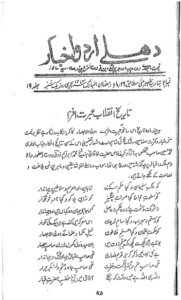
(Poem by Mohammed Hussain Azad, published on May 24, 1857, openly in support of Badshah Bahadur Shah Zafar and against tyrants like the British
Courtesy: https://zikredilli.com/f/dehli-urdu-akhbar)
ROLE DURING 1857:
The Akhbar was not an ardent opponent of the British initially and was on the whole favourably disposed towards the Company. It praised the Company depending on the event, but was prepared to assign blame when its policies directly harmed the welfare of the readers. However, this attitude changed quickly after the revolt broke out. The revolt broke out on 10th May 1857 and spread from Meerut to Delhi within a day’s time. Mughal Emperor Bahadur Shah Zafar was declared the leader of the revolt, and Delhi came under Rebel administration from May till September 1857, when Delhi was recaptured by the British forces. The editor of Dehli Urdu Akhbar in 1857, Maulvi Muhammad Baqar, contributed devotedly to the Akhbar in the capacity of editor and reporter. He was loyal to Bahadur Shah Zafar and supported the cause of the rebels.
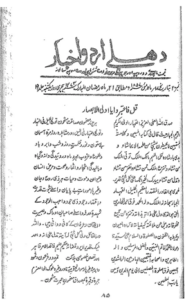
The May 17, 1857 edition of the Dehli Urdu Akhbar
(Courtesy: https://zikredilli.com/f/dehli-urdu-akhbar)
After the revolt had broken out, Delhi was cut off from the rest of the country. The postal services became non-functional, and it was not possible to report on what was happening other than what took place within the limits of the city. In the issue of 24th May, Baqar complains about the postal services still not being fixed. This meant that the Akhbar had to rely on information from people as well as direct observations.
In June 1857, the revolt intensified. Governor-General Lord Canning reportedly accused the native press of spreading anti-British sentiments among the general population. The style of reporting of the Dehli Urdu Akhbar would reflect this. Baqar encouraged the sepoys, and in the issue from 14th June, one can see him appealing to both the Hindu and Muslim sepoys to unite.against the British. He would later start referring to the sepoy army as sipah-i-Hindostan (the Army of India) and use other phrases like ahl-i watan (people of the homeland) and aziz ham-watan (beloved countrymen), emphasising the need for Indians to stay united. He referenced examples from both Hindu and Muslim traditions to motivate them and highlight the importance of staying together during this fight. He strongly condemned and criticised the ishtihar (in issue from 5th July) that was found pasted on the walls of the Jama Masjid, allegedly left there by British agents, which claimed that Muslims should wage the war against the Hindus instead, because Christians were ‘People of the Book’ (Ahl al-Kitab) according to Islamic tradition. Baqar reiterated that Indians were one and criticised the British and dubbed them as foreigners in this land.
On 12th July 1857, Maulvi Muhammad Baqar changed the name of Delhi Urdu Akhbar to Akhbar-uz Zafar as a tribute to the Emperor Bahadur Shah Zafar (moreover, Zafar means triumph, so the name implied the victory of the rebels), and the last 10 issues of the paper were published under this name. Instead of Saturdays, now the Akhbar was issued on every Sunday, as a non-compliance to the Christian observance of the Sabbath, to challenge the British authority.
In his book The Last Mughal (2006), historian William Dalrymple described Baqar as ‘a British informer’. According to G.D. Chandan, this accusation of Baqar being on the side of the British stems from the fact that in the initial days of the revolt, Baqar provided refuge to an acquaintance, the then principal of the Delhi College, Francis Taylor. Taylor was much disliked for converting people to Christianity, and a crowd was out there looking for him. Despite Baqar’s attempt, the crowd eventually found Taylor and put his life to an end. Taylor allegedly gave Baqar a letter before his death, which he faithfully handed over to another British officer. Many other scholars like Rana Safvi and Shireen Moosvi have argued that Baqar was not a traitor, and the Britishers certainly did not see him as an ally.
The Dehli Urdu Akhbar came to an end in September 1857. The British forces finally were able to enter the city of Shahjahanabad in September, and Baqar was taken by the British during the mass arrests on 14th September 1857. He was made to appear in front of Major William Hodson, who ordered his execution. On 16th September 1857, Maulvi Muhammad Baqar was executed. He is believed to be the first martyr journalist of the Indian freedom struggle. The British burned down the remaining issues of the newspaper, and the Dehli Urdu Akhbar came to an end with the demise of its last editor. However, the surviving issues of this newspaper reveal to us the early print culture of Delhi.
BIBLIOGRAPHY:
1. Margrit Pernau. (2003). The Dehli Urdu Akhbar Between Persian Akhbarat and English Newspapers. The Annual of Urdu Studies, 18.
2. Chandan, G. D. ‘Maulvi Mohammad Baqar’. Nuqoosh, Lahore, 141, 131–153.
3. Liddle, S. (2022). THE BROKEN SCRIPT DELHI UNDER THE EAST INDIA COMPANY AND THE FALL OF THE MUGHAL DYNASTY, 1803-1857.
4. https://zikredilli.com/f/dehli-urdu-akhbar
5. https://m.thewire.in/article/history/forgotten-hero-of-1857/amp
6. https://www.dawn.com/news/1208216
7. https://archives.peoplesdemocracy.in/2007/0429/04292007_1857.html
8. https://www.youtube.com/watch?v=biUklvgFyTU