
By Aryan Singh
Deep inside the thick forests of Delhi’s Ridge, surrounded by the posh lanes of Chanakyapuri, lies a forgotten monument shrouded in mystery—Malcha Mahal. Unlike the bustling forts and palaces that draw visitors every day, this palace sits in eerie silence, its crumbling walls guarding a story that is as tragic as it is fascinating.
Malcha Mahal traces its roots back to the 14th century when Sultan Firoz Shah Tughlaq, one of the prominent rulers of the Delhi Sultanate, built it as a hunting lodge. In those times, it echoed with the sounds of royal pursuits and the pride of the Sultan’s empire. But history had a strange fate in store for this palace. Centuries later, in the 1980s, its decaying structure was handed over to the controversial descendants of the once-glorious Awadh dynasty. After years of petitioning for royal rights and recognition, Princess Wilayat Mahal and her children were granted residence in Malcha Mahal. Their claim of being part of the royal family was challenged, and various articles were published by The NewYork Times.
What was meant to be a home soon turned into a prison of despair. Cut off from the world, with no grandeur or comforts of royalty, the family lived and died in seclusion within its darkened halls. Over time, the palace earned a reputation not only for its royal tragedy but also for the ghostly aura that now surrounds it.
This article journeys through Malcha Mahal’s forgotten past and haunting present, uncovering how a place of royal leisure transformed into a ruin of sorrow, mystery, and neglect.
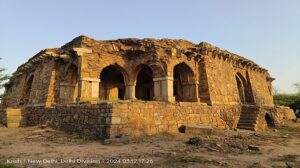
Source: Wikipedia Commons, Malcha Mahal
Malcha Mahal means Deer Palace and is named after the old village of Malcha, on whose land the Viceroy’s House—now Rashtrapati Bhavan—was built. When Lutyens’ Delhi was developed, the village gradually disappeared, but its story never truly ended. To this day, descendants of its residents continue a legal battle, demanding compensation for the land the British seized without paying. Malcha’s legacy isn’t just about loss—it also symbolises resilience. During the Great Uprising of 1857, the villagers of Malcha transformed the crumbling Mahal into a secret refuge. (New York Times)
Once a shelter for rebels and a symbol of resistance, Malcha Mahal now stands in ruins, drawing curious visitors on haunted walks. Adding to its eerie reputation was a chilling sign once hung at the entrance: “Entry Restricted. Intruders shall be gunned down.” No wonder the place became wrapped in fear and mystery.

Source: Wikipedia Commons, Entry gate of Malcha Mahal
The haunted tales of Malcha Mahal are tied to Begum Wilayat Mahal, who tragically ended her life on 10th September 1993, reportedly by crushing and consuming diamonds. Since then, local legends whisper that her spirit still roams the palace corridors, wrapping the ruins in an air of mystery and dread.
Who was Begum Wilayat Mahal?
Begum Wilayat Mahal and her family claimed their lineage from Nawab Wajid Ali Shah, who was dethroned in 1856 on charges of “misgovernance” and exiled to Calcutta after the annexation of his kingdom. While the Nawab’s descendants scattered across the country, controversy has always surrounded the authenticity of Wilayat’s royal claim.
Wilayat, the second wife of Inayatullah—a Kashmiri by birth—married him during her teenage years. Later, they settled in Lucknow, where Inayatullah took up the post of registrar, and the couple was blessed with five sons and one daughter. After the Partition, their lives changed dramatically when Inayatullah was attacked, prompting them to escape to Karachi. There, he served as Secretary of Pakistan Aviation Limited until he died in 1951. (Ellen Bury)
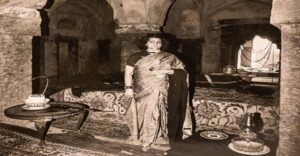
Source: Reddit, Begum Wilayat Mahal in Malcha Mahal
Wilayat was not just a homemaker; she was an outspoken activist, known for supporting Kashmiri independence. In 1954, she openly challenged Pakistan’s Prime Minister, which led to her arrest and alleged mistreatment. Seeking relief, she applied for asylum in India and returned in 1962, asking to resettle permanently. One of her sons, Sadiq, chose to return to Pakistan, but the rest of the family stayed on, permitted to remain in India only on a year-to-year basis, depending on “good conduct.” (Ellen Bury)
It was during this time that Wilayat began styling herself as the “Begum of Oudh.” According to a 1981 report in The New York Times, she was given a small palace in Srinagar by Jawaharlal Nehru as compensation for her lost Lucknow properties. But in 1971, the palace mysteriously burned down—a tragedy she believed was no accident, hinting at government involvement and communal motives. The family then moved to Lucknow, where sympathetic politicians offered her a house in Aliganj. Proud and defiant, Wilayat refused, determined to hold out for what she believed was her rightful due.
The family eventually moved to Delhi, where they staged a dramatic protest by taking up residence in the waiting room of New Delhi Railway Station’s Platform 1. Their demand was clear: they sought accommodation worthy of their royal heritage, in return for the ancestral properties seized by the British in 1856. The unusual sight of a so-called royal family living in a railway station soon drew media attention and even sparked debates in Parliament. The growing pressure finally led Prime Minister Indira Gandhi to step in, and in 1985, the government granted them Malcha Mahal. Interestingly, the family had also been offered Porsche apartments in Delhi’s elite neighbourhoods, but they refused—insisting they could never live “among commoners.” (Tornos india.com)
During their long stay at the railway station, the Awadh family faced many troubles—hostility from the public, pressure from authorities, and even attacks from goons who wanted them out. Before the family finally moved into Malcha Mahal, the building had been used by young Delhi painters under the Lalit Kala Akademi. But in 1967, the artists were asked to leave when an earth station was built nearby. To protect their paintings—and to keep monkeys away—they had put up metal shutters on the gates, some of which remain.
Malcha Mahal was hardly a royal residence. It had only five arched chambers without doors or windows, lacked a proper water supply, and had none of the comforts of modern life. For years, the family collected water from the market until, after eight long years, they finally got a connection from the nearby ISRO Earth Station. Food was cooked over open fires, and ration supplies had to be brought from Paharganj. (Tornos India.com)
In her memoirs, Sakina, the daughter of Begum Wilayat, recalled the harsh conditions they endured. Though the family paid the municipal corporation for water, tankers could not reach the Mahal’s remote location—most of the supply spilling away before it arrived. Electricity, too, was a struggle. Even when a power grid was installed nearby, Wilayat had it removed, fearing it might harm her dogs. In desperation, the family even tried digging a well, but the effort failed, leaving them dependent on the Earth Station for survival.
Sakina recalls in her memoirs that her mother, Begum Wilayat, was a heavy smoker, with a packet of cigarettes always lying on her table. When Wilayat died on 10 September 1993, Sakina described it as a “Black Friday.” What followed was haunting—she and her brother stayed with their mother’s body for days, without food or water. Finally, they wrapped the corpse in a silk sari, dug a grave themselves, and lined it with marble slabs before laying her to rest. (New York Times)
Prince Ali Raza, the last known heir of Malcha Mahal, lived a life of quiet solitude within its crumbling walls until his death on 2nd September 2017. Just 58, he had been battling illness, relying on the kindness of nearby earth station guards for essentials like milk and groceries. In his final days, the once-proud descendant of royalty struggled in obscurity, even earning a modest living by helping diplomats breed their dogs.
When guards from the space research organization ventured inside the palace one day, they discovered him lying lifeless on the floor. No relative came forward to claim his body. On 5th September, he was quietly laid to rest at a graveyard on Bahadur Shah Zafar Marg, buried by local police rather than kin. With his passing, not only did Malcha Mahal fall silent, but the fragile legacy of a royal family, once entwined with Delhi’s history, faded into the shadows forever. (Tornos india.com)
Controversy about their lineage
The story of Malcha Mahal took an even darker turn when The New York Times launched an investigation, questioning the family’s royal claims. Their report suggested that the so-called descendants of the Nawabs of Awadh were, in fact, Kashmiri Butts—Sunni Muslims by origin. This directly contradicted their assertion of belonging to the House of Oudh, a Shia dynasty established by Saadat Khan, a nobleman of Persian lineage. (New York Times)
The revelations didn’t stop there. The report alleged that there were nearly 20 sons in the family, including Shahid and Ali Raza. From his deathbed, Shahid himself supposedly confessed that their royal heritage was fabricated. Yet, Sakina—the princess who guarded the palace walls with stoic silence—refused to acknowledge Shahid as her brother, dismissing him perhaps as a mere step-sibling. (New York Times)
With these conflicting claims, the truth about Malcha Mahal remains shrouded in mystery—was it the last refuge of a fallen dynasty, or simply the stage for a family’s elaborate masquerade?
Moluddin Chishti Dargah
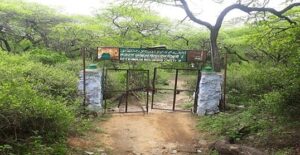
Source: Wikipedia commons, Entry gate of Moluddin Dargah
Tucked away near the crumbling Malcha Mahal lies a forgotten marvel of Delhi’s past—a massive 14th-century masonry dam and the modest dargah of Hazrat Moluddin Chisti. The saint, as his gravestone records, was laid to rest here on 11 Rajab 1300 Hijri (May 18, 1883), at the very spot where he spent years in prayer and meditation. (Anand Vivek Taneja, 2017)
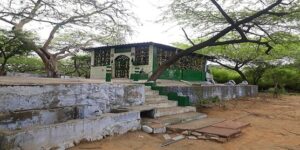
Source: Wikipedia Commons, Inner Complex of Dargah
Water has always been at the heart of this sacred site. Oral traditions recall that the dam once held such vast reserves of rainwater that a shimmering jhil stretched from Dhaula Kuan to Rajinder Nagar. Built along the Delhi Ridge, this ancient reservoir was a lifeline—collecting monsoon rains, preserving them, and channelling them to irrigate the fertile fields of Malcha village. (Anand Vivek Taneja, 2017)
But legends also speak of turmoil. The caretaker narrates how the British, in their campaign of dominance, attacked the village, driving away its people and leaving behind only whispers of its once-thriving life. Today, the silent dam and the saint’s shrine stand as weathered sentinels, reminding us of a time when water, faith, and community shaped the very soul of Delhi.
References
1. “The Residents of Malcha Mahal, Delhi – PIX.” PIX, 23 Apr. 2020, www.enterpix.in/editorials/personal-paradigms/the-residents-of-malcha-mahal-delhi/.
2. Today, India. “Secrets of Delhi’s 700-Year-Old Malcha Mahal: Tughlaq Legacy and Royal Tragedy.” India Today, 2 Jan. 2025, www.indiatoday.in/education-today/gk-current-affairs/story/haunted-history-of-delhis-700-year-old-royal-lodge-malcha-mahal-2658740-2025-01-02. Accessed 20 Aug. 2025.
3. “No Royal Burial – Mysterious Royal Family of Awadh in Delhi’s Malcha Mahal Die One by One Leading a Recluse Life. «TORNOS – India.” Tornosindia.com, 2019, tornosindia.com/no-royal-burial-mysterious-royal-family-of-awadh-in-delhis-malcha-mahal-die-one-by-one-leading-a-recluse-life/. Accessed 20 Aug. 2025
4. “Reclaiming the Lost House of Oudh.” The Chakkar, www.thechakkar.com/home/houseofoudh.
5. “Jinnealogy: Time, Islam, and Ecological Thought in the Medieval Ruins of Delhi: Taneja, Anand Vivek, 1980- Author: Free Download, Borrow, and Streaming: Internet Archive.” Internet Archive, 2017, archive.org/details/jinnealogytimeis0000tane/page/194/mode/2up. Accessed 20 Aug. 2025.
6. Barry, Ellen. “The Jungle Prince of Delhi.” The New York Times, 22 Nov. 2019, www.nytimes.com/2019/11/22/world/asia/the-jungle-prince-of-delhi.html.