
Depiction of Love through Ragamala Paintings : Bundi-Kota Substyle of Rajasthani Painting
- April 6, 2026
RAVNEET KAUR
“To the Indian mind the unity of all forms of art is indivisible”
~ Visnudharmottara Purana
“What does never change,
Since the days of the gods,
Is the way how a river runs
What does never change,
Since the days of the gods,
Is the way how love flows”
~ Noguchi, The Spirit of Japanese Poetry
Ragamalas, literally ‘garland of ragas’, is a set of miniature paintings singularly known as Ragachitra. These Ragachitras are a visual depiction of ragas – a range of musical modes arranged in specific sequences. They are often accompanied by a small text in Sanskrit giving the Ragas’ description, known as Raga Dhyana. The Sangam (Confluence) of music and painting is formed here, and among the many emergences of its, the foremost is love.
Music and paint have been married many times over, across the world in various ways. During the Renaissance, Raphael and Leonardo da Vinci made use of ratios of consonance (of musical notes) in their artworks. The merger of art forms was furthered during Romanticism. The Ragamala Paintings (16th-19th Centuries) do the same, albeit differently. In Indian Classical Music, Ragas are associated with specific moods which they are meant to evoke. These associated emotions are visualised in the form of symbols, seasons, scenery and background, which culminate in the Ragamalas.
In this essay, we’ll see how these moods are evoked and emotions manifested to depict love in the Bundi-Kota style Rajasthani Ragamalas.
The nomenclature of ‘Rajasthani painting’ is given by Ananda Coomaraswamy in his Rajput Painting (1916). He divided Rajput painting into two – Pahari (in Punjab Hills) and Rajasthani (Rajputana) – as both were patronised, more or less, by Rajput rulers. Rajasthani painting is further classified into different schools/styles and sub-styles, the classifications varying from scholar to scholar. Major styles and sub-styles of Rajasthani Painting are – Mewar, Marwar, Jodhpur, Bikaner, Kishangarh, Bundi, Kota, Amber, Jaipur, Nath Wada, Uniara and so on.
The 7th to 15th Centuries saw the development of iconography, painting and architecture in Rajasthan. Major influence of Jaina and Gujarat styles is visible – the majority of the pictorial texts of Rajasthan from the 12th to 15th Centuries are based on Jain Texts. The Mewar-Marwar textual illustrations of the Jaina text Kalpa Sutra are one such example. The style of painting here is known as the – Apbransh style. By the 15th-16th Centuries, with the development and influence of Mughal miniatures, the Rajasthani miniature paintings emerged. The Ragamalas belong to this school.
There are six principal ragas, though they are different in Shiv Mât, Bharat Mât, Hanumat Mât and Kallinath Mât. According to Hanumat and Kallinath Mât, the six principal Ragas are Bhairav, Malkos, Hindol, Dipaka, Shri and Megh. The ragas are visualised as males and have five (in some cases six) female counterparts each, called Raginis. Furthering the family analogy, they also have Ragaputras (sons) and Ragaputris (daughters).
There are varying opinions on the origin of raginis and the extended family. Ganguly’s analysis shows that ragini as a word is not mentioned in the works of Dattila, Bharata, or in the Brhaddesi. Dr M. K. Sharma in his Rajasthani Ragamala Chitra Parampara, argues that if the taal (rhythm) ascends towards the higher pitch, then it is classified as masculine. In any case, raginis are believed to be “graceful, minor, diminutive, or abbreviated forms of ragas”. They are perceived as the derivatives of the root-ragas, and as reflecting the character of the ragas’
The Paintings are influenced by numerous musical treatises, such as – Brihaddesi of Matanga (7th-8th Centuries), Ragasara of Narada and Dattila (8th Century), Manasollasa by Someswaradeva, Sangitaratnakara by Sarangadeva (c1212-1247 C.E.) and so on. Not only musical treatises, but they are also based on medieval literary creations like Keshava Dasa’s Rasikpriya, Jaidev’s Geet Govind, Bhanudatta’s Rasmanjari and Matiram’s Rasraaj.
Each Raga is associated with a time of the day – early morning, morning, evening, night and seasons – spring, summer, monsoon, early winter, winter, etc. The Raga and its setting are meant to set a mood and evoke certain emotions in both – the musician and the audience. The Ragamalas serve the same goal of eliciting these emotions from the viewer. Vasudeva S. Agarwal in The Heritage of Indian Art aptly summarises –
“Each raga or ragini has its burden an emotional situation based on some mood of love, either in union or separation. The picture of a raga is a visual representation of this state of mind, treating the material world and nature as a mirror of the mood”
Among the nine rasas, the influence of Srinagar rasa is the most dominant and thus love, romantic, erotic or devotional, is at the forefront of the Ragamalas. However, apart from love, other emotions are also summoned. For instance, the Nat Ragini is connected with the imagery of a battlefield, while that of Devgandhar Ragini is with a Sadhu and thus symbolises renunciation of all worldly pleasures. On the other hand, the Shri Raga, enjoying music, can be interpreted with the enjoyment of earthly delights.
The Ragamalas make heavy use of symbols, scenery and background to convey the emotion to the spectator. Animals, birds, human figures, their postures and gestures, the use of colour palette, seasons and so on are the vehicles of deliverance. A tiger would symbolise Ragini Bangali, and a camel Ragini Maru. Hindol Raga is always identified with a swing, Megh Raga with rains, and the colour red is heavily used with Raga Dipaka. All symbols and sceneries come together and their culmination peaks at the realisation of the intended Bhava (emotion) in the viewer.
The Ragachitras with human love as their theme are based on Indian love lore and erotics (rasashastra). The characters are conceived as heroes and heroines in accordance with the nayaka-nayika bhed. O. C. Ganguly writes that the usage of these poetical ideas “has not only enriched the significance of the musical expressions, but has also helped to achieve a happy and a subtle unification of literary and musical ideas.”
Let us take a look at some Ragamalas from Kota-Bundi in Rajasthan. The paintings selected and shown here are all from approximately c. 1725 C.E. Though Kota and Bundi are different substyles, they are greatly influenced by each other and have shaped each other, too, due to their geographical proximity. The paintings are attributed to both Kota and Bundi, due to their stylistic similarities and maybe also due to the difficulty in ascertaining the one single origin, if there is one to be found. A significant detail is the colour palette in these paintings, which is sombre and yet not gloomy.
FIGURE I
RAGINI TODI
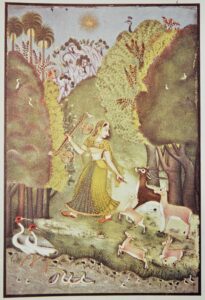
“Her slim body is radiant as the frost or the kunda flower, and is smeared with the paste of saffron and camphor. She beguiles the deer in the woodlands, carrying her vina, such is a Todika”
Ragini Todi is the wife of Raga Malkos. It is supposed to be sung in the early morning/ sunrise, and morning. Ragini Todi is always painted with a veena and is accompanied by animals, mainly deer and birds. She symbolises the lovelorn nayika as she wanders in the forest searching for her lover. The deer can be read as a motif for the absent lover. It is theorised that the imagery is based on milkmaids who looked after their herds and sang songs to them, as herein also, all the birds and animals are enchanted by Todi’s music. About Todi, in Sri-Hari’s ‘Nagdnandam’, Atreya (Act 1), says, ‘Even the deer prick up their ears, and listen to the strain with their eyes closed, while from their mouth falls the half-chewed grass.”
FIGURE II
RAGINI LALITA
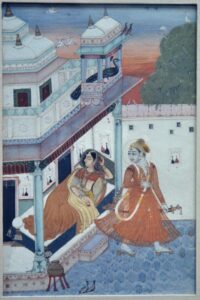
Ragini Lalita, in some texts also classified as Bhairava’s son and Ragaputra Lalita, is a morning raga as Bhairava itself is sung in the morning. Ragini Lalita is showcased as a sleeping nayika who is abandoned by her lover, who looks at her over his shoulder. She embodies unsatiated love and the sorrow of separation at daybreak. A very interesting detail emerges in Ganguly’s analysis of the differences between the earlier Sanskrit Dhyanas (verses/short texts describing the corresponding painting) and the later Hindi Dhyanas in his Ragas &Raginis (1947). In the Sanskrit Dhyana-shlokas, the nayika “heaves heavy sighs” upon waking up as the lover has gone to attend the duties of the day. In the later Hindi dhyanas, the description becomes elaborate, and the emotion is taken up a notch, where the nayika plunges into the depths of grief because her lover has abandoned her. Moreover, there’s a lovers’ quarrel where she even falsely accuses him of going to another lover!
FIGURE III
RAGINI VILAVALI
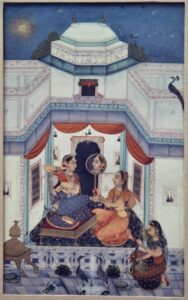
“Having indicated to her beloved the place of tryst, she decks and shows off her person. Every moment she prays to the God of love, Vilavali has the complexion of a blue lotus”
Ragini Vilavali is another wife of Raga Bhairava and a morning melody. In the painting, she can be seen as preparing and getting ready, with the help of her attendants, to meet her lover. The act of beautification is ladled with Sriangar rasa. The scene evokes hope, anticipation and expectation. Maharaja Sawai Pratap Sinha Deo of Jaipur (1779-1804) in his Hindi work entitled Sangitasra, writes –“For the purpose of meeting her beloved in the trysting-place, she is putting on her jewels, (sitting) on the terrace; and she is repeatedly recalling and invoking her favourite deity — the god of love; her complexion is like the colour of blue lotus. A ragini visualised as above, one should recognise as Velavali.”
FIGURE IV
RAGINI KAMODI
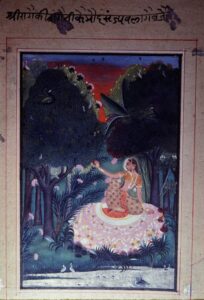
“The fine haired lady wears a yellow robe. She weeps in distress by the voice of the cuckoo in the woods, she looks about in mighty terror, Kamodika recalls her beloved “
Ragini Kamodi is Dipaka’s wife and is the melody of the evening/early night. She is the personification of viraha (separation). She showcases the separation of lovers and exemplifies the emotion of longing. This loneliness is further heightened by the fact that she is completely alone, without any Sakhi (companion) or attendant, and has ventured out alone at night to wait for her beloved. The garland in the painting is a symbol of union, of a tryst between lovers and solidifies the absence of the beloved.
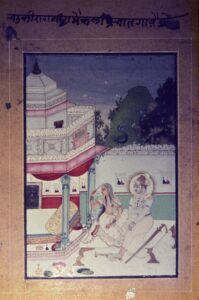
FIGURE V
RAGINI RAMKALI
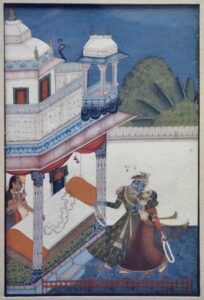
Similarly, multiple such facets of love emerge in the Ragamalas. The Ragini Ramkali (FIGURE V) depicts the offended beloved, where the nayaka tries to pacify her. The Ragini Dhanishri (FIGURE VI), an evening melody, is showcased as painting a portrait of her beloved, while Ragini Desi (FIGURE VII) is described as – “Dressed in blue, and of shining complexion, she is standing near her lord, carrying a fan, full of desire for dalliance. She is burned by passion and has a voice like the cuckoo which captivates the heart of her beloved. Proud of her youth, and full of joy, she is called Desi ragini”.
The symbols help us in decoding these paintings, but let us not forget that these cannot be seen in isolation. The compositions are to be seen and read in their entirety, and only then can one reach the pinnacle of the emerging aesthetic emotion or rasa, which is the very motive of the raga. One has certainly attained an epiphany if one achieves this understanding of rasa. Maybe then the artists of these Ragamalas have achieved the goal with which they had set out. But there’s something more to be learned from them – not only attaining the intended emotion of love but also the learning of the very art of loving. Coomaraswamy has strung it in better words than I when he wrote –
“Rarely has any art combined so little fear with so much tenderness, so much delight with such renunciation …. Indian art can teach us how not to misunderstand desire, for we are constantly reminded here that the soul of sweet delight can never be defiled”.
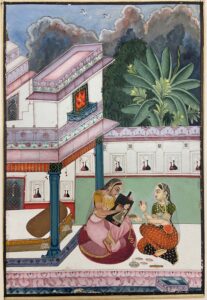
FIGURE VI
RAGINI DHANISHRI
FIGURE VII
RAGINI DESI
BIBLIOGRAPHY & REFERENCES
1. Agarwala, Vasudeva Sharan. 1964. The Heritage of Indian Art. Publications Division, Ministry of Information and Broadcasting, Government of India.
2. Neeraj, Jai Singh. 1991. The Splendour of Rajasthani Painting. Abhinav Publications.
3. Ganguly, O. C. 1947. Ragas & Raginis: A Pictorial & Iconographic Study of IndianMusical Modes based on original sources. Calcutta. Clive Press.
4. Ghosh, Soma. 2022. A Garland of Melodies: Reimaging Ragamalas through the Collection of Salar Jung Museum, Hyderabad. Chitrolekha: Journal on Art and Design. Vol VI. (https://chitrolekha.com/v6n201/?amp=1)
5. Lahoti, Supriya. 2024. Stylistic Development of Ragamala Paintings in 17th Century Mewar. Chitrolekha: Journal on Art and Design. Vol VIII.
6. Santra, Mehuli. Maitra, Nivedita. 2018. Turning Audibility into Visuality: Narratives in the Ragamala Painting with Special Reference to the Raga Bhairava and the Raga Meghmallar. The Criterion. Volume 9. (HM01.pdf)
7. Shekhar, Brahmanshi. 2022. Semiotic Analysis of The Ragini(s) of Raga Deepak Through Ragamala Paintings. Vageeshwari: The World Classical Music e-Research Journal. Volume 36. Department of Music, Faculty of Music & Fine Arts, University of Delhi.
8. Agarwal, Simran. 2020. Western India’s Ragamala Paintings blend Music and Art into a Single Frame. Scroll.in. (https://scroll.in/article/959474/western-indias-ragamala-paintings-blend-music-and-art-into-a-single-frame)
9. Randhawa, Mohinder Singh. 1994. Kangra Paintings on Love. Publications Division, Ministry of Information and Broadcasting, Government of India.
10. Noguchi, Yone. 1914. The Spirit of Japanese Poetry. London. John Murray, Albemarle Street, W.
IMAGE CREDITS
1. FIGURES – I, II, III, IV V, and VII
Ragamala Paintings. Cornell University Library Digital Collections. (https://share.google/diihM2nnVNXJujvb5)
2. FIGURE VI
Ragamala: Music from the Exhibition. Reitberg Museum. (https://rietberg.ch/en/exhibitions/ragamala-music)