
By Saiee Katkar
The first time you watch a Dhangar caravan move across the Deccan, you feel as if the land itself is walking. The dust rises gently, the bells on the sheep echo softly, and the people move with a calm confidence that comes only from living with nature for generations. There is no rush, no noise, and no need to prove anything to the world. Their life looks simple from the outside, but once you begin to understand it, you realise that the Dhangars carry one of Maharashtra’s most sophisticated cultural traditions. Their way of living blends mythology, ecology, and wool craftsmanship into a heritage system that is still alive, still moving, and still teaching.
Dhangar culture is not something that sits locked inside archives. It breathes through migration, stories, wool, and the steady rhythm of pastoral life. Their heritage is a complete ecosystem shaped not by monuments, but by footsteps.
Mythologies That Guide the Herds
Dhangar stories are not just tales. They are maps. In their imagination, pastoral life begins with the shepherd-god Biroba. He is believed to have entrusted the first sheep to the Dhangars and asked them to care for the herds as a sacred duty. Their myths describe goddesses and guardian spirits who walk along with the caravans, offering protection and guidance.
Anthropologist Günther Sontheimer notes that Dhangar deities are often located along actual migration routes. This means their stories are tied to the soil they walk on. When a caravan stops at a shrine, the myth becomes part of the landscape. Wool threads are tied to sacred stones, prayers are whispered before journeys, and the stories that the elders tell remind everyone that movement is not just physical. It is spiritual.
The beauty of their mythology lies in how naturally it blends with the environment. In a world where many of us feel cut off from nature, the Dhangars show us a very different philosophy. For them, the land is not just a resource. It is a relationship.
Pastoral Rhythms: Life in Motion
Dhangar life follows the seasons, not the clock. Their migration runs across districts such as Pune, Satara, Solapur, Sangli, and Ahmednagar. These routes are not random. They are shaped by the memory of grasslands, rainfall, and generations of environmental observation.
Ethnographic studies by Gokhale describe the precision of their movements. When lambing season begins, the pace of migration slows. When the monsoon arrives, the herds move to higher ground. When dry winds blow, they follow old paths that lead to water sources that never fully disappear.
Wool Textiles: The Heartbeat of Dhangar Culture
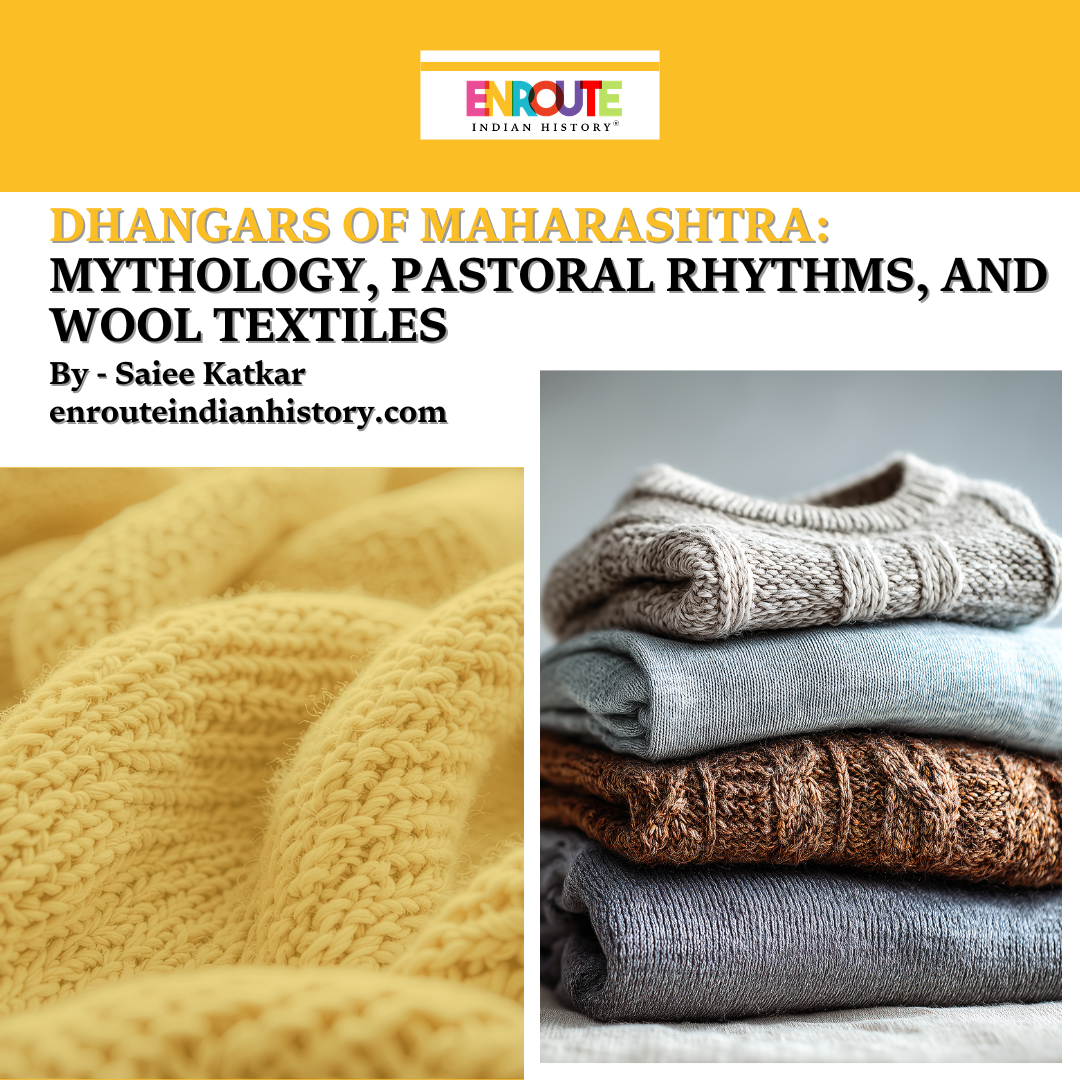
If myths give meaning to Dhangar life, then wool gives it texture. It is impossible to speak of this community without speaking of its textiles. Their wool is not merely material. It is memory, livelihood, and identity.
Ghongadi: The Black Wool Blanket
Ghongadi is the most iconic Dhangar creation. Thick, black, and almost waterproof, it has protected shepherds through storms, long, cold nights, and open landscapes. Ghongadi is used as bedding, a shelter during rain, a wrap for infants, a seat for worship, and even a respectful offering during rituals.
Its simplicity hides its brilliance. It is woven to last years, sometimes decades. Many families still preserve older ghongadis that hold the smell of campfires and the dust of old journeys. For the Dhangars, it is not just an object. It is a companion.
Dhavdi: The Women’s Woolen Drape
The dhavdi is a lighter woolen cloth traditionally worn by Dhangar women. It moves easily during migration, protects against sudden temperature drops, and is woven with remarkable skill. The takli, a small spindle, remains the heart of this craft. Watching someone spin on the takli feels like watching time slow down.
Paghdi and Bandi
The woolen paghdi and bandi worn by Dhangar men are signs of identity. They are shaped not just for tradition but for practical needs. A paghdi protects from heat, sun, and thorny shrubs. A woolen bandi keeps the core warm during long hours in the field.
Wool as Social Exchange
Historically, wool was a form of currency. Dhangars exchanged blankets and live sheep for grains, oil, and household essentials. Their economy ran on trust, craft, and reciprocity.
This material culture shows how deeply wool is woven into Dhangar life. It is economic, spiritual, emotional, and ecological all at once.
Wool in Ritual and Social Life
Dhangar rituals are practical yet profoundly symbolic. Wool appears in almost every life event. When a lamb is born, wool threads are tied around it for protection. During marriages, ghongadi is used as a symbol of stability and continuity. In temples of Biroba, a tuft of wool is offered in gratitude for safe journeys and healthy herds.
Songs sung by Dhangar women describe wool as a divine gift, something that warms not only the body but also the spirit. Slowly, you begin to understand why wool occupies such a sacred place. It is the bridge between nature, culture, and survival.
Challenges Faced Today
Although Dhangar heritage is rich and layered, it faces severe challenges today.
Land that once welcomed migration is now fenced for private farming, development, or mining. Climate change disrupts grazing cycles, making the long journeys more unpredictable. Synthetic textiles have replaced handmade wool in urban markets, weakening the economic value of their craft. Many young Dhangars choose wage labour or urban jobs because pastoral life is too demanding and uncertain.
Studies by Kalpavriksh and the Pastoral Collective of India highlight how traditional knowledge is disappearing not because it is irrelevant, but because it is unrecognised.
Revival and Future Possibilities
There is still hope. Designers, researchers, and sustainable craft organisations are working with Dhangar weavers to revive the ghongadi tradition. Market linkages, GI tag efforts, and documentation of migration routes are slowly rebuilding pride in pastoral identity.
In the face of the climate crisis, Dhangar pastoralism offers important lessons. Rotational grazing maintains grassland health. Mobility prevents overuse of land. Wool is renewable, biodegradable, and far more sustainable than synthetic fibres.
Reviving Dhangar culture is not just a cultural project. It is an ecological necessity.
Conclusion: A Culture That Walks With the Land
The more I learn about the Dhangars, the more it becomes clear that their heritage cannot be understood while sitting still. It has to be experienced in movement. Their stories travel with them. Their textiles carry journeys in each thread. Their rituals rise from the land they walk upon.
In a world obsessed with speed and convenience, the Dhangars remind us that continuity sometimes depends on patience. They show that ancient practices can still hold meaning, and that wisdom can come from communities that choose to walk rather than settle.
Their legacy is not a museum exhibit. It is a living, breathing cultural journey, carried forward by people who continue to hold together nature, myth, and craft with a tenderness that is rare today.
References
Gokhale, S. (1996). Pastoral Communities of Maharashtra: A Study of Social Ecology. Deccan College Post-Graduate and Research Institute.
Government of Maharashtra. (1884–1960). Gazetteers of the Bombay Presidency. State Gazetteer Department.
Kalpavriksh. (2014). Life and Livelihood of Pastoral Communities in Maharashtra. Kalpavriksh Environmental Action Group.
Pastoral Collective of India. (2021). Challenges and Adaptations Among Nomadic Pastoralists in Western India.
Sontheimer, G. D. (1989). Pastoral Deities in Western India. Oxford University Press.