
By Aryan Singh
In the heart of South Delhi, where the modern city hums with restless energy, lies a sanctuary of silence, devotion, and history — the Dargah of Hazrat Nasiruddin Mahmud Chirag Dehlavi. Known lovingly as the “Chirag-e-Dilli” or “Lamp of Delhi,” he was a 14th-century mystic, the devoted disciple and spiritual heir of Hazrat Nizamuddin Auliya. As the final revered Khalifa of the Chishti order in Delhi, Hazrat Chirag’s spiritual light still burns bright—casting a timeless glow over the city’s soul and drawing countless seekers, mystics, and devotees to his sacred shrine even today.
This Dargah was built by Sultan Firoz Shah Tughlaq in 1356. It stands in the middle of Chirag Delhi, a small semi-urban village in South Delhi. To reach it, one must walk through a maze of narrow, bustling lanes that echo with everyday life. Just outside the Dargah, a single flower shop welcomes visitors with fresh petals and incense — simple offerings that carry deep devotion. Inside the peaceful complex lies the tomb of Hazrat Chirag Dehlavi, alongside the graves of his nephews and a few of his close disciples. While the Dargah remains a place of spiritual calm, the outer part of the village contrasts this serenity with a busy market area, where shops sell everything from construction materials to automobile parts — a blend of the sacred and the everyday, coexisting side by side. This article takes you on a journey through the Dargah’s spiritual charm and dives into the life and legacy of the last Chishti saint of Delhi. (Abhishek Jain, 2016)
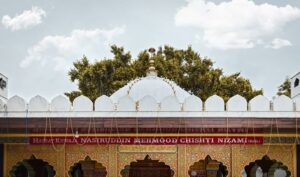
Source: Dreamstime.com, Front view of the Tomb of Sheikh Nasiruddin
To truly understand the spiritual depth of this shrine, we must look back at the roots of the Chishti order in India. It was Khwaja Muinuddin Chishti, a revered mystic from Persia, who brought this spiritual path to India during the time of the Ghori conquest. He eventually made Ajmer his home, where his shrine still draws countless devotees.
The Chishti order flourished over time, reaching its golden age in Delhi through great saints like Baba Farid (Fariduddin Ganjshakar), who later left Delhi for Ajodhan in Punjab and lived in Khanqah (Sufi retreat or hospice) there, and Hazrat Nizamuddin Auliya, whose Dargah remains one of the most visited in the capital even today. Toward the end of Nizamuddin Auliya’s life, sensing that one of his disciples had attained spiritual perfection, he named Sheikh Nasiruddin his Khalifa (spiritual successor). In a moment of deep emotion and divine trust, he handed over the Tabarrukaat (Sacred relics) passed down through generations to this chosen one, entrusting him with the future of the Chishti Silsilah in Delhi. This is where the legacy of the “Lamp of Delhi” begins to shine.
Importance of the Dargah
The true importance of this shrine lies in the deep faith of the pilgrims who come here to offer their prayers. They believe that the shrine is not just a resting place of their spiritual guide (Pir), but a source of blessings and support in life’s difficult moments. The spiritual power or Barakat of the Pir fills the entire space, turning the grave into a Mazar — a sacred place people visit for peace and healing. These saints, known as Auliya (friends of God), may have left the physical world, but their spirit still lives on for their followers. That’s why they are lovingly called Zinda pir — the living master. At a Sufi shrine, it is this sense of presence, this living energy of the Zinda Pir, that fills the air and touches the hearts of those who visit. (Abhishek Jain, 2016)
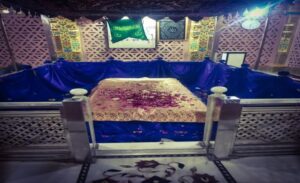
Source: Dreamstime.com, Mazar
The Making of a Sufi Saint
Long before he became the spiritual light of Delhi, Sheikh Nasiruddin’s journey began in the sacred city of Ayodhya, where he was born. But his roots stretched far deeper — his grandfather, Sheikh Abdul Latif Yazdi, had journeyed from Khurasan in northeast Iran, settling first in Lahore, where Nasiruddin’s father, Sheikh Mahmud Yahya, was born. Eventually, the family made Ayodhya their home, thriving as respected traders in woollen goods and living a life of comfort and prestige.(Mohammad Abdul Hafiz, 2025)
Spiritual wisdom ran deep in the family — his sister, Badi Bibi or Badi Bua, was herself a renowned Sufi saint, and her shrine still stands in Ayodhya as a quiet testament to her legacy.
There are different opinions regarding their lineage. Some historians believe he was a direct descendant of Hazrat Imam Hussain, the beloved grandson of Prophet Muhammad. Others suggest he traced his roots to Hazrat Umar ibn Khattab, the revered second Caliph of Islam.
At an early age of 9 years, he lost his father, and the burden of education fell upon his mother. He studied important texts like Bazoodi, a well-known book on Islamic law, but even as a child, his heart burned with deep spiritual longing. By the age of 25, he had turned away from worldly life and began intense Mujahedas (spiritual struggles), spending nearly eight years in the remote mountains and forests of Awadh, seeking closeness to the Divine. (Mohammad Abdul Hafiz, 2025)
At 43, he came to Delhi and became part of Hazrat Nizamuddin Auliya’s spiritual world, starting a new journey. One day, Nizamuddin Auliya noticed him sitting humbly near a tree in his khanqah (spiritual retreat). Curious, he called him and asked who he was. With deep humility, Nasiruddin replied, “I’ve come to help the dervishes (fakir) wear their shoes.” This simple, powerful gesture of service touched Nizamuddin’s heart, and he immediately accepted him as a murid (disciple). (Mohammad Abdul Hafiz, 2025)
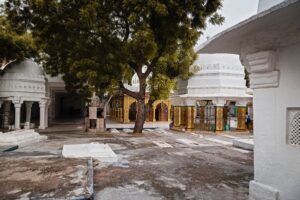
Source: Dreamstime.com, Inner complex of Dargah
Death
He breathed his last on the 18th of Ramadan, 757 AH (Anno Hegirae, a Latin term meaning “in the year of hijra”, which is the migration of Prophet Muhammad from Mecca to Medina), a date forever etched in the hearts of his followers. As the end neared, he sensed a turning point. With Delhi crumbling under the weight of Tughlaq rule, he believed the Chishti Silsila (spiritual order) was not ready for another leader. In a bold and deeply symbolic decision, he appointed no successor, declaring that none of his disciples could shoulder the heavy responsibility of guiding the order in such chaotic times. (Mohammad Abdul Hafiz, 2025)
Instead, he gave one final command — that the sacred relics of the Chishti tradition, passed from master to master, be buried with him, sealing a golden chapter of Delhi’s Sufi history. After his death, Sultan Firoz Shah Tughlaq built a shrine in his honour. Later, in 1729, Emperor Muhammad Shah added the enclosing walls that still protect the tomb today. (Mohammad Abdul Hafiz, 2025)
The Story Behind the Title “Chirag”
According to a well-known tale, during the construction of a reservoir for the Sufi retreat, Sultan Ghiyasuddin Tughlaq, wary of the growing influence of the Sufi saints, attempted to halt the work by cutting off the oil supply to the khanqah, hoping that without light, the project would come to a standstill at night. But the saint was undeterred. In a moment of divine grace, he turned water into oil, lighting the lamps and allowing the work to continue without pause. This miraculous act left everyone in awe. (Mohammad Abdul Hafiz, 2025)
From that day forward, he was lovingly called “Chirag-e-Dilli” — The Lamp of Delhi — a symbol of spiritual light that could not be extinguished, no matter the darkness around.
References
1. Abdul, Mohammed. “Hazrat Nasiruddin Chiragh Dehlavi.” Scribd, 2025, www.scribd.com/document/192223303/Hazrat-Nasiruddin-Chiragh-Dehlavi. Accessed 6 July 2025.
2. Risley, Gordon. The Seven Cities of Delhi. 1906.
3. Jain, Abhishek. “Shaikh Nasiruddin Chirag-i Delhi.” Academia.edu, 16 Apr. 2016, www.academia.edu/24464895/Shaikh_Nasiruddin_Chirag_i_Delhi. Accessed 6 July 2025.