

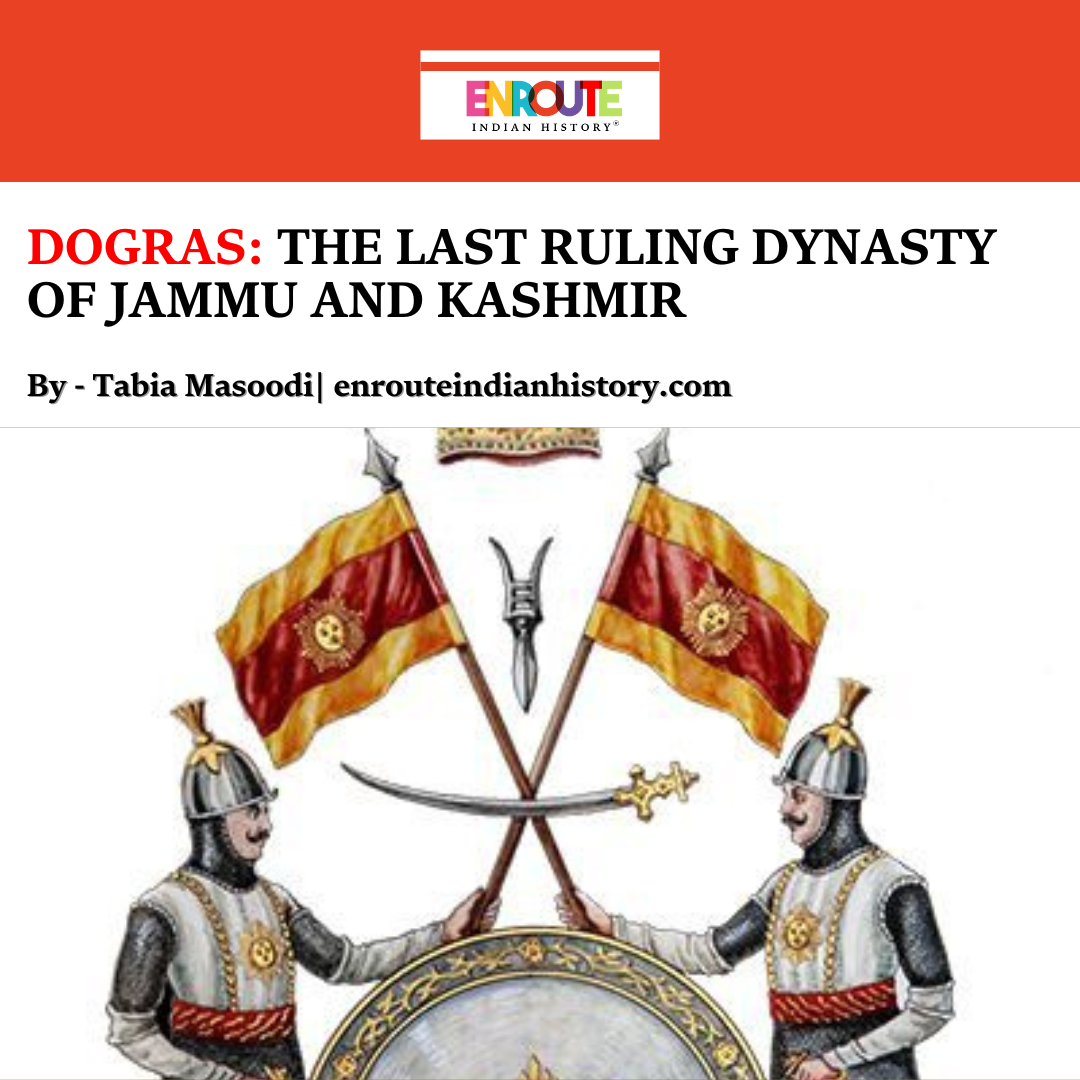
By Tabia Masoodi
Nestled amidst the snow-capped peaks and verdant valleys of the northern Himalayas, the rise and rule of the Dogra Maharajas uncover not just the chronicles of kings and battles, but also the story of a dynasty told in the shadow of towering mountains and turbulent politics.
ORIGIN OF THE DOGRA DYNASTY
The Dogras are a Rajput clan and an Indo-Aryan ethnic group that lived in the hilly area between the Chenab and Ravi rivers. Dogra is often traced back to the Sanskrit words Do and Garth, which translate to two lakes, though this usage became widespread only after the Dogra ascendancy in Jammu(Bhat, 2016). Traditional accounts and local legends suggest that the ancient capital of the Dogra region was at Bahu. The city of Jammu itself is attributed to the legendary Raja Jambu Lochan, an early ancestor of the Jamwal clan, who is said to have founded it after witnessing a lion and a goat drinking peacefully from the same stream, a symbol of harmony and coexistence. The Jamwal Rajputs were the first ruling dynasty of the
Jammu hills, governing Jammu and the surrounding plains. Jamwals are descended from Raja Kush, son of Suryavanshi King Maharaja Ramchandra of Ayodhya(Manhas, 2019). Their migration was a result of political upheaval after the abdication of Raja Soumitra, the last king of Ayodhya.
The early Dogra polity was marked by a feudal structure, with numerous chieftains or thakurs and ranas ruling over small principalities. The Rajputs from the outside easily defeated them, and over time, these fragmented states gradually coalesced into hereditary dynasties, often through conquest or strategic alliances. By the 10th century, Jammu and other nearby hill states like Mankot, Jasrota, and Samba were established, each ruled by different Dogra clans. However, the Jamwals emerged as a dominant clan and Jammu as a Dogra state under them, paving the way for the Dogra dynasty. The region's administration evolved from feudal chieftainships to primogeniture-based hereditary dynasties over time.
In the 18th century, Raja Ranjit Dev, a prominent ruler of the Jamwal clan, established sovereignty over large parts of Jammu and united it after Mughal rule weakened. His period lasted from 1733 to 1782 and saw great political stability and social reform. His rule, lasting about four decades, brought together various Dogra territories and integrated neighbouring regions such as Poonch and Kishtwar. The Dogra chieftains, including the Jamwal clan, gradually asserted dominance, setting the stage for the emergence of a unified Dogra state. However, after Dogras under Raja Jit Singh lost the battle of Jammu in 1808, the Sikh forces captured Jammu and was annexed and made a tributary by the Sikh empire(Khajuria, 2021). The advent of the Sikh Empire under Maharaja Ranjit Singh influenced the fate of the Dogras. Gulab Singh and his brothers, Dhyan Singh and Suchet Singh, prominent figures and direct descendants of Ranjit Dev, played important roles in the Sikh court and military battles. Gulab Singh's loyalty and military acumen earned him the title of Raja of Jammu in 1822, marking the formal beginning of the Dogra dynasty's rule.
ESTABLISHMENT OF THE DYNASTY
Gulab Singh, the first ruler of the Dogra dynasty, rose after achieving different military and political ranks during the Sikh Rule, eventually becoming the Raja of Jammu in 1822, officially starting the Dogra dominance in the region. Through his reign, the Sikh Empire extended its control into Ladakh, Baltistan and other Himalayan areas.
Back in 1809, Gulab Singh was simply another soldier in Maharaja Ranjit Singh's army. However, he soon established himself as a remarkable figure, particularly during the 1819 occupation of Multan and when he was fighting the hill bandits close to Jammu. In 1820, Ranjit Singh awarded him a jagir (land grant) close to Jammu in recognition of his role an military prowess in the conquest of Kashmir(Singh, 2017). Following the death of his father, Kishore Singh, in 1822, Ranjit Singh formally anointed Gulab Singh as the hereditary Raja of Jammu in a grandiose ceremony at Jia Pota, Akhnoor.
Ranjit Singh played a crucial role in elevating Gulab Singh to one of the leading figures in the Sikh Empire by providing him with a personal army and jagirs. Under Gulab Singh's guidance, he united several small hill principalities and effectively put a stop to uprisings, including the Poonch insurrection in 1837. His influence expanded as he helped suppress revolts, participated in key battles (like the Afghan defeat at Saidu in 1827), and gained control over vital Punjabi cities along with tax rights. Gulab Singh cemented his power with the annexation of Ladakh in 1834 and Baltistan in 1845, laying the groundwork for a unified princely state. However, the formal establishment happened only after the First Anglo-Sikh War.
CREATION OF PRINCELY STATE
Following the defeat of the Sikh Empire in the First Anglo-Sikh War in 1846, the British East India Company and the Sikh Empire signed the Treaty of Lahore on March 9, 1846. Under its terms, heavy war reparations of 1.5 crore were imposed on the Sikh Empire, which they struggled to pay off completely. As a result of settling the outstanding indemnity, the Sikh Empire ceded several territories to the British, including the Kashmir Valley. However, the British did not govern Kashmir to recoup war expenses, create a strategic buffer, and avoid the challenges of direct governance in a remote and potentially unstable region; instead, they sold Kashmir to Gulab Singh as a reward for his loyalty and neutrality for the sum of 75 Lakh rupees along with its people through the Treaty of Amritsar on 16th March 1846. The agreement placed Gulab Singh as the autonomous and sovereign leader of Kashmir, Jammu, Ladakh, and the nearby regions, formalising the creation of the Princely state of Jammu and Kashmir. The rule of the Dogra dynasty spanned over a century with four rulers.
JAMMU AND KASHMIR UNDER THE DOGRA DYNASTY
After the creation of the Princely state, Gulab Singh was given liberty and the ability to start his dynasty when the treaty terminated his responsibilities to the Sikh Empire. The integration of Jammu, Kashmir, and other areas was unprecedented due to its multi-ethnic nature. The administration, taxation, and government of the state experienced substantial changes during the Dogra reign as a result of attempts to consolidate regions and centralise authority. The political and social climate of the area established by the Dogras gave preference to Dogras and Kashmiri Pandits in positions of authority. At the same time, the Muslim majority of Kashmir was excluded from positions of power. The administration under Gulab Singh was
highly authoritarian and repressive, especially toward Muslims. Gulab Singh's regime levied heavy taxes on the shawl weavers and imposed new land revenues that broke the backs of artisans and peasantry, especially in Kashmir. His administration was marred by the oppression and suppression of dissent and the elimination of rival claimants. The legitimacy of Dogra's rule was built around the narrative of Hindu Rajput Heritage and its role as its defenders. The British also supported and promoted this narrative without considering the interests of the population of Kashmir. Despite such repressive nature of his rule, Gulab Singh established a relatively stable state structure. The administrative framework he put in
place, with its hierarchy of tehsildars and thandars overseeing revenue and law enforcement, provided the foundation for the governance of Jammu and Kashmir for decades to come. His reign also saw the extension of Dogra authority into the frontier regions of Ladakh, Gilgit, and Baltistan, further enhancing the strategic significance of the state. His reign lasted for a decade from 1846 to 1856.
SUCCESSIVE RULERS
RANBIR SINGH:
Maharaja Ranbir Singh was the son of Gulab Singh and the second ruler of the Dogra dynasty. He ascended to the throne in 1856 and ruled the princely state till 1885. His reign ushered in a period of cultural modernisation, socioeconomic reforms, and administrative consolidation that revolutionised the princely state of Jammu and Kashmir. His rule is widely recognised as the period during which the foundations of a modern, unified state were firmly established. Influenced by European administrative structures, Maharaja Ranbir Singh aimed to bring about some changes in his realm, to improve efficiency and simplify the government. He implemented administrative reforms by redividing the state into distinct districts and instituting a well-organised legal system, with 25 courts and a legal framework, the Ranbir Penal Code, which remained effective till 2019, until the unilateral abrogation of Article 370. His reign also saw educational reforms, as many educational institutions were set up. Modern medical care also emerged during his reign, notably Durgjan Hospital and a women's hospital at Rainawari. Economically, his reign witnessed the elimination of superfluous taxes, the promotion of agriculture, and the stimulation of local enterprises, notably the discovery of sapphire mines in the Padar valley.
However, his reign was also marked by systemic discrimination against the Muslim majority. His reign was without a doubt progressive, but discriminatory practices and exclusion of Muslims were integral to the Dogra dynasty. Ranbir Singh suppressed Islamic practices, Muslim religious places were confiscated, and Muslim names were changed to Hindu names. For instance, Islamabad into Anantnag and Takt-i-Sulaimani into Shankaracharya (Shahida and Fayaz, 2019).
PRATAP SINGH:
Maharaja Pratap Singh was the third ruler of the Dogra dynasty with the longest reign of forty years. He ascended to the throne after the death of his father, Maharaja Ranbir Singh, in 1885. His reign is noted for modernisation, infrastructure development and improved education and healthcare. He supervised the construction of the Jhelum Valley Road and Banihal Cart Road, which enhanced communication between Kashmir and Kohala, boosting trade and transportation as well as military movement. The state's agrarian structure remained fundamentally feudal, with land concentrated in the hands of a few, and the majority Muslim peasantry subjected to high taxation and exploitative practices like begār (forced labour).
Though Pratap Singh aimed to abolish forced labour, it remained persistent within marginalised communities. While Pratap Singh was relatively moderate compared to his predecessors, he continued policies that favoured Hindu elites, particularly Kashmiri Pandits, in administration and education, further marginalising the Muslim majority. The British continuously interfered with the governance, which curtailed the Maharaja's
autonomy and violated the terms of the Treaty of Amritsar. They were indirectly ruling Jammu and Kashmir. In February 1889, Pratap Singh was temporarily deposed due to misgovernance and alleged collusion with the Empire's enemies (Bhat, 2014). This intervention underscored the precarious position of princely states under indirect colonial rule, where loyalty to the British Crown often superseded local governance priorities.
HARI SINGH:
Maharaja Hari Singh was the last ruler of the Dogra Dynasty. He was the son of Maharaja Pratap Singh and succeeded him in 1925. He inherited a state facing mounting social and political challenges. His rule coincided with the rise of mass political consciousness among the state's Muslim majority and increasing demands for reform. Although Hari Singh's government implemented certain administrative and educational changes, it remained authoritarian and opposed real power sharing. Non-Muslims, especially Dogras and Pandits, continued to control the state's economic resources and bureaucracy, while Muslims were still under-represented in government employment and denied land rights. The monopolisation of revenue departments by non-Muslim bureaucrats and the regressive taxation regime made rural poverty and discontent worse.
The 1931 uprising marked a turning point in the state's history, as widespread protests against religious discrimination and economic hardship. On July 13, 1931, an uprising began with mass protests outside Srinagar Central Jail during the trial of Abdul Qadeer, whose arrest for sedition sparked widespread anger among Kashmiri Muslims suffering from economic discrimination, religious marginalisation, and repressive taxation under Maharaja Hari Singh. The police fired on unarmed protesters, killing 22, which is widely regarded as the start of organised political resistance in Kashmir and led to the formation of the Glancy Commission to address Muslim grievances. The commission's recommendations led to limited reforms, such as increased Muslim representation in administration and greater freedom of expression, but these measures did not fully address the underlying structural inequalities. The period also witnessed the emergence of political organisations and the articulation of Kashmiri Muslim identity in opposition to Dogra rule, setting the stage for later movements demanding autonomy and self-determination.
FALL OF DOGRAS
The fall of the Dogra dynasty was rooted in both internal as well as external forces. The Dogra rulers, viewing Kashmir as their "purchased property" under the Treaty of Amritsar, governed with a sense of entitlement that further alienated the local population, especially as they favoured their homeland, Jammu, in matters of development and administration. The oppressive policies, cruel taxation and continuous marginalisation of the Muslim majority fractured the core of Dogras and resulted in the emergence of organised resistance. By the 1940s, the Dogra state was beset by mounting internal dissent, economic decline, and communal tensions, all of which were further inflamed by the broader anti-colonial struggle and the impending partition of British India. The inability of the Maharaja to accommodate the diverse aspirations of his subjects, coupled with his vacillation during the accession crisis of 1947, eroded whatever legitimacy the dynasty retained. During the partition of British
India, Kashmir was an independent princely state, and Hari Singh initially attempted to keep its independence. However, after the tribal invasion by Pakistan, the Maharaja sought military help from India and, as a condition, signed the Instrument of Accession, making Kashmir a part of India for matters of defence, external affairs, and communications while retaining autonomy in other affairs. The signing of the Instrument of Accession effectively ended Dogra's sovereignty in 1947 and ushered in a new era of contested governance in Jammu and Kashmir.
Hari Singh was forced to abdicate after accession, and his son Karan Singh succeeded him as the constitutional head of state (Sadr-i-Riyasat) in 1952, signalling the end of Dogra monarchical rule and the beginning of democratic governance under India. Maharaja Hari Singh's son and heir is Dr. Karan Singh, who was born in 1931. He held the positions of Sadr-i-Riyasat (President) and the first Governor of Jammu and Kashmir following the abolition of the monarchy. Karan Singh continues to hold the title of titular Maharaja and is acknowledged as the present leader of the Dogra family, even though the princely title no longer has legal force. His position is largely ceremonial and symbolic. Dr Karan Singh has had a long and illustrious career as a politician, diplomat, and cultural leader.
References:
Bhat, S.A., 2016. State formation in colonial India: An analysis of the formation of the modern state of Jammu and Kashmir. International Journal of Scientific and Research Publications, 6(2), pp. 153. Available at: https://www.ijsrp.org/research-paper-0216/ijsrp-p5024.pdf
Manhas, P., 2019. Emergence of Rajputs as Ruling Elite in Jammu Region. International Journal of Research and Analytical Reviews, 6(2). Available at: https://www.ijrar.com/upload_issue/ijrar_issue_20543820.pdf
Khajuria, S., 2021. Druva's shining star – Maharaja Gulab Singh (The founder of the erstwhile sovereign state of Jammu and Kashmir). International Journal of Advanced Research in Science, Communication and Technology (IJARSCT), 4(2). Available at:
https://ijarsct.co.in/A1060.pdf
Singh, K., 2017. Rise of Gulab Singh from a soldier to the Maharaja of Jammu and Kashmir. The Research Journal of Social Sciences, 8(2). Available at: https://www.ijfmr.com/papers/2022/2/964.pdf
Umar, F. & Umar, M. (2024) 'Treaty of Lahore and Beyond: Punjab from Sovereignty to Subjugation', Journal of Historical Studies, 10(1), pp. 47–60. Available at: https://jhs.bzu.edu.pk/upload/Vol-I-24_article03-24-1.pdf_25.pdf
Huttenback, R.A., 1961. Gulab Singh and the creation of the Dogra state of Jammu, Kashmir, and Ladakh. The Journal of Asian Studies, 20(1). [insert page numbers if available]. Available at: https://pahar.in/pahar/Books%20and%20Articles/Indian%20Subcontinent/1961%20Gulab%20Singh%20and%20Creation%20of%20Dogra%20State%20of%20Jammu%20Kashmir%20and%20Ladakh%20by%20Huttenback%20from%20J%20Asian%20Studies%20v20%20s.pd
Shahida and Fayaz, F., 2019. A comparison of the socio-political and economic conditions of Kashmir during the 19th century, Dogra rule from 1846 to 1947, with their relevant impact. Journal of Emerging Technologies and Innovative Research (JETIR), 6(5). Available at:
https://www.jetir.org/papers/JETIR2006214.pdf
Kour, V. and Raje, V., 2021. The formation of the princely state of Jammu and Kashmir: An overview. International Journal of Research in Social Sciences, 11(10). Available at:
https://www.ijmra.us/project%20doc/2021/IJRSS_OCTOBER2021/IJRSS1Oct21.pdf
Bhat, A.H., 2014. Partap Singh's British rule. Kashmir Life, 3 March. Available at:
https://kashmirlife.net/partap-singhs-british-rule-56245
Bashir, D., 2021. Decoding the 13 July 1931 uprising: Communal or socialist? Kashmir Reader, 13 July. Available at: https://kashmirreader.com/2021/07/13/decoding-13-july-1931-uprising-communal-or-socialist/
BBC News, 2025. Kashmir: Why India and Pakistan fight over it. 7 May. Available at:
https://www.bbc.com/news/articles/c30q09638n8o