

By Ashutosh Pandey
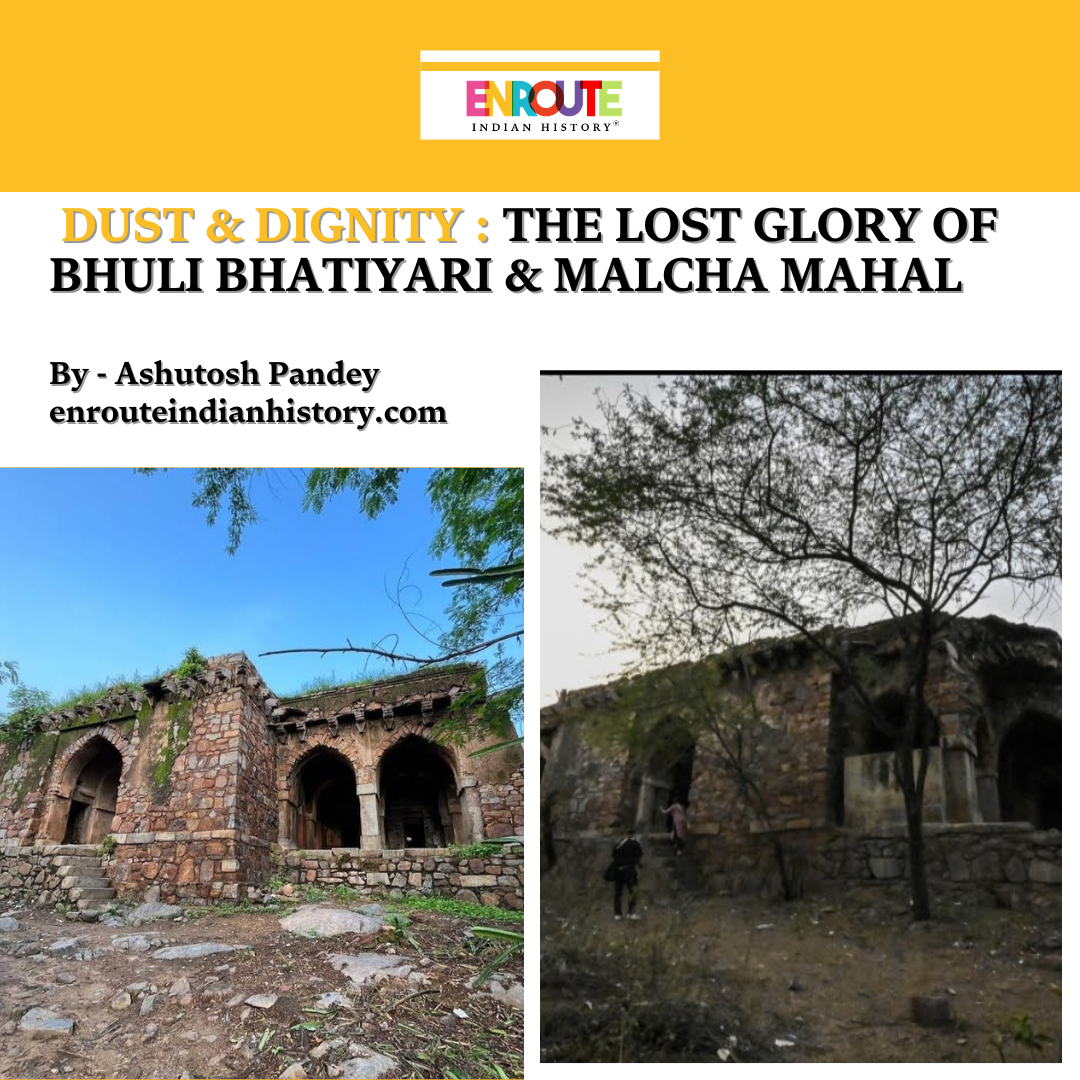
Delhi wears its history like an old robe that looks frayed,beautiful and sometimes heavy with forgotten stories.Amid its polished domes and heritage walks lie two silent witnesses that history abandoned : Bhuli Bhatiyari ka Mahal & Malcha Mahal. Both stands on the ridge ,away from the tourist’s gaze,half consumed by time and myth.Once royal hunting lodges built under powerful Tughlaq dynasty, they now rest in haunting stillness – their arches echoes not in the footsteps of sultans but with whispers of neglect.These monuments failed to make it to the government postcard campaigns.They live in the cracks of Delhi, a place were people pass by but rarely see.Their fading walls reminds us that restoration isn’t about architecture only,it is about memory and dignity. To restore Bhuli Bhatiyari ka Mahal and Malcha Mahal is to restore a part of Delhi that has been disappearing under dust and disinterest.This article retraces their origin and explores their decay through the lens of India’s evolving philosophy of restoration and conservation.
Every monument tells us a story from the past.The story of ambition,conquest and decline.Today we are going to talk about two such monuments those were once the symbol of but today they are fighting for own identity.Hidden in the dense forested ridges and modern neighbourhood lies architectural gem of Tughlaq era Bhuli Bhatiyari Mahal and Malcha Mahal.These both were once royal hunting lodges of Tughqal dynasty ,built in 14th century under Firoz Shah Tughlaq.But now both of these structures stands nothing more haunting sites,And reminds us the urgent need for heritage restoration and conservation.
Their survival ,despite being neglected for centuries, embodies the very idea behind the theme “Restoration and Conservation” and its importance . It’s our responsibility to safeguard them,as they are more than just monuments,their survival is significant for the cultural memory of Indian History.
Understanding Restoration and its prevalence in History & Archaeology
The process of restoration and preservation is not new in our culture.From ancient times, every civilization had their own ways to preserve their heritage. In Indian culture , restoration was historically embedded in the temple rebuilding,fort repairs,maintenance of stepwells,etc.However , the history tells us that Tradition of systematic restoration was started by british when ASI was established in colonial period 1861.After independence,the monuments became active participants in cultural continuity.But as the cities like Delhi developed and grew , along with it the tension between preservation and development also increased.And with the rapid urbanization , architectural figures like Bhuli Bhatiyari Mahal and Malcha Mahal slipped into obscurity and their relevance and popularity were overshadowed by better known sites of history like Humayun’s Tomb,Safdarjung Tomb,Red fort,etc. Yet these less popular sites are not less significant,they have equally shared the past culture of our country as other monuments did.These two sites from Tughlaq era tell us about the architectural phase of Tughlaqs,To restore such monuments is to reclaim a missing voice in Delhi architecture narrative.
Historical Background
Firoz Shah Tughlaq who ruled from 1351-1388,was not just a sultan but also an ardent builder. He in his reign constructed fortresses, canals, bridges, gardens and hunting lodges – several of them still survive in the fragments across Delhi.
Bhuli bhatiyari ka Mahal was built around the mid-14th century , It was a royal hunting lodge (Shikargah) and it was placed strategically for the overlooking dense forest teeming with wildlife. It represents the typical Tughlaq style,structure comprises of regular rectangular courtyard surrounded by small chambers and double gateway , which once provided shelter to royal entourage.For decades , the building was left in disuse and it destroyed most of the parts of the site.Layers of vegetation ,encroachment and urban expansion engulfed the architecture . Locals say that it was named after Bhatiyari women who lost her way, another story tells that once it provided shelter to a Sufi Saint. These myths show its historical essence. Today it is nothing more than a haunting site for people.
Malcha Mahal story is almost similar to Bhuli Bhatiyari Mahal , situated in Chanaykyapuri area of Delhi; it was also built during the Firoz Shah Tughlaq period as a part of his network of lodges and rest houses. The building is made of red sand stone and rubble masonry , In 20th century Malcha Mahal regained fame when Begum Wilayat Mahal of Awadh was granted Malcha Mhal as a residence by Indian Government, Renaming it as “ Wilayat Mahal “.Begum used to live there with her 3 children but after death of prince Ali Raza in 2017 it was abundant again and it patiently waits for its next chapter – hopefully a restoration.
Restoration
Restoration is a professional practice that involves stabilising the decaying process of old monuments(mostly).Actual work is conserving and reviving them without changing its authenticity,Agencies like INTACT,ASI,Delhi department of Archaeology ,etc employs number of different methods for restoration.Some of the common things which is done during restoration process are :
1) Removing Vegetation : This involves the removal of vegetation that develops on the surfaces of monuments ,green in appearance mostly. It damages the structure and makes it weak,clearing vegetation is one of the initial steps that is taken in restoration.
2) Lime Mortar Repointing : Using traditional lime (Chuna) and surkhi mixes to replace decayed cement plaster.
3) Consolidation of Cracks : using stainless-steel dowels or lime grouting for structural stability.
4) Rubble Masonry repair : matching the original stone texture and size.
5) Photogrammetry and 3D documentation : it ensures accurate recording before intervention.
Like for Bhuli Bhatiyari ka Mahal , INTACT team carried out partial restoration , focusing on clearing of vegetation,stone repairing, and stabilising the boundary walls .The aim of restoration was that minimum intervention should be done while preventing the further decay.The restoration of Malcha Mahal was a bit complex because of its recent residential use .Although the government of Delhi in coordination with Forest department have approved a phased conservative plan for the mahal – Beginning with structural safety first.
Every restoration process must rest on four guiding principals i.e. Minimum Intervention, Reversibility,Authenticity and Sustainability.Only essential repairs or treatment are carried out to preserve the monuments integrity , avoiding unnecessary alteration that might change its original character,thats why minimum intervention.While restoration it is kept in mind that any work which is done using materials and methods can be undone in the future if required without damaging the structure’s reversibility.Authenticity,the true historical,cultural and material essence of monument must be maintained ,ensuring that any addition or repair remains faith to its original design and craftsmanship.And last with sustainability restoration should ensure the long term preservation of structure by using eco-friendly materials,maintaining local craftsmanship and adapting the environmental changes taking place.
Present scenario
The restoration of Bhuli Bhatiyari ka Mahal represents the slow but visible progress.The monument was left to ruins ,losing its identity to merely a haunting site,overrun by weeds and graffiti has seen partial revival of site through targeted conservation work and fencing.However it do not solve all issues,challenges still persists ,what is needed to be done is to restore its identity along with its structure as Tughlaq era relic and not just a haunting place.
For Malcha Mahal its recent human history of Awadh royals descendants adds up an emotional angel to its restoration process.Delhi Archaeology department have announced plans to survey of mahal and after that it will opened for public viewing once its safety measures are ensured.And this step will definitely help in the survival and continuity of Malcha Mahal identity.
Conclusion
If Delhi wanted to be remained as city of history , not just a city built over history then its forgotten monuments must be given voice again.Monuments like Bhuli Bhatiyari Mahal,Malcha Mahal,Hastsal Minar, Tuekmens Gate,etc must be given voice again.These monuments can be transformed from neglected relics into restored symbol of Delhi’s layered past with their indelible memories,stories and its architecture.Restoration is more like emotional act than technical one ,Rebuilding the identities of monuments that narrates the stories of history to contemporary world.They reminds us of rich and diverse history of our country.`
Bibliography
1. Archaeology Department, Government of NCT of Delhi.
“Bhuli Bhatiyari Ka Mahal.” Official site. https://archaeology.delhi.gov.in/archaeology/bhuli-bhatiyari-ka-mahal
→ Provides official historical details, architectural description, and conservation data for Bhuli Bhatiyari Ka Mahal.
2. Archaeological Survey of India (ASI).
Conservation Manual: A Handbook for the Use of Archaeological Officers and Others Entrusted with the Care of Ancient Monuments. New Delhi: ASI, 1923 (reprint).
→ Classic reference on conservation principles, used for framing restoration methodology and terminology.
3. INTACH (Indian National Trust for Art and Cultural Heritage).
“Heritage Projects and Conservation Works – Delhi Chapter Reports.” (INTACH Delhi Region publications, 2020–2023).
→ Documents practical conservation initiatives including the Ridge area and minor Tughlaq monuments.
4. Peck, Lucy. Delhi: A Thousand Years of Building. New Delhi: Roli Books, 2005.
→ Provides architectural chronology of Delhi including Tughlaq-period lodges.
5. Brown, Percy. Indian Architecture (Islamic Period). Mumbai: D. B. Taraporevala Sons, 1942.
→ Explains features of Tughlaq architecture, used for describing the stylistic context of both monuments
6. Smith, R. Venkatraman. The Monuments of Delhi. Delhi: Aryan Books, 1997.
→ Detailed documentation of Delhi’s lesser-known monuments including hunting lodges.
7. The Indian Express.
“Bhuli Bhatiyari Ka Mahal: Once-lost 14th-century hunting lodge conserved.”
The Indian Express, 17 September 2021.
https://indianexpress.com/article/cities/delhi/bhuli-bhatiyari-ka-mahal-once-lost-14th-century-hunting-lodge-conserved/
→ Reports recent INTACH conservation efforts and the site’s condition.
8. The New Indian Express.
“The hyped-up Bhuli Bhatiyari Ka Mahal.” The New Indian Express, 12 February 2021.
→ Discusses the myths, legends, and public perception of the site.
9. The Indian Express.
“Delhi’s Malcha Mahal: The 14th-century hunting lodge could see a revamp.”
The Indian Express, 20 October 2019.
https://indianexpress.com/article/cities/delhi/delhis-malcha-mahal-the-14th-century-hunting-lodge-could-see-a-revamp-6049562/
→ Details government plans and historical background for Malcha Mahal