
P. Sanjay
The Andaman and Nicobar Islands (A & N) are situated in the west basin of the Andaman Sea, extending between 6° to 14° North and 92° to 94° East, covering an area of about 8249 sq km. Geographically, situated 1200km far from the mainland of the country. The Nicobar Islands forms the southern part of the Andaman and Nicobar Islands which consists of twelve major inhabited Islands namely – Car Nicobar, Choura, Tillang Chong, Teressa, Katchal, Nancowry, Kamorta, Pulomilo, Little Nicobar, Great Nicobar. The Car Nicobar and Pulomilo are the most and least populated Islands in the Nicobar District respectively. The Islands of Nicobar are stretched for 500 kms, which makes them separated. The Bomboka, Trinket and Kondul Islands which were inhabited in the 2001 Census became uninhabited during the last decade, as no population was reported in the 2011 Census.
Historically, Nicobarese have mastered the sea routes and the wind patterns. They have an excellent bond with Nature – winds, sun, moon, waters and the plants and animals. The knowledge helps them to carry out inter-island trade, which has been prominent for the exchange of goods. The pots made in the island of Chowra have ritualisitc significance, the pots were traded to other islands and were used in rituals. From the 16th century onwards, Car Nicobar and Nancowry have been important islands for the European ships involved in long distance trade to halt for fresh water and food.
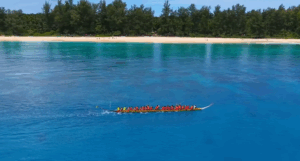
Canoe Race In Car Nicobar, (Source : Youtube – Sublime Island)
Though the Nicobarese belong to the Mongoloid race and have a common language origin, there are differences in the dialects. These dialects are so different that they find it difficult to understand the dialects other than their own. Not only the dialects of the people are distinct, but their larger cultural expressions, arts & crafts, kinship system and rituals. Though there are notable differences among the Nicobarese, when it comes to celebrate the shift in season – the advent of Monsoons throughout the Nicobars, they celebrate it with different names and practices.
Nicobarese are meat eaters as well as eaters of tubers as well. They consume pig, fishes and grow a wide range of crops like bananas, papayas, yams, jackfruit. They also consume fruits and tubers like pandarus, cycas, coconuts, areca nuts etc. . Rice has never ever been a part of their diet. It was introduced later after the acculturation of the natives.The advent of Monsoons denotes the change in the vegetation and the dietary practices of the region. Shifts in winds depict the shifts in the pattern of consumption as well. People celebrate and pray to ancestors for abundance of food in the upcoming season.
With the coming of the Southwest monsoon, the people of the central Islands of the Nicobar, namely Katchal, Kamorta and Trinket organise a festival called Anuchoilu. With a lot of enthusiasm, they celebrate the festival with a competition. In the month of May or June, where several canoes, each representing a team, have to catch the kauwa fish before the six coconut leaves are burnt. The canoe which picks up more fish in a given time wins the competition. Six coconut leaves are burnt – which acts as a timer for the game. The dietary pattern for this season now changes, foods like Pandanus (screw pine), Humlem (Cycas rumphii )and danduse (Giant Barracuda) are now forbidden, it’s usually not eaten until the next season arrives.
The Southwest Monsoon in Chaura Islands is also necessary for driving away spirits in rafts to other islands. On a full moon night, a decorated raft is constructed which then is allowed to carry away by the winds to the uninhabited islands of the Tillangchong, which is believed to be the land of spirits. A stick fight is also organised to scare away diseases and spirits. After a week, on a no moon night, Kanchuello festival begins with cooking chicken and also they start consuming coconuts and other items which were forbidden.
The Northeast Monsoon also holds the equal importance, even though it brings less rainfall than the Southwest, the winds remain crucial for them as it denotes the change in the season and vegetation. The people of the Central Islands of Nicobar, organise and celebrate the Kinleava Festival. A fishing trap which is known as Inaya is laid in the sea during low tides, soon it emerges in water they start erecting poles known as kanaya decorated with tender coconut leaves and fruits. The previous year kanaya is slashed down, following the new kanaya is erected by the families. They start shouting and evoke devotion – crying for the abundance of food from their ancestors. The inyun is emptied every alternate day till the waning phase of the moon and then people go on for fishing flying fish, which they use as a bait to catch danduse (Giant Barracuda) which was restricted before. This festival is celebrated differently in the Central Islands, as some inaugurate the festival by eating crabs, some with snails.
In the Islands of Chaura, during the onset of Northeast winds, annual pig festival starts or Panuohonot. This festival is celebrated in the memory of their ancestors. The preparation for the festival starts few months ago right from the cultivation of the fruits and tubers which are eaten during the upcoming months. The Elpanam – community house is decorated and flags are hoisted. A pig fight is conducted where young Nicobari men are supposed to defeat the pig and then they are continuously slaughtered according to their need for consumption. The festival is accompanied with singing, dancing and drinking toddy. A special pig sacrifice takes place which is called hancheha. They smear the blood of the pig as a belief for good health and disease free life. Its then cooked and eaten together by the whole community. Canoe Race is the important competition of this festival.
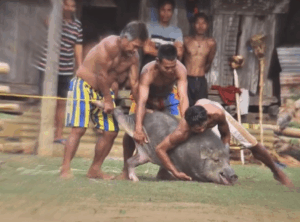
Pig Fight, (Source: Youtube: Lals Official)
Though these festivals were a sense of collective belongingness, today the relevance and importance have been reduced. The influence of christianity has been so great in the islands that 98% of them have been converted into christians. The festivals like Christmas and Easter have replaced most of the festivals of their own.
“The winds come and go, as faithful as ever,
but they do not receive the same welcome as before”. – Simron Jit Singh
The acceptance of change by the people has greatly affected their culture and food practices. The food that was once a staple for them – the “Nicobari aloo” – has now been replaced by rice. Horticulture and the growing of yams, tubers, and other fruits are now also disliked by younger generations opting for food which was never theirs.
These festivals were recorded and observed by Simron Jit Singh, who carried out a two year field study and the terms are recorded as they appeared to him. Also Edward Horace Man has written down the practices of Nicobarese in the end of the 19th century. All these festivals are not celebrated today with the same enthusiasm as they did several decades ago. A self-sufficient society has completely changed into one that is dependent on imports. A sustainable society has transformed into a society using all the modern implements that has been now a threat to the Islands’ culture, people and ecology at the same time.
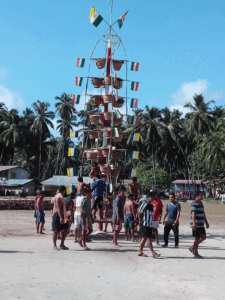
Modern Kinleava Durinng The Pig Festival Decorated With Indian Flags, (Source: Newspaper : The Daily Telegram)
References
Singh, Simron Jit. “Winds over the Nicobars.” India International Centre Quarterly, vol. 27/28, 2001, pp. 123–38. JSTOR, http://www.jstor.org/stable/23005705. Accessed 19 July 2025.
Man, Edward Horace, et al., The Nicobar Islands and Their People. Printed and pub. For the Royal Anthropological Institute of Great Britain and Ireland by Billings and Sons, 1932, pp. 143-166.
Singh, Simron Jit. “Festivals in the Nicobars.” India International Centre Quarterly, vol. 27/28, 2001, pp. 139–48. JSTOR, http://www.jstor.org/stable/23005706. Accessed 19 July 2025.