

P. Sanjay
A fascinating heritage left by the famous Mughal Empire, the Mughal gardens have been a treat to the eyes of the travellers then and now. The scenic beauty, mesmerizing building architecture, geometrical patterned gardens planted with colourful flowers and all sorts of scented herbs, and the iconic hydraulic system. All these features describe how a Mughal garden was unique in its own way. The Mughal gardens are influenced by the Persian and Central Asian where water acts as a central feature of the Gardens.
Kashmir is defined as the treasure The waterworks in the Mughal gardens symbolises not only the technological advancement in the field but also their concern to preserve the treasure of Kashmir Landscape ecology and their continuous intellectual engagement with the natural heritage of Kashmir (Numani, M.A., 2018). The gardens acted as pleasure gardens, famous summer spots and open air palaces to the Mughal Emperors. To spend their leisure time, to admire the beauty of Kashmir, and to enjoy the aesthetics of the palace and the garden that the Mughals built.
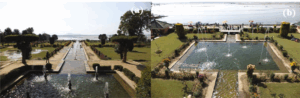
Nishat garden, situated facing the Dal lake, Photo by: M. A. Numani
The history of construction of gardens of the Mughals in Kashmir starts with the Emperor Jahangir. Though the region became a part under Akbar, Jahangir was the first who was keen to undertake the garden projects in Kashmir. Shalimar Bagh, Achanbal, and Verinag garden was constructed by Jahangir. Asaf Khan, brother of Nur Jahan laid out the Nishat Bagh in Srinagar, which is the most magnificent of all the gardens in Kashmir. Chashma Shahi was built by the ruler Shah Jahan, with a garden of flowers and waterfalls. Water was supplied from springs which then fell into the lower terrace. Pari Mahal, sponsored by Dara Shikoh, was situated on the southern side of Dal Lake. Most of the gardens were laid around the famous Dal lake for its scenic beauty, blending the natural beauty with the royal grandeur.
The source of water for all the hydraulic requirements tends out to be different for various geographical regions and locations. In the Upper Gangetic plains, water was usually drawn from wells termed as wa’in or ba’oli or chah. Various devices were used for lifting water from the wells and stepwells, the most efficient was the Persian wheel. Water was lifted from a great height and then poured it into the waterducts. In Kashmir, canals drawn from the natural springs surrounding the mountains and rivers serve as the sole sources of water. These feed the gardens, where water cascades through terraced levels and sparkles as it flows from elegant fountains. One great example would be of Shahjahan laid Shah Nahr, a canal built by Jahangir to water the Shalimar bagh which was further carried by Asaf Khan to the Nishat Bagh. (Sadaf Fatma and Sadaf Fatima, 2012)
The water travels through the breathtaking terraces of the Mughal garden, but what are these terraces? Mughal gardens as steep areas were cut into several terraces, providing a domesticated landscape. The applied gravitational force brought the powerful streams and springs from the hill fell into the ground with immense force driving the water. At places not so steep, Mughals made slopes and artificial terraces in that case. Each terrace was followed by another, from which water fell like a waterfall at every structural level like the garden lined with three terraces in Shalimar Bagh, twelve terraces in Nishat Bagh, six terraces in the Pari Mahal and many more.
Water in the Mughal gardens not only held iconic aesthetic value but also played a vital role in nourishing the fruit- and flower-bearing plants. Tanks were present in the corner of the garden and were connected to the canals and big tanks, these go all the way watering the garden through terracotta pipes. Underground channels were also used to transport the water as terracotta pipes buried inside the gardens have also been excavated. The tanks were of various shapes from circle, square to octagon. The squaring of the circle has made the Hexagonal and Octagonal shaped pools, which were quite popular as symbolically the circle represented heaven and square represented the earth. Octagon shaped pools also represent the number eight, which describes eternal life in the Islam.
The abundance of water flowing in the Mughal gardens takes different dramatic forms. It falls off large sheets in the form of cascades and falls into the successive terraces. It can also take the form of a “Chadar”, a slanting water chute , with sculpted patterns on it which flows like sheets, making beautiful patterns and mesmerizing sounds. The pattern when made like a fish’s body is quite popular (mahipusht) gives the water a rippling effect. The word chadar, which means a shawl, is how poetically water is being referred to as having taken the form of a shawl. Cascades also have niches where the candles and lamps have been kept, it is known as chini-khanah which gleams behind the falling water, gleaming over the waters. The chini-khanah in the Shalimar Bagh is very famous, where Jahangir and Nur Jahan enjoyed the beauty of the garden.
The fountain remains a major attraction of the gardens due to its varied shapes and designs made by the fountains. They are usually placed at the centre of the gardens which symbolically represents the cycle of birth as the fountain rises and merges, similarly to humans. Tasneem and Salsahil are the fountains of paradise according to their Islamic belief. The fountain usually consisted of a base pipe, fountainhead and nozzle all made up of bronze and alloys. The fountain technology was at its peak, with various innovations within the designs of fountainheads such as the fountainhead in the shape of an hourglass, cone-shaped which was quite popular. The Mughal fountain technique was subtle, using a range of techniques like bubbling fountains, sprays, multiple spouts and jets to create unique effects.
The Mughal garden presents as an important cultural symbol of the Mughals and a heritage of the famous Mughal rulers. It shows the immense technological prowess and hydraulic techniques. From building the monuments to bringing out canals and from planting the trees to maintaining the whole garden, it would have required skilled workers and labourers. The water travels throughout the garden. It takes various forms, at times falling off from the terraces, being thrown out forming fountains and sliding through the chadars. It finally leaves the gardens to join the Dal lake.
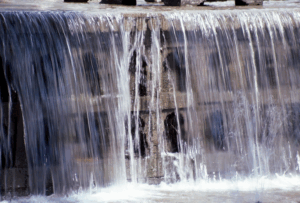
Chini-khanah in Shalimar Bagh, (Source: archnet.org)
Conclusion
The Mughal gardens of Kashmir stand as enduring symbols of medieval heritage, blending Persian and Central Asian influences with the breathtaking natural beauty of the region. Their intricate hydraulic systems, terraced landscapes, and artistic integration of water reflect not only the technological advancements of the Mughal period but also an appreciation for nature. Serving as pleasure gardens, open-air palaces, and places for rulers to spend time in leisure, they include the harmony of architecture, environment, and philosophy preserving a heritage that continues to enchant visitors centuries later. The legacy of Mughals fascinates us with its mesmerizing gardens which still after 400 years remains to be one of the greatest marvels.
References
James W. P. Campbell & Amy Boyington (2018) Fountains and water: the development of the hydraulic technology of display in Islamic gardens 700–1700 CE, Studies in the History of Gardens & Designed Landscapes, 38:3, 247-267, DOI:10.1080/14601176.2018.1452827
Numani, M.A. (2018). Landscape Gardening and Environmental Restoration: Concerns in Mughal Kashmir. In: Singh, V., Yadav, S., Yadava, R. (eds) Water Resources Management. Water Science and Technology Library, vol 78. Springer, Singapore. https://doi.org/10.1007/978-981-10-5711-3_5
Fatma, Sadaf, and Sadaf Fatima. “Waterworks in Mughal gardens.” Proceedings of the Indian History Congress. Vol. 73. Indian History Congress, 2012.
Fayaz, Farooq. “Mughal Gardens Around the Dal Lake – The Cultural Documents of Mughal Aesthetics”, The Journal of Kashmir Studies, Volume 5(1), 2011.