

By Tehreem Asad
The dome is one of the most prominent and recognisable features of Islamic architecture. It is an architectural structure that can be described as a hollowed-out hemispherical ceiling. Its earliest monumental expression in Islamic architecture is seen in the Dome of the Rock (691 A.D.), which is often regarded as the first monumental Islamic construction. Mosques across the world have prominent domical constructions. Beyond their structural utility, domes have acquired symbolic significance as markers of glorification and power, which has been largely shaped by royal and secular patronage rather than religious prescription. While early Islamic doctrine discouraged the building of grand structures over graves (emphasising equality in death), gradually rulers began commissioning monumental architecture to assert prestige and authority, resulting in the construction of grand tombs and mausoleums. Consequently, domes also became important features of the tombs of Muslim rulers and elites.
This architectural and symbolic evolution of the dome found an expression in the Indian subcontinent, starting under the Delhi Sultanate (1206–1526). The five dynasties of the Delhi Sultanate, Mamluk, Khalji, Tughlaq, Sayyid, and Lodi dynasties, ruled over large parts of the Indian subcontinent for over three centuries. This period signalled the introduction and adaptation of Islamic architectural forms within a new cultural and material context of the Indian subcontinent. The domes of the Delhi Sultanate present the continuity of broader Islamic traditions and innovation that were moulded by local conditions.
INDO-ISLAMIC STYLE OF ARCHITECTURE
Domes were not unknown before the Muslim rule in India; however, there are discernible structural differences in the domes of the earlier period. The ancient Indian architecture primarily used a trabeated style based on the post and lintel system, in which the roofs approximated the shape of a pyramid. Domes of this period were often vaulted roofs that rested on an octagonal base. Structures like Jaina temples commonly used corbelled domes, while Buddhist Stupas constituted some of the first masonry domes. Features like amalaka (ribbed stone disk crowning the shikharas) and kalasha (decorative finial on top of the dome) can also be found in several of the domes.
From the 12th century, the Indo-Islamic style of architecture emerged in the Indian subcontinent. The most evident development of this style of architecture begins with the establishment of Delhi as the capital by Muhammad Ghori in c.1193. Indo-Islamic style brought with it new techniques and structural features of Islamic architecture into the subcontinent. However, it was largely a synthesis of both Islamic and local architectural traditions. There is an evident presence of Indian decorative elements in addition to the Turkish, Persian, and Saracenic influences. The final result was also heavily dependent on the availability of resources, materials, the skill of workers, the preferences of the patron, etc.
The development of Indo-Islamic architecture gained momentum with the emergence of the Delhi Sultanate. It can be broadly categorised into the Imperial Style (Delhi Sultanate), the Provincial Style (Mandu, Gujarat, Bengal, and Jaunpur), the Mughal Style (Delhi, Agra, and Lahore) and the Deccani Style. The architecture from the period of the Delhi Sultanate, as well as the subsequent Mughal dynasty, bears close semblance to the Islamic architecture of Central Asia, derived particularly from Iran. The Indo-Islamic architecture was mainly produced for Islamic patrons. Of the buildings commissioned by the Muslim elites, mosques and tombs were the most widespread. Both of these structures typically included large domes and numerous arches.
Central Asian and Persian Islamic architecture made use of domes and arches to improve their design and structural qualities. The arrival of Islamic rule introduced the arcuated system, bringing concepts of true arches, vaults, and domes into the subcontinent. Initially, the construction of arches and domes by Indian masons, who were unfamiliar with the techniques of building true arches and voussoirs, was based on the corbelled system. Later, with the increased understanding of the arcuate system, arches could be built using voussoirs and keystones. Voussoirs are the wedge-shaped blocks used in constructing an arch, and the keystone is the topmost voussoir that locks all the others in place. Building an arch through this technique enables the arch to bear weight by distributing forces outward and downward to the supports, which creates a self-supporting structure. Voussoirs were arranged in the shape of a curved hemisphere in order to create a true dome. Turks also popularised the use of lime mortar, which served as an essential cementing agent and was used extensively in the Sultanate architecture.
DOMES OF DELHI SULTANATE
MAMLUK DYNASTY
The developments in the construction of domes of the Delhi Sultanate are noticeable if we closely observe the structures of the five dynasties. The initial phase of the Sultanate monuments comprises buildings that reutilised material that was obtained by demolishing already existing religious structures. This temporary building technique lasted for the first thirty years of the Sultanate rule, when it was emerging as a new political power in the subcontinent, and the assertion of political authority was crucial. There was also a lack of building material, funds and labourers. With time, techniques and methods of construction improved, resulting in planned and increasingly more embellished structures made out of newly quarried material. Both religious and secular buildings were constructed during the Sultanate period in India, but religious structures like mosques, tombs, madrasas (schools), dargahs and khanqahs (hospices of Sufi saints) outnumbered the secular structures.
As previously discussed, the constructions of the earlier period of the Sultanate had to steer a middle course between the skills of the native workmen and the demands of the patron. Housed within the Qutb Minar complex, the Quwwat-ul-Islam Mosque was the first mosque built in Delhi. Its construction was started by Qutb-ud-din Aibak in c.1192. Being one of the very first structures to be built under the new Muslim patrons, the local masons made use of the trabeate and corbelled systems for its construction. Since the techniques for creating a true arch were not yet known in the region, corbelled arches were created without using voussoirs, epitomising the primitive stage of the Indo-Islamic architecture. The square base of the mosque was refashioned into an octagon using corner beams, which was then roofed by a low, corbelled dome. Local decorative elements are also evident in the mosque. The mosque does not use mortar in its construction. After the Quwwat-ul-Islam Mosque, each consecutive building in the Qutb Minar complex shows the gradual transition from corbelling style towards the building of true arches. The evolution of domes, arches, and squinches can be traced in the structures of the complex.
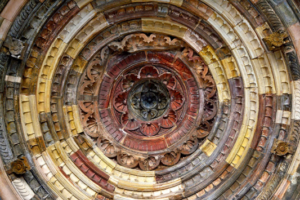
Interior view of the dome at the Quwwat-ul-Islam Mosque, Qutb Complex
Photograph by Ayan Ghosh
(Courtesy:https://www.sahapedia.org/domes-of-delhi#lg=1&slide=3)
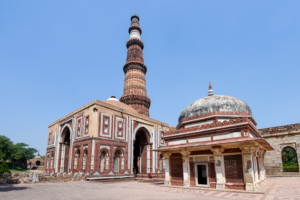
Quwwat-ul-Islam Mosque (at the front), Qutb Minar Complex, Delhi
(Courtesy:https://www.orientalarchitecture.com/sid/155/india/delhi/quwwat-ul-islam-mosque)
The first effort at building the tomb of a Muslim ruler in Delhi is seen with the tomb of Iltutmish (built c.1235). Its dome does not exist today; however, it can be speculated that it consisted of a square base and was topped with a corbelled circular dome. The earliest example of a true arch and a squinch with voussoirs is thought to be the tomb of Ghiyath al-Din Balban (built c.1287-88), which can be found in the Mehrauli Archaeological Park. The dome of the tomb also does not survive today.
KHALJI DYNASTY
Structures from the time of the Khalji dynasty show visible changes in the style of architecture. The use of true arches and true domes with recessed arches under the squinch becomes apparent. The Alai Darwaza is another structure in the Qutb complex. Built in c.1311 by Alauddin Khalji in an effort to extend the Quwwat-ul-Islam Mosque, it is the southern gateway to the Quwwat-ul-Islam Mosque and was supposed to be one of the four grand gateways to the Qutb complex. However, the construction stopped with only the Alai Darwaza, possibly due to the death of Alauddin Khalji. It has the first dome in India that uses stones cut into voussoir blocks, making it the earliest true dome. It uses arches to transform the square plan into octagonal which is then converted into a polygon with 16 sides through corbelled brackets. The dome is a shallow one with a finial on top. It is believed to be the first Indian structure created entirely according to the Islamic principles of construction. It is possible that the assistance from the masons of the disintegrated Seljuk empire was taken in the construction of the Alai Darwaza, since its architecture shows a marked change in the use of technology and ornamentation.
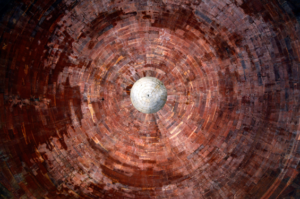
Interior view of the dome of the Alai Darwaza, Qutub Complex
Photograph by Ayan Ghosh
(Courtesy:https://www.sahapedia.org/domes-of-delhi#lg=1&slide=3)
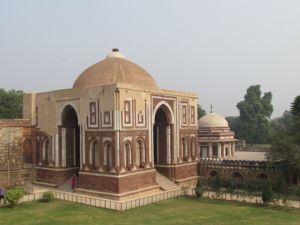
Alai Darwaza, Qutb Minar Complex, Delhi
(Courtesy: https://en.wikipedia.org/wiki/File:Alai_Darwaza.JPG )
Architecture from the Khalji period utilised shallow domes. In a shallow dome, the height of the dome is less than that of the radius, and the vertical space taken up by the dome is comparatively less. This type of dome can also be observed in the Jamatkhana Mosque in Nizamuddin. With later constructions, the height was increased using new techniques in order to increase their structural and aesthetic appeal.
TUGHLAQ DYNASTY
While shallow domes were prevalent during the Khalji period, the architecture of the Tughlaq dynasty saw the development of a pointed dome with a pronounced neck. The tomb of Ghiyath al-Din Tughluq (completed c.1325) is situated to the south of the Tughlaqabad Fort. Here, one can observe that the verticality of the dome is elevated by its pointed shape, and the dome is crowned by kalasha and amala. The white marble dome of the tomb is made up of finely cut stone voussoirs, which have alternating bands of shallow and deep stones. In contrast, the late 14th-century domes use roughly cut stones, which were then covered in render. This change most likely happened due to the dismissal of skilled Seljuk workmen due to the shift of capital from Delhi to Daulatabad. Such domes are observable in the Khirki Masjid (c. 1375) and the tomb of Firoz Shah Tughlaq. The tomb of Khan-i-Jahan Tilangani, which is one of the first octagonal tombs in India, has a large raised dome atop a central chamber, which is surrounded by a verandah.
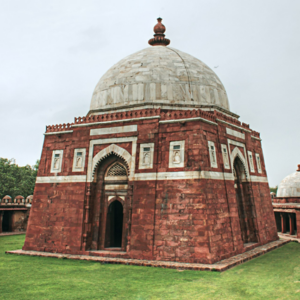
Tomb of Ghiyath al-Din Tughluq, Delhi
(Courtesy:https://commons.wikimedia.org/wiki/File:Tomb_of_Ghayasuddin_Tughluq_-_Delhi.jpg)
LATER CONSTRUCTIONS: THE SAYYID AND THE LODI DYNASTIES
The death of Firoz Shah Tughlaq (1388) and the Timurid sacking of Delhi (1398) led to the weakening of the Delhi Sultanate, which made the construction of elaborate monumental buildings difficult. Hence, much of the construction done by the Sayyids and the Lodis in Delhi consisted of small tombs and mausoleums.
The use of an octagonal plan instead of a square one started with the Sayyid dynasty. In the tomb of Mubarak Shah (built c.1434), the plan changes from an octagonal one to a 16-sided one by using arches, which subtly converts the octagonal base into a circular one, transitioning into the dome. The soffit of the dome is plastered and decorated with arch motifs.
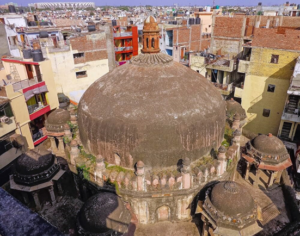
Tomb of Mubarak Shah, New Delhi
(Courtesy:https://kevinstandagephotography.wordpress.com/2024/09/20/tomb-of-mubarak-shah-sayyid-delhi/)
During the Lodi dynasty, the construction of double domes developed for the first time. The height of the dome was enhanced even more by introducing an octagonal drum, which allowed the circular dome to rest on a square base, while muqarnas (niche-like decorative elements) provided a transition from the square-shaped lower structure to the dome. The use of chatris (small domed pavilions) around a huge dome emerges during this period. Separate tomb-building practices were followed, with octagonal plan-based mausoleums being built for the royalty and square plan-based tombs for high-ranking officials during this period. Both of these structures, however, were surmounted by a dome.
The enhanced height of the dome can be observed in several structures of the Lodi period. The Bara Gumbad Mosque was constructed under the reign of Sikander Lodi (c.1494), and is located within the Lodi Garden. The mosque consists of a single aisle on top of which lie three domes raised on muqarnas. The tomb of Sikander Lodi has a single-shelled, three-centred dome, capped with a lotus finial. This tomb is speculated to have been the first effort at constructing a double dome due to the presence of an opening in the dome that is visible from outside, however, there is no conclusive proof for this theory.
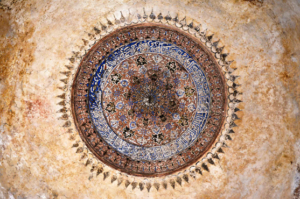
Interior view of the dome of the Bada Gumbad Mosque, Lodi Garden
Photograph by Ayan Ghosh
(Courtesy:https://www.sahapedia.org/domes-of-delhi#lg=1&slide=3)
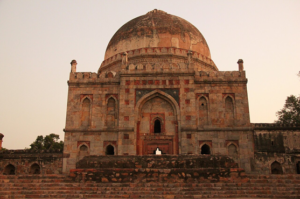
Bara Gumbad Mosque, Lodi Gardens, New Delhi
(Courtesy:https://en.wikipedia.org/wiki/Bara_Gumbad#/media/File:Bara_Gumbad_2015.JPG)
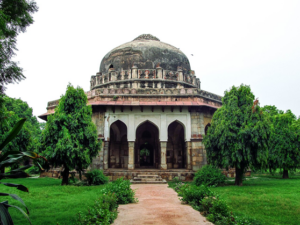
Tomb of Sikander Lodi, Lodi Gardens, New Delhi
(Courtesy:https://en.wikipedia.org/wiki/Tomb_of_Sikandar_Lodi#/media/File:Tomb_of_Sikandar_Lodi_(1_of_1).jpg)
The first battle of Panipat (1526) marked the beginning of Mughal rule in India, effectively ending the Sultanate. Under the Mughals, the Indo-Islamic style underwent even more developments, which represent the peak of this style of architecture. The Mughal architecture introduced double-shell domes, which tended to be more bulbous in shape. The architecture of the Delhi Sultanate provided the technological foundation which influenced and aided the later architectural ventures. Mughal architecture was able to reach a high point due to the influence of these earlier developments, and also ended up influencing local building practices in turn.
The architecture of the Delhi Sultanate introduced a new style of monumental construction in India. Tombs and mosques were the most frequently constructed structures, and domes were the central element of these structures. The initial buildings of the Sultanate were intended for more functional purposes, and with time, they acquired distinct aesthetic characteristics. In the architecture of the Delhi Sultanate, domes initially catered to practical and symbolic functions. Over time, these domes underwent significant morphological refinement. What began with the replication of unfamiliar methods of construction by the Indian masons gradually evolved into a very distinct style of architecture altogether.
BIBLIOGRAPHY:
1.Burton-Page, John. “SULTANATE ARCHITECTURE.” Indian Islamic Architecture: Forms and Typologies, Sites and Monuments, edited by George Michell, vol. 20, Brill, 2008, pp. 3–25.
2. Welch, Anthony, and Howard Crane. “The Tughluqs: Master Builders of the Delhi Sultanate.” Muqarnas, vol. 1, 1983, pp. 123–66.
3. Ali, Asif, and Ahmad Sanusi Hassan. “From Corbelled to Onion-Shaped: The Morphological Development of Domes in the Islamic Architecture of North India.” The Arab World Geographer 22.3 (2019): 254-275.
4. Gupta, Shubhru. (2006). Delhi domes in transition.
5. Khan, Sahil & Kamal, Mohammad Arif. (2022). Analysis of Domes in Tomb Architecture of Delhi: Evolution and Geometrical Transition. Journal of Islamic Architecture. 7. 95-103.
6. Grabar, Oleg. “The Islamic Dome, Some Considerations.” Journal of the Society of Architectural Historians, vol. 22, no. 4, 1963, pp. 191–98.
7. https://www.sahapedia.org/the-qutb-complex-and-the-arcuate-system-of-construction-india
8. https://encyclopedia.pub/entry/30413
9. https://www.historymarg.com/2023/11/indo-islamic-architecture-before-and.html
10. https://www.news18.com/photogallery/india/domes-of-delhi-a-look-at-the-indian-architectural-masterpieces-1790055.html
11. https://egyankosh.ac.in/bitstream/123456789/20198/1/Unit-31.pdf




















.jpg)