

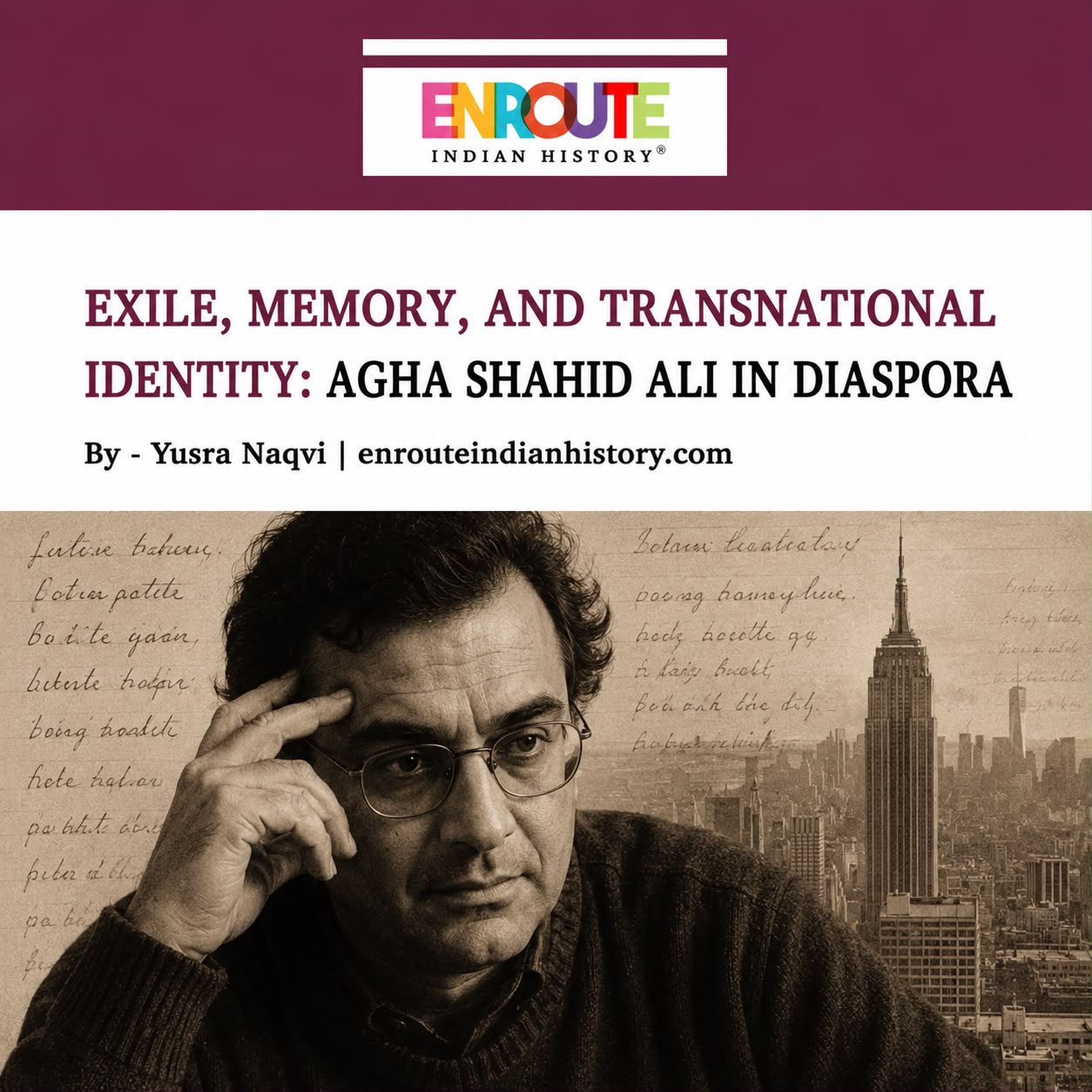
:- by Yusra Naqvi
Abstract
This article examines the life and works of Agha Shahid Ali in the diaspora, focusing on his poetic imagination as well as thematic and literary interventions that were shaped during his prolonged stay in the United States. His life is situated within the broader framework of postcolonial diaspora, where questions of displacement, memory, and identity become central to creative expression. Ali’s poetry articulated a complex engagement between memory and belongings, where Kashmir is seen both as a lived homeland and a reconstructed imaginative space. Furthermore, his roles as a teacher, translator, and editor in the United States contributed to the dissemination of South Asian literary traditions such as the ghazal within global Anglophone contexts. By engaging with critical scholarship on diaspora and postcolonial identity, this article positions Agha Shahid Ali as a key figure of transnational poetry whose work was rooted in loss, memory, and cultural continuity.
Keywords: Agha Shahid Ali, ghazal, diaspora, postcolonial identity, memory
Introduction
The late twentieth century witnessed an increasing prominence of diasporic voices in global literature, particularly from South Asia, where writers began to explore new forms of identity and belonging. In this context, the work of Agha Shahid Ali stands out for its deeply evocative engagement with exile, memory, and politics of his homeland. Although his poetry emphasises the awareness of distance, both physical and emotional, it does not reduce his experience to that of alienation.
Born on February 4, 1949, in New Delhi, India, and brought up in Srinagar, Kashmir, Agha Shahid Ali grew up in a culturally and intellectually rich Kashmiri Muslim family. His early exposure to Urdu, Persian, and English poetry and literature shaped his sensibility towards poetry. In the 1970s, he moved to the United States to pursue higher education and completed his PhD in English at Pennsylvania State University and later pursued a Master of Fine Arts at the University of Arizona, eventually establishing a career in academia. This transition marked the beginning of a life outside India, while his intellectual and emotional ties to Kashmir remained profound. He went on to teach at several American institutions, including Hamilton College and the University of Massachusetts, Amherst. His academic career positioned him within a network of writers and scholars engaged in contemporary literary debates. This allowed him to introduce Indian literary forms to a wider audience.
Agha Shahid’s work should be understood within the broader discourse of postcolonial diaspora, where migration often entails a reconfiguration of cultural identity. For him, Kashmir becomes not just an abandoned place but a recurring presence that he encounters through the lens of memory and political turmoil. His poetry thus engages with the questions of representation and distance alters perception. Besides, Ali’s position within American academia and literary circles enabled him to function as a cultural mediator. His work reflects an ongoing negotiation between different literary traditions, particularly Persian, Urdu, and English. This article explores these intersections, emphasising that his diasporic experience is central to understanding the thematic depth and the global significance of his poetry.
Poetry of Emotions, Memory, and Loss
Agha Shahid Ali’s poetry is constantly shaped by memory. In his writings, memory often acts as a bridge between the homeland and the hostland. His collection A Nostalgist’s Map of America exemplifies this dynamic where he reimagines the space through longing and America becomes the landscape through which Kashmir is continually recalled, reimagined, and mourned. In his poetry, he used the cultural artefacts of Urdu, Kashmiri, Hindi, Syrian, and Andalusian literary cultures to express the emotions of longing, love, and displacement, be it historical or current.
In the Country Without A Post Office, he lists eighteen variations : ‘Kashmir, Kashmir, Cashmere, Cashmir, Cashmire, Kashmere, Cachemire, Cushmeer, Cashmere, Cashmir. Or Cauchemar in a sea of stories? Or: Kacmir,Kaschemir,Kashmere, Kachmire, Kasmir. Kerseymere?’ (The Blessed Word: A Prologue,” pg 171). These variations demonstrate the ‘disturbed homeland’ that is being reimagined from afar. It carries the difficulty of fixing a singular identity onto a place that is undergoing violence, and shows the feeling of loss and uncertainty.
In 1987, Ali published The Half-Inch Himalayas with the famous poem ‘Postcard from Kashmir’ to portray a blend of multi-cultural experiences and to foster the ideas of ethnicity, nationality, and identity. The poem reads:
Kashmir shrinks into my mailbox,
my home a neat four by six inches.
I always loved neatness. Now I hold
the half-inch Himalayas in my hand.
This is home. And this is the closest
I’ll ever be to home. When I return,
the colors won’t be so brilliant,
the Jhelum’s waters so clean,
so ultramarine. My love
so overexposed.
And my memory will be a little
out of focus, in it
a giant negative, black
and white, still undeveloped.
Memory is shaped by absence and distance. The homeland is reconstructed through fragments of images, sounds, and cultural references. He deals with the uncertainties that people were facing back in Kashmir, and feels the issue to be communal and emotional. In spite of the turmoil, he remembers the beauty of his homeland and glorifies the Himalaya and Jhelum, thus reinforcing his identity. Another poem, “I See Kashmir from New Delhi at Midnight”, highlights how distance produced a fragmented, indirect relationship with his homeland. ‘See’ did not refer to a direct experience, rather it meant the imagination of ‘Midnight’ or the darkness and uncertainty that had surrounded his beloved Kashmir.
Translation and Editorial Work
Agha Shahid Ali’s contribution to literature extends beyond his own poetry. As a translator , editor, and teacher, he played a vital role in introducing South Asian literary traditions to American audiences. His translation of Faiz Ahmed Faiz in The Rebel’s Silhouette brought Urdu poetry into dialogue with English readers. Similarly, he also published seven volumes of poetry and edited an anthology of ghazals called Ravishing DisUnities. His editorial work and teaching practices fostered an appreciation for non-Western literary forms within American academia. This challenged the marginalisation of these traditions and advocated for their inclusion within the broader canon of world literature.
Shahid ‘s most celebrated achievement was his experiments with the ‘English Ghazal’, which involved a struggle in establishing the Urdu and Persian literary tradition in the English language. His collection of ghazals in English, Call Me Ishmael Tonight: A Book of Ghazals, was published posthumously.
Ali’s transnational identity is also evident in his use of language. Writing primarily in English, his writing is shaped by multiple influences and incorporates elements of Urdu and Persian, creating a shared linguistic space that resonated with people from diverse backgrounds. Scholars like Amitav Ghosh have highlighted his mastery of language and form, reflecting on his ability to transform exile into a space of creative possibilities.
Love for Food, Storytelling, and Music
Besides being a poet, Agha Shahid Ali was known among his friends as a warm, sociable, and deeply cultured companion. Amitav Ghosh in his essay ‘The Ghat of the Only World’, documents the final months of Shahid in Brooklyn and reveals his personality shaped by wit, charm, hospitality, aesthetics, and the ability to “transmute the mundane into the magical” even while suffering from a brain tumour in his last days.
Shahid celebrated friendships and had deep conversations about art and philosophy. During his stay in the United States, he frequently hosted mehfils and indulged in deep literary discussions by quoting Mir, Ghalib, Faiz, and Western poets with equal ease. He often encouraged friends to read aloud and engage with poetry collectively. Besides that, he was a food lover. Ghosh writes about him cooking elaborate meals, especially Kashmiri dishes, for friends. Very often, these meals became occasions for storytelling and memory-making. Amitav Ghosh recalls how Shahid would insist on feeding guests generously, turning ordinary events into celebratory gatherings, which he maintained even during his illness. Moreover, he was known for his vivid, playful personality, and dramatic storytelling. He loved anecdotes about literature, films,and personal life, and could shift from seriousness to humour effortlessly.
Shahid was extremely fond of music, particularly the ghazals and thumris of Mallika-e-Ghazal, Begum Akhtar. He often invited his friends over for listening sessions that evoked his nostalgia for his homeland. His love for Begum Akhtar was so profound that he mentioned her in several poems, including ‘Snow on the Desert’. They met in the late 1960s, and she frequently visited his home in New Delhi. He, in fact, once drove her to buy cigarettes in Srinagar. He was most impressed by her expressions in singing, and her ability to weave “threads of solace and longing”. Upon her death, he was a 25-year-old boy who was so devastated to hear the news that he immediately flew to her burial place in Lucknow to honour her. He often said that Begum Akhtar brought him close to Urdu ghazals and worshipped her as the embodiment of the art form. He paid tribute to her by dedicating to her his famous elegy “In Memory of Begum Akhtar”:
Do your fingers still scale the hungry Bhairavi,
Or simply the muddy shroud?
Ghazal, that death-sustaining widow,
sobs in dingy archives, hooked to you.
She wears her grief, a moon-soaked white,
corners the sky into disbelief.
You’ve finally polished catastrophe,
the note you seasoned with decades
of Ghalib, Mir, Faiz:
innovate on a note-less raga.
Conclusion
For Agha Shahid Ali, his homeland was never just a place left behind. Its presence was felt in every corner and refused to fade away. It was a memory that kept returning with quiet insistence. Even while staying in the United States, his imagination remained tethered to the Ghats, the chinar trees, the cadences of Urdu poetry, and the rhythms of his abode. Kashmir, in his work, is mourned, felt,and spoken to, almost as if it were still within his reach. He writes as someone who belongs, yet cannot return. The violence in Kashmir appears in his poetry as something that is lived, internalised, and grieved. There is a quiet pain in his poetry, a sentiment that keeps the memories of Kashmir alive forever. Alongside, his deep grounding in Indian and Urdu tradition shaped the very texture of his poetry, with an emotional attachment with the ghazals and nazms of Mir, Ghalib, and Faiz. Even in English, his poetry carries the cadence, restraint, and longing that come from the ghazal tradition.
And yet beyond his poetry, he was someone who recreated memories of home through friendships, food, and mehfils filled with conversation and poetry. His attachment to Kashmir and to the traditions of Indian poetry and music was transformed by the diaspora, and made its revival more delicate and necessary. His poetry returning to loss time and again also means that he remembered with utmost longing while staying abroad, even till his death in 2001. In that longing lies its quiet power and the feeling to not make it disappear.
References:
- Ghosh, Amitav, ‘The Ghat of the Only World’: Agha Shahid Ali in Brooklyn’, 2002, https://www.amitavghosh.com/aghashahidali.html
- Ali, Agha Shahid, ‘I Dream I Am the Only Passenger on Flight 423 to Srinagar’, The Veiled Suite: The Collected Poems, Penguin Publishing House, New Delhi, 2009
- Ali, Agha Shahid, ‘In Memory of Begum Akhtar’, The Veiled Suite: The Collected Poems, Penguin, New Delhi, 2009, 53
- Ali, Agha Shahid, ‘The Country Without a Post Office’, W. Norton, 1997
- Ali, Agha Shahid, The Rebel’s Silhouette: Selected Poems of Faiz Ahmed Faiz, Of Massachusetts P, 1992.