

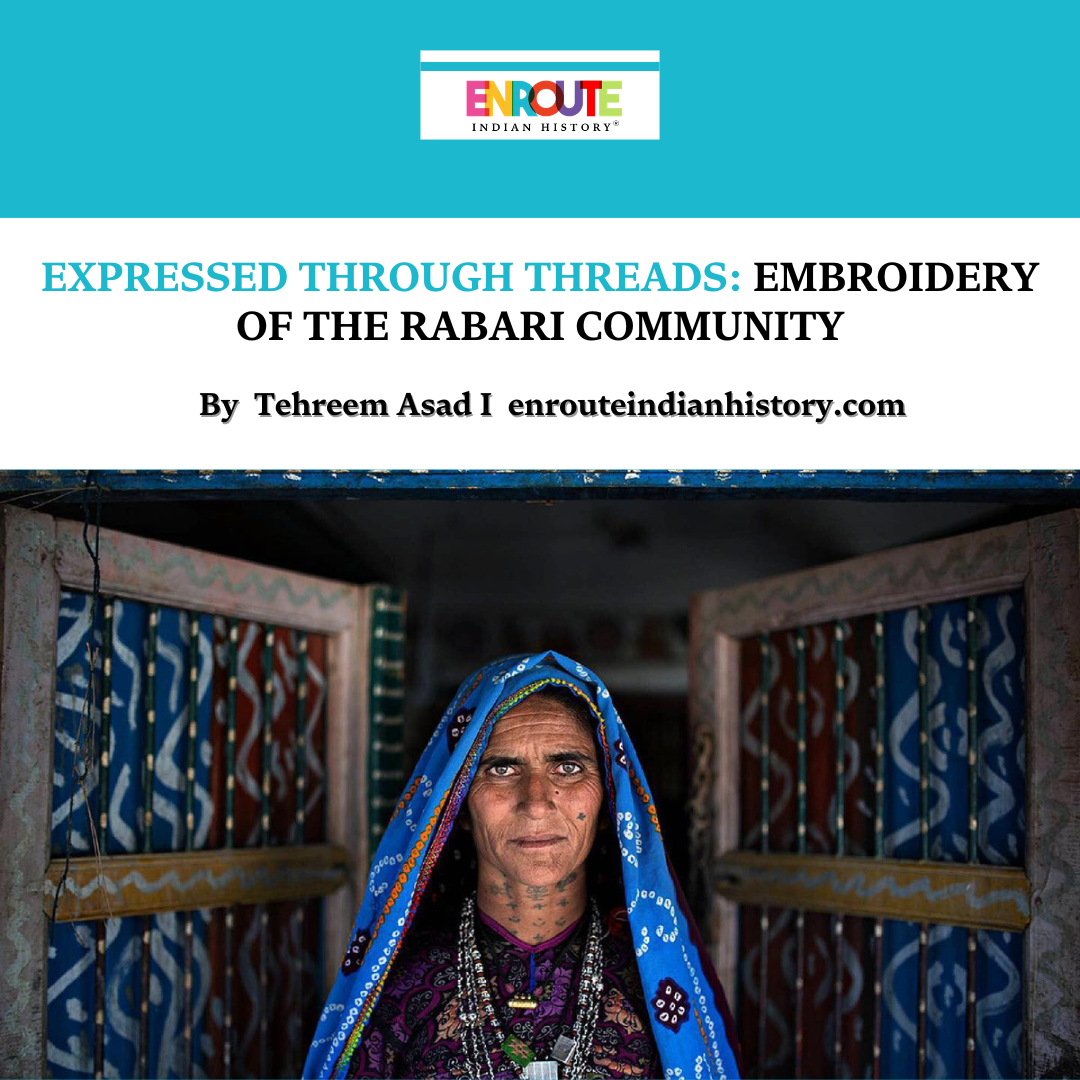
By Tehreem Asad
In regions of Gujarat and Rajasthan, profuse with aridity and sweltering weather, resides the pastoral-nomadic Rabari community. They primarily occupy four broad regions, including Kutch, Saurashtra, north Gujarat, and western and southern Rajasthan. Based on the regions they migrated to, they further branched out into culturally distinguishable subgroups. The climatic conditions of these regions do not facilitate agriculture, so the Rabaris are mainly dependent on animal husbandry as a means of livelihood, camels being the animal of choice traditionally.
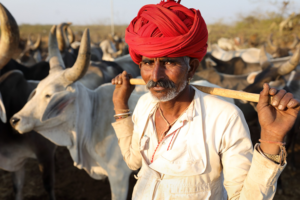
(Courtesy:https://dietmartemps.com/photo/india-rabari-man-in-kutch_6171/)
The Rabaris have a distinct style of clothing. Not only that, each sub-group of the Rabaris has adopted unique elements that mark them as different from the others. Even so, these subgroups preserve some features from the clothing of the group that they branched out from. The attire of the Rabaris is influenced by the climate and socio-economic conditions of the regions that they inhabit. The women typically wear a three-part outfit consisting of a blouse (kapadu), a skirt, and a veil, while the men wear turbans, shoulder cloths, and sometimes a jacket (kediyun). This traditional attire is not exclusive to the Rabaris but can be seen across the communities of these regions, but the combination of the type of fabric, colour of clothes, and decoration separates the dresses of the Rabaris from those of other communities. The most remarkable attribute of Rabari clothing is the visual articulation of their identity, the Rabari style of embroidery.
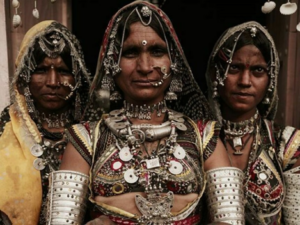
(Courtesy:https://www.meer.com/en/8284-dating-rabaris-the-nomads-of-kutch)
Rabari embroidery is an integral part of the community. It is primarily the women who undertake the task of embroidery. It is an assertion of Rabari cultural identity, a guardian of their history, and an expression of their creativity. The embroidery is not just limited to clothes, as will be discussed later, but is present on various items of cultural and personal significance. The style and motifs of embroidery have evolved over time and act as the distinguishing features of subclans, though some similarities can be found across the embroidery of the community. Unfortunately, the academic literature documenting the Rabari community has been largely scanty. However, scholar and author Judy Frater has written extensively on Rabari embroidery. This article is predominantly based on the research done by her on the Rabari embroidery.
A BRIEF HISTORY OF RABARI EMBROIDERY
Before the 11th century, the Rabaris lived mainly in Rajasthan, but there is no evidence indicating that they embroidered. In the 14th century, they migrated from Rajasthan to north Gujarat, where they picked up embroidery. Subsequently, they modified their embroidery according to regional styles, which resulted in the distinct Rabari style of embroidery. Rabari of north Gujarat, Kutch, and Saurashtra all took up embroidery.
The Patanvadi Rabaris of north Gujarat are a mostly settled group. They were the first to adopt the practice of embroidering due to the influence of the neighbouring communities. They use two distinct styles of embroidery that regionally belong to north Gujarat. For household decorations, they use a combination of Kathi-influenced geometric motifs (common in Saurashtra) and other stitches from the Kutch region. On the other hand, they use floral patterns for clothes, which is a contrast from other Rabari subgroups. This indicates an urban influence, probably obtained from professionally chain-stitched embroideries, and shows close contact and integration with the surrounding cultures.
The Rabaris of eastern Saurashtra, migrating there from eastern Kutch, reached the region in the 15th century. They were relatively settled by the mid-1980s. From 1900 to the 1970s, they adopted Kathipo embroidery, which was a geometric style influenced by the Kathis. Beginning around the 1930s, they were also influenced by the embroideries of the Saurashtra Mochis, where parrot and floral motifs were mainly used. For household decorations, the Rabaris of this region embraced the regional influences completely. Interestingly, however, they retained the traditional style for embroidering their veils, suggesting both integration into the region and preservation of community identity.
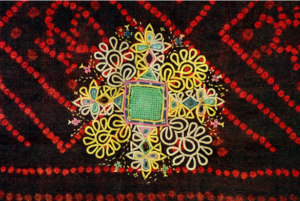
Kachhi Rabari ludaki (girls’ woollen veil) Bhujodi, c. 1970
(Courtesy:https://dhaaramagazine.in/2021/01/20/rabari-embroidery-chronicle-of-womens-identity-and-creativity/)
The Rabaris of Kutch migrated there from Rajasthan via Sindh in the 14th century. They took up embroidering in Sindh and, later, in Kutch, modified their traditional embroidery according to the regional styles, which finally culminated in the composite but distinct Rabari style of embroidery. Three subgroups of the Rabaris exist in Kutch, including the Kachhis, the Dhebarias, and the Vagadias. All of these sub-groups, by the 1980s, came up with their own styles of embroidery, though all of them were variations of the Rabari style.
Sorathi and Bhopa Rabaris in southern and western Saurashtra did not adopt any regional elements, mostly because of their relative isolation. Instead, they kept following the style of the areas from which they migrated (North Gujarat and Kutch, respectively). All styles of embroidery of these subgroups, although influenced by the regional styles, retained a recognisable Rabari element. This act of integrating the earlier traditions within the constantly evolving embroidery helped the Rabaris in maintaining their sense of identity.
ABOUT THE RABARI EMBROIDERY
Embroidery is connected closely with the heritage of the Rabaris. Besides its ornamental appeal, the embroidery is an expression of distinctiveness, innovation, and creativity. Motifs used in the embroidery serve as a record of the Rabari traditions and give us valuable information about them. Rabari Bharat Kaam (embroidery) is characterised by its stitches (bharat or taanka), motifs (jhad), colours (rang), and fibres. The entire group follows strict rules in order to stitch in a certain style. These styles have developed over generations and can be seen as a form of communication between the previous generations and even within the community at the present, due to the meaning they hold. Since every subgroup has its own style, it also becomes the marker of its identity.
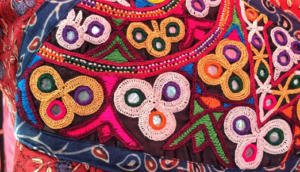
An essential feature is the use of mirrors of differing shapes and sizes. According to Frater, the Rabari women used to ‘outline patterns in yellow and white chain stitch, then decorate them with a regular sequence of mirrors and accent stitches, in a regular sequence of colours.’ Bakhiya or decorative back stitching is used to decorate seams of women’s blouses and men’s jackets. Now, outlines are done using machines, and then women fill in the empty areas by hand using their preferred patterns.
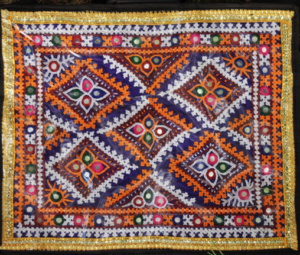
(Courtesy:https://www.sahapedia.org/the-rabaris-the-nomadic-pastoral-community-of-kutch)
Though differences remain in the style of embroidery within the different subgroups, there are also discernible commonalities, beginning with the objects that are embroidered. Embroidery is, of course, present on the attire worn by the community, most prominently in the veils worn by women. As mentioned previously, embroidery is not just limited to clothes. Objects of household decoration, like toran (door hanging), are often embroidered. Kutchis embroider objects of ritual significance, including those specifically meant for marriages. Among many groups, women embroidered clothes, household items, and dowry sacks (to carry their belongings) for their dowries. The embroidery on the clothing is usually more traditional in style compared to that of other objects. While the embroidery tells us a lot about the tradition of the Rabaris, the process of change in style and motifs demonstrates the adaptability and evolution of these traditions.
EVOLUTION OF MOTIFS
Early Rabari embroidery contained motifs that were pictorial, used chain or square chain stitch, and illustrated simple depictions. They represented details of everyday life. For instance, the Paaniyaari motif portrayed a woman with a pot on her head, symbolising a daily chore important for survival. Aambo (mango tree), Baavaliyo (acacia), and Phul (flower) symbolised local plants of value. Similarly, the Deri motifs (temple) symbolised the importance of religion in the life of the community. The saandhiyo (camel) motif represents an animal that is very important to the livelihood of the Rabaris, while the Haathi (elephant) and Vinjano (fans) motifs alluded to the ruling family of Kutch, who appointed Rabaris as camel breeders and messengers. Portrayal of other animals included Sulo and Popti (parrot), Mor (peacock), Kaagdaa (crow), and Yinchhi (scorpion). Domestic animals were not seen as motifs, suggesting that only animals of perceived status were embroidered. Other motifs included Makoliyo (ants), Maakhli (flies), Pharphariyaa (puffed rice), and Trajko (raindrops). Objects commonly found in nomadic households, shapes (like circles and triangles), and ornaments of celebrations were also important motifs.
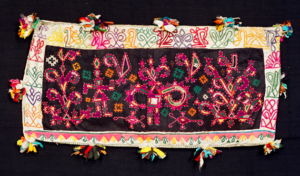
Kachhi Rabari oshiku (pillow cover) c. 1960 The tableau, depicting left to right a tree with a peacock on top, a woman carrying water pots, a peacock, a scorpion, an elephant with rider, and again peacock, scorpion and tree, evokes a Rabari wedding.
(Courtesy:https://dhaaramagazine.in/2021/01/20/rabari-embroidery-chronicle-of-womens-identity-and-creativity/)
From the 1950s, the motifs, outlined in square chain stitching, became larger and bolder and started using more geometrical patterns. According to Frater, three changes have taken place in the later trends: changes in the naming of motifs, changes in portrayal, and changes in production. Over the years, traditional motifs lost their cultural significance, and several Kachhi Rabari motifs were modified and given a new meaning. For instance, Haathi became Kabaat (cupboard), indicating a settled life. Motifs like Mirini (cat), portraying a domestic animal, also indicate the accommodation towards a settled lifestyle. The relevance of the Paaniyaari motif decreased with the growing use of taps and tube wells; it was replaced by the mythological character Shravan, known for his devotion towards his parents. Other contemporary motifs include Saikal (bicycle), which is an important form of transport. Another important change is that with time, the motifs of the Rabari embroidery have become more abstract and decorative than narrative as the life of the community becomes more complex.
ROLE OF WOMEN
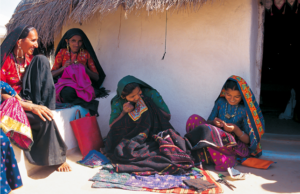
Traditionally, embroidering is undertaken by the Rabari women. It provided them with an opportunity to express their creativity through accessible means. Women use embroidery to beautify themselves as well as their households. They are artists who demonstrate their skills through this medium and, at the same time, contribute significantly to preserving the Rabari culture. This practice also helped in community building since mothers, daughters, and neighbours often sat together in groups while embroidering, strengthening their relationships.
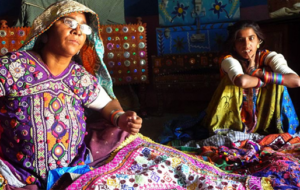
(Courtesy: https://gaatha.com/kutch-rabari-embroidery/)
These embroidered objects have another significance in women’s lives. They were a part of women’s dowries, which they had to bring to their in-laws’ houses after marriage. Over the course of several years, women embroidered dowry items such as skirts, veils, blouses, dowry sacks, pillowcases, wall hangings, etc., required for their dowries, without which they are forbidden to move to their husband’s homes. The quality of the embroidery became a basis for judging a girl’s value. The extremely detail-oriented and labour-intensive nature of the work, however, meant that the process became very time-consuming. In fact, the elders of the Dhebaria Rabaris banned the making and wearing of embroidery because the requirement of embroidering clothes for dowry delayed the moving in of brides to their in-law’s homes.
Women of other subgroups continue to embroider, but even they want to avoid losing out on precious time. By the 1980s and the 1990s, Rabari women started to seek jobs to supplement their household incomes. They sold goods, worked as domestic helpers and construction workers, and embroidered for merchants and designers to earn wages. Earning wages and balancing household chores along with it left hardly any time for them to embroider. However, Rabari women did not abandon the practice of embroidery; they found a modern fix to their problems. To save time, Kachhi Rabari women took the help of machines to facilitate the process and make it easier. Although the process became mechanised in order to hasten it, the embroidery did not lose its character.Even the Dhebaria Rabari women, despite not being able to embroider, beautify their clothes by sewing ribbons and trims on them using machines. Pabiben Rabari, a Dhebaria Rabari woman , even started her own business of hand embroidered bags called the ‘Pabi Bag’.
(Courtsey:https://dhaaramagazine.in/2021/01/20/rabari-embroidery-chronicle-of-womens-identity-and-creativity/)
It is apparent that the ritual, communal, cultural, aesthetic, and personal significance of the Rabari embroidery makes it highly valued within the community. However, issues like machine imitation, exploitation, and declining interest of the younger generation pose a threat to the craft. But in spite of these issues, the Rabari embroidery is by no means abandoned, but rather has found global recognition. As mentioned before, during the 1980s, the ecological crisis made it difficult to earn income through traditional means. Thus, women started to embroider for the market to earn a living. Since the appreciation for handicraft was growing on a global scale, the Rabari embroidery, gradually, reached a wider audience. At present, Kutch embroidery, inclusive of the Rabari embroidery, has acquired a GI tag (Geographical Indication) in India, which preserves the craft and protects it against counterfeits, thus boosting its economic value. The Rabari embroidery weaves together tradition, adaptability, and global recognition, thus ensuring its relevance in the contemporary world.
BIBLIOGRAPHY
1. Frater, Judy. Threads of Identity: Embroidery and Adornment of the Nomadic Rabaris. Mapin Publishing, 1995.
2. Frater, Judy. ‘WHEN PARROTS TRANSFORM TO BIKES: SOCIAL CHANGE REFLECTED IN RABARI EMBROIDERY MOTIFS.’ Nomadic Peoples, vol. 3, no. 1, 1999, pp. 31–49.
3. Frater, Judy. ‘‘THIS IS OURS’: RABARI TRADITION AND IDENTITY IN A CHANGING WORLD.’ Nomadic Peoples, vol. 6, no. 2, 2002, pp. 156–69.
4. Dyer, Caroline, and Archana Choksi. ‘THE DEMAND FOR EDUCATION AMONG THE RABARIS OF KUTCH, WEST INDIA.’ Nomadic Peoples, vol. 1, no. 2, 1997, pp. 77–97.
5. Frater, J. (2016). Embroidery: A Woman’s History of Kutch. Indian Horizons, 63(2), 22–35.
6. https://dhaaramagazine.in/2021/01/20/rabari-embroidery-chronicle-of-womens-identity-and-creativity/
7. https://www.craftcentres.com/post/rabari-embroidery-kutch?srsltid=AfmBOooXVSCa1BYtYpzpShMtb5_-GR9sE2HuoAM3zYxiG02ihIO8Nc4y
8. https://www.sahapedia.org/the-rabaris-the-nomadic-pastoral-community-of-kutch
9. https://timesofindia.indiatimes.com/city/vadodara/Rabari-woman-goes-global-with-her-bags/articleshow/46490096.cms