


By Shreya Kamboj
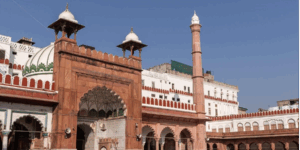
Amid the religious and architectural landmarks of Old Delhi, Fatehpuri Masjid stands out not just for its scale or design, but for what it reveals about power, control, and resistance. Built in 1650 by Fatehpuri Begum, one of Shah Jahan’s wives, the mosque functioned as a space of worship, gathering, and authority. Its role changed sharply under colonial rule. After the Revolt of 1857, the British viewed it as a potential centre of unrest. The mosque was seized, auctioned, and then returned to the Muslim community in 1877 as a part of a calculated move.
To trace this history is to see how colonial governance extended beyond forts and offices into the sacred. As Michel Foucault suggests in The Subject and Power, to analyze power is to look beyond “a series of institutions” narrowly defined as political and instead trace how power operates through relationships, visibility, and spatial control. (Foucault 1982) This insight becomes especially vital when we examine sacred spaces like mosques, which lie at the intersection of the spiritual, the communal, and the political.
The Symbolic and Spatial Significance of Fatehpuri Masjid in the Mughal Period
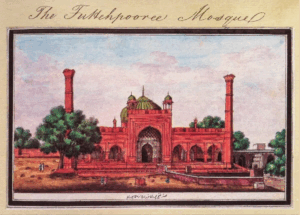
The Fatehpuri Mosque was named after Fatehpuri Begum, one of Shah Jahan’s wives, who was credited with its commissioning. (Liddle 2017) This royal patronage places the mosque within what Stephen P. Blake categorizes as the second tier of mosques in Shahjahanabad, those constructed under the auspices of imperial women or noble elites. Asher notes a striking similarity between the mosques constructed by Fatehpuri Begum, Jahan Ara, and Akbarabadi Begum, which leads her to suggest that this uniformity in the imperially sponsored mosques was intentional and a means of signaling power. Notably, the Fatehpuri Mosque is aligned along the same axis as the Jama Masjid and the Red Fort, forming a carefully curated visual and spatial corridor that links sacred space with sovereign power. Architecturally, the mosque exhibits quintessential features of Indo-Islamic design, including a prominent central dome, a seven-arched prayer hall, an expansive open courtyard, and slender twin minarets.
Henri Lefebvre’s theory of the “production of space” helps elucidate the mosque’s role in shaping social relations. If seen through the prism that prominent historians and art-historians like Stephen P. Blake and Catherine Asher see it through, i.e., as a space carefully designed by elite patrons in an attempt to align with the imperial spatial logic, it would be categorized as what Lefebvre calls ‘representations of space’ or conceived space which was not merely built for worship (‘ideology’) but was an extension of Mughal ideology. However, this top-down approach takes no account of the way this space came to be used, experienced, and felt which Lefebvre does while theorizing ‘lived spaces’ or ‘representational spaces’ – the space as it is experienced by people, not how it is designed, it’s shaped by memories, emotions, habits, childhood, and even conflicts. Thus, the real meaning of the space emerges when common people gather, pray, discuss, or remember colonial trauma. These experiences give the mosque its emotional and symbolic value.
Fatehpuri Masjid and the 1857 Revolt: The Sacred as Sedition
The Revolt of 1857 was not merely a military insurrection but a symbolic confrontation between colonial authority and indigenous structures of power. In this charged atmosphere, mosques like Fatehpuri and Jama Masjid became ideological battlegrounds. Delhi’s mosques were widely perceived by colonial authorities as symbols of Mughal power and centers of sedition.1 Maulana Fazl-e-Haq Khairabadi’s fatwa of jihad, disseminated through mosque sermons, was a call to arms couched in religious vocabulary. (Husain 1987) These pronouncements gave the colonial state ample justification to view sacred congregations as political assemblies in disguise.
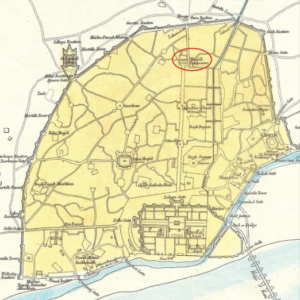
The region, including the Jama Masjid and Zinat-ul-Masajid, was the symbolic heart of Mughal Delhi and consequently a critical space for the British to dominate and dismantle. Zinat-ul-Masajid was believed to have been harbouring the rebel forces and while Fatehpuri Masjid is less documented, its spatial affiliation made it ideologically guilty by association. Hugh Chichester, one of the military officers stationed at Delhi after the revolt wrote in his letter: “There are several mosques in the city most beautiful to look at, but I should like to see them all destroyed. The rascally brutes desecrated our churches and graveyards and I do not think we should have any regard for their stinking religion…” (Aziz 2017, pp. 21-22) Though Fatehpuri was spared demolition, it was confiscated and auctioned to Rai Lala Chunnamal, a Hindu merchant loyal to the British, for Rs 39,650. This act symbolized a dramatic shift in spatial authority – from a Muslim sacred site to the property of a British collaborator. The auction, much like the occupation of Chandni Chowk itself, represented a rewriting of the city’s moral and symbolic map. Poetic responses from the period encapsulate the trauma of spatial desecration. In Khwaja Altaf Husain Hali’s 1874 marsiya, we find this lament:
“O adventurer, your heart will be seared with pain and grief. Hearken to me, do not go into the ruins of Delhi. At every step, priceless pearls lie buried beneath the dust.”
(Gupta 1981, pp. 1)
Restoration and Regulated Return
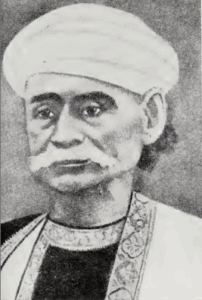
Once auctioned off to Lala Chunna Mal, it remained in his possession until a strategic gesture by Lord Lytton returned the mosque to Delhi’s Muslim community during the Delhi Durbar. This seemingly generous act was tightly managed by the colonial authorities, who sought to ensure that control passed only to Muslim “loyalists.” Mosque committees were formed, composed of respectable figures like Ilahi Bux and Kutbuddin – the latter a Wahhabi, included for his wealth and influence despite Wahhabis being viewed with suspicion. The appointment stirred controversy within the Muslim community itself. Reformist voices like the Anjuman Islamia’s secretary demanded that only “Rashideen Muslims” be entrusted with mosque affairs and called Wahhabis as politically dangerous and socially inferior.
Although the Jama masjid and Fatehpuri Masjid Committees had overlapping memberships, the latter managed to gain a distinctive socio-religious position. According to Gupta, after its return, the mosque emerged as a focal point which was a rival to the Jama Masjid. Unlike the Jama Masjid, which had come under closer administrative scrutiny, the Fatehpuri Masjid became an arena for “unorthodox religious sermons and animated politics”, patronized by the prosperous Punjabi merchants of Sadar Bazaar. (Gupta 1981, pp. 128)
While the mosque eventually came under the stewardship of elite figures such as Hakim Ajmal Khan and Ghulam Mohammad Husain Khan, this committee was not without critics. Nationalist Muslims like Mirza Hairat and Abdul Wahab accused it of corruption and excessive loyalty to the British. Although Gupta states that these allegations were largely unsubstantiated, they were reflective of the growing tension between loyalist Muslim elites and emergent anti-colonial reformers.
Colonial Power in Transition
The transition from the British state’s mass execution of Delhi’s Muslims in 1857 to its eventual management of Islamic institutions like Fatehpuri Masjid exemplifies what Michel Foucault calls the historical shift in the modality of power: from sovereign violence to disciplinary control. In the days and months following the Revolt, Delhi witnessed an unprecedented colonial terror campaign: Muslim neighborhoods were emptied, thousands were killed, and mosques were desecrated, seized, or repurposed. This was power in its raw, sovereign form – what Foucault describes in Discipline and Punish as a mode that operates through “spectacle and blood”, where punishment is public, performative, and intended to display the absolute authority of the state over life and death. The Muslim body, in this moment, became both a target and warning, a political body marked for extermination. Space itself became a witness and participant in this violence: the gallows at Chandni Chowk, the emptied mohallas, and the silent minbars all became registers of power’s capacity to destroy.
However, the very totality of this destruction eventually necessitated a recalibration. As the British sought to consolidate control and maintain administrative order, they adopted what Foucault identifies as disciplinary power: a regime that no longer seeks to kill but to regulate, correct, and manage. Thus, the destruction of architecture in Chandni Chowk was stopped and mosques were reintegrated into the urban order under careful watch.
Louis Althusser would describe this shift as a move from Repressive State Apparatuses (RSA) (the army, police, and legal system violently deployed during the revolt) to Ideological State Apparatuses (ISA), like religion and education, which the state used to subtly reproduce colonial obedience. In permitting the mosque’s restoration in 1877, the British did not surrender power; rather, they recalibrated it.
Conclusion
As Foucault says, space plays a critical role in how power operates and is exercised across societies, and the Fatehpuri Mosque reflects that truth. Its very form tells stories: of royal women who commissioned it, of colonial forces that tried to silence it, and of those who prayed and resisted within its walls. The courtyard, where several graves lie, including those of Hazrat Nanoon Shah of Thaneswar, his Khalifa Hazrat Shah Jalal, and scholars like Mufti Muhammad Mazhar and Maulana Dr. Muhammad Sayeed, reminds us that this is not just a monument, but a space of lived devotion and quiet continuity. Fatehpuri Masjid is, in many ways, a palimpsest – a sacred space written and rewritten over time. It teaches us how places remember, even when people forget, and how power may shape a space, but never fully owns it.
References
1. Asher, Catherine B. 1992. ‘Architecture of Mughal India’. Cambridge [England]: Cambridge University Press.
2. Aziz, Sadia. 2017. ‘Mosque, Memory and State: A Case Study of Jama Masjid (India) and the Colonial State c. 1857.’ The Polish Journal of Aesthetics. 47 (4/2017), pp. 13–29
3. Blake, Stephen P., 1993. ‘Shahjahanabad: The Sovereign City in Mughal India, 1639-1739’. Cambridge [England]: Cambridge University Press; New Delhi: Foundation Books. pp. 50-55
4. Fatehpuri Shahi Masjid: A mute witness to the travails of Dillee. Fatehpuri Shahi Masjid: A mute witness to the travails of Dillee (Accessed on 27 June 2025)
5. Foucault, Michel. 1995. ‘Discipline and punish: The birth of the prison’ (A. Sheridan, Trans.; 2nd ed.). New York: Vintage Books. (Original work published 1975)
6. Foucault, Michel. 1982. ‘The Subject and Power’. Critical Inquiry, vol 8, no 4, pp. 777-795.
7. Gottdiener, M. 1993. ‘A Marx for Our Time: Henri Lefebvre and the Production of Space’. Sociological Theory, Vol. 11, No 1, pp. 129-134
8. Gupta, Narayani. 1981. ‘Delhi Between Two Empires, 1803-1930: Society, Government and Urban Growth’. Delhi: Oxford University Press
9. Husain, Iqbal. 1987. ‘Fazle Haq of Khairabad—A Scholarly Rebel of 1857’. Proceedings of the Indian History Congress, Vol. 48 (1987), pp. 355-365
10. Liddle, Swapna. 2017. ‘Chandni Chowk: The Mughal City of Old Delhi.’ Speaking Tiger Publishing.
11. Lefebvre, H. (1991). ‘The production of space’ (D. Nicholson-Smith, Trans.). Oxford: Blackwell. (Original work published 1974)
12. Peck, Lucy. 2005. “Delhi – A Thousand Years of Building”. Delhi: Roli Books