
By Prishnika Mazumdar
Transgender is an umbrella term used for persons whose gender identity, gender expression or behaviour does not conform to the identity, expression or behaviour that is generally associated with the sex which they were assigned at birth (American Psychological Association, 2024). Within the ambit of this term, we have the Hijras. All transgenders, however, are not Hijras. To become a Hijra, a trans person must be initiated through a ritual adoption by a Hijra guru (mentor) into the Hijra community (Goel, 2021). A Hijra, therefore, is a complicated category of gender non-conforming effeminate group of individuals in South Asia. In addition to India, Hijras are also found in Pakistan and Bangladesh (Reddy, 2018). Historically, they have been subjected to stigma and discrimination. In addition to external discrimination, their ways of being are complicated by their internal hierarchies. In this article, we will try to understand such complicated hierarchies of kinship, discipleship and their interaction with the existing caste hierarchies by taking up the case of Hijras of Delhi.
Their History
Ancient stories and myths about Hijras often gave them important places in society, linking them to ideas of purity, spirituality, and good fortune. During the Mughal period, Hijras were called Khawjasaras and were respected as protectors of royal harems and trusted advisors to the kings. Some were even sold as eunuch slaves, and it is said that certain families would castrate their sons in hopes of gaining royal favour and stable jobs (Goel, 2016).
But royal courts declined, and India moved into colonial and later modern state structures and the position of Hijras worsened. Under British rule, they were labelled as part of a ‘criminal tribe’ through the Criminal Tribes Act of 1871. Even though this label was removed later, the memory and social prejudice persisted. Many people came to believe harmful myths, such as Hijras kidnapping and forcibly castrating boys, stories that further marginalised them (Goel, 2016).
For a long time, Hijras have lived in poverty and faced extreme discrimination. They are often denied basic rights such as food, housing, and healthcare. Violence against them, including sexual assault and police brutality, is common. A part of the problem is their mystification. Because their lives are so invisible to the mainstream, the full extent of their struggles has rarely been studied or understood (Goel, 2016).
Who is a Hijra?
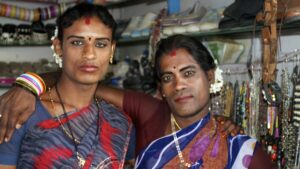
There is inherent public confusion surrounding who the Hijras are and who they are not. To address such confusion, Hijra communities have made demarcations between the “fake” and the “real.” “Real” Hijras are affiliated with a house or a Hijra gharana. The Hijra gharanas make symbolic units of lineage that guide the framework of social organisation for the Hijra community in India. The “fake” Hijras, then, are simply men who act as “cross-dressed beggars.” It is interesting to note that typically only those born as intersex or male-to-female transgenders are Hijras. This excludes the female-to-male transgenders (Goel, 2021).
Means of Livelihood
In Delhi, Hijras are associated with occupations of toli-badhai, begging and sex work, in the decreasing order of the respect attached to each occupation. Toli-badhai refers to the collection of ritual blessings on newborns and newlyweds in exchange for gifts, both in cash and kind (Reddy, 2018).
Those at the bottom of the Hijra social system are often sent to beg at traffic lights or on public transport. Higher-ranking Hijras, like gurus, have the power to assign begging tasks to those below them and usually do not beg themselves (Goel, 2021).
Some Hijras with slightly higher ranks may also turn to sex work to earn more. But for those at the bottom, entering sex work is not easy. They often cannot afford things like makeup, stylish clothes, or hormone treatments that help them look more feminine. This impacts how they are seen by potential clients. Many of them, for example, cannot afford laser hair removal, so shaving leaves stubble, which makes them less appealing. Those who earn more usually have smoother skin, breast implants, and better access to hormones, which helps them attract clients who pay better. On top of this, Hijras in cruising areas also face tough competition from other gender-nonconforming men and female sex workers (Goel, 2021).
At the top of the Hijra hierarchy are the gurus. They assign tasks like who can take part in toli badhai. This is the most respected form of work in the community. Gurus choose Chelas (disciples) based on personal relationships, money, beauty, caste, and sometimes luck. However, even this ritual work is a traditional form of begging in a more socially accepted and ritualised form (Goel, 2021).
At the very top are the maha nayaks, who do not need to work at all. They get a portion of the money made by everyone below them and help keep order in the community by leading internal councils called panchayats or jamaats. They are responsible for settling disputes and taking care of the group (Goel, 2021).
The money system within the Hijra community works like a chain: those at the bottom pay those above them. In return, those at the top are expected to care for those below, especially in cases of abuse or police violence. Many lower-ranking Hijras have to work multiple jobs to make ends meet (Goel, 2021).
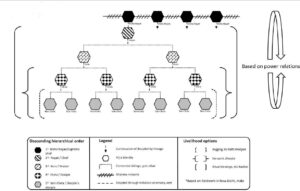
Kinship, discipleship, and caste hierarchies within the Hijra community form a tight and complicated system of social organisation. Hijra kinship is not based on blood but on a ritual adoption process where a guru takes in chelas. This forms symbolic households or gharanas. This system is hierarchical, where one’s rank, from nati-chela to guru to Nayak, determines their livelihood options, respect, and power. Kinship ties, then, are also regulated by internal councils (jamaats or panchayats) (Goel, 2021).
This system overlaps somewhat uneasily with caste. While Hijra initiation is supposed to erase caste by dropping birth surnames, caste discrimination continues within the community. Lower-caste Hijras may be excluded from prestigious ritual roles like toli-badhai and pushed instead into begging or sex work. Discipleship can also trap chelas in financial and emotional dependence, especially if the guru has paid for their gender-affirming procedures, leading to a form of bonded servitude. While kinship offers belonging and support, it also reinforces caste and power-based exclusions (Goel, 2021).
Ina Goel presents a diagram to explain the kinship ties and hierarchies among the Hijras:
Hijras of Delhi
Hijras meet each other on various occasions, and recruitment happens from far-off places. It is a community that exists at a multi-state level, and within Delhi, we observe considerable diversity. As a result of local variations in ideas on gender, religion, law, etc, we observe region-specific characters emerging. This system remains quite similar in regions of Delhi and Hyderabad, but the two stand in stark contrast to transgender communities of other regions, such as the Nupi Maanbis of Manipur (Reddy, 2018).
Almost all habitable land in Delhi is divided among Hijras, with each area known as a particular guru’s ilaqa or area. This arrangement spans across Hijra occupations. Each location has parallel segregation based on the occupation of the Hijras. This means that a particular ilaqa will have certain Hijras possessing a right to do toli-badhai, while others go on begging in the same area. Almost every locality can be found on the toli-badhai map, but begging is limited by the logic of supply and demand (Reddy, 2018).
As noted, Hijra communities have their own way of organising and ranking their members through the system of gharanas. This system creates a hierarchy within the community, helping to define social roles and positions. In Delhi, this structure is believed to have started with two major groups: the Badshahwallas and the Wazirwallas. Over time, these two gave rise to four main Hijra gharanas in the city (Goel, 2016).
The Badshahwallas, a term meaning those connected to the king (Badshah), are considered the senior group. Two gharanas come from this line: the Sujani gharana and the Rai gharana.
1. Sujani comes from a mix of Hindi and Urdu and refers to someone wise or able to judge well.
2. The Rai title has two possible roots: it was used during British rule for loyal Indian officials, and it is also linked to a caste of landlords in the Indian caste system.
The Wazirwallas, seen as the junior group, are named after the Wazirs, or ministers to the king. From them come two other gharanas: Kalyani and Mandi.
3. Kalyani means someone who brings welfare or goodness to others, and
4. Mandi means market in both Hindi and Urdu.
There is no confirmed link between the meanings of these names and the status of the gharanas, but their use does suggest that differences in rank or power exist between the groups (Goel, 2016).
Conclusion
There are many gaps in popular imagination about Hijras. Such gaps and confusion often translate to intense discrimination against them. For the Hijras, their world is shaped by ritual initiation, symbolic family structures, and internal caste and rank divisions that govern access to work, respect, and livelihood. Although kinship offers belonging and a sense of shared identity, it also reproduces structures of exclusion, particularly for those from lower-caste backgrounds. Discipleship ties can become bonds of dependence, and caste continues to affect opportunities even within a group meant to transcend it. The Hijra community thus becomes a place where those already marginalised may find a sense of belonging, even then it reproduces new hierarchies and exclusions, meaning that for many within it, true acceptance or equality still remains out of reach.
References
APA (American Psychological Association) webpage
American Psychological Association (2024) Transgender people, gender identity and gender expression. APA. Available at: https://www.apa.org/topics/lgbtq/transgender-people-gender-identity-gender-expression (Accessed: 19 June 2025).
JWU Pressbooks chapter on Hijras
Goel, I. (2021) ‘Understanding caste and kinship within Hijras: A third gender community in India’, in Gendered Lives: Global Issues. JWU Pressbooks. Available at: https://jwu.pressbooks.pub/genderedlivesgeneseo/chapter/chapter-5-understanding-caste-and-kinship-within-Hijras-a-third-gender-community-in-india/ (Accessed: 17 June 2025).
CDE-DSE Working Paper
Reddy, G. (2018) With respect to sex: Negotiating Hijra identity in South India. CDE-DSE Working Paper. New Delhi: Centre for Development Economics, Delhi School of Economics. Available at: http://cdedse.org/wp-content/uploads/2018/06/1.pdf (Accessed: 17 June 2025).
ResearchGate article on Hijra communities of Delhi
Goel, I. (2016) ‘Hijra communities of Delhi’, Sexualities, 19(5–6), pp. 518–534. Available at: https://www.researchgate.net/publication/303559285_Hijra_Communities_of_Delhi (Accessed: 17 June 2025).
Image Sources
Global Voices (2022) A Representative Image of Hijras. Available at: https://globalvoices.org/2022/11/03/societal-beliefs-and-perceptions-are-the-enemies-of-transgender-people-in-india/ (Accessed: 23 June 2025).
Wikimedia Commons (2012) A Hijra Dancing at a Hair-Shaving Ceremony in Delhi. Available at: https://commons.wikimedia.org/wiki/File:Hijra_dancing_in_Delhi.jpg (Accessed: 23 June 2025).
Goel, I. (2021) Ina Goel Presents a Diagram to Explain the Kinship Ties and Hierarchies among the Hijras, in Gendered Lives: Global Issues. JWU Pressbooks. Available at: https://jwu.pressbooks.pub/genderedlivesgeneseo/chapter/chapter-5-understanding-caste-and-kinship-within-Hijras-a-third-gender-community-in-india/ (Accessed: 23 June 2025).