

-: by Ayush Tripathi
Between the eleventh and nineteenth centuries, the royal families of Manipur and Burma formed a series of marriages that had impacts far beyond the ceremonial settings where they took place. Manipuri princesses, later known as ‘Awa Leima’ (queens of Ava), entered the courts of the Toungoo and Konbaung dynasties. They brought the prestige of the Ningthouja lineage, the culture of the Meitei world and often dramatic turns in the course of history. These women served as diplomatic tools, cultural representatives, and occasionally, instigators of war. Their experiences highlight the complicated and often violent relationship between these two neighboring powers. They also reveal the largely overlooked role that royal women played in influencing the political landscape of mainland Southeast Asia.
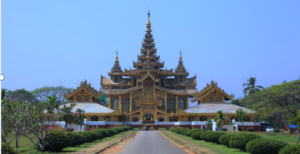
Kanbawzathadi Palace, originally built by Emperor Bayinnaung of Toungoo dynasty [Photo credits: Wikimedia Commons]
The tradition of marriage alliances between Manipur and Burma appears to begin, according to various records, at a notably early time. Meitei settlement patterns and records from the Ava kingdom show that Meiteis were present in what is now Myanmar from at least the thirteenth century. An early example involves Meitei King Senbi Kiyamba (1467-1508 CE), who arranged a marriage with Kikhomba, the ruler of Pong, a historical kingdom in northwestern Myanmar. This alliance, noted in the Cheitharol Kumbaba, led to a joint military campaign against the Kyang-a Shan kingdom in 1470 to 1471 CE. It demonstrated that these marriages were connected to military strategy and control of territory from the start.
In 1558, during King Chalamba’s rule in Manipur, a princess was offered to the powerful Toungoo king Bayinnaung, whose ambitions had drawn much of mainland Southeast Asia under his influence. The Manipuri attendants who came with this princess settled in Taungoo, creating an early form of a permanent Meitei diaspora community in Burma. Historian Memchaton Singha, writing about marriage diplomacy between Manipur and Burma in the eighteenth and nineteenth centuries, places these early alliances within a larger regional trend. She notes that offering a royal daughter served both as an acknowledgment of power and a way to secure protection and preferential treatment.
The Burmese court had a custom that allowed the eldest daughter of a defeated king to be claimed as a marriage prize by the victorious monarch. W.S. Desai records in A Pageant of Burmese History (1961) that this tradition continued well into the nineteenth century. The eldest royal daughter usually stayed unmarried so she could be offered as a marriage bargaining chip in case of a loss. This power imbalance, built into the institution of royal marriage, created a complex position for a Manipuri princess at the Burmese court. Although she might arrive as a respected queen, her status was always dependent on the shifting political tides between the two kingdoms.
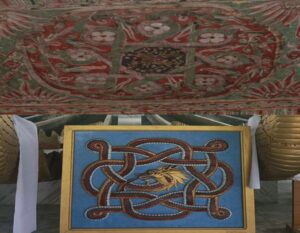
On top: Naga-lein on the ceiling, Mipaya cave-temple, Powindaung, eighteenth century [Photo credits: Alexandra Green]
On bottom: Hijagang (traditional boathouse) at Kangla Fort, Imphal, Manipur [Photo credits: Wikimedia Commons]
Princess Who Crossed Chindwin : Chakpa Makhao Ngambi
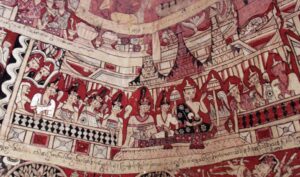
Burmese royal court depicted in Ava period mural from Po Win Taung Cave complex located near Monywa (Myanmar) on the west bank of Chindwin River [Photo credits: myanmartours.us]
No marriage alliance between Manipur and Burma carries more historical significance or cultural impact than that of Princess Chakpa Makhao Ngambi and Burmese King Taninganway in the early eighteenth century. We know her name through four syllables of Meitei that seem to resist a fixed meaning. Each part of her name carries a complex history and a set of meanings that scholars from Manipur to Myanmar have debated for decades without reaching an agreement. Yet this very ambiguity, the name’s inability to settle into a single, neat identity, is perhaps the most truthful aspect we have about her.
‘Chakpa’, in the social context of the Meitei kingdom of the Imphal Valley, mainly refers to a Loi community, the fishing people who live along the islands and reed-lined shores of Loktak, the expansive shallow lake in the southern part of the valley. The Chakpa were neither enslaved nor fully assimilated within the Meitei social system. They held a unique position where an occupational community kept its own identity while being seen by the dominant culture as just outside the circle of complete belonging. They fished in dugout canoes on a lake whose surface changed with the seasons, where floating islands of vegetation (the phumdi) drifted and reorganized with the winds. These people were in a fluid unpredictable world at the edge of a stable society.
The fact that a princess from the Ningthouja dynasty, a woman of high Meitei royal blood, should begin her name with this term is the first puzzle. Yumlembam Ibomcha Singh, in his critical edition of the Cheitharol Kumbaba, argues that ‘Chakpa’ likely refers not to the Loi community but to a geographical location or a place called Chakpa, perhaps near the lake, where this branch of the royal family had some custodial or ritual role. In the Meitei naming custom, princes and princesses often carried the names of territories, water bodies and sacred sites over which they or their mothers held symbolic responsibility. Under this interpretation, ‘Chakpa’ indicates a link to a place rather than a caste identity.
Gangmumei Kamei, in his book A History of Manipur (1991), considers another possibility with careful thought, that ‘Chakpa’ denotes the community of the princess’s mother, a secondary queen or concubine of Chakpa Loi background who rose to a place in the royal household. This was common in Meitei court customs; the boundaries between the royal Salai clans and the Loi communities were often more permeable than formal hierarchy suggested, especially with secondary marriages. If this is accurate, then Chakpa Makhao Ngambi’s name embodies her dual heritage: Ningthouja from her father’s royal blood and Chakpa from her mother’s community. She was, in the truest sense, a person who straddled two social worlds within Manipur before she ever traveled across any geographical boundary.
‘Makhao’ connects her to a place of the same name in the Kabaw Valley, the border region between Manipur and Burma known for its constant conflicts and negotiations. ‘Ngambi’ is the part with the most historical significance. In Meitei, it means conqueror or ‘one who has won’. Its male variant, Ngamba, appears in the titles of many Meitei kings like Pamheiba, who held the title ‘Takhel Ngamba’ to commemorate his victory over Takhel (Tripura) and ‘Samsok Ngamba’ for his victory over Samsok (a region in eastern Burma).
On 18 January 1703, the 1st of Phairen in the Meitei calendar, two ambassadors from the Burmese king arrived at Kangla. The Cheitharol Kumbaba records their names: Senpi Mayangkong and Lousingpa Aawa Tunglacha. They came with gifts and a proposal to marry a princess from the Ningthouja royal house.
Negotiations lasted for two years. The Meitei court did not regard the proposal as a subordinate offer; they imposed strict political conditions. According to Dr. Memchaton Singha’s 2016 peer-reviewed article “Matrimony as Diplomatic Tool,” there were two main conditions. The Burmese king agreed that Chakpa Makhao Ngambi would be named the Phampan (chief queen) of the Kingdom of Ava. Additionally, the disputed tributary communities of Kabaw Valley such as Pungpun, Kamu, Chirang, Kharo, Ting Yitsa, Maru Kondong and Loipi Tarao Khundon, would pay tribute to the Meitei king. Thus, a princess was exchanged for a territorial agreement. The marriage was both a personal and political matter.
In 1704, the Burmese ambassador Potshangba Hanjaba Moirengjamba arrived with the formal bride price, which consisted of two elephants, one male and one female. On the 20th of the month, a group of twenty-two people, including a Gosain Muni, formally delivered the bride price. The Samsok Ngamba adds details about the gifts. They included gold, bronze, silver, lead, dishes and colorful fabrics; all of which were items that both courts understood to carry diplomatic significance.
On the 23rd of Poinu, 1704, or December of that year, Chakpa Makhao Ngambi left Kangla (fortified palace of Imphal). King Charairongba himself escorted her through the forested hills separating the Imphal Valley from the Kabaw Valley lowlands, leading her to the Ningthi or Chindwin river, which marked the boundary of her world.
The Samsok Ngamba captures a poignant moment from this journey, preserved in three centuries of Meitei cultural memory. At Loukeirao hill, a viewpoint from which the entire Imphal valley could be seen, the party paused. Chakpa Makhao Ngambi turned to look back at her valley. Charairongba attempted to comfort her, but she found no solace. She expressed her sorrow in words recorded by Laisram Aroi, who drew from the court traditions of Pamheiba’s reign:
“I, this Meitei princess, have been removed from my parents and brothers from this day.”
These are the only direct words attributed to Chakpa Makhao Ngambi found in the historical record. They come from a source closely connected to the court and significant events, giving them weight. Whether they reflect her exact words or represent a literary interpretation of her grief, they have been preserved in history, a simple yet devastating statement.
At the Chindwin, Charairongba handed her over to the Burmese escort. She crossed the river that marked the edge of her world and entered the Irrawaddy basin. The wedding ceremony took place in the Kingdom of Ava. After the marriage, she was declared Phampan, officially becoming the chief queen of the Burmese kingdom.
Her official title as Phampan placed her at the top of the Burmese palace hierarchy. The Ava palace had a precise ranking system for royal women, from the primary queen (Mibaya Gyi) to recognized secondary queens (Nanmadaw), consorts, and concubines. As Phampan, Chakpa Makhao Ngambi held the highest position in this structure, with her own living quarters, a staff of attendants, including likely Meitei women who came with her from Manipur, a regular allowance and formal representation at all significant court events.
From Palace of Ava To Ruins of Samsok
After arriving in Ava and being formally proclaimed as chief queen, Chakpa Makhao Ngambi gave birth to a son, named Mangtra Kentu Ngampa. What should have been a fulfilling moment for the diplomatic agreement turned into its violation. The Hmannan Maha Yazawin’s list of Taninganway’s sons does not mention any born of a Kathe mother. This might mean that she had no sons, that any she had died young, that the compilers left out the Kathe maternal identification for political reasons or that a politically inconvenient half-Meitei prince sent away to remove him from the Burmese succession. L. Joychandra Singh discusses this last possibility in ‘The Lost Kingdom’ without concluding the matter
After the birth of her son, the Burmese king removed Chakpa Makhao Ngambi from her status as chief queen and downgraded her position. Wahengbam Ibohal Singh’s The History of Manipur: An Early Period (1986, pp. 319–320) considers this demotion a key event in Meitei-Burmese relations. This demotion was not just a personal insult. It broke a specific, formally agreed diplomatic term. The Meitei court had conditioned the princess’s marriage on her being made and kept as chief queen. Thus, the Burmese king’s decision to downgrade her rank was a violation of the marriage contract was a breach as serious in its political implications as failing to return the Kabaw Valley tributaries, which Charairongba’s final words in the Samsok Ngamba also identified as a betrayal by the Burmese.
The news of her demotion reached Charairongba at Kangla. The Samsok Ngamba describes the profound effect it had on him. He was broken-hearted; the Imphal Review of Arts and Politics (2021) echoes this sentiment, using the same phrase from the text. He vowed to take military action against the Burmese king. However, he did not live to fulfill that promise. As he lay on his deathbed, the Samsok Ngamba reports that he passed this obligation to his son Pamheiba.
“Lairen Yipari, I have received the news of my sister Sicha Chakpa Makhou Ngampi being insulted in the capital of Khamaran (Burma)… Besides, the king of Aawa Tongtoi does not return me my tributary Tarao Khundon Manin Naipa. For these reasons, I took my oath in front of my people at Kangla to fight with the King of Awa with sword.”
— Charairongba’s dying words, as recorded in the Samsok Ngamba
Pamheiba became the ruler of Kangleipak around 1709. He took on his father’s unresolved conflict with the Burmese court and had the responsibility to avenge his aunt. What transpired in 1716 highlights his political skill.
On the 10th of Wakching, 1716, which was a Wednesday, a Burmese delegation of 156 people arrived in the Meitei capital. They brought valuable gifts and asked for the hand of another Meitei princess. Pamheiba gathered his advisors and military leaders. In his speech, noted in Moirangthem Chandra’s Samsok Ngangaba (pp. 9-10) and published in the Imphal Review of Arts and Politics (2021), he expressed noteworthy thoughts about the situation:
“My great leaders, the royal order of my father Charairongba stays in my memory, and I cannot forget the news about my aunt Chakpa Makhao Ngambi. The king of Awa has sent his emissaries with many gifts and letters to seek the hand of my daughter once again, like his tributes. My loyal commanders and advisors, I cannot forget the issues concerning border tributary villages, including Tarao. Now I will fight until the ten regiments of the Burmese army are defeated and the Samsoks are destroyed.”
Pamheiba publicly accepted the Burmese proposal, allowing the delegation to leave with the belief that a second marriage alliance was likely. He then organized a military campaign. The following year, he began the siege of Samsok in Upper Burma, marking the start of a long military expansion that would continue, with breaks, until 1749.
The military actions that followed over the next thirty years were bold and extensive. The Samsok Ngamba vividly recounts the first major battle, the siege of Samsok (Thaungdut), a Shan principality in the Chindwin Valley. The Meitei army besieged the town for a month. The people of Samsok ran out of food and were eventually reduced to eating horse meat and wild plants. When Samsok fell, reinforcements from Burmese generals Chaothap and Tarung Tekwa arrived but were also defeated. Garibaniwaz displayed military discipline and some mercy. When the chief and people of Samsok begged for food and help to rebuild, he agreed immediately.
The battle descriptions in the Samsok Ngamba hold a unique literary quality. The conflict is described in ways that reflect the natural environment of the Meitei homeland: “The bullets from the intense fire of the Burmese streaked across the sky like startled game birds flying out of Loktak Lake. The Meitei force responded with guns and arrows. The entire scene resembled the erratic flight of meteors, and the loud sound of guns echoed like the roar of the approaching monsoon.”
These metaphors (the birds of Loktak Lake and the thunder of the monsoon) place the far-off Burmese battlefield imaginatively within the familiar Meitei landscape. This helps a Meitei audience understand the foreign war.
In 1735, Garib Niwaz launched a major campaign into the Mu Valley in central Burma. His forces entered Myedu in the Shwebo district, destroying villages and pagodas, and capturing about one thousand people. In 1737, he bested two consecutive Burmese armies that had seven thousand foot soldiers, seven hundred cavalry, and twenty elephants. In 1738, he crossed the Chindwin River again, defeated a combined force of fifteen thousand infantry, eight thousand cavalry, and eighty elephants, and led twenty thousand men to the historic capital of Sagaing, capturing key positions. As a bold act of defiance, Garib Niwaz entered the Kaunghmudaw Pagoda, one of the most revered Buddhist structures in Upper Burma, and marked its eastern door with a sword’s imprint. This mark remained visible for generations, a physical sign of Meitei military power reaching into the center of Burmese religious life.
In 1739, he made an attempt to capture Ava, the Burmese capital. Although this attack ultimately failed as the Meitei forces were driven back at Myedu and Garib Niwaz, abandoned by his Cachari allies, had to retreat; his reaching the capital walls sent shockwaves through the Burmese court. The Hmannan Yazawin (Glass Palace Chronicle), the official Burmese court record, notes the alarm caused by Manipuri forces getting so close to Ava, and modern historians point out that the Mon Rebellion that ultimately led to the fall of the Toungoo dynasty partly resulted from the Ava court’s failure to protect its heartland from repeated Manipuri advances.
The connection made in Meitei sources between the demotion of Chakpa Makhao Ngambi and the subsequent wars is significant. Historian Memchaton Singha argues in ‘Matrimony as Diplomatic Tool (2016)’ that breaking the marriage agreements represented an act of war, a formal breach of treaty obligations. The Meitei king’s public promise at Kangla, witnessed by the court, created a binding political duty that went beyond a brother’s personal loss. In a political framework where royal oaths were sacred and the honour of the dynasty relied on its military strength, the lowering of Chakpa Makhao Ngambi was, in the most literal sense, a cause for war.
It is important to note, as Sorokhaibam does, that the story of the princess’s dishonour might have been politically exaggerated. Whether or not her demotion occurred as described, framing it as a dynastic insult served Garib Niwaz’s strategic goals in gaining popular and military support. Yet even if we recognize this aspect, the reality remains that the marriage conditions were violated: the Burmese had agreed that Ngambi would be the chief queen, and they had promised to uphold Meitei tributary rights in the border areas. Neither of these conditions seems to have been respected. The wars were therefore responses to a personal insult, a treaty breach, a territorial dispute, and a manifestation of Meitei ambitions under its most powerful king.
Queen of Three Kings : Satyamala Devi
Chakpa Makhao Ngambi was not the last Meitei princess to join the Burmese royal family. During the later Toungoo and early Konbaung periods, there were more marriage alliances, most notably that of Satyamala Devi (or Nongleima), the daughter of Khamlang Pamsaba or Wangkheirakpa (a brother of Maharaja Garib Niwaz). She was raised as Garib Niwaz’s adopted daughter. She arrived at the Toungoo court in 1749 as the queen of Mahadhammaraja Dipati, the last king of the Toungoo dynasty, and took the title Maha Devi. Her son with this king, known as Khura Letpa, was titled Minye Sithu, as recorded by Nwe Ni Hlaing in her study of Meitei crown service groups in Myanmar, published in the Journal of the Myanmar Academy of Arts and Science in 2015.
The fall of the Toungoo dynasty came quickly. The Mon kingdom of Pegu, led by King Binnya Dala, looted and destroyed Ava in 1752, deporting hundreds of royal family members, including Satyamala Devi, to Pegu. In a surprising turn of events, Binnya Dala made her his queen, giving her the title ‘Thirizeya Mingala Devi’. She had thus, without choice, become the queen of the very kingdom that had destroyed the one she first served. This sequence, where a foreign queen moved from one court to its conqueror, shows the vulnerability of royal women in a political environment where they were both symbols of dynastic legitimacy and prizes of conquest.
The last chapter of her remarkable story unfolded when Alaungpaya, the Bamar village leader from Moksobo who founded the Konbaung dynasty, expelled the Mon forces and restored Burmese power. Satyamala Devi, having escaped from Pegu with Mon General Dalaban, was delivered to Alaungpaya in December 1756 and became his concubine, as noted in the Konbaung Set (Volume I) and cited by Bryce Beemer in his doctoral thesis, The Creole City in Mainland Southeast Asia: Slave Gathering, Warfare, and Cultural Exchange in Burma, Thailand, and Manipur, 18th-19th Centuries (University of Hawaii at Manoa, 2013).
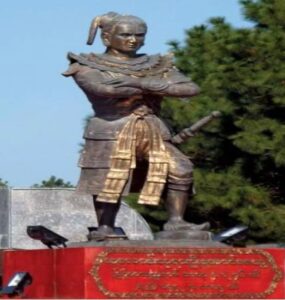
Statue of Alaungpaya (founder of Konbaung dynasty) outside the Defence Services Academy, Maymyo, Myanmar [Photo credits: Britannica]
She served as queen to three kings across two dynasties and one conquering leader, surviving the most violent political turmoil the region had faced in a century. Her relationship with Alaungpaya led to significant historical consequences. The Konbaung-zet Mahayazawin details how Alaungpaya justified his decision to invade Manipur in 1758 as a duty to Satyamala Devi. He claimed, “The Manipuri queen is under my golden foot,” indicating his responsibility for her safety and the well-being of her homeland. Beemer’s translation of this statement shows the complicated reasoning behind how a foreign wife at court could spark a war. Alaungpaya declared his takeover of Manipur on January 12, 1759. The stone marker of this announcement was set up at the Manipur palace on January 19, 1759, as noted in the Royal Orders of Burma, Part III. The situation was ironic as a Manipuri princess who had endured the fall of two courts now, through her third husband’s logic, justified the destruction of her own land.
Blood Of The Burmese Covenant
These two marriages, Chakpa Makhao Ngambi’s in 1704 and Satyamala Devi’s in 1749, frame the forty-five years of conflict that shifted power on the Manipuri-Burmese border and changed the demographic and cultural landscape of Upper Burma forever.
Gariba Niwaz’s successor kings faced an increasingly unstable border. Alaungpaya founded the Konbaung dynasty in 1752 after eliminating the last remnants of the Toungoo dynasty. As a young man in the Shwebo region, he witnessed the yearly Meitei raids that devastated his homeland. His campaigns against Manipur were both personal and political. In July 1757, Alaungpaya captured thousands of Meiteis, according to historian W.S. Desai, relocating them to Sagaing and Amarapura. They brought the Acheik pattern in silk weaving, the iconic zigzag design that became a celebrated form of Burmese traditional textile, into Burma. Meitei Brahmins began working as astrologers and priests at official state events. When Alaungpaya attacked Siam (Thailand), he included five hundred Meitei cavalry soldiers from the captured Manipuri population.
A devastating deportation followed Hsinbyushin’s campaigns in 1764. Meitei king Bhagyachandra (Chingthang Khomba) fled to the Ahom kingdom in Assam, where he lived in exile for four years. The Scottish scholar Francis Buchanan-Hamilton, writing from Ava, reported that around three hundred thousand people of various ages and genders were taken away or killed: “The Burmese invaded Manipur about the year 1768 and for eight years remained there, committing every kind of devastation… it was said, while I was at Ava, that 100,000 captives stayed near the city.” While these figures might be exaggerated, they highlight the scale of population displacement noted by contemporary observers. Scholar L. Ibungohal indicates that Ibungsai Joyram, who led guerrilla resistance against the Burmese, was deceitfully arrested with thirty thousand Manipuri followers and sent to Burma.
A.C. Banerjee gives the most thorough account of what these deportees contributed to Burmese court life: “Thousands of people were deported to settle in Sagaing and Amarapura districts. Among them were boatmen, silk workers, and silversmiths. From this point onward, the astrologers at the Burmese court were Manipuri Brahmins, while Manipuris formed a cavalry in the Burmese army known as Cassay (Manipuri) Horse.” In 1780, King Bodawpaya brought Meiteis from Manipur to Mogok to work in the ruby mines, and in 1812 he resettled even more Meiteis there. The Meitei silk-weaving tradition, based on the fine cotton and silk fabrics of the Manipuri loom, became part of Burmese textile culture, leaving a lasting legacy still seen in Burmese crafts today.
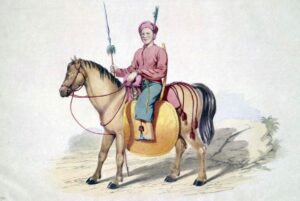
Painting of a Meitei Kathe (Manipuri Horseman)[Photo credits: Wikimedia Commons]
The patterns set during these decades would repeat over the next century. After Bhagyachandra’s death (r. 1763-1798), political stability in Manipur declined. Rival claimants to the Manipuri throne sought military backing from the Burmese by offering their daughters or sisters in marriage. Prince Marjit Singh, who spent seven years at the Burmese court in Ava seeking Bodawpaya’s help for his claim to the throne, illustrated this blend of marriage and military alliances. The Burmese emperor’s demands on Maharaja Marjit, including personal attendance at his coronation, and Marjit’s refusal triggered the Burmese invasion of 1819. This invasion marked the beginning of the Chahi Taret Khuntakpa (the Seven Years Devastation, 1819-1826), the most disastrous period in Manipuri history and the peak of a century-long decline in relations between the two kingdoms.
Under General Maha Bandula, the Burmese forces of King Bagyidaw invaded Manipur in 1819. They turned the capital, Imphal, into ruins, enslaved thousands of Meitei people, and installed a series of puppet kings under Burmese control. Some estimates suggest that the adult male population of Manipur dropped to fewer than three thousand. This devastation altered the demographic geography of the entire northeastern Indian region, as hundreds of thousands of Meitei refugees fled to Cachar, Tripura, Assam, and East Bengal. N. Birachandra’s monograph Seven Years Devastation (1819-26), published by P.S. Publications in 2009, is the most comprehensive scholarly account of this period. Birachandra places the invasion in the broader context of Burmese-Manipuri rivalry, arguing that ongoing succession conflicts within Manipur, the resulting military weakness of the kingdom, and Marjit Singh’s failures in diplomacy combined to create the conditions for Burmese victory. The Meitei captives taken to Burma during this invasion and the earlier ones of 1757-1759 and 1764 were settled around Sagaing and Amarapura, forming communities that exist today. The Konbaung dynasty incorporated the Meitei captives’ renowned horsemanship into the royal military, creating the elite Cassay cavalry (Kathe myindat) and Cassay artillery (Kathe a hmyauk tat) regiments from these displaced groups.
The invasion did not end due to Manipuri military recovery but because of British intervention during the First Anglo-Burmese War. The Treaty of Yandaboo (February 1826), signed by General Archibald Campbell and the Burmese, restored Manipuri sovereignty and appointed Gambhir Singh as maharaja. According to Parratt’s translation of the Cheitharol Kumbaba, Gambhir Singh led the Manipuri Levy, trained by Captain Grant and Lieutenant R.B. Pemberton, driving Burmese forces beyond the Chindwin River and expanding Manipuri territory eastward. However, the human cost of the preceding decades was lasting. The diaspora communities of Meitei refugees and captives in Burma, Assam, Tripura, and Eastern Bengal (now Bangladesh) became permanent features of the regional demographic landscape.

Shumang Leela performance based on the story of Chakpa Makhao Ngambi [Photo credits: Iramdam Manipur Aristes’ Association]
One of the most common ways to commemorate the Manipuri-Burmese historical relationship is through the theatrical tradition of Shumang Leela. This is a Manipuri courtyard theatre where plays are performed in open arenas for large audiences. The story of Chakpa Makhao Ngambi has been staged many times in this style. The 11th Manipur Winter Shumang Leela Festival recently opened with a performance by the Iramdam Manipur Artiste Association, devoted to her story. This play dramatizes her marriage, her fall from favor and the war it was followed by. Beyond Manipur, the play Chakpa Makhao Ngambi has been showcased at national festivals of northeastern Indian theatre, such as the Poorvottar Natakotsavam in Hyderabad, presented by the group Chinglen Thiyam, bringing this eighteenth-century diplomatic marriage to new audiences far from its original setting.
Bibliography
- Arambam Parratt, Saroj Nalini, trans. The Court Chronicle of the Kings of Manipur: The Cheitharol Kumpapa, Vol. 1, 33-1763 CE. Imphal: Jain Book Shop Publication, 2019.
- Arambam Parratt, Saroj Nalini, trans. The Court Chronicle of the Kings of Manipur: The Cheitharol Kumpapa, Vol. 2, 1764-1843 CE. New Delhi: Cambridge University Press, 2009.
- Ibungohal Singh, L., and Ningthoukhongjam Khelchandra Singh. Cheitharol Kumbaba. Imphal, 1989.
- Royal Orders of Burma, A.D. 1598-1885. Vol. III. Kyoto: Centre for Southeast Asian Studies, Kyoto University, 1988.
- Singh, Mangi Laishram, and Longjam Mani Singha. Manipur Itihas Meitei Puran, Bijoy Panchali, Garib Niwaz Charit. Imphal: Bhakti Shastriya Samaj, 1966.
- Aung, Maung Htin. A History of Burma. New York and London: Columbia University Press, 1967.
- Bahadur, Mutua. Kate: Myanmarese Meetei/Meitei. Imphal: Mutua Museum, 2017.
- Bahadur, Mutua. Awa: Kate and Paona. Imphal: Mutua Museum, 2014.
- Banerjee, A.C. The Eastern Frontier of British India (1784-1826). Calcutta: A. Mukherjee and Bros., 1946.
- Beemer, Bryce. “The Creole City in Mainland Southeast Asia: Slave Gathering Warfare and Cultural Exchange in Burma, Thailand and Manipur, 18th-19th Centuries.” PhD dissertation, University of Hawaii at Manoa, 2013.
- Birachandra, N. Seven Years’ Devastation (1819-26). Imphal: P.S. Publications, 2009.
- Brown, R. Statistical Account of Manipur. New Delhi: Mittal Publication, 2001. (Original work published 1874.)
- Charney, Michael W. A History of Modern Burma. Cambridge: Cambridge University Press, 2009.
- Desai, W.S. A Pageant of Burmese History. Calcutta: Orient Longman, 1961.
- Guillon, Emmanuel. The Mons: A Civilisation of Southeast Asia. Bangkok: Siam Society, 1999.
- Harvey, G.E. History of Burma from the Earliest Times to 10 March 1824. London: Longmans, Green and Co., 1925. Reprinted New Delhi: AES, 2000.
- Hodson, T.C. The Meithies. Delhi: B.R. Publishing Corporation, 1981. (Original work published 1908.)
- Johnstone, J. My Experiences in Manipur and the Naga Hills. London: S. Low, Marston and Company, 1896.
- Kabui, G. History of Manipur. Vol. 1: Pre-Colonial Period. New Delhi: National Publishing House, 2003.
- Kamei, G. A History of Modern Manipur (1826-2000). New Delhi: Akansha Publishing House, 2015.
- McCulloch, W. Valley of Manipur. Delhi: Gyan Publications, 1980. (Original work published 1859.)
- Pemberton, R.B. The Eastern Frontier of India. New Delhi: Mittal Publications, 2015. (Original work published 1835.)
- Sanajoaba, Naorem, ed. Manipur Past and Present: The Heritage and Ordeals of a Civilization. 4 vols. New Delhi: Mittal Publications, 1988-2005.
- Scott, George. Gazetteer of Upper Burma and Shan States. Rangoon: Government Press, 1900.
- Shah, Sudha. The King in Exile: The Fall of the Royal Family of Burma. New Delhi: HarperCollins India, 2012.
- Singh, Wahengbam Ibohal. The History of Manipur: An Early Period. Imphal, 1986.
- Spearman, H.R. The British Burma Gazetteer. Vol. 1. Rangoon: Government Press, 1880.
- Wolleng, Angelee. The Politics of Identity and Settlement of Manipuri in Myanmar. Delhi: Ruby Press and Company, 2017.
- Baruah, S.L. “The Burmese and the North East: From the Middle of the 18th Century to the Treaty of Yandabo in 1826.” Proceedings of the Indian History Congress, Vol. 44 (1983): 609-613.
- Ikeya, Kazumasa. “The Foreign Presence in Mandalay during the Konbaung Period: A Review of the Urban Area.” The Journal of Sophia Asia Studies 32 (2014): 113-128.
- Nwe Ni Hlaing. “The Meitei (Kathe): Crown Service Group in Myanmar from the Earliest Times to the End of Monarchical Rule.” Journal of the Myanmar Academy of Arts and Science Vol. XIII, No. 9 (June 2015).
- Parratt, S.N. “Garib Niwaz: Wars and Religious Policy in 18th Century Manipur.” Internationales Asienforum 20, nos. 3-4 (1989): 295-302.
- Singha, Memchaton. “Marriage Diplomacy Between the States of Manipur and Burma, 18th to 19th Centuries.” International Journal of Humanities and Social Science Studies (2016).
- Sorokhaibam, Manglemjao S. “Satyamala Devi: The Life of a Manipuri Princess Who Became the Queen of the Most Powerful 18th Century Ava King.” Imphal Review of Arts and Politics, 3 July 2021.
- Sorokhaibam, Manglemjao S. “Garibaniwaz (Pamheiba): The Master of Manipur and Upper Burma (West of Irrawaddy) (1709-1748).” Imphal Review of Arts and Politics, 10 July 2021.
- Tejbanta, S. “Politics of Religion: A Study from Bhagyachandra to Chandrakirti.” In Proceedings of the Manipuri Historical Society, 8th Session, edited by Sudhir H., S.B. Singh, and N.J. Singh, 174-185. Imphal: Rinda Publications, 2015.