
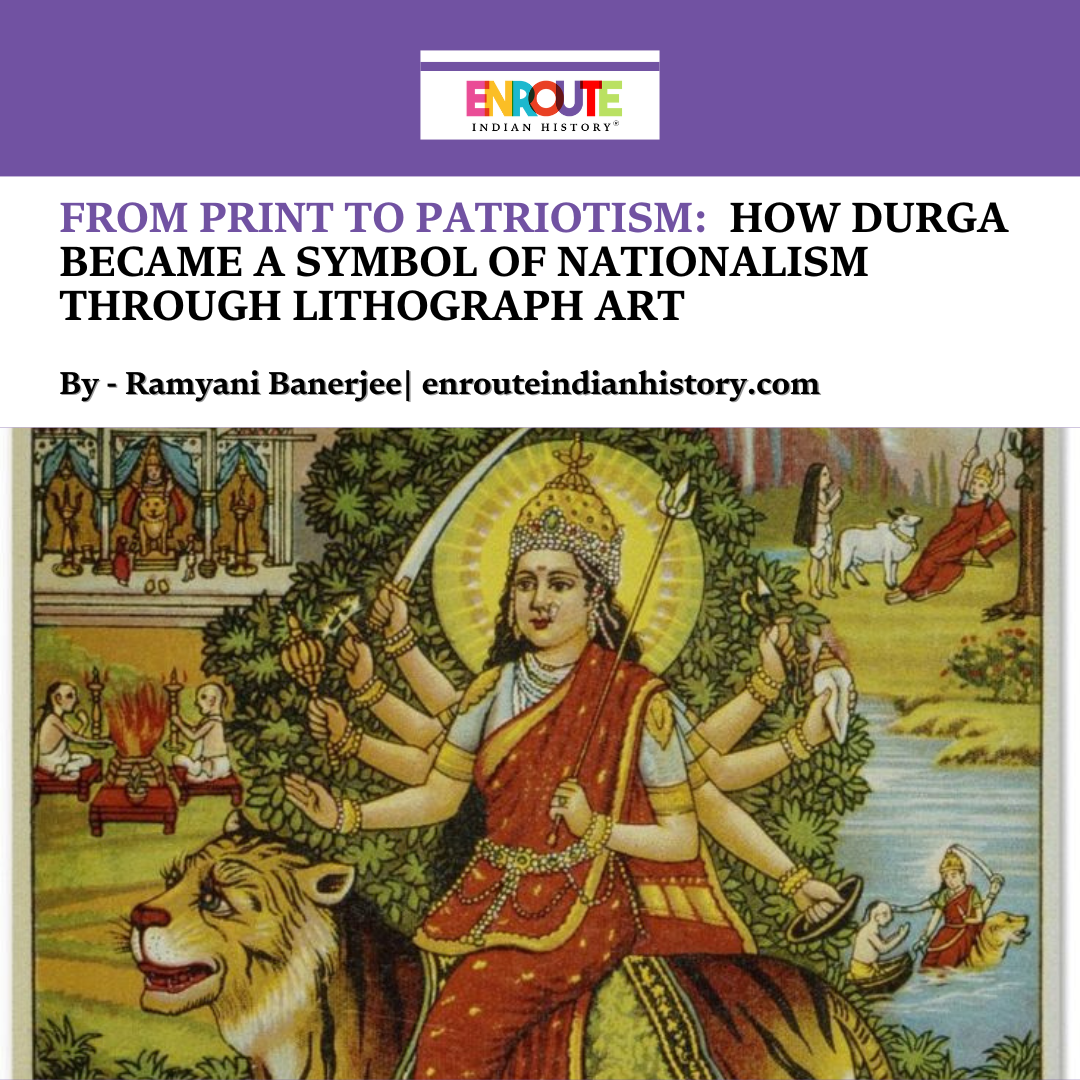
From Print to Patriotism: How Durga became a symbol of Nationalism through Lithograph Art
- December 10, 2025
By Ramyani Banerjee
The Early Beginnings:
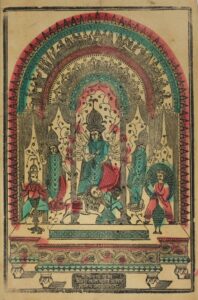
(Left) Durga in Battala Print, late 19th century. Available at: https://dagworld.com/bengalwoodcut03.html [Accessed 25 September 2025].
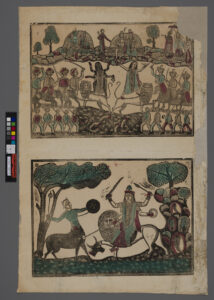
(Right) Goddesses Durga (as Jagaddhatri) and Kali fighting with the Demons, Battala Print, 1850’s.
Available at: https://ccaha.org/news/treatment-focus-19th-century-woodcut-print-kali-durga [Accessed 25 September 2025].
Before lithography transformed the visual culture of Bengal, Durga’s image had already circulated widely through the vibrant traditions of Battala woodcut prints and Kalighat Patachitra paintings. The Battala prints emerged in the bustling presses of north Calcutta in the early 19th century, an area known for its cheap publishing houses that catered to a rapidly expanding reading and devotional public. Often dismissed as crude or cheap, these woodcuts
were nevertheless crucial in democratizing goddess imagery. Although produced on inexpensive paper with thick, unrefined lines and limited colour, they made Durga very accessible to middle- class households, far removed from aristocratic or temple patronage. You would find, in Battala sheets, Durga was accompanied by the full retinue of her children—Lakshmi, Sarasvati, Kartikeya, and Ganesha—arranged in iconic poses that could be instantly recognized,
reproduced, and worshipped. Their affordability ensured that even the urban poor and lower- middle classes could enshrine Durga in their homes, making Battala an early engine of mass devotional culture.
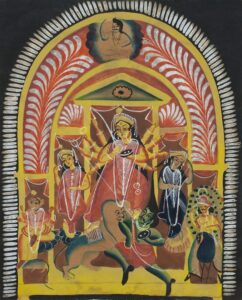
Durga in pata- painting, n.d. DAG: Kalighat Painting. Available at: https://dagworld.com/patk025.html [Accessed 25 September 2025].
If Battala represented popular reproducibility, Kalighat Pats captured the pulse of a changing city. Produced by patuas (scroll painters) who had migrated from their rural hometowns to settle around Calcutta and particularly at the Kalighat temple precinct— these paintings gave Durga a striking new aesthetic. Executed on mill-made paper with bold brushstrokes, flowing outlines, and vibrant pigments, Kalighat pats were both devotional and satirical. The Kalighat style Durga, rendered with graceful curves and dramatic gestures, was distilled into a form that was
immediately legible—flat, stylized, yet full of vitality—mirroring the contradictions of 19th- century Calcutta itself. This pre-lithographic visual culture meant that by the mid-19th century, Durga was already a household presence across classes, reproduced in cheap prints and hand- painted pats.
The Lithograph Prints:
By the late 19th century, a European invention was reshaping the very look of colonial India. Lithography—a printing technique born in the late 18th century—had arrived, and with it came a visual revolution. Cheap, portable, and easily reproduced, these prints flooded Calcutta’s streets and homes. They adorned bazaars, domestic walls, and found their way into temples, turning lithographs into the new visual currency of the city. These lithograph prints borrowed the motifs from Kalighat pats and Battala woodcuts, but unlike woodcuts, lithographs allowed for sharper detailing, mass reproduction, and vivid coloration, making images both affordable and visually striking. In the hands of Bengali artists and publishers, the lithographic press became more than a devotional tool; it turned Durga into a symbol for everyone, capturing her many stories—her fierce battle with Mahishasura, her joyous homecoming, tender moments with Lord Shiva, the bittersweet farewell of Bijaya and so on.
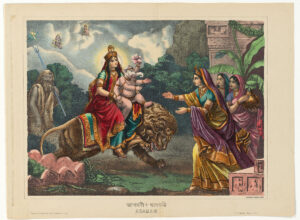
Agamani/Homecoming of Durga. The Metropolitan Museum of Art, 1878–1883. Available at:
https://www.metmuseum.org/art/collection/search/849513 [Accessed 25 September 2025].
Studios like the Calcutta Art Studio (founded 1878) and the Chore Bagan Art Studio, staffed by trained artists from the Calcutta School of Art (later the Government College of Art), gave Durga an entirely new iconographic life. In their prints, the goddess’s body was rendered with anatomical precision, her ornaments gleamed with a metallic sheen, and her lion crouched with the muscular realism of European painting. Yet this was no mere mimicry of the West. As Christopher Pinney has shown, missionaries regarded these prints as “archaeological relics” of a Hinduism on its deathbed, convinced that Western realism would weaken religious devotion.
Instead, Indian artists appropriated realism to make the gods more palpable—Durga looked more present, more immediate, and more authoritative than ever before. By the turn of the twentieth century, Durga’s lithographic presence gradually merged into the vocabulary of nationalism: orthodox Hindus celebrated her as Shakti incarnate, reformers saw her as an allegory of moral regeneration, and nationalists increasingly identified her with Bharat Mata, by extension. In a climate where political dissent was tightly controlled, her image became a subtle yet powerful rhetoric of resistance.
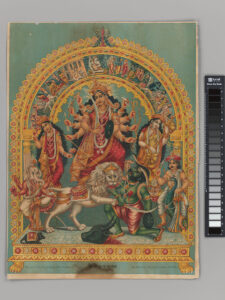
Mahishasuramardini, with Lakshmi, Saraswati, Karthik and Ganesh, ca. 1885–95. Chromolithographic print on paper. The Metropolitan Museum of Art. Available at: https://www.metmuseum.org/art/collection/search/786763 [Accessed 25 September 2025].
How did the political spectrum grow important?
By the 1870s and 1880s, as the harsh, repressive realities of colonial rule became undeniable, Bengal’s middle classes increasingly turned to indigenous cultural resources to craft a sense of national identity. The evocative imagery of Tantra, particularly through lithographs of the Dasamahavidya, amplified this fusion of spirituality and nationalism. India now could be imagined as bharat-shmashan—a blazing cremation ground, emptied, haunted, and inhabited by
the half-dead. Also, during the colonial period, politics and religion were conceptually separated into separate domains, politics being placed under strict surveillance while religion was granted a freer hand, treated as an “autonomous” domain. This curious divide created a loophole: under the banner of “religious expression,” Indians could stage acts of solidarity and protest that would have been forbidden under the name of “politics.” 2 Historian Sandria Freitag has drawn an important comparison between nation-building in Western Europe and South Asia. In India, she argues, ‘Public arenas’ emerged by involving a ritual enactment of polity which involved religious festivals, processions, and neighbourhood organisations. The stage of politics was thus set in the streets, where massive crowds gathered. Music, dance, theatre, and drama became rallying points of both ritual and resistance. 3 Even brandishing of sword signaled that devotion and defiance were increasingly entwined. The result was profound: struggles for power, prestige, or reform found themselves articulated in the idiom of religion, a development that would eventually harden into the fault lines of communalism.
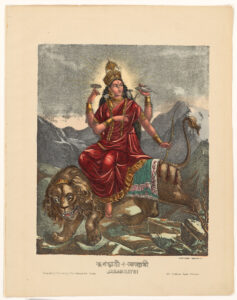
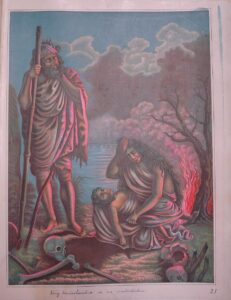
(Left) Goddess Durga in the form of Jagaddhatri, who by extension was later imagined as Bharat Mata
c.a. 1878–1883, lithograph with hand-colouring, West Bengal, Calcutta. Available at:
https://www.metmuseum.org/art/collection/search/849501 [Accessed 27 September 2025].
(Right) King Harishchandra at the cremation ground, with his wife and dead son. This was a symbolic depiction of ‘Bharat- Smashan’. The British Museum, 1885-1900.
Lithograph print, “Popular Print; Album.” Available at: https://www.britishmuseum.org/collection/object/A_2003-1022-0-21[Accessed 6 Nov. 2023].
One of the most famous phrases from the novel Anandamath captures the symbolic power of Bengal’s divine mothers: the wild and fearsome Kali embodies the “Mother” as she has become—oppressed and starving—while the radiant, ever-bountiful Durga, as Jagaddhatri, represents the vision of a future liberated motherland. This newly articulated mother-son relationship immediately acquired nationalistic overtones, merging devotional sentiment with political imagination. Reflecting on this, Aurobindo Ghose observed, “The third and supreme service of Bankim to his nation was that he gave us a vision of our mother… it is not till the motherland reveals herself to the eye of the mind as something more than a stretch of earth or mass of individuals, it is not till she takes the shape as a great Divine and maternal power…” Ghose also declared that nationalism was nothing less than a divine calling. He wrote: “When therefore it is said that India shall rise, it is the Sanatan Dharma that shall rise. When it is said that India shall be great, it is the Sanatan Dharma that shall be great. When it is said that India shall expand and extend itself, it is the Sanatan Dharma that shall expand and extend itself over the world. It is for the dharma and by the dharma that India exists.”
Revolutionary thinkers seized upon this power. It was within this landscape that new visual allegories emerged. One of the Calcutta Art Studio’s first chromolithographs, Bharat Bhiksha (“India Begging,” c.a. 1878–80), personified India as an elderly woman (inspired from Dasamahavidya icon Dhumavati) seated beside Britannia, with a child symbolizing a new India. The image was layered with ambivalence: it oscillated between helplessness and hope, between a nation infantilized under colonial rule and a nation yearning to be reborn. Subtle as they were, such images carried a political charge impossible to miss— they engaged with debates on national identity, reform, and the moral critique of colonialism.
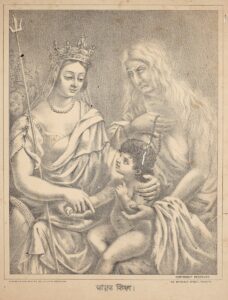
Bharat Bhiksha, c.a. 1878-80. DAG World. Available at: https://dagworld.com/bengallitho162.html (Accessed: 27 September 2025).
The Beginning of Political Symbolism:
It wasn’t only Durga who captured the Bengali imagination. Jagaddhatri—the cosmic sustainer—and Kali, the fierce destroyer, were also reborn in poetry, plays, and fiction as political symbols. Writers and dramatists of the 19th century began weaving Shakta myths into their work, imbuing them with fresh urgency and resonance. The tale of Sati, for instance, was recast to portray Shiva as the redeemer of a lifeless, colonized land. The sacred geography of
Bengal’s Shakta-Pithas—pilgrimage sites where Tantric practitioners worshipped Sati’s dismembered body parts—offered early patriots like Bhudev Mukhopadhyay (1827–94) a powerful idiom to articulate the nation as a unified motherland.
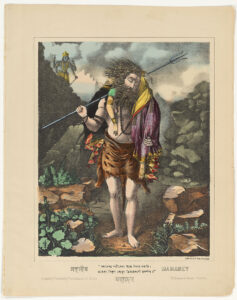
Shiva Mahadev, carrying Sati, hand-coloured lithograph. Collection of Mark Baron and Elise Boisante. Metropolitan Museum of
Art (The Met), 1878–1883. Available at: https://www.metmuseum.org/art/collection/search/849504 [Accessed 5 November 2023].
Yet the political imagery of the mother goddess was not without contradiction. Historian Sumit Sarkar shows how 19th-century bhadralok discourse often framed women within the home as either victims needing reform, paragons of threatened virtue, or symbols of capitulation to foreign ways. 9 The male patriot, in this rhetoric, was imagined as the ascetic figure holding together the shattered body of the nation. Strikingly, lithographs of a grief-stricken Shiva
carrying Sati became visual archetypes of the revolutionary ideal: the lone man trying to piece together a broken India. By the early 20th century, this imagery crystallized into a new iconography. It was Abanindranath Tagore who first painted Durga as Bharat Mata—Mother India—an artistic vision that his disciple Nandalal Bose would carry forward, and forever entwined the goddess and the nation. It is also worth noting that in his speeches, Netaji Subhash Chandra Bose often evoked Durga and Bhavani as national mothers who inspired courage. And during his leadership of the Indian National Army (INA), this symbolic appropriation became more pronounced. During the 1920s, while imprisoned in Mandalay Jail, Bose wrote to Basanti Devi describing the festival and expressing his wish that “the divine mother would visit the prisoners year after year, easing their pain and suffering.” 10 Later, Netaji served as President of the Puja Committee, and between 1938 and 1939, he played a significant role in elevating and
glorifying the festival.
Durga Lithographs, outside Bengal:
By the early twentieth century, lithographs of Durga grew bolder. No longer confined to Bengal, her likeness spread westward through the presses of Poona and Bombay. The Chitrashala Press—founded in 1878 by Vishnu Krishna Chiplunkar, a close ally of Bal Gangadhar Tilak—and later the celebrated Ravi Varma Press, reimagined the goddess in a strikingly modern style. Drawing on European realism, their lithographs showed Durga with flowing black hair, a
red sari, and a golden crown, set against naturalistic backdrops. But these were not just devotional images. One popular print depicted Ashtabhuja Devi lashing out at butchers over a cow sacrifice. The colonial state, quick to sense its incendiary potential, banned it under the 1910 Press Act, wary that such imagery might stoke both anti-British and anti-Muslim sentiments. In this visual language, Durga had become something more than divine: she was Bharat Mata, Mother India, righteous avenger of sacrilege and foreign domination.
The politics of the goddess only deepened with time. By the 1930s, artists like Rup Kishor explicitly fused Durga’s Mahamaya Shakti with nationalist motifs. Her battlefield stance mirrored the revolutionary struggle, her weapons echoing calls to resist imperial rule. Chiplunkar’s larger project of nurturing Hindu religious life had by then merged seamlessly with a nationalist drive, with print culture as its engine. Chromolithography allowed these images to
circulate widely, creating what Benedict Anderson would call an “imagined community,” bound by shared symbols of faith and freedom.
Even the iconography was reshaped for the times. Traditionally, Durga’s tiger was shown vanquishing Mahishasura, the buffalo demon. In these nationalist prints, however, the tiger mauled the carcass of a cow—a visceral image that heightened the emotional stakes of colonial exploitation and communal anxieties. Such deviations from scriptural imagery reveal a deliberate strategy: to refashion myth for modern politics. In doing so, Durga’s image moved beyond the sacred, becoming a rallying emblem of both resistance and nationhood. 13 In visual culture, mass-
circulated lithographs of Durga and Kali gave middle-class Indians new ways to revere the motherland, while their stark symbolism spoke just as directly to the poor.
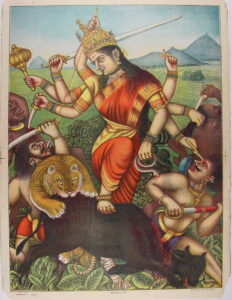
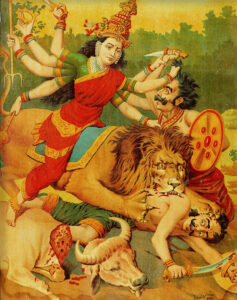
(Left) Print of Ashtabhuja Devi (Durga) slaying the demon Mahisha (Mahishasuramardini), chromolithographic print, Royal
Ontario Museum. (c. 1890) Chitrashala Press, Pune. Available at: https://collections.rom.on.ca/objects/519555/print-of- ashtabhuja-devi-durga-slaying-the-demon-mahisha- (Accessed: 27 September 2025).
(Right) Raja Ravi Varma’s print of the same Ashtabhuja Durga, before the British confiscated all copies. The Tribune, 10
October 2010. Available at: https://www.tribuneindia.com/2010/20101010/spectrum/main1.htm [Accessed 27 September 2025].
In his book, Christopher Pinney notes that 19th-century India was increasingly saturated with religious imagery. A British report at the time emphasized the importance of ‘pictorial advertising’ in a country like India where consumers were likely to be illiterate. 14 So when these bright, alluring lithograph images started displaying Hindu mythological themes and deities like Durga, Jagaddhatri and especially Kali, they really created a far-reaching and powerful niche as a recurring and dominant theme.
Conclusion:
This new realism in lithograph prints imbued Durga—often also identified as Bhavani or Jagaddhatri—with unmistakable political charge. No longer merely Mahishasuramardini, the slayer of a mythic demon, she could now be imagined as the mother who might vanquish oppression itself. In this transformation, the worship of Durga moved beyond the ritual sphere, entering the political grammar of the age, where devotion and defiance overlapped on the same sheet of paper. Yet, as inclusive as this vision seemed, it remained anchored in Hindu revivalist thought—an intellectual enterprise of the nationalist elite who sought to invent a pan-Indian nation-state that was modern, but simultaneously turned towards ancient Hindu traditions for legitimacy.
REFERENCE:
1. Anderson, B., 2016. Imagined Communities: Reflections on the Origin and Spread of Nationalism. Deckle Edge, 13 September.
2. Chakrabarty, R., 2002. Bangalir Dharma, Samaj O Sanskriti. Subarnarekha, pp.245–260.
3. Pinney, C., 2004. Photos of the Gods: The Printed Image and Political Struggle in India. Reaktion Books. https://press.uchicago.edu/ucp/books/book/distributed/P/bo3536077.html
4. Chattopadhyay, B., 2017. Anandamath (Bengali Edition). Createspace Independent Publishing Platform, p.50.
5. Freitag, S.B., 1989. Collective Action and Community: Public Arenas and the Emergence of Communalism in North India. University of California Press. https://www.academia.edu/113554390/Collective_Action_and_Community_Public_Arenas_and_the_Emergence_of_Communalism_in_North_India
6. Mondal, A., 2002. ‘The Emblematics of Gender and Sexuality in Indian Nationalist Discourse.’ Modern Asian Studies, 36(4), pp.913–936. https://doi.org/10.2307/3876478.
7. Banerjee, R., 2024. “Analysing ‘Kali’ as a Pioneering Representative of Cultural Resistance, in context of the Militant Nationalism in Bengal (Late 19th–Early 20th Century): In Retrospect of Visual Culture, Gender and Revolutionary Propaganda”. In: G. Majee and S. Haldar, eds. 20th Century Bengali Society, Culture and Women: A Historical Outlook. New Delhi: Authors Press. p. 30-34, 37 https://www.amazon.in/Century-Bengali-Society-Culture-Women/dp/9360950785
8. Mukherjee, S. (2023) ‘How Netaji Subhas Chandra Bose transformed Durga Puja celebrations’, Times Now News, 23 October. Available at: https://www.timesnownews.com/lifestyle/people/how-netaji-subhas-chandra-bose-transformed-durga-puja-celebrations-article-114008931 (Accessed: 27 September 2025).
9. Ray, D., 2022. ‘A Formidable Figure, a Symbol of Shakti: The Evolution of Goddess Kali over the Ages in West Bengal.’ Economic Times, 24 Oct., pp.1–2. Available at: https://economictimes.indiatimes.com/magazines/panache/a-formidable-figure-a-symbol-of-shakti-the-evolution-of-goddess-kali-over-the-ages-in-west-bengal/articleshow/95066331.cms[Accessed 19 Sep. 2023].
10. Paul, Ashit. ‘19th Century Swadeshi Art: Paintings & Prints’, Akar Prakar, 28 August – 15 October 2017, https://www.akarprakar.com/exhibitions/19th-century-swadeshi-art.
11. Sri Aurobindo, 2025. India’s Rebirth. Sri Aurobindo Ashram Trust. Available at: https://sri-aurobindo.co.in/workings/sa/00/indias_reberth_e.htm [Accessed 26 September 2025].
12. Sri Aurobindo Institute, n.d. Vande Mataram Mantra. Available at: https://www.sriaurobindoinstitute.org/saioc/Sri_Aurobindo/vande_mataram_mantra [Accessed 26 September 2025].
13. Sarkar, S., 1992. ‘“Kaliyuga”, “Chakri” and “Bhakti”: Ramakrishna and His Times.’ Economic and Political Weekly, 27(29), pp.1543–1566. https://doi.org/10.2307/4398664. Available at: https://www.jstor.org/stable/4398664