

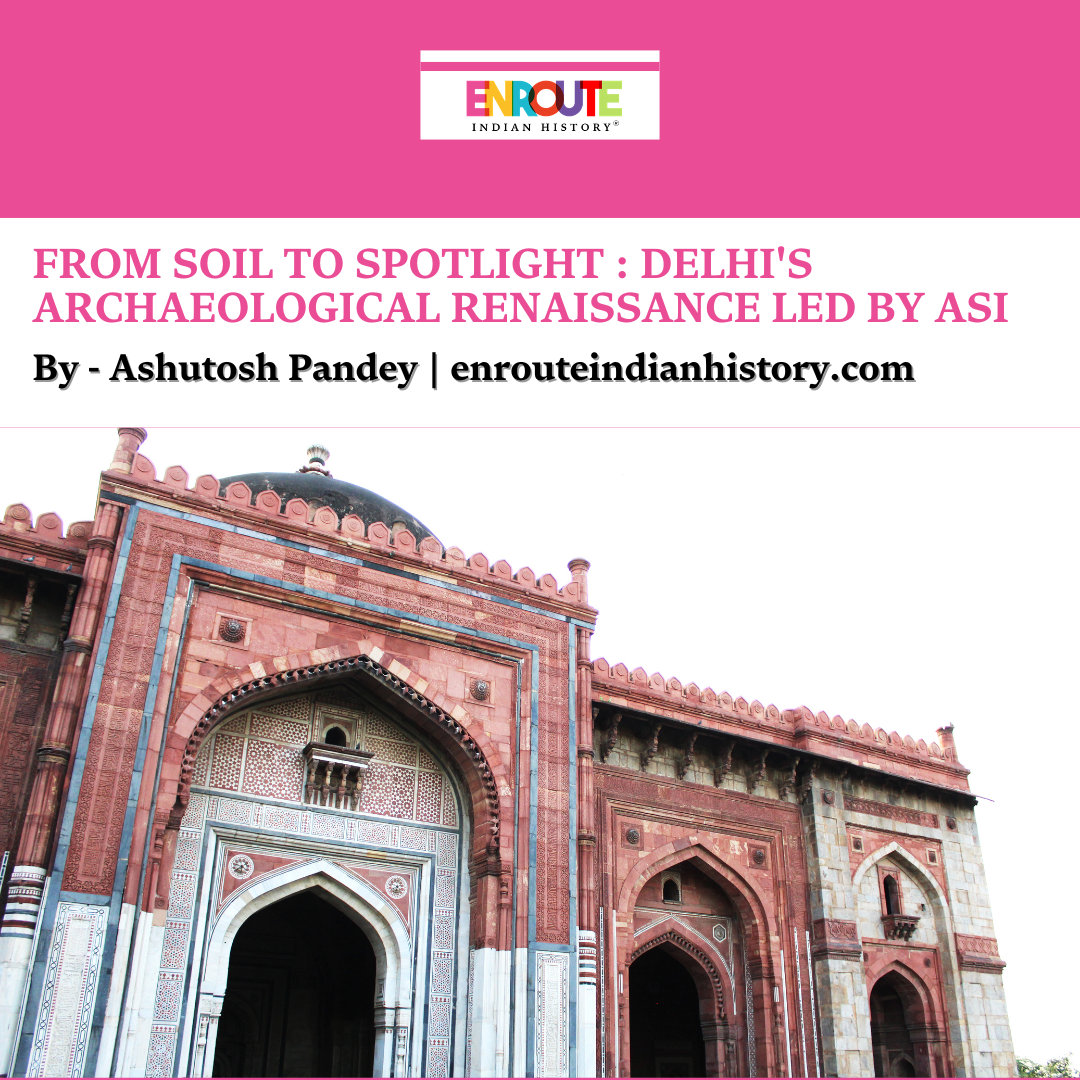
By Ashutosh Pandey
Introduction
Delhi, India’s timeless capital, has always been a palimpsest of history — where successive civilizations built, buried, rediscovered, and rebuilt. In 2025–26, an extraordinary confluence of archaeological discoveries, conservation efforts, scientific surveys and technological innovation has rejuvenated Delhi’s historical narrative. At the forefront of this transformation stands the Archaeological Survey of India (ASI) — the government’s premier heritage body — helping peel back centuries of soil, stratigraphy, and neglect to bring ancient Delhi’s stories into the light.
Unearthing the Past: Excavations at Purana Qila
One of the year’s most riveting archaeological undertakings has been the continued exploration of Purana Qila, an ancient citadel on Mathura Road believed to correspond to the legendary city of Indraprastha — the Pandava capital of the Mahabharata. Under ASI’s supervision, excavations have revealed stratified historical layers spanning over 2,500 years, confirming multiple cultural phases from pre-Mauryan eras through the Sultanate and Mughal periods.
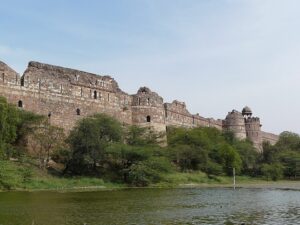
These excavations, which began in earnest in three distinct seasons (2013–14, 2017–18 and 2022–23), have uncovered a rich array of evidence:
*Mauryan structures including terracotta ring wells and workshop debris indicating ancient craft activity.
*Sunga and Kushan period housing foundations with brick walls and clay floors.
*Rajput era postholes and defensive structures.
*Painted Grey Ware — a ceramic tradition linked with early Iron Age sites and possibly with the Mahabharata era.
Visitors are now able to witness these exposed remains under protective canopies, and the ASI has considered expanding the exposed area to showcase more cultural layers.
Excavations of this magnitude are not merely about artefacts; they transform how we understand urban evolution, cultural continuity and Delhi’s place in ancient South Asian history.
Reconceiving Artifacts at Purana Qila: Gallery Expansion
Building on archaeological momentum, the ASI is also expanding the Purana Qila Gallery of Confiscated and Retrieved Antiquities, originally established in 2019. Plans now call for more storage and display space for tens of thousands of artefacts — including items recovered from illicit antiquities networks and those repatriated from abroad. This expanded gallery, augmented with a dedicated online portal for researchers and enthusiasts, aims to contextualize Delhi’s material culture from proto-historic to modern periods.
Although access to some new displays will initially be limited to scholars, the online portal promises broader engagement with these heritage treasures.
Mehrauli: Ancient Tombs and Supreme Court Mandates
In the sprawling Mehrauli Archaeological Park, a heritage landscape dotted with ruins of multiple eras, ASI’s role has included both archaeological and conservation responsibilities. Among the most noteworthy 13th-century structures undergoing restoration is Balban’s Tomb — one of Delhi’s earliest Indo-Islamic monuments distinguished by its true arch architecture. ASI’s conservation work on this and other structures is part of broader efforts to stabilise fragile masonry and remove invasive vegetation.
ASI’s responsibilities in Mehrauli recently extended to legal compliance and heritage protection when the Supreme Court of India ordered the ASI to repair two ancient dargahs (shrines) within the park boundaries, affirming that unauthorized construction must not be allowed to jeopardize historic fabric.
This intervention underscores a broader stewardship approach: ASI as not only an excavator but also a guardian against neglect and legal threats.
Conserving Monuments: Safdarjung and Humayun’s Tomb
Just as excavation reveals Delhi’s buried past, restoration preserves its standing heritage. Two of the city’s iconic Mughal monuments have been in ASI’s conservation spotlight:
1. Safdarjung’s Tomb — an 18th-century Mughal mausoleum built in classic Indo-Islamic style — continues to receive attention to stabilise its gardens, facades and interiors, preserving the atmosphere of its famed charbagh (four-part garden)
2. Humayun’s Tomb, a UNESCO World Heritage Site and precursor to the Taj Mahal in architectural prestige, remains in excellent condition under ASI oversight, even when unrelated structures nearby suffered collapse.

These conservation projects are not merely structural. They involve careful documentation of original materials, water-management planning for gardens, visitor-flow strategies and protective maintenance — all calibrated to historical authenticity.
Unearthed Beyond the Trenches
While high-profile excavations at Purana Qila have captured public attention, Delhi’s archaeological narrative in recent years has quietly expanded beyond a single citadel. Scattered across the city’s peripheries and historical landscapes are lesser-known but equally significant sites that push Delhi’s antiquity further back in time and widen the scope of its material history.
Among the most important of these are the prehistoric and proto-historic remains at Mandoli, Bhorgarh and Kharkhari Nahar, located on the city’s northern and western fringes. Documented by the Delhi government’s archaeology department and studied alongside ASI data, these sites have yielded evidence of Late Harappan and post-Harappan habitation, including pottery fragments, structural remains and habitation debris. Their significance lies not merely in their age, but in what they reveal: Delhi was not a cultural vacuum awaiting medieval capitals, but part of a wider settlement network that interacted with the Indus Valley and upper Gangetic plains thousands of years ago. These discoveries quietly challenge the perception of Delhi as primarily a Sultanate–Mughal city, anchoring it instead within a much longer continuum of human occupation.
Moving forward in time, the ruins of Qila Rai Pithora (Lal Kot) represent another crucial layer in Delhi’s archaeological stratigraphy. Built in the 11th century by the Tomar Rajputs and later expanded by Prithviraj Chauhan, it stands as Delhi’s earliest fortified city. Though no large-scale excavation is underway, conservation, documentation and interpretative planning by the ASI have brought renewed attention to this site. Massive stone ramparts, reused pillars and surviving gateways illustrate a phase of urban planning that predates the Delhi Sultanate, marking the transition from regional Rajput polities to imperial rule. In archaeological terms, Qila Rai Pithora bridges the gap between ancient settlement patterns and medieval urbanism.
Another often overlooked dimension of Delhi’s archaeological landscape lies beneath its stepwells (baolis) — especially those within the Mehrauli region, such as Rajon Ki Baoli.
Recent conservation and desilting efforts have revealed not only architectural finesse but also the sophisticated water-management systems that sustained medieval Delhi. These structures functioned as social spaces, hydrological solutions and architectural statements, reflecting how archaeology can illuminate everyday life rather than only royal narratives. Their restoration underscores a broader shift in ASI’s approach: preserving infrastructure heritage alongside monumental architecture.
In central Delhi, the Battashewala tomb complex and other funerary structures near Nizamuddin further enrich the archaeological mosaic. These late Mughal-period monuments, often overshadowed by Humayun’s Tomb, testify to Delhi’s role as a sacred mortuary landscape where memory, architecture and spirituality intersected. Their documentation and protection highlight the importance of safeguarding smaller clusters of heritage that together form the city’s historical ecology.
Collectively, these sites reinforce a crucial archaeological insight:
Delhi cannot be understood through isolated monuments or singular excavation sites. Its history is layered, dispersed and interconnected — from prehistoric villages to Rajput forts, water systems, burial grounds and imperial capitals. By bringing these lesser-known excavations and conserved landscapes into focus, archaeology shifts from spectacle to scholarship, revealing Delhi as a continuously evolving human habitat rather than a city frozen in selective historical moments.
Mapping the Monuments: Digital and Scientific Surveys
In parallel with field excavations and masonry conservation, the ASI is embracing cutting-edge technology to record and monitor monuments across Delhi and India. In recent years, digital mapping initiatives have been launched, such as through the Indian Heritage app, which integrates interactive monument maps and textual content for hundreds of protected sites.
Beyond mobile apps, ASI’s use of GIS (Geographic Information Systems), LiDAR (Light Detection and Ranging), drones, and aerial surveys is transforming archaeological documentation. These techniques capture high-resolution spatial data, reveal hidden structural vulnerabilities, and create comprehensive records of archaeological landscapes more efficiently than traditional manual methods.
In conjunction with such technologies, stratigraphic surveys — the systematic recording of soil layers — help archaeologists piece together ancient occupation sequences at sites like Purana Qila. Stratigraphy is central to understanding how successive urban layers relate to one another through time; digital tools enhance this by enabling spatial visualization and long-term preservation of stratigraphic information.
Delhi’s status as a living archaeological site necessitates these advanced methods: as modern infrastructure evolves, accurate digital documentation ensures that heritage is not irrevocably damaged or lost.
Heritage in the Public Imagination: Parks, Pathways and Experiences
The ASI’s archaeological work is amplified by broader urban heritage initiatives. Mehrauli, Purana Qila and the Humayun’s Tomb–Purana Qila corridor are increasingly envisioned as part of an integrated archaeological park network — green corridors that connect historical sites for education and tourism.
Within Mehrauli Archaeological Park, pathways, signage and visitor facilities are being enhanced so that citizens and tourists alike can appreciate the layered history visible above ground. From pool restorations to landscaped public seating and interpretation panels, these spaces are being activated, not just preserved.
Heritage walks and guided tours — especially at Purana Qila — help locals connect emotionally with archaeology, fostering deeper stewardship of Delhi’s past.
Conclusion: A Heritage at a Crossroads
Delhi today stands at a remarkable moment in archaeological history. The layered earth beneath its streets and gardens is no longer silent. Through ASI’s excavations, strategic conservation, digital mapping and scientific survey work, ancient Delhi’s narrative is being told with unprecedented clarity and public engagement.
From the deep strata of Purana Qila to the domes of Humayun’s Tomb, from Balban’s tomb restoration to searchable digital maps accessible globally, the city’s past is being foregrounded for future generations. This is more than preservation — it is active cultural recovery, ensuring that Delhi’s heritage matters not just as relics, but as living chapters of India’s continuing story.
Bibliography
1)Archaeological Survey of India (ASI).
Indian Archaeology – A Review (Annual Reports).
Ministry of Culture, Government of India.
2)Ministry of Culture, Government of India.
Monument Conservation and Archaeological Excavations Reports.
Press Information Bureau (PIB).
3)Archaeological Survey of India.
Protected Monuments of Delhi Circle.
ASI, New Delhi.
4) Government of NCT of Delhi, Department of Archaeology.
Archaeological Sites and Excavations in Delhi.
Delhi Archives and Archaeology Directorate.
5)Cunningham, Alexander.
Archaeological Survey of India Reports.
Government of India.
6)Hindustan Times.
Coverage of Humayun’s Tomb conservation, Mehrauli Archaeological Park and urban heritage.
7)The Times of India.
Articles on Purana Qila excavations, Balban’s Tomb restoration and ASI initiatives.
8)The Indian Express.
Reporting on monument conservation, antiquities recovery and archaeological policy.