

RAVNEET KAUR
Gold and silver are both ductile and malleable metals. By itself, silver is prone to tarnishing, and gold is brittle, therefore the two are not used separately for thread making. Silver is used for its strength, and gold beautifies the thread by coating silver and giving it lustre. In this manner, both gold and silver are used together and have a symbiotic relationship. Several Indian textiles, woven and embroidered, make use of gold and silver; these are – brocades, Kanchipuram, Paithani, Chanderi, among woven textiles and Gota, Kamdani, Mukaish, Mukka, Dori, Danka, Tilla and Zardozi in embroidered.
Zar refers to gold in Persian, while zari means the golden craft of gold and silver thread making. The embroidery done with this gold and silver thread is zardozi. Over millennia, these textiles have been used for ceremonies and celebrations, have been a part of religious rituals, trans-continental trade and even bore the brunt of colonialism and the Industrial Revolution. The craft of zardozi is believed to have arrived in India from Iran centuries ago, though mentions of gold and silver textiles date back to Vedic times in the Indian subcontinent.
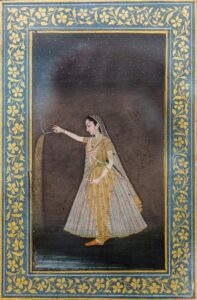
Figure 1: Lady Holding a Sparkler. Paper. Mughal, c. 1660. National Museum, New Delhi. She is dressed in a gold ensemble. Wikimedia Commons. (https://commons.wikimedia.org/wiki/File:Lady_Holding_a_Sparkler.jpg)
ZAR: HISTORICAL ACCOUNT OF GOLD TEXTILES IN INDIA
The earliest mention of textiles woven with gold can be found in the Vedas, which tell of gods dressed in “Hiranya atkan” (clothes of gold) and declare the superiority of gold over all other metals. Gold is associated with the Sun, and several qualities are attached to gold – mahas (greatness), yasas (prestige), ojas (authority) and so on. Atka (a long cloak for men), drapi and pesas are some of the garments mentioned, and kind of obviously Brahmins and Kshatriyas are the only ones who can wear them according to the prescription. Silver, on the other hand, is associated with protection and the moon; it is also said to be both auspicious and inauspicious.
Over the centuries, there has been an abundance of gold and silver textiles in writings and art. The Ajanta caves showcase women, most probably elite women, in gold embroidered clothes, while the Jain text Ācārāṅga Sūtra says “a monk or a nun should not accept any of the following materials …. Golden plaids, plaids glittering like gold, interwoven with gold, set with gold, embroidered with gold”. In his Travels, 13th-century traveller and merchant Marco Polo talks about the goods bought from the Tamil lands of the Pandyas and especially mentions that “they also work cushions embroidered with gold, so fine that they are worth six marks of silver a piece”.
Zari work reached new heights under the Delhi Sultanates and was at its peak under the Mughals. Al Umari, the 14th-century biographer of Muhammad bin Tughlaq, writes that “Most of the Tartari robes are embroidered with gold (muzarkasa bi dhalab). Some wear garments with both sleeves having a tiraz border of gold embroidery (zarkas)”. Contemporary Indian writers like Ziyauddin Barani and travellers such as Ibn Battuta give similar accounts of clothes with gold and silver embroidery. The probable first use of the term ‘zardozi’, that is, the craft of embroidery using gold and silver threads, is in Firoz Shah Tughlaq’s autobiography Futuhat-i-Firoz Shahi. Jahangir’s memoirs, Tuzuk-i-Jahangiri, are another source. Gold embroidered robes of honour in Babur’s and the Iranian courts were also very crucial. The better the quality and more intricate the gold embroidery, the more eminent was the position of the receiver (Mackie, 2002).
Zari work was done in Mughal Karkhanas – royal studios and workshops – where, amongst the production of gold and silver textiles, shawls, bridal trousseau, other articles like jewellery, boxes, bowls, vases, hookahs, trinkets, and spittoons were also made. During this period and until the 19th Century, the prominent centres of zari were Delhi, Lahore, Lucknow, Agra, Varanasi, Patna, Burhanpur, Hyderabad, Aurangabad, Surat, Ahmedabad and Poona.
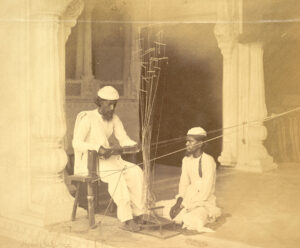
Figure 2: Two zardozs (gold lace makers) at Delhi in India, taken by Shepherd & Robertson, c. 1863, Archaeological Survey of India Collections. Wikimedia Commons. (https://commons.wikimedia.org/wiki/File:Zunlozis,_Gold_lace_makers,_Delhi_1863.jpg)
The Industrial Revolution brought in cheaper and faster methods of manufacture and led to the import of metal thread in India. Slowly, the handmade process of making zari became completely mechanised as electrically powered drawplates were used for making wires. Along with this gilding, flattening and winding machines were also used. Apart from this, the process of electroplating allowed the use of baser and cheaper materials and thus began the era of imitation zari.
ZARI: THREADMAKING PROCESS
Traditionally, the process of zari making was handmade at all stages. In her book, Jewelled Textiles (2014), Vandana Bhandari presents historical accounts of traditional zari making and delineates the process. The process was as follows – “A bar of silver, tapering at both edges, is first gilded. This is accomplished by once or twice wrapping gold leaf around it and placing it in a furnace till the gold fuses and is united with the silver. Thus prepared, the bar is drawn out, and for this purpose, it is inserted by one of its ends within a round opening in a massive sheet of strong iron, fixed in an upright position. The protruding portion is seized by a powerful clamp and forcibly pulled through the opening, time and time, until the gold-coated silver bar is drawn out and gradually assumes the thickness of a hair and is many miles in length”.
The next step was the flattening process or the lametta, which, before mechanisation, was done through hammering. The process was so refined that no portion of the wire escaped the hammer, and the extreme thinness of the flattened wire was ensured. The fine wires thus formed are then spun around silk or cotton thread, which leads to the result called zari or kalabatun in the north, and kasab in the west and south India.
Economic historian Tirthankar Roy observes the delicacy of the process and emphasises how crucial judgment was from furnace to the final thread making (Bhandari, 2014). This zari’s quality and price were determined according to the amount of gold and silver present in it.
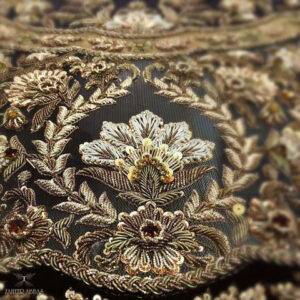
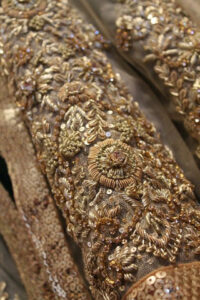
Figure 3&4: Zari designs and motifs. The Design Cart. (https://thedesigncart.com/blogs/news/the-art-of-zari?srsltid=AfmBOoqQWUXH8rwwzpwyVZmNZDmbkye5yWpIJWbnbhnoE_ze8e7_N8Ws)
In the 20th century, mechanisation and synthetic materials entered the arena and took over the game. Nowadays, the procedure of making zari is completely mechanised. Today, the process for real zari is as follows – first off, raw silver is melted in a furnace with some amount of copper, then it is cast into silver bars or ingots and afterwards passed through machines to form elongated rods. In the next step, wires are drawn through machines of various gauges and dies. Next comes the tarkashi process, where wires are pulled through dies repeatedly until the needed fineness is achieved. In this process, the metal becomes brittle, so annealing is needed.
Further ahead is the flattening of wires to make lametta or badla, which is done through chapad, flattening machines. Then, with the use of winding machines, bitai, spooled wire is wrapped on various materials like silk, art silk or cotton yarn. The next and crucial step is electroplating with pure 24 carat gold to create real zari thread, and “finally the gold-plated real zari thread, either flattened or rounded, is wound on reels for marketing”.
Imitation zari is also made through a similar process, but it makes use of copper instead of silver. Silver is electroplated, while imitation zari may be gilded with gold (half fine gold thread) or coloured golden through chemical lacquering. Metallic zari is the third type of zari made in present times. For metallic zari, metal-coated synthetic film is used as an alternative to gold and silver wire.
ZARDOZI: THE EMBROIDERY
When the Persian zar (gold) and dozi (embroidery) come together, it becomes zardozi, the art of gold and silver embroidery, done by the zardoz, the embroider. It is “a variety of metal wires in different shapes and forms, along with other materials such as beads, stones, elytra beetle wings, and the like, which are filled into a pattern defined by zari outlines”.
Nowadays, a generic term for a wide range of metal-worked embroideries done on silk, cotton, satin or velvet. A labour-intensive process, this sartorial legacy was earlier worn by the royalty and nobility, the Mughals, Rajputs, Nawabs and Nizams. Electroplating and synthetic fabrics, while robbing traditional artisans, has brought manufactured zardozi to the closets of the commonfolk.
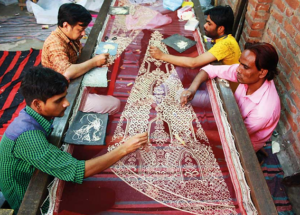
Figure 5: Karigars at work. Kaadambini. (https://share.google/Ds45tp6kydrSAGYp0)
BIBLIOGRAPHY & REFERENCES:
1.Bhandari, Vandana. 2014. Jewelled Textiles: Gold And Silver Embellished Cloth of India. Om Books International.
2. Mackie, Lousie W. 2002. Jewelled Islamic Textiles: Imperial Symbols. Textile Society of America Symposium Proceedings. DigitialCommons. University of Nebraska.
3. Raheja, Radhana and Simmi Bhagat. 2022. “Historic Indian Textiles of Gold And Silver”. Shodhkosh: Journal of Visual and Performing Arts 3(2). ((PDF) HISTORIC INDIAN TEXTILES OF GOLD AND SILVER)
4. Wheeler, Monroe (ed.). 1956. Textiles and Ornaments of India: A Selection of Designs. The Museum of Modern Art, New York.
5. The Artistic Prowess of Zardozi. Vogue India. (https://www.vogue.in/fashion/promotion/the-artistic-prowess-of-zardozi)
PHOTO CREDITS
1.Figure 1: Lady Holding a Sparkler. Paper. Mughal, c. 1660. National Museum, New Delhi. Wikimedia Commons. (https://commons.wikimedia.org/wiki/File:Lady_Holding_a_Sparkler.jpg)
2. Figure 2: Two zardozs (gold lace makers) at Delhi in India, taken by Shepherd & Robertson, c. 1863, Archaeological Survey of India Collections. Wikimedia Commons. (https://commons.wikimedia.org/wiki/File:Zunlozis,_Gold_lace_makers,_Delhi_1863.jpg)
3. Figure 3&4: Zari designs and motifs. The Design Cart. (https://thedesigncart.com/blogs/news/the-art-of-zari?srsltid=AfmBOoqQWUXH8rwwzpwyVZmNZDmbkye5yWpIJWbnbhnoE_ze8e7_N8Ws)
4. Figure 5: Karigars at work. Kaadambini. (https://share.google/Ds45tp6kydrSAGYp0)