

Gardens of the Djinn & Fortresses of the Devs: Medieval Haunted Literature of Delhi and Its Fantastical Imaginary
- June 12, 2026
:- by Ayush Tripathi
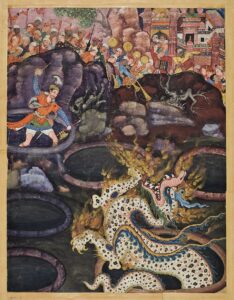
Painting from Akbar Hamzanama (by Daswanth)[Photo credits: Wikidata]
There is a unique quality to the literary imagination surrounding Delhi, or Dilli, or Shahjahanabad, depending on the name the city adopted in any century. This quality is about accumulation, where the past merges with the present, similar to one fort rising from the remnants of another. Delhi, in Mir Amman Dihlavi’s tender words, is the city where “the cord of my navel is buried.” It is the place where Amir Khusrau crafted his riddles and ghazals, where Nizamuddin Auliya healed the sick, and where the grand Mughal era eventually faded in the chaos of Ahmad Shah Durrani’s raids. Writing from Delhi, even in exile like Mir Amman, who created Bagh-o-Bahar in Calcutta, felt like being haunted.
The two texts we will explore are products of this shared culture of loss and endurance, though they are quite different in style. Bagh-o-Bahar (“Garden and Spring”), finished by Mir Amman Dihlavi in AH 1217/AD 1803 at Fort William College in Calcutta, is the Urdu translation and adaptation of the Qissa-e Chahar Darvesh (“Tale of Four Dervishes”), a Persian narrative tradition long linked to the Delhi poet Amir Khusrau (d. 1325), although scholars today believe it has a more complex and later origin. The Dastan-e Amir Hamza (“Adventures of Amir Hamza”), in its finalized Urdu version compiled by Ghalib Lakhnavi in 1855 and revised by Abdullah Bilgrami in 1871, presents quite a different story: a sprawling epic of several hundred thousand words rooted in the oral legend-cycles of Hamza ibn Abdul Muttalib, the uncle of Prophet Muhammad. Its true essence lies in the imaginative world of the dastan tradition, filled with peris and devs, tilism and ayyari, enchanted mountains, and fortresses controlled by demons. Yet both works belong to the same cultural framework: the Indo-Persian and Indo-Muslim literary civilization of the Mughal and post-Mughal Period, centered in Delhi and Lucknow, rich in ornate Persian prose and the supernatural realms of djinn, fate, and wonder.
To understand these texts historically reveals their haunting nature. Mir Amman came from a family of Mughal retainers tracing back to Humayun’s reign. He witnessed the Jat ruler Suraj Mal take over his family’s jagir (estate). He saw Ahmad Shah Durrani’s forces destroy his home. He left a Delhi that was already becoming a ruin and translated an ancient tale in a colonial college for a foreign audience. The sadness of this situation permeates Bagh-o-Bahar: a story about wandering princes who lost their kingdoms, about love snatched away by supernatural forces, about reunion made possible only through the help of djinn kings in a world ruled by fate and divine grace. Here, the fantastical is not merely an escape; it reflects historical mourning.
The Dastan-e Amir Hamza appears in a different time but carries its own weight of historical awareness. Its oral and literary peak in India coincides exactly with the height of Mughal imperial culture. Emperor Akbar, reportedly dyslexic as translator Musharraf Ali Farooqi notes, ordered an exquisite illustrated manuscript of the Hamza story, which court storytellers recited while Akbar and his courtiers admired the paintings. This commission, the famous Hamzanama manuscript now spread across museums from Vienna to New York, turned an oral epic into a grand imperial artwork; one of the most ambitious artistic initiatives in Mughal history, featuring around 1,400 large-format paintings on cotton fabric created over nearly fifteen years under master painters Mir Sayyid Ali and Abd as-Samad. As Hamid Dabashi has suggested, it resembled an early form of cinema: a multi-sensory court experience combining storytelling, visual spectacle, and performance.
In this historical context, it is significant that Emperor Muhammad Shah (r. 1719-1748), known as “Rangila” (the Colorful), is closely linked to the revival of dastan performance culture in Delhi. His court was well-known for supporting musicians, dancers, poets, and professional storytellers at a time when Mughal political power was rapidly declining. When Nader Shah Afshar attacked Delhi in 1739 and stole the Hamzanama manuscript among other treasures, he took not just artwork but a part of the empire’s mythology. That Muhammad Shah continued to support the dastan tradition after the Persian invasion and the theft of the Peacock Throne and the Koh-i-Noor diamond was not just about cultural continuity. It was a defiant statement, showing that the imaginative life of an empire could endure despite the loss of its material foundations. The joys of the Hamza narrative, in this context, are intertwined with the anxieties of an empire facing its disintegration. The text serves as a form of cultural mourning disguised as triumph.
Haunted Frame: The Graveyard, the Lamp and the Four Dervishes
The opening of Bagh-o-Bahar is one of the most evocative passages in classical Urdu literature. Its setting, a cemetery at night during a storm, sets the tone for the entire work. King Azad Bakht of Turkey, mourning the absence of a son, ventures out in disguise late at night to pray at graves. “A mighty storm broke out just then,” writes Mir Amman, “Roaring, violent winds began to blow all around.” Yet the king notices a flame at a distance in the cemetery, miraculously unextinguished: “bright like a morning star in that cemetery.” He wonders: “Is it a talisman? Or has someone sprinkled alum and brimstone around its wick to sustain it? Or is it some holy spirit which makes it burn?”
The king approaches cautiously, first ensuring that the four figures he sees, “sitting quietly against each other with their heads on their knees… like dead figures on the wall“, are not evil spirits in disguise. He hides to observe. The earthen lamp on the stone burns “as though shaded by the heavens.” The figures look “all wearing the dress of the dead.” This masterful buildup creates a haunting atmosphere: a graveyard, a storm, an unexplained flame, and eerily still figures. The entire scene exists between the realms of the living and the dead, the natural and the supernatural.
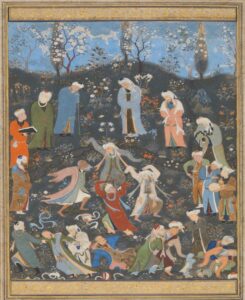
Dancing Dervishes from the divan of Hafiz, attributed to painter Bihzad Iranian [Photo credits: The Metropolitan Museum of Art]
When one of the dervishes sneezes and proclaims “Praise be to God!” the mood shifts. This moment is important: the sneeze and the invocation of God confirm that these are indeed living people and not spirits. The supernatural is both acknowledged and dismissed. However, the setting retains its eerie quality
throughout the narrative. We remain in a world of the extraordinary, of wandering princes, of divine guidance and supernatural help, even if the active players are human. The text acts as a spiritual talisman. As Mir Amman explains in the prologue, the tale was first told by Amir Khusrau to entertain his ailing spiritual master Nizamuddin Auliya at his residence “near Lal Bangla, beyond the Matia Darwaza outside the Lal Darwaza, about three miles away from the Fort.” When Nizamuddin recovered, he offered a blessing: “Whoever hears this tale, will, by the grace of God, remain in health.” The text has a healing purpose from its very beginning, making the supernatural more than just entertainment.
The lamp that shines through the storm is a common folklore motif (Stith Thompson motif F960.1, “extraordinary natural phenomenon as omen or sign”), but in its specific Indic-Islamic context here, it carries the added meaning of the chirag: the lamp of the shrine, signifying a saint’s presence. The miraculous flame appearing in a graveyard aligns with the Sufi tradition of visiting graves (ziyarat) as a devotional practice, deeply connected to Delhi’s landscape, which was filled with the tombs of saints and emperors that served as sites of pilgrimage and supernatural encounters.
The First Dervish and the Princess of Damascus: Wounded Women and the Politics of Secrecy
The First Dervish’s tale begins in the bazaar of Yemen, travels through Damascus, and ends (for now) in the wilderness of an unnamed country. Its supernatural elements are more subtle than those in later tales, but they are equally skillfully crafted. The most dramatically haunted moment is when the princess of Damascus is discovered in a wooden chest lowered over the city wall.
“It was a wooden chest,” the First Dervish recounts, “When I opened it, I couldn’t believe my eyes. There lay a beautiful woman. She was wounded, and the blood on her clothes was still fresh. Her eyes were closed, and her face showed she was in intense pain.” She speaks to an unseen attacker: “O cruel wretch, is this how you repay my kindness and care? Then go ahead and strike me again.” The First Dervish is shocked, “I found myself wondering aloud, ‘I cannot fathom who could think to harm such a lovely lady.‘”
The wooden chest is a substitute for a coffin; the would-be murderer treated her as if she were dead and discarded her like a corpse. Her recovery over forty days under the care of the barber-surgeon Eisa; through stitching, washing with neem-water, chicken soup, and musk-water; gives her a new life, complete with the “bath of health” (ghusl-e sihat) marking her return from death’s brink. The number forty is significant in Islamic and broader Middle Eastern mystical traditions: forty days of fasting summon the djinn, forty days of mourning honor the dead, and forty days signify the healing of the living.
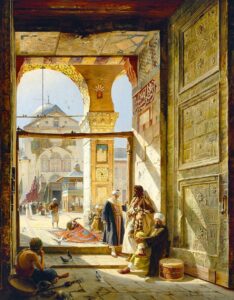
Gustav Bauernfeind’s painting by the gate of the Great Umayyad Mosque of Damascus [Photo credits: Wikimedia Commons]
When the princess finally reveals she is the daughter of the king of Damascus, her eight-day silence before sharing her story is like another burial: a hidden truth waiting to be unearthed. This follows the “interdiction violated” and “revelation of secret” pattern (Thompson K1011), but with an intriguing twist: the woman holds the secret, while the man must wait for her to share it. The text suggests that this patience is a moral virtue, similar to the patience required by divine will.
The most shocking part of the princess’s tale is the execution scene: after the young man and his lover have been drugged and fall unconscious, the princess orders, “Cut off their heads.” The woman guard then draws her sword and beheads them, leaving their bodies lying in blood. This is a princess commanding an execution, using her female guards as instruments of divine justice. Mir Amman does not preach about the violence; he presents it as the inevitable result of betrayal, as natural as gravity.
The veil the princess wore when the First Dervish found her, along with her command to him “never meddle in my business,” sets a pattern of female knowledge hidden from male understanding throughout Bagh-o-Bahar. Women in this story hold secrets that men cannot access without consent. The supernatural also represents a world of hidden information that can only be revealed through patience, virtue, and divine help.
The Second Dervish, Prince Neemroz and the peri on a Jewelled Throne
The Second Dervish’s tale is the most complex supernatural story in Bagh-o-Bahar, providing the text’s most detailed description of the peri world and djinn-summoning. The prince of Neemroz is confined as an infant because his horoscope predicts madness if he sees the sun or moon before he turns fourteen. He grows up in “a palace underground, bright and well-ventilated but covered with thick felt.” This underground life, a form of living burial, prepares him for a supernatural encounter.
“I saw a throne covered in jewels,” the prince later describes, “raised on the shoulders of fairies. A fairy, dressed elegantly in shiny clothes and with a jeweled crown, was sitting on it.” The throne descends through the felt dome of his underground garden palace, breaking through the protective cover of his confinement. The image of the peri descending on her jeweled throne is one of Bagh-o-Bahar’s most striking: a celestial being entering an earthly space, the invisible world breaking through into the sealed human realm.
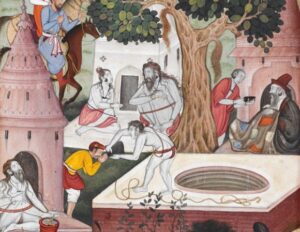
Painting depicting Jogis by Kesu Khurd from the ‘Baburnamah’, 1590-92 (British Library Or.3714, f.320v)
The prince soon becomes fixated on the fairy. He leaves his underground palace, travels to India to meet a holy man (a jogi-gusa’in) during the festival of Shivratri, and obtains a book about “the Great Name of God and the various ways to worship and pray to summon the djinn, fairies, and spirits, as well as control the sun.” This acquisition represents the text’s clearest exploration of magical knowledge as a form of technology. It is not forbidden knowledge but divine knowledge, discovered by chance on a shelf left by the jogi and gained through the prince’s legitimate spiritual journey.
After forty days of fasting and prayer, the djinn king Malik Sadiq appears, ready to grant the prince his wish: a meeting with the fairy. But when the prince tries to bring the union to fruition, “a djinn with evil intentions against me stole my book.” At that moment, the fairy disappears, the djinn is transformed into a bull by the prince’s lingering incantations, and the fairy remains unconscious, lost in the unseen world.
The prince’s punishment is cyclical and public: each month, on the first day of the lunar calendar, he rides his bull through the gathered crowd (all dressed in mourning black), breaks an emerald vase, and kills a servant. “I ask forgiveness from God,” he admits, “but this is what I must do; it happens on its own.” The repetitive nature of this act; publicly displaying grief, destroying beauty and killing the innocent; embodies the structure of trauma manifested in society. In Proppian terms, this reflects the “lack” (the missing magical object and person) combined with the “interdiction violated” motif (Thompson A2191), creating a curse that can only be lifted by outside narrative intervention.
The prince’s transformation of the enemy djinn into a bull presents a remarkable twist: instead of the enemy causing the transformation (Thompson D620, “transformation as revenge”), the victim has inadvertently turned his own enemy into the instrument of his public sorrow. The bull represents both the imprisoned enemy and the vehicle of punishment; the prince traverses the city on his own tormentor each month, turning his private pain into a public display.
Khwaja the Dog-Worshipper: The Dog, Solomon’s Prison and the Faithful Animal
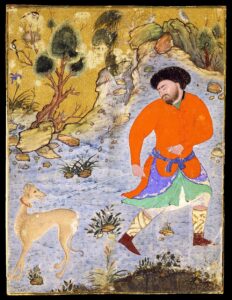
16th century painting depicting man with Saluki (Persian hound) [Photo credits: Wikimedia Commons]
The embedded story of Khwaja the Dog-Worshipper, within the Second Dervish’s narrative, is one of Bagh-o-Bahar’s most thorough explorations of supernatural suffering. Its central theme; a man kept alive in a pit through a dog’s loyalty; compresses the Job narrative into a folktale format and deserves closer examination.
The Khwaja, the youngest of three merchant brothers who have repeatedly tried to kill him, finds himself trapped in Solomon’s Prison: “a mountain about two miles away from the city where a djinn dug a dark, narrow well in the time of Solomon.” This setting is rich in supernatural history. The well was created by a djinn under Solomon’s order, placing it within a cosmic framework where djinn labor and human kingship intertwine. It exists as a supernatural space that continues to entrap and isolate.
In this pit, the Khwaja’s dog saves him in a series of actions that Mir Amman describes with great detail and emotion: “It went to the city where fresh loaves of milk-bread were always piled up at the bakers. Grabbing one in its mouth, it ran away. People chased it, throwing stones, but it outran them. When city dogs attacked, it fought them all, saving the bread for me. When it dropped the bread into the well, it barked.” The dog then sought water, discovered an old woman’s pots, broke them trying to carry them, and then rolled on the ground before her, “rubbing its muzzle on her feet and wagging its tail. Frantically, it ran toward the mountain and then back to her, pulling at her dress. By God’s grace, that kind woman understood what the dog wanted and followed it with a bucket of water.”
This passage represents one of the great animal narratives in Urdu literature. The dog skillfully expresses need, translating the trapped Khwaja’s hunger into gestures that communicate well. The dog acts as a bridge between the world of the living and the buried world, serving a role similar to the mystical guide (Khizr) in other tales: a supernatural helper appearing in moments of deep human helplessness.
The moral point, made explicit by the Khwaja himself when he finally tells his story before the king: “An ungrateful man is worse than a faithful animal.” The dog, ritually impure in Islamic law, becomes the embodiment of the highest Islamic virtue: faithfulness (wafa). This is a deliberate inversion, using the most humble and legally problematic creature to shame the morally elevated (the brothers) through contrast. Thompson motif B331 (helpful animal kept as reward for gratitude) applies, but the Bagh-o-Bahar reversal is more radical: the dog receives no reward and seeks none, acting purely from love.
The rescue from Solomon’s Prison, a rope descending in the night, an unknown benefactor pulling the Khwaja out and the discovery that the rescuer intended to free someone else; is a masterpiece of providential comedy. The misidentified rescuer “bit one of his fingers with his teeth in anguish… and suddenly charged at me but I parried his thrust by falling from my horse.” The rescuer who liberates the wrong man, and then attempts to kill the accidentally liberated victim, and is then persuaded to mercy by the victim’s eloquent plea — this is providence wearing the face of accident, divine design disguised as human error.
The Merchant’s Son of Azerbaijan: The Idol, the Living Dead and the City of the Accursed
The most Gothic episode in all of Bagh-o-Bahar is the Merchant’s Son of Azerbaijan’s story, embedded within Khwaja’s tale: a young man shipwrecked, cast up on strange shores, entering a city where the living are buried with the dead. This constitutes the text’s most sustained exploration of the haunted space between life and death.
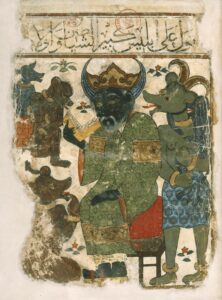
Paintings of Satan: Iblis the Demon, from Kitāb al-mawālīd (‘The Book of Nativities’), 7th century AH/13th century CE. peris, Bibliothèque nationale de France, Arabe 2583, folio 2r. Müller und Schindler.
The city the young merchant stumbles into is controlled by an idol that speaks: “From inside the idol, Satan himself tells the name and religion of every visitor.” The idol functions as a supernatural surveillance mechanism, a divine panopticon managed by the wrong deity. The young man is forced to prostrate before the idol, is given a wife, enjoys prosperity, and then watches her die in childbirth. At this point the text enters its most genuinely uncanny territory.
The custom of the city requires that the surviving spouse be buried alive with the dead: “They put each of them in a chest. In another chest they kept bread, sweetmeats, meat preparations, dry and green fruits and other eatables. The dead body of my wife was put in another chest. Both the chests were hung across a camel and they mounted me on it and put the box of precious stones in my lap.” The procession through the city, the priests singing hymns, the guard weeping, the sealed stone gate: this is a living burial described with the precision of ritual.
Inside the sealed fort, the young man discovers he is not alone: there are bones, boxes of jewels belonging to the previously buried, and two other survivors. “I found a tiny streak of water flowing out of a pot-like mouth in the cut out stones of the wall.” He survives on provisions, and then, when a new corpse and new companion are delivered through the gate, does the unthinkable: “I went up to him and gave him such a blow on his head that his brains spilled and he died at once. I took his provisions and lived on them. Thereafter, it became my practice to kill the living person who accompanied each coffin.”
Mir Amman narrates this without moral judgment. The merchant kills to survive, and the text accepts this as an extreme expression of the survival instinct. When a beautiful girl is delivered with a coffin, “I did not have the heart to kill her“; the conventional emotional brake and erotic attraction reasserts itself. He teaches her Islam, marries her, and they have a son. Escape comes through a dream: “a person in my dream saying to me, ‘If you want to get out from this place, get out through the drain.'” One year of enlarging the drain with iron rods and stones, and they emerge, blinking, into the light.
This episode has structural parallels with the motif of the hero in the belly of the whale (Jonah/Yunus in the Quran), the descent into the underworld (Orpheus) and the harrowing of hell. The sealed fort is simultaneously tomb, womb, and prison: the hero must survive a kind of death (entombment with the dead) to be reborn into a larger life. That this rebirth is enabled by a dream (divine guidance penetrating even the sealed world of the fort) confirms the text’s theological claim that providence is always present, always accessible, even in the most extreme situations of apparent abandonment.
The Stone Woman and the Third Dervish: Eros, Idolatry and Petrified Desire
The Third Dervish’s embedded tale of Nu’man the Merchant provides Bagh-o-Bahar with one of its most powerful supernatural images: a beautiful woman who has been turned to stone. The old hermit Nu’man has failed to save his beloved princess from the Farangi king who imprisoned her lover; unable to rescue her or avenge her, he has built her statue and retreated to worship it in the wilderness.
“I touched her feet,” the Third Dervish narrates, “and found them quite hard. I realized then that all that she was formed out of was stone, as if Azar the idol-maker had made her.” The comparison to Azar is deliberate and charged: Azar is Abraham’s father, the maker of idols whose devotion to false gods Abraham renounced. By comparing Nu’man’s stone woman to an idol made by Azar, Mir Amman both aestheticizes and morally indicates the old man’s obsession. The stone woman is literally an idol, an object of unlawful worship that has replaced the living beloved.
The Third Dervish’s own response to the stone woman is equally indicted: “I said to the old man, the idol-worshipper, ‘I struck an arrow into your deer’s leg but you have planted in my heart the dart of love.'” He has seen only a stone effigy and already feels erotic fascination. He abandons his princedom, travels to Farang in search of the living princess who inspired the statue, and eventually succeeds in reaching her and living with her in a brave soldier’s house for six months. Their escape, the princess’s drowning, the Third Dervish’s suicidal despair, and the appearance of the veiled rider (Murtaza Ali) form the trajectory from which the narrative delivers him to Istanbul and the graveyard meeting.
What the stone woman episode adds to the text’s supernatural imagination is a meditation on the relationship between representation and reality, between the image of the beloved and the beloved herself. Nu’man worships a stone because the living woman is unavailable. The Third Dervish falls in love with a stone woman and must travel to find the living original. Both are caught in the trap of mediated desire: loving a representation rather than a presence. The supernatural resolution, reunion with the living beloved through the intercession of Malik Shahbal, replaces the representation with reality, the stone with flesh and the image with the living body.
The Fourth Dervish, the Monkey-Figurines and the Kingdom Beneath the Carpet
The Fourth Dervish’s tale is the Bagh-o-Bahar’s most explicitly supernatural in its mechanisms, involving djinn kings, magical figurines, and a kingdom hidden beneath an emperor’s carpet. The prince of China, learning from the faithful slave Mubarak that his treacherous uncle intends to kill him, discovers beneath the carpet of his father’s private room a trapdoor and a world of accumulated magical wealth: thirty-nine vases of gold suspended by chains in four underground rooms, each surmounted by a golden brick and a monkey-figurine of precious stones.
Mubarak explains the figurines’ history with characteristic dastan precision: “The figurines of monkeys you see here have a story behind them. In his youth your father had made friends with Malik Sadiq, the king of the djinn and they used to visit each other. Once a year your father paid him a visit and stayed with him for a month… each time he took his leave, Malik Sadiq used to give him the figurine of a monkey studded with precious stones.” Each figurine commands a thousand powerful demons. But forty are required to activate their power: “Only one monkey-figurine more was all that was needed when the king passed away.” The incomplete collection is a perfect emblem of frustrated purpose: vast power accumulated but one unit short of activation.
Mubarak applies “a little solomon-collyrium” to the Fourth Dervish’s eyelids, and the invisible world of Malik Sadiq’s court is suddenly revealed: “I could see the djinn and his people and the tents. All the djinn were good-looking and well-dressed. Recognizing Mubarak, they all embraced him and looked happy to see him there.” This transition from the invisible to the visible world through a pharmacological application is the text’s most compressed articulation of the dastan’s supernatural epistemology: the invisible world is co-present with the human one, accessible through the right kind of perception.
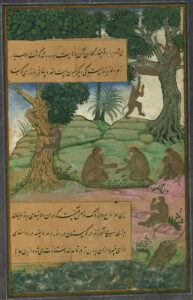
Animals of Hindustan monkeys called bandar that can be taught to do tricks, from Illuminated manuscript Baburnama (Memoirs of Babur)[Photo credits: Wikimedia Commons]
Malik Sadiq’s court, when revealed, resembles the Mughal darbar. A throne full of precious stones stands at the center. Malik Sadiq, the king of the djinn, lounges there on cushions. He wears a crown and a dress made of pearls. The supernatural kingdom mirrors the political structures of the human world on a grand scale. When Malik Sadiq asks the Fourth Dervish to locate the woman represented in a portrait, he acts like a Mughal emperor sending a diplomatic mission: a prince sent abroad to fulfill the sovereign’s wishes. The supernatural and political realms are structurally the same.
The climax of the Fourth Dervish’s story, when he stabs Malik Sadiq and the djinn king rolls into a ball to soar into the sky before returning to kick the prince into an unnamed wilderness, is the most humorous supernatural moment in the text. Even the powerful king of the djinn faces humiliation when human desire disrupts cosmic order.
Alqash, Bagh-e Bedad and Murder : Hamzanama’s Opening World:
Shifting from the intimate, chamber-scale fantasy of Bagh-o-Bahar to the Dastan-e Amir Hamza feels like moving from a walled garden to an endless continent. Before we meet Hamza, the Hamzanama requires us to understand the cosmic reasons for evil that his birth is meant to address. The opening tale of Alqash and Khwaja Bakht Jamal clearly sets these conditions.
Emperor Qubad Kamran rules at Ctesiphon, where he is noted for dispensing justice, allowing “the hawk and the sparrow to roost in the same nest.” Into this just kingdom enter two friends: merchant Khwaja Bakht Jamal and Alqash, the emperor’s vizier. When Khwaja finds Shaddad’s buried treasure beneath a ruin, he immediately informs Alqash instead of taking it for himself. Alqash’s reaction defines the Hamzanama’s main moral issue: “the thought suddenly flashed across Alqash’s mind that Khwaja Bakht Jamal was aware of this secret.” Fearing betrayal, Alqash kills his benefactor with an “unrelenting dagger” and buries him in the very vault that contains the treasure.
He then builds a garden over the murder site called Bagh-e Bedad (Garden of Injustice). This garden is described in one of Hamzanama’s most vibrant passages, filled with an array of flowers, including tulips, violets, calendulas, and many others. This beautiful garden is founded on murder. It’s the place where beauty hides crime. The moral world of the Hamzanama is established in this contrast, as the most elaborate garden is also a graveyard.
Within Bagh-e Bedad is Bagh-e Hasht Bahisht (Garden of Eight Paradises), located at its center, resembling a precious stone in a ring. Evil contains an image of paradise at its core. This is not irony; it reflects moral structure. The most beautiful things are built on the worst foundations, and only the birth of a hero (Hamza, yet unborn) can reveal and eliminate the crime beneath the splendor.
Buzurjmehr: The Omniscient Child
The first supernatural hero of the Hamzanama is not Hamza, but the boy Buzurjmehr, born to Khwaja’s wife after his death. He reads a book left in his father’s house, which clearly holds occult knowledge, and quickly gains complete understanding. “I have learned all that has gone before and all that shall come to pass. I cried to learn that the vizier Alqash killed my innocent father, and that his body still lies above the ground, awaiting last rites. And I laughed upon knowing that I will avenge my father’s blood and become our emperor’s vizier.”
This reflects Hamzanama’s hallmark: the all-knowing child who sees through appearances to the truth underneath. Buzurjmehr uses this supernatural knowledge in a series of everyday situations: he threatens the grocer with knowledge of poison, the butcher with a buried murder, and the jeweler with similar secrets. His understanding of hidden crimes serves as both his supernatural ability and social tool.
One impressive use of this power occurs when he recounts Emperor Qubad Kamran’s forgotten dream: “Your Majesty dreamt that forty-one dishes of all sorts were laid out. You took a piece of halva from one dish when a black dog lunged forward, snatched it from your hand, and devoured it. Your Highness was startled and forgot the dream.” The interpretation is that the black dog is Alqash, who has taken the king’s treasure before he could claim it. Recounting a person’s forgotten dream showcases supernatural power at its purest; complete access to another’s unconscious.
The episode concerning the conveyances is noteworthy: when the emperor calls Buzurjmehr, the boy refuses the horse (Wind and clay are manifest opposites), the elephant (reserved for the emperor), the litter (for the sick or dead), the camel (too lofty for a mortal), the mule (illegitimate), the ox (for corn-chandlers) and the ass (for the guilty). He chooses only to ride Alqash himself: “For, as the saying goes, everyone tends toward his own. I will ride him and present myself before His Majesty to describe his dream in full.” This represents trickster logic elevated to cosmic humor: the only appropriate vehicle for the seeker of justice is the embodiment of injustice itself.
The Birth of Hamza, Amar and Muqbil: Prophecy, Destiny and the Supernatural Nursery
The birth sequences of the Hamzanama’s three main figures present one of the text’s most elaborate prophetic narratives: three births occurring in quick succession, each laced with supernatural significance, each declaring its fictional character’s destiny with striking accuracy.
Hamza’s birth is announced in the djinn world before it happens among humans. Emperor Shahpal of Mount Qaf learns from his vizier Abdur Rahman that a human will come from Arabia to subdue the rebellious djinn of Qaf and asks: “Is that boy born yet?” Abdur Rahman casts his dice and responds, “In Arabia, there is a city called Mecca. He is the son of its chieftain, and today marks the sixth day since his birth. He has been named Hamza, and today his father has sent his cradle to the roof of his house.” Shahpal then instructs four perizads to bring the cradle and present this bliss before him.
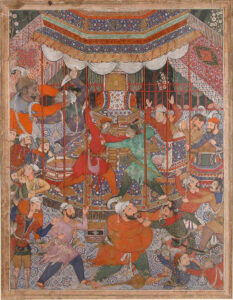
Painting depicting Hamza and his heroes fighting (attributed to Shravana, Daswanth and Tara)[Photo credits: The Metropolitan Museum of Art]
What follows is one of Hamzanama’s most tender supernatural moments: baby Hamza is brought to the court of Mount Qaf while his parents believe he is lost. “The emperor lifted Hamza from his cradle, kissed his forehead, and had his eyes lined with the collyrium of Suleiman.” Then, peris, devs, and djinn nurse the infant: “He had Hamza nursed by devs, peris, jinns, ghols, lions, and panthers for seven days.” The baby is both a human child and a supernatural crown prince, embodying two worlds.
The vizier Abdur Rahman then proclaims, “My knowledge of ramal tells me that Aasman peri shall be betrothed to this boy, and the union of man and wife shall bind the son of Aadam and the daughter of Jan.” The central supernatural love story of the Hamzanama is thus foretold before Hamza leaves his cradle. When Shahpal places him in a new jeweled cradle, “legs and poles made of emerald, and side pieces of ruby”, and adorns it with “several shining carbuncles,” he treats the baby as he would a son, forming supernatural bonds that will shape the narrative for eighteen years.
Amar Ayyar’s birth is humorously told in true Hamzanama style. Umayya, eager to claim the reward for the firstborn boy, kicks his wife in the abdomen out of impatience, causing a premature delivery. Buzurjmehr looks at the baby and laughs: “This boy will be the prince of all tricksters, unmatched in cunning, deceit, and guile. Great kings and champions of Rustam and Nariman will tremble at his name. He will seize hundreds, even thousands of castles alone and defeat vast armies single-handedly. He will be greedy, crafty, and a seasoned liar. He will be cruel, tyrannical, and cold-hearted, yet he will also be a loyal friend and confidant to Hamza.” Amar’s character is a mix of contradictions: cruel yet trustworthy, a liar yet dependable. The Hamzanama avoids simplistic moral categories in defining heroism.
The infant Amar quickly reveals his nature by taking Buzurjmehr’s ring off his finger and hiding it in his mouth. When the sherbet is served and Amar is offered a drink, the ring falls out. Buzurjmehr says nothing because he already knew.
Hamza’s Early Adventures: The Tamed Horse, the Prophet’s Arms and the Lion-Robber
Hamza’s childhood stories establish the Hamzanama’s heroic template: great strength used for justice, supernatural help shown through discovered objects, and the steady conversion of enemies into allies. The horse Siyah Qitas, the demon-steed of Prophet Ishaq, arrives at the merchant’s caravan heavily restrained with chains instead of ropes, a muzzle over its face, blinders on its eyes, and iron shackles instead of front and heel ropes. When Hamza mounts it, the horse runs for ten leagues without Hamza able to stop it, while Amar runs behind on foot until the soles of his feet become sore from thorns. This wild ride is like Arthur pulling the sword from the stone: the destined hero shown by the supernatural object’s submission to him.
At the end of this ride, the veiled rider appears, the angel Jibrail, and gives Hamza a reliquary of prophetic arms. This includes the vest of Ismail, the helmet of Hud, the chain mail of Daud, the arm guard of Yusuf, the ankle guards of Saleh, the cummerbund and dagger of Rustam, the swords Samsam and Qumqam of Barkhia, the shield of Garshasp, the mace of Sam bin Nariman, the scimitar of Sohrab, and the lance of Nuh. This is not just a list of weapons but a brief sacred history of heroism: every prophetic and legendary warrior of the Islamic-Persian tradition, with their armor now passed to Hamza as the heir to all their virtues.
Meanwhile, Khizr appears to the tired Amar and offers him a bread-cake. Amar, hungry and angry, protests: “How can I eat my fill with this bread-cake?” Khizr replies patiently, “Start eating in good faith, and then you can judge for yourself.” The bread-cake turns out to be endless; so does the small water flask Khizr gives him. Amar tries to keep both, saying, “Once you are gone, I see no reason why you should return!” Khizr agrees, gives him the objects, and also the Timbal of Sikander to deliver to Hamza. Amar’s receipt of supernatural gifts through cheek rather than reverence shows that the trickster’s path to the supernatural is just as valid as the warrior’s.
At age seven, Hamza’s first act of heroic justice occurs in a bazaar: Suhail Yemeni’s deputies are violently collecting tribute from shopkeepers, hitting them and treating them poorly. Hamza orders Amar and Muqbil to stop them. When they are ignored, he punishes some of the deputies severely, breaking their arms and legs and cracking their skulls. The King of Yemen sends forces against this seven-year-old boy and his two companions. Hamza defeats them, and the king ultimately converts to Islam and gives Hamza the title of Amir. This pattern will repeat across thousands of pages: confrontation, combat, conversion, alliance. The Hamzanama’s supernatural imagination supports this political and theological mission.
The story of Tauq bin Heyran, the robber who keeps a lion chained beside him on the road to Yemen, captures the hero’s moral code. Tauq sits in the road and explains, “Whenever someone passes by, I let my lion loose at him. After the lion kills him, I take his goods and sell them.” When Hamza spears the lion in one stroke and throws the robber down, then gently helps him back to his feet when he begs for mercy, the conversion scene is the Hamzanama in miniature: confrontation, defeat, mercy, conversion, alliance. Every enemy can become a companion if properly defeated and shown mercy.
Naushervan the Just & Owls Uttering Words of Wisdom
One of the most memorable supernatural episodes in the Hamzanama involves no magic, or rather, the magic of language. Buzurjmehr translates the conversation of two owls discussing their children’s marriage, and his translation humiliates the emperor into justice. He tells Naushervan, “The boy’s parents will not agree unless the girl’s parents give three wastelands in her daughter’s dowry. The girl’s parent replies that if Naushervan continues in his cruel and daring ways, she would offer her whole empire, not just three wastelands, as a bridal gift.”
Naushervan’s reaction marks one of the rare moments of true moral growth: “Our tyranny has become so widespread that even the animals know of our injustice!” He sheds many tears of remorse, feeling ashamed of his wicked deeds. The result is the Bell of Justice, a bell in the Court of Justice that anyone could ring without announcement or mediation, bypassing all courtly barriers. From that day forward, Naushervan’s justice became legendary, and he is remembered as Naushervan the Just by all.
In Islamic tradition, understanding animal speech is a prophetic gift; Solomon spoke the language of birds, as the Quran states. By giving this ability to Buzurjmehr in a secular context, the Hamzanama claims a form of prophetic intelligence for its clever vizier. The owl conversation is supernatural not because owls usually discuss marriages, but because a human can understand the moral lessons in animal behavior and translate them into political reform.
Amar Ayyar : The Transgressive Trickster, The Zambil and Carnivalesque Humiliation
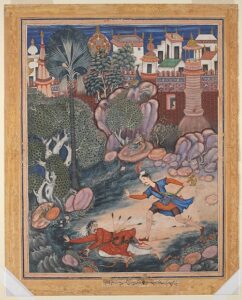
Painting depicting Amar Ayyar [Photo credits: Wikimedia Commons]
Amar Ayyar is Hamzanama’s greatest character and its most subversive force. Where Hamza embodies the heroic ideal of strength, courage, loyalty, and devotion, Amar represents everything that idealism generally overlooks: cunning, dishonesty, appetite, and transgression. His antics provide the most substantial folk-comic content in the Hamzanama, built around what Mikhail Bakhtin calls “grotesque realism,” which emphasizes bodily functions, desire, and inverted hierarchies.
His childhood pranks at the academy set the template: selling the mulla’s turban for sweets and poisoning the mulla with croton oil so he spends the day rushing to the toilet; hiding needles under the mulla’s mattress; arranging a scene in which Abu Jahal’s ring appears on the mulla’s daughter as proof of an affair; drugging everyone with black poppy and then positioning them in sexually compromising ways while they are unconscious. These pranks expose hidden corruption: the grocer who poisons a farmer, the butcher who kills a shepherd, the mulla who steals from his students. Amar’s trickery reveals the truth. He becomes a transgressive truth-teller.
His zambil, the seemingly bottomless bag of tricks from which he can produce disguises, drugs, weapons, food, and stolen goods, is key to his trickster identity. In one of Hamzanama’s most outrageous episodes, Amar drugs the entire court of Naushervan with wine mixed with narcotics. He loots the pavilion and fills his zambil until even the last carpet is stuffed inside. He shaves Naushervan’s beard with his urine, dyes his hands and feet with indigo, blackens his face with lime, and then creates a situation that has audiences roaring: he positions Bakhtak and Bakhtiarak, father and son, in a scenario of involuntary incest, greasing Bakhtak and partially inserting him into his son’s body.
The morning scene, when the drugs wear off, unfolds as a series of unintentional revelations. Bakhtak, still dazed, feels his erection and pushes deeper, thinking he is with a woman. Bakhtiarak feels his rear tearing and shouts, “For shame! For shame! How can you act this way toward me when you are my father?” This scene represents the extreme of carnival humiliation: the high brought low, with patriarchal authority symbolized as sexual violation of one’s own child. The note Amar ties around Naushervan’s neck adds to the humiliation: “O fire worshipper! Make sure to send me the monthly tribute of your beard and whiskers and do as I order you.”
This episode has strong ties to the folk-comic tradition described by Bakhtin. It highlights the temporary suspension of hierarchy and reveals powerful figures as mere bodies driven by desires and indignities. The emperor, who used his authority to hunt and harm Hamza, becomes a source of physical comedy. His dignity isn’t destroyed; instead, it is shown to be constructed, temporary, and reliant on gravity, which Amar’s actions make impossible to sustain.
The Dev, the peri and the Cosmology of Mount Qaf
The supernatural world in the Hamzanama is incredibly varied. Its array of creatures deserves detailed study. The main categories include devs, peris, ghouls and a wide range of hybrid beings such as Shutar-Pas (“Camel-Foot”), Gao-Sars (“Cow-Head”) and Gosh-Pas (“Ear-Foot”) that inhabit the distant areas of Mount Qaf. The devs are the most psychologically intricate supernatural beings in the text. They are giants, hideous in appearance, and can wield tree trunks as weapons (like Kharchal and Kharpal using box trees). However, they can also show loyalty, experience pride, and even convert. When Hamza defeats Kharchal and threatens Kharpal with death, Kharpal vows, “If you spare my life, I will serve you faithfully and never go against your wishes.” Hamza lets him go, believing that a defeated enemy who changes their ways deserves mercy. The devs are not inherently evil; their “infidel” label is more political than metaphysical, with conversion resolving their status.
The dev Arnais exemplifies these themes well. After he agrees to carry Hamza back from Qaf, Hamza ties him to a tree, following Khizr’s advice to never trust a dev. Arnais’s inner thoughts reveal his wounded sense of dignity: “In Qaf, I claimed the status of a god, but the one who persuaded me to give it up considers me so untrustworthy that he tied me to this tree and then fell asleep. He shows no regard for my suffering and offers me no mercy.” Arnais then flies away, tree in tow, leaving Hamza stranded in the desert. The dev is not malicious but feels insulted, and his response to this disrespect is to abandon rather than harm. This adds depth to the psychology of the devs, making them more than just demonic figures.
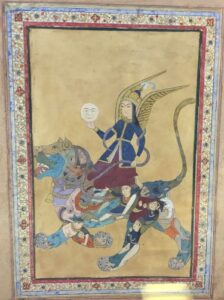
Painting depicting peri (fairy)[Photo credits: Yerevan Manuscript Museum]
Aasman peri (Sky-Fairy), Hamza’s supernatural wife and the queen of Qaf, represents another side of the supernatural feminine. She is proud, can be cruel, and embodies a celestial erotic power that also reflects sovereignty. When Hamza finally finds Mehr-Nigar in the human world, Aasman peri stands at the seven doors of the women’s quarters. She demands a toll at each door before Hamza can enter. “At one door, she asks for Muqbil Vafadar and forty thousand slaves; at another, she wants Hamza’s sword, the Aqrab-e Suleimani, and his horse Siyah Qitas.” The negotiations at the seven doors condense the whole courtship story. Aasman peri acts both as a gatekeeper and an obstacle, illustrating the complex view of supernatural femininity in both texts. She is both a queen and a wife; her love and authority are intertwined.
The horse Ashqar, Hamza’s magical steed (the offspring of a djinn horse), is another being from the invisible world. “Hamza told Amar, ‘He is my horse. Go tell him, O son of Arnais and Laneesa, the Sahibgiran has sent for you, and you have come as my loyal servant to bring him to me. He will follow you right away.‘” This horse understands human speech and reacts to the proper respectful address. Here, the familiar becomes strange, as the natural world is revealed to have hidden supernatural elements.
The Tilism: Universe of Magic & Mystery
The tilism is the Dastan-e Amir Hamza’s most unique supernatural idea. It is a self-contained magical universe, usually a large fortified area where a sorcerer connects their life force to a talisman or mechanism. The tilism narratively functions like a complex dungeon: it has layers of increasing challenges, filled with traps, inhabited by conjured demons and automatic defenses, requiring both bravery and cleverness to navigate.
A key example is the tilism of Ifrit’s mother, Maloona Jadu. When Hamza comes down from the mountain to reach Shehristan-e Zarrin, he gets “surrounded by such dark that even the darkness of the Shab-e Yalda seems bright in comparison.” He climbs up, and the darkness lifts. When he descends, it returns. “These wonders are due to the tilisms created by Ifrit’s mother, Maloona Jadu,” the perizads explain, “which stretch from here to her castle.” The tilism is not just a physical challenge but a barrier to understanding, blinding any approach before a battle can even start.
The help that rescues Hamza comes from a heavenly messenger. “Amir stopped and saw Salasal perizad appear. He greeted Amir and handed him an emerald tablet with the names of God, saying, ‘Abdur Rahman sent this tablet for you and instructed you not to move without consulting it first.'” The emerald tablet carries divine names and acts as a counter-tilism: a portable divine text that neutralizes the sorceress’s spatial magic. The names of God override Maloona Jadu’s enchantments.
The connection between the tilism and the city of Delhi is significant. Delhi’s seven cities, each layer reflecting the power of a dynasty that built them only to be consumed by them, can be viewed as an historical tilism. When Mir Amman writes from his exile in Calcutta about the city where “five to ten generations of his family have lived” and which has been “plundered” by Durrani invaders, he describes it as a tragic tilism. Here, the talisman of Mughal power is broken, releasing not wealth but devastation.
Immortal who drank from the Water of Life
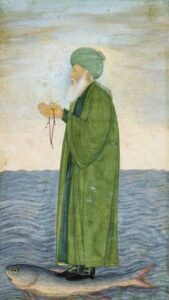
Painting depicting Pir Khizra [Photo credits: Wikimedia Commons]
The prophet Khizr, the immortal guide who drank from the Water of Life, appears throughout Islamic tradition as a helper for those in distress. He is the most frequently used supernatural figure in the Hamzanama. His role remains consistent: he intervenes at moments of great peril, providing precise advice that the hero must act on without delay.
The poisoned water episode represents the most intense example of Khizr’s intervention. Amar is on his way to Mecca when he sees an old man in the distance and runs to catch up, yet he cannot bridge the distance no matter how fast he moves. “Even as Amar leapt and hurried, he remained just as far behind the man.” Finally, he pleads for the man to stop “in God’s name.” The man halts: it is Khizr. “O Amar! At this moment, Hamza is thirsty, and Qaran has given him a goblet of poison. The cup is still in Hamza’s hands. Hurry and take it from him and throw it to the ground. Rush forward, shouting, ‘Drink it not! Drink it not!'”
What follows is pure narrative action: Amar runs, yelling his warning, and “Hamza had raised the goblet to his lips when he heard a voice calling out, ‘Drink it not! Drink it not!’ He put down the goblet and looked around to see who stopped him.” The poison cup is raised; the voice comes at the last moment; the cup is lowered. This is Hamzanama’s version of the machine’s intervention; but carried out through human effort (Amar’s run), initiated by a divine agent (Khizr’s warning) and the hero must hear the voice.
Khizr also visits Amar directly in the wilderness, offering miraculous bread and water. Amar reacts to this supernatural gift in his typical self-serving manner. After eating and finding the bread whole, and drinking while discovering the flask still full, he quickly plots to keep both indefinitely. “Once you leave, I see no reason for your return!” Khizr grants this wish, as the Hamzanama’s God is not just just but generous, and Amar’s boldness reflects a trust in divine kindness.
Garden as Supernatural Space: Beautiful Danger of Enclosed Paradise
Both texts are filled with the garden as a powerful supernatural space, a paradise that separates the human and supernatural worlds, safety and danger, containment and exposure. Bagh-e Bedad (Garden of Injustice) in the Hamzanama illustrates the garden’s moral complexity, where great beauty stands over murder. Its inner garden, the Bagh-e Hasht Bahisht (Garden of Eight Paradises), can be accessed only after moving through the outer garden’s beautiful areas. The garden becomes a trap: the more beautiful it is, the more dangerous it becomes. The visit by Emperor Qubad Kamran to Bagh-e Bedad is lavishly described, with a parade of horses from various breeds (Tazi, Iraqi, Arabian, European, Kathiawari, Kacchis, Turkish, Tartar, Najdi, Cape Vella etc) and thousands of bridled camels (Arabian, Baghdadi, Bactrian, Marwari, Jaipuri, Bikaneeri). This visit represents an ironic triumph: Alqash, at the peak of his power, hosts the emperor in a garden built on his best friend’s corpse while Buzurjmehr, the avenger, grows up in the city.
In Bagh-o-Bahar, the rainy-season garden visit in the princess of Damascus’s tale shines as the most hauntingly beautiful and dangerous section of the text. “Drops of rain on the green leaves shone like pearls set in emerald; red flowers against the low-hanging clouds presented a sight like the crimson sky at sunset. The canals, full of rippling water, glistened like a glass floor.” This beauty prepares for the violence and betrayal that follow. The princess enters the garden at a vulnerable moment, “possessed by the devil as I was,” where her young man’s treachery comes to a head.
Both texts see the garden as a place where social boundaries momentarily loosen. Here, rank matters less, desire expresses itself, and the supernatural more easily connects with the human world. The garden serves as both paradise and danger zone, both refuge and trap. The title Bagh-o-Bahar (Garden and Spring) frames the entire text as a garden space, an enclosed paradise separate from the dangerous outside world of history and loss.
Imperial Mythology and Its Afterlives
The Dastan-e Amir Hamza in its post-Mughal Urdu version cannot be separated from the cultural and political context of declining Delhi. To understand the text’s longevity and its ability to provide meaning in the eighteenth and nineteenth centuries, we need to explore the ties between Akbar’s illustrated Hamzanama and the courtly performance culture of Muhammad Shah “Rangila.” Akbar’s Hamzanama project (c. 1562-1577) was an act of building an empire: creating a mythology that matched the ambitions of a universal empire.
The Hamza narrative, with its geography of worlds (Arabia, Persia, India, China, Farang, Qaf), its cosmology of djinn and devs that can convert to the True Faith, and its hero whose victories cover all known and unknown kingdoms, provides a mythological framework for a multi-religious empire. Hamza’s mission to convert the inhabitants of Qaf reflects Akbar’s effort to unite diverse peoples under a single imperial order based on justice and divine grace. The illustration project involved dozens of artists from Persia and India working together, creating a blend of artistic styles similar to the cultural unity the empire claimed to represent.
When Muhammad Shah Rangila continued to support dastangos in Delhi after the destructive invasions of the early eighteenth century, he was doing more than just providing entertainment. He was affirming the ongoing value of an imaginative tradition that had suffered material loss. The Hamzanama, filled with dev-kingdoms, peri-courts, and tilism-fortresses, centers on the spread of rightful power against wrongful power, offering a way to reflect on what was lost and what could potentially be regained. The dastango performing in Muhammad Shah’s court was not just entertaining; he was presenting a liturgy of imperial hope.
The Ghalib Lakhnavi and Abdullah Bilgrami edition of 1855-1871 (the version we read today) emerges at another time of imperial decline, specifically during the final dissolution of the Mughal empire after the 1857 uprising. The fact that the definitive Urdu text of the Hamzanama was compiled at the moment of Mughal extinction is not a coincidence. It serves as cultural preservation: keeping in narrative amber an imaginative world that no longer existed politically. The Dastan-e Amir Hamza stands as a ghost of Mughal imperial culture, continuing in text after the world that created it has vanished.
The supernatural realms of Bagh-o-Bahar and the Dastan-e Amir Hamza are not just colorful additions of magic and wonder. They are complex theological and philosophical frameworks through which a literary culture explores its deepest worries about fate, justice, human suffering, divine meaning, ethics of power, and the lingering impact of the past on the present.
Mir Amman’s text, written from exile by a Mughal retainer who witnessed his city’s fall, offers consolation through the supernatural as proof of divine care. Each reunion summoned by djinn, every miraculous escape from danger, every veiled horseman appearing amidst despair serves as a theological argument: the universe is governed by love and justice, and these principles will ultimately triumph over treachery, imprisonment, and loss. The supernatural becomes the form that hope takes when history seems to offer no more human options.
The Hamzanama, commissioned by an emperor striving to build an impossible universal empire and later memorialized in the waning courts of eighteenth-century Delhi, serves as a literature of heroic potential. The supernatural world with devs, peris, enchanted fortresses, and tilisms doesn’t simply provide an escape from reality; it reflects and expands upon it, projecting the political and moral landscape onto a boundless canvas where justice can always be achieved through courage and divine support. Amar Ayyar’s cleverness is as crucial as Hamza’s fighting ability, showing that this justice transcends military might; it demands wit, cunning, and insight to uncover the truth beneath appearances.
Between these two texts, written over several centuries but both originating from Delhi’s cultural heritage and literary traditions, we can trace the complete arc of the Indo-Muslim supernatural imagination. From the intimate setting of Bagh-o-Bahar’s dervish circle to the grand cosmological tale of Hamza’s eighteen years in the realm of Mount Qaf, both texts remind us that the visible world is not the entirety of existence. The invisible world pushes through at critical moments and the story (the qissa or the dastan) serves as a method of supernatural communication, conveying blessings and healing in its very telling.
“Whoever hears this tale,” said Nizamuddin Auliya, “will, by the grace of God, remain in health.” In Mir Amman’s words, the garden and spring of the text “will remain green, as ever; vagaries of autumn it does not know.” The haunted literature of Delhi, with its djinn courts, peri thrones, graveyard lamps, tilism fortresses, loyal dogs, treacherous brothers, stone women, unending wells, clever ministers, and weapons of prophets, survives because it embodies the shared dream life of a civilization that clearly understood the ever-looming threat of decline and the persistent, inexhaustible nature of the invisible world.
Bibliography
- Amman, Mir. Bagh-o-Bahar (trans. Mohammed Zakir as A Tale of Four Dervishes). London: Penguin Classics, 2006.
- Lakhnavi, Ghalib, and Abdullah Bilgrami. Dastan-e Amir Hamza (trans. Musharraf Ali Farooqi as The Adventures of Amir Hamza: Lord of the Auspicious Planetary Conjunction). New York: Modern Library, 2007.
- Bakhtin, Mikhail. Rabelais and His World. Trans. Helene Iswolsky. Bloomington: Indiana University Press, 1984.
- Faruqi, Shamsur Rahman. Sahiri, Shahi, Sahibgirani: Dastan-e Amir Hamza ka Mutalaa (3 vols.). New Delhi: National Council for the Promotion of Urdu Language, 1999-2004.
- Pritchett, Frances W. The Romance Tradition in Urdu: Adventures from the Dastan of Amir Hamzah. New York: Columbia University Press, 1991.
- Propp, Vladimir. Morphology of the Folktale (2nd ed.). Trans. Laurence Scott. Austin: University of Texas Press, 1968.
- Radin, Paul. The Trickster: A Study in American Indian Mythology. New York: Schocken Books, 1972.
- Subrahmanyam, Sanjay. Three Ways to Be Alien: Travails and Encounters in the Early Modern World. Waltham: Brandeis University Press, 2011.
- Thompson, Stith. Motif-Index of Folk Literature (6 vols., revised ed.). Bloomington: Indiana University Press, 1955-1958.
- Turner, Victor. The Ritual Process: Structure and Anti-Structure. Chicago: Aldine Publishing, 1969.