

By Ashutosh Pandey
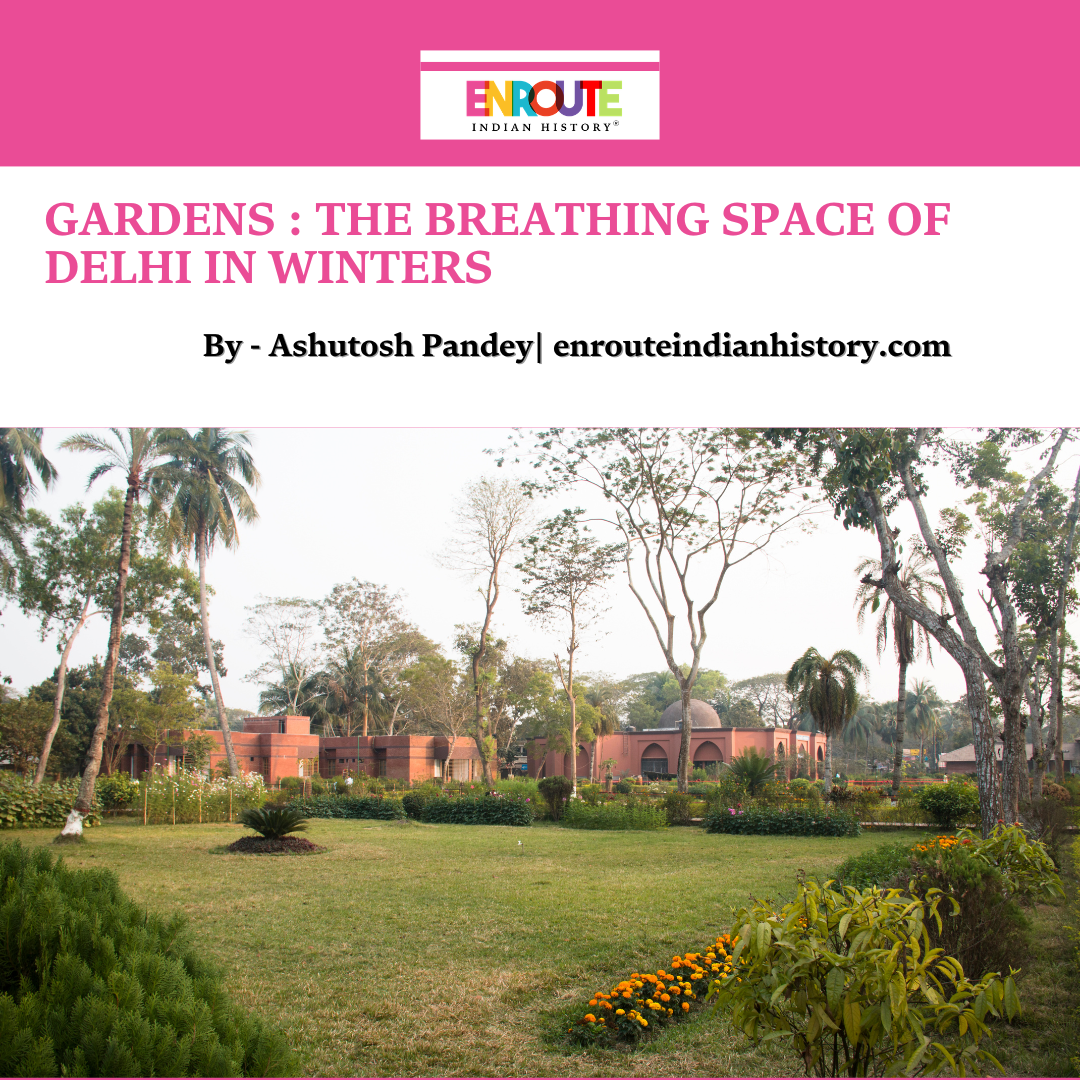
Winter in Delhi arrives with contradiction , the morning wrapped in silver fog , the sunlight drips slowly through the cold air and yet the city wakes beneath a blanket of pollution that blurs its skyline and dulls its energy . But even when the smog hangs low,Delhi instinctively turns toward its gardens,those gardens open the lungs of the city where the air feels lighter,mind feels clearer and history seems to breathe again.
Enter any garden in Delhi during winter morning and you’ll experience the change.The noise softens,air smells of dew rather than dust and the city’s hurried pulse slows down,Here around flowers and their aroma Delhi feels more human.Among the city’s many green spaces , four stand out for their beauty,history and winter charm.Sundar Nursery,Lodhi Garden,Roshanara Bagh & Shalimar Bagh.These gardens are more than landscapes,they are chapters of Delhi’s identity.
These gardens are the place where winter becomes the season of reflection rather than retreat.Each garden holds a different mood, different memory and different vibe.
The legacy of Delhi garden
Delhi’s identity is deeply tied to gardens , Mughals introduced the concept of Charbhag, which they believed to be mirror image of paradise.Later British planners reshaped the city with wide lawns ,walking paths and botanical layouts and after independence Delhi adopted these gardens as public common place where people from every background could share the space.
In short,Delhi gardens are living chapters of its history and winter is when they read best.
Sunder Nursery – The Garden of Renewal
Sunder Nursery situated beside Humayun’s tomb is where Delhi’s past and future stands hand in hand,once a neglected 16th century Mughal burial ground , now it has been transformed into one of the most admired heritage parks in the country, thanks to the intensive restoration by the Aga Khan Trust.Sunder Nursery stands on what was once known as Azim Bhag , a mughal royal garden laid out along the Yamuna floodplain.Tombs like Sunderwala Burj and Lakkarwala Burj connects it directly with early Mughal architectural narrative.
Families spread out picnic mats ,children run between tombs , heritage walks start at dawn ,bird watchers gather with binoculars and the cold air feels gentler under dense tree canopies.Sunder Nursery represents Delhi’s ability to revive itself.
Lodhi Garden – Where Delhi wakes up
Few places define the rhythm of Delhi’s winter mornings like Lodhi Garden.Built around the 15th century tombs of the Lodhi dynasty and redesigned by the British in 1936 as “Lady Willingdon Park”,it blends Indo-Islamic architecture with English landscaping.
The domed tombs of Sikandar Lodi and Mohammad shah ,along with the striking Bara Gumbad and Sheesh Gumbad,form a rare cluster of pre Mughal monuments.This structure represent a transition in Indo-Islamic architecture i.e. arches,domes and decorative tilework that flourished under the Mughals.Lodi Garden is not simply a park its Delhi’s morning routine. It brings people together in a rare harmony,proving that the city’s warmth is stronger than its winter chill.
Roshanara Bhag – A Princess’s Dream in Quiet Ruins
Built in 17th century by Roshanara Begum , the ambitious daughter of Shah Jahan and ally of Aurangzeb, Roshanara Bagh once rivalled the finest Mughal gardens.Roshanara was known for her intelligence , political influence and patronage of arts and her garden reflected her stature.
The garden once had flowing water channels,fragrant flowerbeds and gatherings of nobles during the winter season.British officers also admired it,using it for winter meets,social events and early horticultural activities giving the garden a rare continuity from Mughal to Colonial Delhi.The Roshanar tombs lies at the centre simple yet dignified,holding the melancholy of a princess who shaped an empire’s politics once.
Winter highlights its quietness,The fog settles gracefully across its open lawns,old trees who are standing like guardians of forgotten stories,and the cold breeze carries a hush that feels almost sacred.
Unlike the busier gardens , Roshanara garden offers solitude , reflection and a slower rhythm which seems perfect for winter afternoons when sun is soft and time feels suspended.Roshanara Bhag is Delhi’s lesson in fragility how beauty can fade ,yet still preserve a soulful presence.
Shalimar Bhag – The Royal Refuge of Winter
Built around 1650 by Emperor Shah Jahan, Shalimar Bhag was among the most elegant Mughal gardens of Delhi,It was here that Aurangzeb was crowned emperor after defeating Dara Shikoh.The garden hosted royal winter feasts , poetry evenings,diplomatic gatherings and leisurely retreats.Built in classic charbhag style Shalimar bhag once had shimmering fountains,fragrant flowers and a grand baradari that witnessed the last centuries of Mughal splendour.Even today the remnants like old canals,century old trees surviving pavilions that whispers the life of an empire.
Shalimar Bhag becomes dreamlike in winter.The sun filters softly through the trees,the fog softens the sharp lines of its pavilions and the garden seems suspended between time and memory. It is quieter than other winter spots,making it ideal for those who seek peace rather than crowds.Shalimar Bhag holds on to its royal dignity even in decay,in winter it’s a place with sunlight and history.
Delhi’s Winter Gardens
In winters these gardens become the city’s gentle answer to pollution,chill and chaos.they create a space where strangers smile at each other,children feed geese and chase pigeons,couples sit quietly under old trees,artists sketch misty domes and elders soak the sun like ritual.
These gardens are also crucial urban lungs in a season when Delhi struggles with pollution.Their winter vegetation actively traps dust,cools the microclimate and offers citizens a rare patch of clearer air. In many ways these spaces are not just gardens as said earlier, they also act as Delhi’s natural defence against winter’s harshness,both climatic and environmental.
Delhi can be harsh in winter,harsh in pollution ,harsh in pace.But in its gardens, peace returns.People slow down,warm up and rebuild a sense of community.The kind of human warmth that outlasts the season.
Conclusion
Step into these green sanctuaries on a winter morning,and the you will feel the air cleaner under the canopies,they carried the scent of dew
rather than dust.The fog plays softly around ancient domes,and the footpaths lined with fallen leaves offer a refuge from the restless rhythm outside.
The winter gardens are more than historical relics or recreational spaces.They are reminders of what the city once was and what it stills longs to be, a place where time moves gently , where beauty survives erosion and where the coldest months bring out the deepest warmth.Each garden in winter becomes a lens through which Delhi rediscover itself
Delhi is not merely a city of stones and smoke. It is also a city of centuries old royal gardens where the cold softens,the heart warms and the soul remembers how to breathe.
Bibliography
1.Welch, Anthony. “Mughal Gardens and the Concept of Paradise.” The Art Bulletin, vol. 58, no. 2, 1976. (Provides historical context for Shalimar Bagh and Mughal garden design.)
2.Nanda, Ritu. Delhi: The Built Heritage. INTACH, 2010. (Direct resource on Delhi’s historical sites including Lodi Garden and Roshanara Bagh.)
3.Central Pollution Control Board (CPCB). * Delhi Air Quality Annual Reports.* (For background reference on winter pollution levels and environmental context.)
4.INTACH (Indian National Trust for Art and Cultural Heritage). Heritage Listing of Delhi. INTACH, various reports. (For conservation details and historical notes on gardens and monuments.)