

By Tehreem Asad
Buddhism emerged in northern India between the 6th and 4th century BCE. A principle central to the teachings of Buddha is the idea of the Four Noble Truths, which includes dukkha (suffering), samudaya (cause), nirodha (cessation), and magga (the path). Buddha emphasised the universal nature of suffering. The cause of this suffering is the excessive attachment of people to material objects and entities, which are ultimately temporary and can not provide meaningful satisfaction to an individual. The suffering ceases when a person lets go of their attachments to this world and adopts the Noble Eightfold Path, which leads to liberation. Buddhism emphasised the fact that attainment of liberation was possible for everyone, regardless of their gender, caste, social origin, or class. Due to its focus on the role of individual action rather than one’s identity at birth and the disregard for the caste system, Buddhism appealed to a large section of society, including women and people from disadvantaged sections of the society.
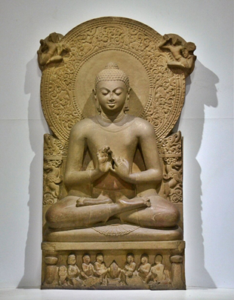
Sculpture of the Buddha preaching his first sermon from Sarnath, 5th century CE
(Courtesy: https://en.wikipedia.org/wiki/File:Buddha_in_Sarnath_Museum_(Dhammajak_Mutra).jpg)
Monasticism is an important institution of Buddhism where individuals renounce their worldly desires in the pursuit of the final liberation from suffering and the cycle of rebirths or Nibbana/Nirvana. However, once the renouncers leave behind their material pleasures, they enter a position of economic dependency. A renouncer in the ancient Indian tradition is a deserving recipient of gifts because of the religiosity they represent and also because of their status as spiritual guides. Thus, initially, the act of gift giving or dana in Buddhism was focused on giving food and clothes to monks and nuns, becoming the main link between a renouncer and other individuals. Since it is not possible for a major section of the followers to relinquish earthly concerns completely, the act of dana allowed them to remain active participants of the faith and secure religious merit.
Later on, devotees also made donations for the construction of religious establishments, and their contributions were often recorded in the form of donative inscriptions. A distinct and striking feature of these inscriptions is the presence of a large number of female donors. Women devotees of Buddhism, whether they were nuns, lay devotees, common women, or women from royal families, have all contributed to Buddhist sites in the capacity of a donor. The focus of this article is to explore the nature of these donations and what they tell us about the role of women in Buddhism as donors. Additionally, observations about the position of women as indicated through these donations are also discussed.
THE CONCEPT OF DANA
The idea of gift-giving and providing for the deprived exists across religions and cultures. Since the Vedic period, gift-giving has been associated with religious rituals in India. The act of gift giving is essentially believed to be a voluntary and spontaneous undertaking, in which the donor does not expect reciprocity. However, upon closer examination of the practice, it becomes clear that the act of gift-giving is not entirely altruistic. The Dharmasutras uphold that dana was to be given from surplus wealth, and it should be made in a way that does not cause damage to one’s family. Additionally, grand donations were often expected to win a person renown and prestige. Donations were also supposed to bring religious merit to the donor. Thus, gift-making was never really a unidirectional affair.
Even in the post-Vedic period, traditions like Buddhism and Jainism regarded charity as a noble and virtuous act. Dana in Buddhism could be offered either in the form of material donations or through the instruction of Dharma. Although all followers could perform the first kind of dana, the latter is only associated with Buddha and his important disciples. The practice of gift-making redirected wealth from the privileged to the voluntarily impoverished. Buddhism popularised the practice of dana and stressed that donations should be made to the monastics, since the sangha (monastic order) was dependent on bhiksha (alms) from laity for its existence. Much like the earlier traditions, this gift-giving would acquire merit and social status for the donor. The four ‘requisite objects’ (i.e., robes, food, medicine, and bedding), if donated to the sangha, were believed to acquire significant benefits to the donor. Apart from common people, the patrons of Buddhism also included royalty. Most notably, Emperor Ashoka from the Mauryan empire was an important patron of Buddhism. Even in the post-Mauryan period, royalty continued to patronise Buddhism.
Donations were also made for the construction of religious establishments. Among the most revered structures in Buddhism is a hemispherical shrine, which is meant to house the relics of the Buddha or other respected monastics, known as a stupa. Also a part of this religious complex are Chaityas (prayer halls) and Viharas (monasteries). The construction of these monuments was possible because of the assistance provided by royal houses, lay worshippers, the religious community, and common people. These sites typically have votive inscriptions that give us information about the donors. A part of recording the donation in these sites through inscription, apart from merit and prestige, was the fact that devotees would enjoy the privilege of permanently placing their names near the sacred relics.
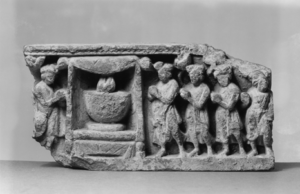
2nd-century stone fragment showing worshippers revering the Buddha’s alms bowl
(Courtesy: https://art.thewalters.org/object/25.37/#:~:text=This%20sculptural%20fragment%20appears%20to,depictions%20of%20the%20alms%20bowl. )
The information from these inscriptions which is of most interest to us here, is that which is related to the donations made by women. Buddhist Stupas often contained donative records which document a large and unprecedented number of female donors. Popularity of Buddhism among women devotees was, in part, due to the fact that they enjoyed a relatively better status in the religion. Buddha asserted that both men and women were equally capable of achieving salvation and supreme attainments through the eightfold path. He said:
‘And be it woman, be it man for whom
Such chariot doth wait, by that same car
Into Nirvana’s presence shall they come.’
The donations made by women are significant to understand the status of these women for at least four reasons. First, the donations were made in hopes of acquiring religious merit, suggesting equal access to the performance of religious rituals. Not only that, since the record of the donations was inscribed on the monument, it would also bring the women donors public recognition. Additionally, their making donations suggests that they had access to economic resources. And finally, since the act of dana was voluntary, women express their individuality through these donations.
WOMEN DONORS AND PATRONS OF BUDDHISM
Buddhism, since the very beginning, has secured the support of women by means of donations. Even during the lifetime of Buddha himself, laywomen became benefactresses of the religion and helped in its establishment and continuance. Scriptural sources talk about women like Visakha of Sravasti, whom Buddha described as his chief benefactress, and Ambapali, a wealthy courtesan (and later a nun) who donated her mango grove. Subsequently, wealthy women, like merchants, courtesans, and queens, as well as lay followers and nuns, contributed actively and substantially to the construction of religious structures until the 4th century CE.
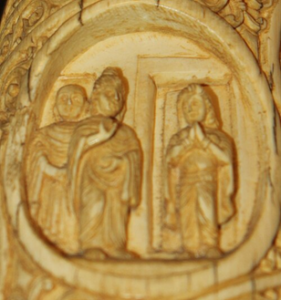
Amrapali greets Buddha, ivory carving, National Museum of New Delhi
(Courtesy: https://en.wikipedia.org/wiki/Amrapali#/media/File:Amrapali_greets_Buddha_Roundel_36_buddha_ivory_tusk.jpg)
Religious monuments like stupas at Sanchi, Bharhut, and Amravati contain records of such donations. Unfortunately, the stupas at Bharhut and Amravati have been damaged over time and do not exist in their original form. At Sanchi, the period between the second century BCE and the second century CE notes 827 donative inscriptions out of which around 346 record the contributions of women. Some of the inscriptions are damaged or non-legible, which suggests that the contribution of women may even be higher than mentioned. At Bharhut, out of the 111 donative inscriptions (starting from the second century BCE) engraved on gateways, pillars, coping-stones, and rails, 45 record donations of women. The chief donor of all the ‘subsidiary structures’ at the Amaravati stupa is believed to be Camtasiri, sister of King Chamtamula from the Ikshvaku dynasty. Apart from this, Buddhist sites like Kanheri caves, Nasik, and Nagarjunakonda also contain records of donations from women.
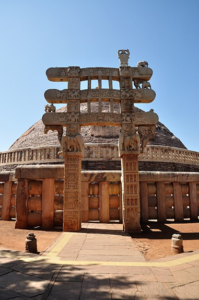
The Great Stupa at Sanchi, Madhya Pradesh, India.
(Courtesy: https://en.wikipedia.org/wiki/Sanchi_Stupa#/media/File:East_Gateway_-_Stupa_1_-_Sanchi_Hill_2013-02-21_4398.JPG )
The female donors of these sites can be broadly classified into three categories, i.e., ordinary women and lay worshippers, nuns, and women of royal families. Additionally, a few observations can be made about gender identity and dynamics based on these epigraphic sources. To begin with, the number of women donors, although present in a significant amount, appears to be consistently less than that of the male donors. Laymen and monks always made more donations than laywomen and nuns, across these sites.
The inscriptions contain identifiers of donors such as kinship ties, occupations, and native places. At Sanchi, kinship as a basis of identification was more important for women (mentioned for 69 individuals and four groups) than for men (mentioned for 17 individuals and six groups). Marital ties were more important for women who identified themselves as mothers (usually of sons, not daughters) and wives. A few also identified themselves as sisters, daughters-in-law, and daughters. Even in Bharhut inscriptions, we find that kinship was more important for women. The only kinship identity mentioned by male donors at Bharhut was that of a son. At Sanchi, occupation is mentioned by male donors more (35 individuals and two groups). In comparison, only one female donor mentioned her occupation, that of gharini (likely meaning housewife). At Bharhut, no women donors mention their occupational identity, compared to five men who mention their occupation . For women donors at Sanchi, kinship was specified more frequently than native place, while the opposite is true for men. At Bharhut, donors contributed to four types of architectural elements to the stupa, namely pillars, rails, coping stones, and gateways. Laywomen most frequently donated rails, probably because they required fewer resources.
Another significant feature of donations at these sites was the contributions of royal women. They became very important patrons of Buddhism. Inscriptions from sites like Mathura and Nasik tell us that queens, princesses, and royal mothers donated relics, caves, land, and monasteries to the Buddhist sanghas. During the Iksvaku dynasty (3rd century CE) at Nagarjunakonda, patronage of royal women became especially prominent. While kings tended to support Brahmanical traditions, queens and princesses supported Buddhism through funding stupas, temples, monasteries, and other religious structures. For instance, Gotami Balarsiri, the mother of Gotamiputra Satakami of the Satvahana dynasty (who referred to himself as ‘unique Brahman’), was a great patron of the Buddhist Sangha.
The inscriptions also tell us about the contributions of clerics along with the laity. Inscriptions from sites such as Sanchi and Bharhut show that both bhikkhus (monks) and bhikkhunis (nuns) played an important role as donors within Buddhism. Although the donations were largely equal in numbers, there were some differences between the donations of monks and nuns based on gender. For instance, in Sanchi, while monks were identified through religious titles and honorific epithets like aya, bhadanta, and thera, there is a lack of such an identification for nuns. Terms associated with specialised knowledge, such as bhanaka (reciter of sacred texts), are used only for monks. This might be an indication of the fact that nuns did not have access to the specialised learning required to acquire such titles. Additionally, nuns were more frequently identified by their place of origin than monks. This suggests that monks were relatively more mobile because native places held more significance for nuns.
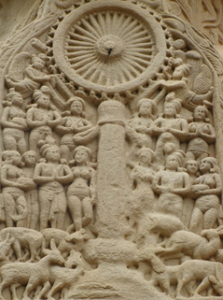
While talking about the donations contributed by women, it is also important to talk about the fact that they had economic control. They were only able to patronise the structures because they had the means to. This is an important insight into the status of women as property owners. However, a crucial question may arise regarding the ownership of resources. Since monastics are forbidden from owning resources and wealth in the Buddhist canon and teachings, how were monks and nuns able to donate to these establishments? There are some explanations that can be proposed for this paradox. Some scholars suggest that the donations made by them may have been in the form of labour. Georg Bühler suggested that monks and nuns may have obtained resources through begging. However, monastic rules classified handling wealth as an offence that requires repentance. Another explanation, based on both textual and archaeological evidence, suggests that monastics were not completely cut off from material resources. Excavations at Sanchi have uncovered coins, jewels, and valuable objects in monastic cells. This indicates that nuns and monks had access to wealth despite official restrictions.
Thus, until the fourth century CE, women emerged as important patrons of Buddhism. The contributions of nuns, laywomen, and royal women helped significantly in the development of the religion. These donations are crucial because they are the records of women becoming active participants in the world of Buddhism. These donations made the women donors visible in the public domain and are an expression of their individuality. Although, based on the epigraphic sources, we can not make generalisations for the Indian society at large, these donations also suggest the fact that at least some women, during this period, had enough resources at their disposal that they could utilize for religious grants. Moreover, their names were placed close to the presence of Buddha, which put them close to such a sacred entity in perpetuity, which puts them at an equal standing with male followers of Buddhism. Women, nuns, and lay followers from different social backgrounds continued donating to Buddhist monasteries until about the mid-third century CE, after which patronage of Buddhist art increasingly became the domain of royalty.
BIBLIOGRAPHY:
1. Willis, Janice D. “Female Patronage in Indian Buddhism.” The Powers of Art: Patronage in Indian Culture, Oxford UP, 1992, pp. 46–53.
2. Singh, Snigdha. “Exploring the Question of Gender at an Early Stūpa: Inscriptions and Images.” Beyond the Woman Question: Reconstructing Gendered Identities in Early India, Primus Books, 2018.
3. Singh, Upinder. “Sanchi: The History of the Patronage of an Ancient Buddhist Establishment.” The Indian Economic & Social History Review, vol. 33, no. 1, Mar. 1996, pp. 1–35.
4. Osto, Douglas. “Women.” Power, Wealth and Women in Indian Mahayana Buddhism, 2008, pp. 88–104.
5. Trivedi, Sushma. “FEMALE DONORS AT SANCHI : ISSUES OF GENDER AND FAITH.” Proceedings of the Indian History Congress, vol. 66, 2005, pp. 94–101.


















.jpg)

