

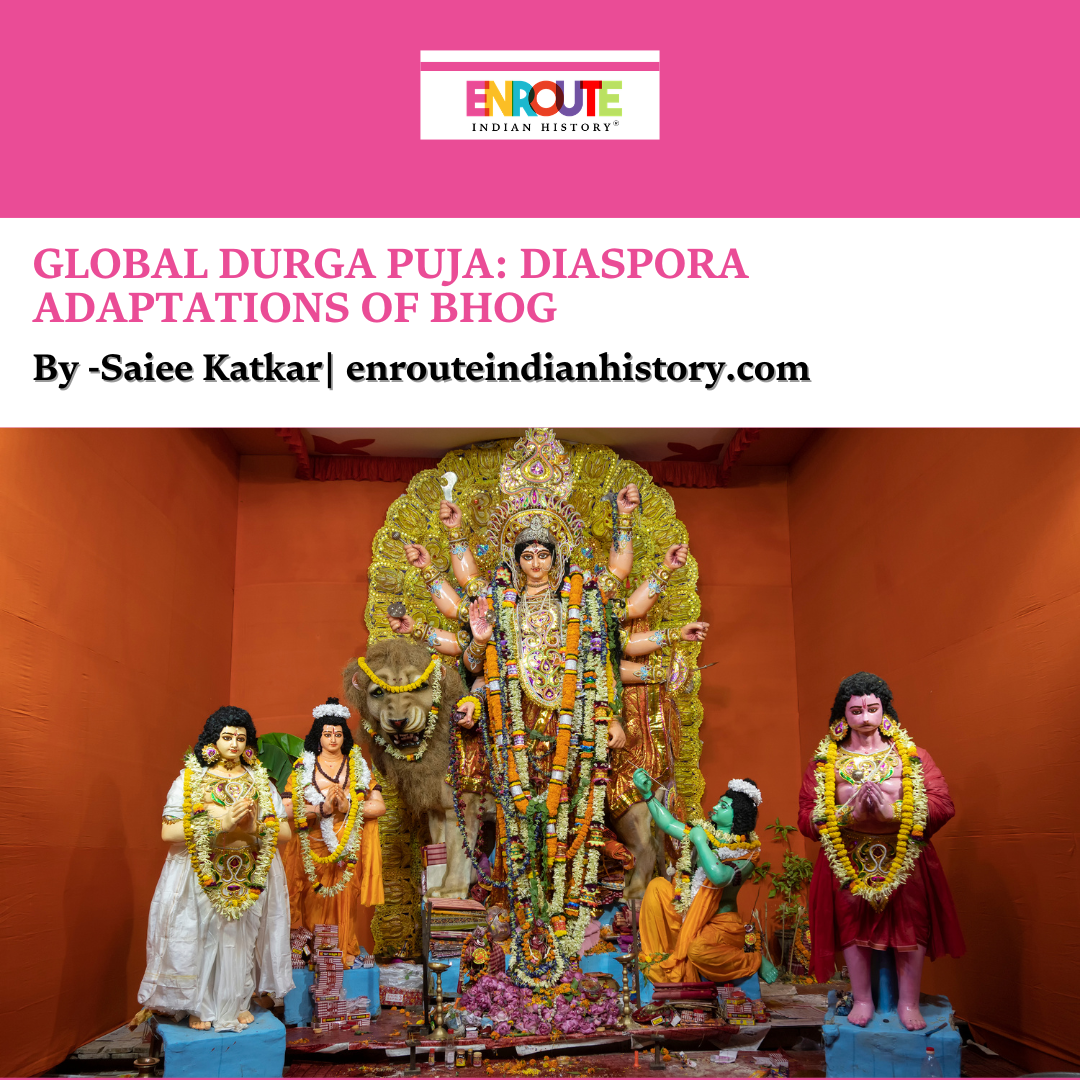
By Saiee Katkar
Every October, as the rhythmic beats of the dhak echo through Kolkata’s pandals, the same sounds and aromas rise in distant corners of the world, from London and Toronto to New Jersey. The festival of Durga Puja has long transcended Bengal’s borders, transforming into a global celebration of faith, memory, and belonging. Among its many rituals, the offering of bhog, food presented to the goddess, remains one of the most emotionally charged. For Bengali communities abroad, it becomes a delicate act of recreating home through taste, carrying sacredness, nostalgia, and
identity across oceans.
The global journey of bhog offers a fascinating glimpse into how sacred food traditions evolve in migration. Traditionally, the bhog platter includes khichuri, labra, chutney, payesh, and fruits, foods symbolizing purity, sharing, and devotion. When this ritual travels abroad, it begins to absorb new geographies and ingredients, reflecting how culture reshapes itself to survive in unfamiliar environments (Appadurai, 1986). Even small changes, like the aroma of basmati replacing gobindobhog rice, evoke subtle shifts in memory, reminding devotees of both loss and continuity.
One of the clearest examples of this adaptation lies in ingredient substitution. The soft lau (bottle gourd) used in labra gives way to broccoli or zucchini, and in the United States, where access to local mishtiwalas is limited, canned rasgullas substitute the fresh ones. These adjustments reveal how migrant communities negotiate authenticity and accessibility. Yet, what remains constant is the emotion behind the food. The warmth of khichuri still carries the faint scent of home kitchens and mustard oil, however improvised the ingredients may be (Ray, 2016).
Bhog as Cultural and Religious Expression
Food anthropologist Arjun Appadurai (1986) describes cuisine as a “system of communication,” a language through which culture speaks. In the diaspora, bhog becomes precisely that, a language of belonging. For second-generation Bengalis who may not speak fluent Bangla or have never visited Kolkata, cooking bhog in a rented community hall becomes an intimate act of reconnection. The recipe becomes a bridge between generations, a sensory memory carried through touch, taste, and aroma.
The ritual setting of bhog has also undergone subtle transformation. In Bengal, bhog is prepared in temple courtyards or beside neighborhood pandals. Abroad, the ritual finds new homes: community halls, school kitchens, or even parking lots. Yet, the sanctity of the offering remains untouched. Before serving the first ladle of khichuri, priest chants mantras, invoking the goddess with sound and fragrance. The sacredness thus lies not in the physical space but in the heartfelt intention of those who cook and serve (Vertovec, 1999).
Community, Commerce, and Food Diplomacy
As the festival expanded within global cities, bhog also entered new economic and social dimensions. In places like London and New Jersey, professional caterers n specialize in Puja bhog packages, supplying vegetarian feasts for large community gatherings. Bengali restaurants see festive spikes, offering “Mahalaya Platters” or “Durga Puja Thalis.” While some may view this commercialization as a loss of sanctity, others interpret it as an evolution of tradition, one that ensures sustainability in a capitalist environment. Community volunteers often balance devotion wit efficiency, proving that sacred and commercial can coexist harmoniously (Ray, 2016).
Beyond religion, bhog has become a subtle form of cultural diplomacy in multicultural settings. In Toronto, London, and New York, non-Bengali visitors often join the communal meal out of curiosity or friendship. Through the act of sharing bhog, cultural dialogue begins. A plate of khichuri can become a conversation about history, migration, and coexistence. This exchange of food and story transforms bhog into a living ambassador of Bengali heritage, welcoming, inclusive, and resilient (Appadurai, 1986; Ray, 2016).
Modern Adaptations and Memory
Newer interpretations of bhog reflect the changing sensibilities of global communities. Vegan or gluten-free versions are emerging to suit contemporary diets. Online platforms and live-streamed Pujas allow people to share recipes and rituals across continents. WhatsApp groups circulate instructions for perfect khichuri, while YouTube tutorials connect home cooks in Kolkata to devotees in Sydney. The sacred meal, once confined to temple spaces, has become a subtle yet powerful symbol o global connectivity and participatory devotion (Ray, 2016).
Behind every spoonful of bhog abroad lies a story of negotiation, adaptation, and memory. It may belong to the homemaker in Canada who replaces milk with almond milk for payesh, or the young volunteers in London who order fifty kilos of rice online for their community’s feast. Each act of cooking becomes a form of devotion, and every adaptation a way of keeping the goddess alive in memory (Vertovec, 1999).
From an archaeological perspective, these evolving traditions carry deep cultura significance. Just as artifacts reveal how ancient communities adapted to ne landscapes, bhog reveals how modern diasporas preserve identity through food. It is not merely a ritual meal; it is a living heritage, an edible memory that connects generations through sensory continuity (Appadurai, 1986).
Conclusion
Durga Puja, at its end, is marked by visarjan, the immersion of the goddess in water Yet, for diasporic communities, the immersion happens differently. The goddess returns to the heart, to the kitchens where she was invoked, to the flavors that kept her alive in unfamiliar lands. The bhog, humble and sacred, becomes the thread binding these scattered worlds together, a symbol of faith that travels, adapts, and continues to taste like home (Ray, 2016).
References
Appadurai, A. (1986). The social life of things: Commodities in cultural perspectiv Cambridge University Press.
Ray, K. (2016). The migrant’s taste: Food and identity in the diaspora. Bloomsbur Academic.
Vertovec, S. (1999). Conceiving and researching transnationalism. Ethnic and Racial Studies, 22(2), 447–462.