

By Shreya Kamboj
In the labyrinthine lanes of Old Delhi, a new kind of public building emerged during the mid-20th century: the single-screen cinema hall. Theatres like the Art Deco-styled Regal, the modernist Sheila, and the locally-rooted Jagat became prominent landmarks and offered spaces of leisure to a city undergoing immense transformation. However, these were not only sites of entertainment, but also reflections of broader social and political shifts, including colonial urban planning, nationalist mobilisation, post-Partition migration, and the development of a commercial middle class.
This paper advances this argument by analysing the emergence, evolution, and eventual decline of Delhi’s single-screen cinemas. The first section provides the necessary historical background. The second section presents detailed case studies of five influential halls, using the frameworks of access, identity, and memory to reveal their specific roles during their golden age. In its final section, the paper will analyze the factors that rendered their business model unviable from the 1980s onwards, arguing that their disappearance marks another key shift in Delhi’s urban and cultural landscape. It demonstrates that these cinemas were not passive backdrops but active institutions, shaped by and fundamentally shaping the story of modern Delhi.
Historical Context: A City in Transition
To understand the rise of cinema in Delhi, it is important to situate it within the city’s spatial and social transformations during the early 20th century. After the Uprising of 1857, Delhi lost its political centrality under the Mughal Empire and was restructured as a provincial town under British rule. While politically downgraded, it remained a significant cultural and commercial centre, especially within the boundaries of Shahjahanabad. Here, a refined urban ethos, known as aadmiyat, defined the everyday life of the Delhiwala. (Gupta 1981) This sensibility, shaped by Urdu poetry, religious coexistence, and neighbourhood ties, created a strong sense of local identity and civility.
Public entertainment was deeply embedded in this world. Wrestling (kushti) matches in local akhadas, kite-flying (patangbazi), and qawwalis at dargahs were common leisure activities. Dastan-goi, the oral art of storytelling, was especially popular and often took place in communal spaces like mosque steps or marketplaces. These forms of entertainment encouraged interaction and collective memory.
A turning point in Delhi’s urban history came in 1911, when the colonial administration shifted the capital of British India from Calcutta to Delhi. The construction of New Delhi to the south of the walled city marked a decisive spatial and administrative break. Historian Narayani Gupta writes that this change reoriented the city’s morphology and extended it westward, linking different zones through new infrastructure. (Gupta 1981) The older city remained densely populated and culturally diverse, while the new capital was designed for colonial officers and bureaucrats, with a focus on order, control, and symbolic power. This spatial division soon translated into social segregation. New Delhi was largely inaccessible to most residents, while Shahjahanabad absorbed waves of migrants and continued to experience demographic pressure. (Dupont et el. 2000)
Cinema entered this bifurcated city in the form of mobile bioscope shows in the early 1900s, but by the 1920s and 1930s, permanent cinema halls began appearing. These theatres reflected Delhi’s internal divisions. In the old city, halls like Jagat and Moti catered to working-class audiences. In contrast, theatres such as Regal and Sheila in Connaught Place targeted elite and English-speaking patrons, with art-deco architecture and Western-style interiors. By the mid-20th century, cinema had become a part of Delhi’s cultural life.
Regal Cinema, The Imperial Capital’s Premier Theatre
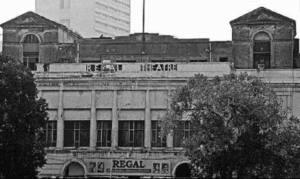
Regal Cinema, inaugurated in 1932 in Connaught Place, was among the earliest grand single-screen theatres of New Delhi. Designed by Walter Sykes George and commissioned by builder Sir Sobha Singh, it blended the Georgian and Mughal motifs. Initially, its programming featured predominantly English-language films and travelling performances, including Russian ballet and European theatre, targeting colonial officials and a growing Indian elite. It quickly became a fixture in Delhi’s social calendar. (Chintamani 2017)
Over time, Regal expanded its repertoire to include mainstream Hindi films, especially post-independence, when cinema was emerging as a national cultural form. Films by Raj Kapoor and Guru Dutt graced its screens, and it became a favoured venue for significant premieres. Its opulent interiors, including chandeliers, sweeping staircases, and plush seating, turned cinema into an event, a shared experience that extended into the public spaces of Connaught Place. Over the decades, it earned the patronage of film and political elites such as Jawaharlal Nehru, Sardar Patel, and members of the Kapoor family.
An often overlooked chapter in Regal’s story is its significance to Delhi’s nascent LGBTQ+ movement. In December 1998, when protesters publicly attacked Deepa Mehta’s film Fire, Regal became the site of one of India’s first-ever public shows of solidarity for queer rights, a candlelight vigil in defence of the film and LGBTQ visibility. As such, it earned recognition in queer cultural memory as the “birthplace of the city’s LGBTQ movement” in the city. (Nair 2017)
By the time Regal closed in 2017, its cultural legacy extended far beyond cinema. It had borne witness to the evolution of Delhi’s public life, from colonial pageantry to postcolonial nationalism, and from shared spectacle to privatised multiplex culture.
Moti Talkies: The Forgotten Jewel of Chandni Chowk
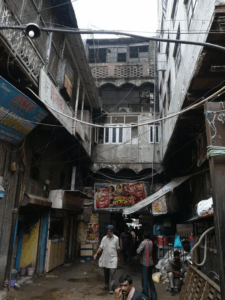
Moti Cinema, established around 1938 in the heart of Chandni Chowk, was one of Delhi’s oldest single-screen cinema halls. It opened at a time when Bollywood’s major studios like Prabhat Talkies and Bombay Talkies were shaping a new cinematic language, and Moti quickly became known for showcasing their celebrated works, including those by Bimal Roy, Mehboob Khan, Guru Dutt, and Raj Kapoor. It even ran English-language films during morning shows into the 1970s, catering to Chandni Chowk’s better-heeled shoppers and literate audiences.
Unlike theatres in Connaught Place, Moti was located in a maze of lanes near the Red Fort side of Chandni Chowk. Despite its modest entrance, a small poster and narrow passageway, it held distinctive prestige in local memories. At its peak, a commemorative clock on its wall celebrated the hundred-day run of Yash Chopra’s Waqt.
Following the rise of multiplexes in Delhi post-1997, Moti’s footfall steadily declined. Located in a high-density, working-class area, it increasingly catered to daily-wage labourers and rickshaw drivers from Bihar who valued its affordability. By the 2000s, the theatre had shifted its programming exclusively to Bhojpuri films to attract its loyal niche audience that included migrants seeking cinematic comfort in their own language.
Despite its adaptability, Moti ultimately could not withstand regulatory and financial pressures. In April 2013, it shut down permanently after the local municipal and fire departments refused the required no-objection certificates necessary for continued operation. At the time of closure, its owner, Kirit Desai (son of the founder, Harshad Desai), carried memories of decades of cinema history.
Fading Pictures: The Rise and Fall of Jagat Cinema
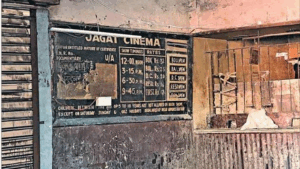
Jagat Cinema, initially known as Nishat or colloquially as “Macchliwallon ka Talkies” due to its proximity to Delhi’s fish markets, opened in the late 1930s (likely 1939) in the Jami Masjid vicinity of Old Delhi, Daryaganj. It served audiences from the densely woven lanes of Shahjahanabad and wove itself into the social fabric of the area.
This modest but storied cinema hall was known for screening some of the most iconic Hindi films of its time. Among these was Mughal-e-Azam, a historical epic that found a particularly receptive audience in Old Delhi’s public. But perhaps no story about Jagat is as enduring as that of Pakeezah’s six-month run in the early 1970s. As recalled by Ziya Us Salam, the author of ‘Delhi 4 Shows: Talkies of Yesteryear’, a poetically inclined resident from nearby Matia Mahal would come daily on a tonga with the women of his family to watch the film. Each day, they would wait for the song “Chalte Chalte” to begin, and then quietly leave.
Even today, long after the theatre’s closure around 2004, Jagat’s imprints remain in the local geography. The lane that runs beside it is still colloquially known as Gali Jagat Cinema Wali, and old letterboxes in the surrounding mohallas also carry this name. The structure of the building remains, albeit in decay. There is a narrow, slotted window on the side wall that once served as the box office for front-stall tickets. One can still imagine the hustle of ticket-seekers and the clerk behind the window, tallying coins and tearing stubs. Jagat Talkies, thus, continues to live in Delhi’s oral histories.
Delite in the Mid-Century Capital
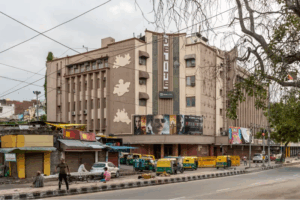
Established in 1954 in Daryaganj, Delite Cinema emerged at a time when cinema was beginning to consolidate its role as a primary mode of mass entertainment in newly independent India. Built by Brij Mohan Lal Raizada on land that had once formed part of the old city wall, Delite was a statement of postcolonial ambition. With a seating capacity of over 1,100 and architecture that blended art deco flair with modernist scale, it quickly became one of Delhi’s most popular venues for Hindi cinema.
Its early years were marked by both spectacle and civic intent. At its inauguration, the film Angarey starring Raj Kapoor was screened to packed audiences, who had been drawn in by loudspeakers cycling around the city announcing its arrival. In contrast to the cramped cinemas of Old Delhi, Delite featured spacious interiors, terrazzo staircases, imported chandeliers, and central air-conditioning, all of which underscored its status as a “destination” theatre rather than a neighbourhood one.
Over the decades, Delite also earned a reputation for inclusivity. It became a welcoming space for purdah-observing women, as well as members of the transgender and LGBTQ communities, many of whom found safety and anonymity in its large and relatively unsegregated interior. It also played a significant civic role during national events. During the 1971 India-Pakistan war, when most cinemas remained shut or restricted, Delite stayed open and even inserted special intervals to broadcast war news updates, which transformed the hall into a hybrid space of information and entertainment.
Delite’s programming remained both mainstream and eclectic: blockbuster Hindi films such as Waqt (1965), Humraaz (1967), Khalnayak (1993), and Bengali regional titles like Megh Kalo (1970) enjoyed extended runs, sometimes beyond their booking periods. In the 1990s, it briefly regained commercial success with films like Hum Aapke Hain Kaun!, before facing pressure from rising multiplex culture. In the 1990s and early 2000s, Delite responded to the rise of multiplexes by upgrading its interiors, reducing seating to about 980 to improve comfort, and adding a café. In 2006, another mini theatre called Delite Diamond was established nearby.
Sheila Theatre: India’s 70mm Pioneer in the Heart of Delhi
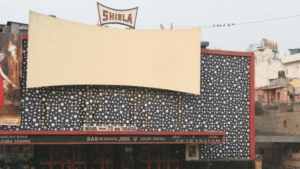
Opened in 1961, Sheila Theatre on DB Gupta Road in Paharganj holds a distinguished place in India’s cinematic history as the first cinema hall in the country equipped with a 70mm screen. At a time when no Indian architect or technician had undertaken a project of such scale or technical sophistication, Sheila marked a decisive turning point in Delhi’s entertainment infrastructure.
The visionary behind the theatre was D.C. Kaushish, who, after witnessing the success of commercial 70mm screenings in New York, sought to replicate the experience for Indian audiences. To bring this vision to life, he enlisted the expertise of Ben Schlanger, a globally renowned figure in motion picture theatre design. Schlanger, as chief consultant, worked alongside Professor Cyril Harris of Columbia University to develop advanced acoustic solutions. Their collaboration introduced a six-track stereophonic sound system, setting unprecedented standards for cinema technology in India.
Sheila’s launch reflected a shift in the cinematic culture of Delhi. Unlike the older single screens concentrated in Shahjahanabad, Sheila catered to an aspirational, often English-speaking audience. It became known for premiering Hollywood epics and major English-language releases, beginning with Solomon and Sheba, its inaugural screening. Over time, it became a magnet for high-profile patrons, including President Zakir Hussain and Prime Minister Indira Gandhi.
Even as multiplexes began to dominate the cinematic landscape in the 2000s, Sheila remained functional and continued to attract loyal moviegoers. Uday Kaushik, son of the founder, took on the responsibility of maintaining its appeal. He oversaw regular upkeep, preserved original design elements, and kept the theatre running with determination, even as rising operational costs and dwindling ticket sales took their toll. In 2017, Sheila finally closed its doors after a 56-year legacy. Yet the theatre lives on in public memory, not just as a site of nostalgia, but as a symbol of a transformative moment in India’s filmgoing experience.
The Decline of Single-Screen Theatres in Delhi
The decline of single-screen theatres in Delhi is the result of overlapping socio-economic and technological shifts that unfolded from the late 20th century onward. In areas like the Walled City, the exit of the middle class during the 1960s and 70s led to a diminished audience base, and the remaining labour-dominated population primarily consumed low-budget films. Theatres in these areas were neglected by civic authorities, contributing to structural deterioration and limited investment.
The arrival of television in the 1970s marked a significant change in urban leisure consumption, followed by video technology and cable television in the 1980s. By the 1990s, the emergence of multiplexes provided a centralised entertainment model with air conditioning, multiple screens, food courts, and digital projection. These features attracted middle-class consumers, especially in a liberalised economy with rising disposable incomes (Bhattacharya and Patel 2021).
In contrast, many single-screen halls lacked the infrastructure and capital to compete. While a few attempted renovations, demand remained insufficient. Theatres such as Sheila, Regal, and Moti struggled to sustain operations, often facing low occupancy rates and increasing operating costs. This pattern intensified during the COVID-19 pandemic, when restrictions led to revenue collapse, and nearly 10% of single screens in North India closed permanently (Bhattacharya and Patel 2021).
Sociologically, single-screen spaces previously enabled a form of social mixing across class and caste boundaries. However, the shift towards individualised viewing through OTT platforms and smartphones has diminished the collective experience of cinema (Srinivas 2025). As a result, cinema consumption has become increasingly privatised, spatially fragmented, and dependent on digital infrastructure.
Conclusion
The emergence of cinema theatres in Delhi in the mid-20th century represented a shift in urban leisure and cultural practices. Theatres such as Delite, Sheila, and Regal catered to a broad urban public, offering relatively affordable access to popular films. These venues remained central to Delhi’s film culture until the late 1990s. However, their decline is attributable to both infrastructural constraints and broader changes in viewing preferences. Theatres that once functioned as social hubs failed to compete with multiplex chains that introduced a premium viewing model aligned with aspirational middle-class values (Mukherjee 2021). The convenience of home viewing, enhanced by digital platforms like Netflix and Hotstar, further contributed to the decline in footfall. The decline of single-screen theatres, therefore, is not an isolated phenomenon but part of a broader transformation in the political economy of film exhibition and public culture in India.
Bibliography
1. Bhattacharya, S. & Patel, U. (2021) ‘Existential Crisis of Single Screen Theatres in India’. International Journal for Research in Engineering Application & Management (IJREAM). Vol-06, Issue-12.
2. Chahar, A. (2019). ‘The Story of Delhi’s Cinema Halls’. www.peepultree.world. (Accessed on 1st August 2025). https://www.peepultree.world/livehistoryindia/story/history-daily/the-story-of-the-cinema-halls-of-delhi
3. ‘Central Delhi’s iconic single screen theatre Shiela cinema shuts shop after 56 years’. (2017). www.hindustantimes.com. (Accessed on 1st August 2025). https://www.hindustantimes.com/delhi/central-delhi-s-iconic-single-screen-theatre-shiela-cinema-shuts-shop-after-56-years/story-64dCvo1kKC6IXTzTAoJ0QL.html
4. ‘Delite Cinema: A Delhi landmark with roots in Calcutta’. (2022). (Accessed on 1st August 2025). https://www.financialexpress.com/life/entertainment-delite-cinema-a-delhi-landmark-with-roots-in-calcutta-2528280/
5. Dupont, V.D.N., Tarlo, E., Vidal, D. (2000). ‘Delhi : urban space and human destinies’. Ajay KumarJain for Manohar Publishers & Distributors.
6. ‘Delite Cinema, 1954’. decoindelhi.com. (Accessed on 1st August 2025). https://decoindelhi.com/building/delite-cinema/
7. Gupta, N. (1981). ‘Delhi between two empires, 1803-1031: society, government and urban growth’. Delhi : Oxford University Press.
8. Kumar, Rajesh. (2013). ‘Heritage Moti cinema shuts’. www.dailypioneer.com. (Accessed on 1st August 2025). https://www.dailypioneer.com/2013/page1/heritage-moti-cinema-shuts.html
9. ‘Making of a city’. (2011). www.hindustantimes.com. (Accessed on 1st August 2025). https://www.hindustantimes.com/delhi/making-of-a-city/story-6wTK7gI97K1NayGwsW2yRL.html
10. Mukherjee, A. (2021). ‘The Social Experience of Cinema-going in Single Screen Theatres: An Ethnography of Audiences in an Indian Small Town’. arfjournals.com. Pp. 63-73.
11. Mukherjee, D. (2021). ‘Space, screen and the Indian multiplex film’. South Asian Popular Culture. VOL. 19, NO. 1, pp. 63–65
12. Nair, M. (2017). ‘A farewell to Delhi’s Regal Cinema, the birthplace of the city’s LGBTQ movement’. scroll.in. (Accessed on 1st August 2025). https://scroll.in/magazine/832816/a-farewell-to-delhis-regal-cinema-the-birthplace-of-the-citys-lgbtq-movement
13. ‘Regal Theatre Shutting Down, An Era Gone By’. (2017). www.thelabmagofficial.com. (Accessed on 1st August 2025). https://www.thelabmagofficial.com/regal-theatre-shutting-era-gone/
14. Salam, Z.U. (2015). ‘The many delights of Delhi’s Delite cinema hall’. scroll.in. (Accessed on 2rd August 2025). https://scroll.in/article/729358/the-many-delights-of-delhis-delite-cinema-hall
15. Salam, Z.U. (2015). ‘Delhi : 4 shows : talkies of yesteryear’. Om Books International.
16. ‘Single-screen theatre Shiela bids adieu to its fans: Here’s at look at its 56-year-long glorious journey’. (2017). www.financialexpress.com. (Accessed on 2rd August 2025) https://www.financialexpress.com/india-news/single-screen-theatre-shiela-bids-adieu-to-its-fans-take-a-look-at-its-56-years-journey/647186/
17. Soofi, M.A. (2025). ‘City Landmark – Jagat Cinema, Old Delhi’. https://thedelhiwalla.blog/. (Accessed on 1st August 2025). https://thedelhiwalla.blog/2025/01/21/city-landmark-jagat-cinema-old-delhi-2/
18. Soofi, M.A. (2020). ‘Delhiwale: On walking past Old Delhi’s iconic Gali Jagat Cinema Wali’. www.hindustantimes.com. (Accessed on 1st August 2025) https://www.hindustantimes.com/delhi-news/delhiwale-on-walking-past-old-delhi-s-iconic-gali-jagat-cinema-wali/story-ujaKy5B6RwFowqrpYjsKaI.html
19. Srinivas, S.V. (2025). ‘After the single screen: performing publics at large’. South Asian History and Culture16 (2): pp. 1-14
20. Shiv, V. (2012). ‘Old Delhi’s Old Cinema Halls’. sarsonkekhet.in. (Accessed on 1st August 2025). https://sarsonkekhet.in/2012/09/17/old-delhis-old-cinema-halls/
21. ‘The Lost Era of Single Screen Cinemas’. (2015). www.theyellowsparrow.com. (Accessed on 1st August 2025) https://www.theyellowsparrow.com/single-screen-cinemas/
22. Vira N., Patwardhan, N. & Srinivas, M. (2025). ‘Death of single screen theatres and a viewing culture’. www.tribuneindia.com. (Accessed on 3rd August 2025)