
By Chanchal Kale
India exemplifies a rich tapestry of cultural diversity, wherein religion fundamentally shapes social structures and interactions. The intrinsic relationship between individuals and their natural environment is often manifested in religious practices and beliefs that foster a sense of equilibrium with nature. Across various faiths, there is a consensus that nature represents a manifestation of the divine, meriting respect and care.
A notable instance of this connection is the Guruvayur Temple in Kerala, where elephants are venerated as embodiments of Lord Krishna, known locally as Swami Guruvayurappan. This reverence underscores the theological viewpoint that elephants, as sentient beings, hold a significant place in the socio-religious framework of the community, reflecting a broader narrative of ecological stewardship ingrained within the spiritual ethos of India.
Historical Analysis of how Elephants got Associated with the Temples in Kerala
In India, particularly in the southern states, elephants are deeply woven into the fabric of temple traditions, a practice that likely originated from their historical role as powerful draught animals used to ferry water from nearby sources. Tamil Nadu stands out in this regard, with a rich history of elephants being employed for such laborious tasks. A notable example comes from the grandeur of the Chola dynasty, which magnificently utilized
elephants to transport massive monoliths for the construction of the iconic Brihadeshwara temple around 1010 CE in Tanjore.
As modern water-fetching techniques emerged and horses gained traction on the battlefield, the traditional role of elephants in fetching water began to decline. However, these majestic creatures found a new purpose within the sacred spaces of temples. They became integral members of temple life, participating in grand processions such as the Gajavāhana and taking on the revered role of blessing devotees—a sight that continues to enchant visitors in southern India today.
Once symbols of royalty and formidable power in battle, elephants gradually transitioned from the chaos of war to the serene beauty of temple grounds. Their grandeur didn’t diminish; rather, it flourished, especially through ornate caparisons that evolved from traditional armor to stunning decorative attire. In regions like Kerala, elite families, particularly among the Namboothiri Brahmins, cherished elephants as a status symbol, often
favouring majestic tuskers for their striking presence.
Sreedhar Vijayakrishnan (2015) delves into the fascinating history of elephants in festivals, tracing their use back to the 1700s and 1800s. Thus, the tradition of elephants gracing temples spans a remarkable 200 to 250 years. In Kerala, unlike in neighbouring states, elephants have taken on a unique role as the bearers of deities during rituals and vibrant pageantries, embodying not just grandeur but the spiritual heartbeat of these important
temples.
Rituals and Festivities at Guruvayur Temple
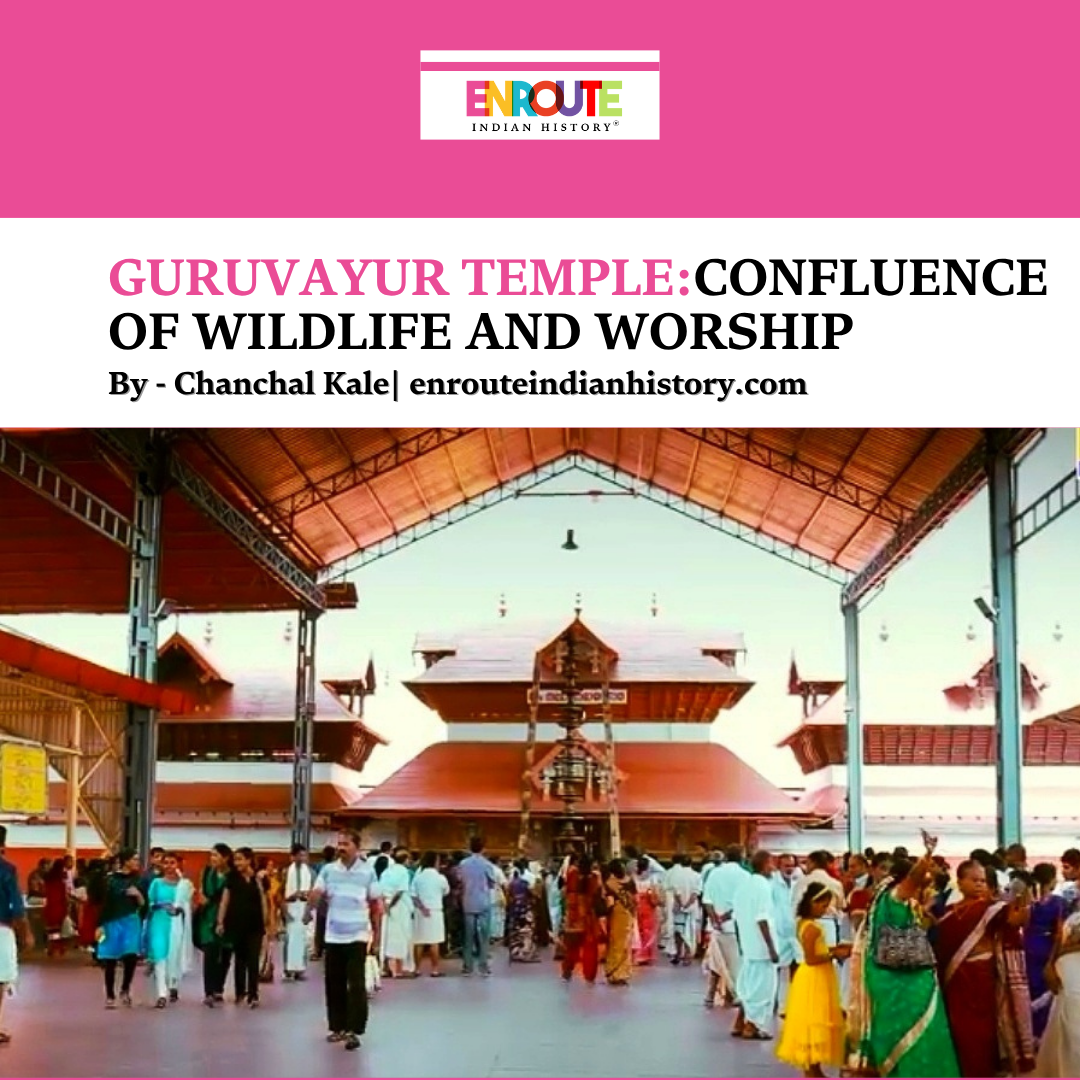
As one steps into the sacred grounds of Guruvayur Temple, an overwhelming sense of devotion to Krishna envelops you, transporting you from the mundane to the divine. This revered spot, known as Bhuloka Vaikuntha—meaning “where heaven meets earth”—is truly a celestial experience.
The temple's fascinating history includes its unique relationship with elephants, a tradition that began two centuries ago. The first resident elephant, a gentle Mākhana, played a vital role in transporting stones for the construction of the temple’s flag post. Following in its footsteps was the illustrious Padmanabhan, whose majestic presence graced the Thrissur Pooram festival 140 years ago, carrying the deity during the spectacular Madathil Varavu.
Each evening, the temple comes alive with a breath-taking Deity procession led by elephants adorned in dazzling jewels and gold. The sight of the resplendent Deity, surrounded by these magnificent creatures, draws thousands of pilgrims eager to witness the splendour. The priests emerge from the Deity's chamber, lifting Lord Krishna on a golden throne placed atop the lead elephant. This ritual is called “Seeveli” were the lead elephant, carrying the deity upon the forehead, circumambulates around the sanctum sanctorum. The scene is a feast for the senses, with priests wielding vibrant umbrellas and ornate fans, musicians playing lively tunes on drums, gongs, and trumpets, and devotees joyously chanting the names of the Lord—all against the backdrop of ten thousand flickering oil lamps illuminating the atmosphere.
The excitement peaks with the Guruvayur Aanayottam, or elephant race, a dazzling spectacle marking the start of the annual ten-day Guruvayur Festival held in the Malayalam month of Kumbham (February-March). This thrilling event showcases the grandeur of the largest land mammals engaged in a surprising contest of speed, truly a sight to behold.
Legend has it that the roots of Aanayottam lie in an age-old rivalry between the Zamorin of Calicut and the Raja of Cochin. According to local lore, the Guruvayur temple lacked its own elephants, relying instead on those from the Trikkanamatilakam temple. A misunderstanding between the authorities of the two temples led to an elephant not being sent to Guruvayur as scheduled. Just when it seemed the festival might not go on, an elephant tethered at Trikkanamatilakam broke free and sprinted all the way to Guruvayur Temple, ensuring the event could be celebrated as planned. To this day, the Aanayottam serves as a symbolic tribute to that remarkable day, were elephants start the race from Trikkanamatilakam to the Guruvayur Temple. Captivating the hearts of all who attend the festival, the winning elephant gets to carry the deity on its back until the next race.
Guruvayur Elephant Camp
Devotees of Guruvayurappan express their reverence by donating elephants to the temple, honouring Lord Krishna with these majestic creatures. In a heartfelt endeavour to care for these elephants, the Punnathur Kings' property was transformed into a sanctuary by the temple authorities in 1975. This sanctuary, known as Punnathur Kotta or Anakkotta, is the largest of its kind in the world and holds a cherished place in the hearts of devotees and elephant lovers alike.
The Guruvayur Elephant Camp is home to approximately 60 elephants offered by devoted worshippers. This unique sanctuary offers an extraordinary chance to witness the grandeur of elephants up close, weaving together cultural, educational, and spiritual experiences. These magnificent creatures play a vital role in temple rituals and festivals, symbolizing strength, divinity, and unwavering devotion.
Among the most renowned of these elephants was Keshavan. In January 1922, the Valiya Raja (King) of Nilambur dedicated one of his prized elephants to Lord Guruvayurappa, fulfilling a vow after reclaiming his property during the Malabar Mutiny. Named Keshavan, this 10-year-old elephant was noble yet mischievous, displaying a remarkable personality. He would bend his front legs only for those carrying the sacred thidambu (Deity), allowing them to mount his back, while others had to find their way by climbing up his hind legs.
Keshavan gained fame not just for his charm but also for his skill, famously winning the Guruvayur Aanayottam (elephant race) and earning admiration throughout Kerala. Towering at around 10.5 feet, he was among the tallest elephants of his time. Whenever the sacred replica was placed atop him, he held his head high, refusing to lower it until the entire procession concluded.
One legendary tale highlights Keshavan's unwavering dedication; he once escaped from a day’s labour as a timber elephant, believing his sole duty was to serve Lord Krishna. Undeterred, he made his way back to the temple on his own, a journey of 30 kilometres! The temple priests were taken aback to see him return without his mahout.
On another occasion, while hurrying to the temple and defying his mahouts, Keshavan encountered a helpless leper unable to flee. To everyone’s astonishment, he gently lifted the leper with his trunk, placing him safely aside before continuing on his path to the temple.
In 1973, Keshavan was bestowed with the title “Gajarajan” (King of Elephants) during the temple’s golden jubilee celebration for elephants. His profound devotion was unparalleled, and once he became the lead elephant of the temple herd, he fiercely protected his status. When another elephant was chosen to carry the Deity in the procession, Keshavan's jealousy flared, and he chased the rival away. Researchers have observed that elephants do exhibit feelings such as envy and jealousy. At such times, they are capable of throwing tantrums or being adamant, just like Keshavan in this tale.
Keshavan dedicated over fifty years of service to Lord Krishna at Guruvayur. However, on the significant day of December 2nd, 1976, coinciding with the Guruvayur Ekadasi festival, he fell gravely ill just as the Deity procession was set to begin. Unable to continue, he was taken to a nearby stable. The following evening, amidst a sea of chanting devotees and the sound of musical instruments, Keshavan peacefully departed to join the eternal realm of Vaikuntha.
A magnificent 12-foot high concrete statue of Keshavan now stands as a tribute at the spot in front of the Panchajanyam Rest House, a fitting memorial for this extraordinary devotee. When pilgrims arrive in Guruvayur, they are greeted by Keshavan’s tusks and his portrait elegantly displayed above the main entrance to the Deity chamber. Throughout the city, colourful paintings of Keshavan adorn many shops, keeping the spirit of this beloved elephant alive in the hearts of all who visit.
Conclusion
The Guruvayur Temple serves as a prominent example of the intricate relationship between ecological systems and spiritual practices in Kerala. Elephants, which play a crucial role in both the economic and social frameworks of Keralite society, are also integral to the region's religious celebrations. This symbiotic relationship highlights the profound interconnection between environmental factors, human communities, and religious beliefs, illustrating how ecological sustainability and cultural heritage are mutually reinforcing in this context.
Bibliography
1. Nalini Ramchandran, “Trumpet Calls: Epic Tales of Extraordinary Elephants”, Hatchette India, 2021
2. Sreedhar Vijayakrishnan and Anindya Sinha, “Human-Captive Elephant Relationships in Kerala: Historical Perspectives and Current Scenarios”,
Gajah 50, 2019, 29-35
3. The Hindu, “Elephant Race Marks Beginning of the Guruvayur Festival”, Published by The Hindu, February 21, 2024,
https://www.thehindu.com/news/national/kerala/elephant-race-marks-beginning-of-guruvayur-festival/article67871420.ece
4. “Deity Worship and Elephant Procession”, published by Holy Dham,
https://www.holydham.com/deity-worship-and-elephant-procession/
5. “Guruvayur- Elephant Camp”, Kerala Tourism,
https://www.keralatourism.holiday/best-places/guruvayur/elephant-camp.php#:~:text=The%20Guruvayur%20elephants%20play%20a,cultural%
20significance%20of%20these%20animals
6. “Guruvayur Aanayottam”, Kerala Tourism,
https://www.keralatourism.org/event/anayottam-festival-thrissur/77/