

Hajimemashite Hindustan! From Land Of Matcha to Land of Chaai
- May 28, 2026
-: by Ayush Tripathi
Picture this : a fifty-six-year-old Japanese manga artist arrives in Delhi in 2004. He speaks no English, has almost no money, and is missing a sigmoid colon. Despite all this, he is convinced he can sell Hindi translations of samurai comics on the streets of the capital. This is Yukichi Yamamatsu, the main character and author of‘Stupid Guy Goes to India’. By any measure, he is unprepared. He can’t read a Hindi sign. He can’t negotiate with printers. He doesn’t even know the word for prostitute in any Indian language, which becomes an awkward issue in one of the book’s notable chapters. He roams Old Delhi like a confused ghost, feeling both lost and fascinated. Yet this lack of preparation is what makes Yamamatsu’s story one of the truest accounts of the encounter between Japan and India at the everyday level. This meeting happens not in government offices, at diplomatic summits, or among elite artists, but on the busy streets of Paharganj and Chor Bazaar, in printing shops in Patel Nagar, and in slums near a Delhi Metro pillar. There, a boy named Shaheed, who only made it to Class IV, tries earnestly to do
multiplication in Yamamatsu’s sketchbook.
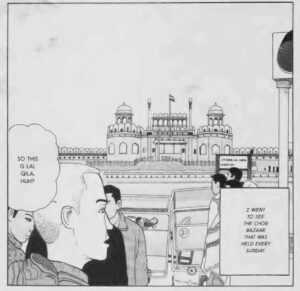
A panel from the manga ‘Stupid Guy Goes To India’ [Photo credits: artist Yukichi Yamamatsu]
A Manga Artist Lost In Delhi
Yamamatsu did not come to India just to observe. He came to sell something, a Japanese comic that reads right to left about samurai. His boldness alone deserves chapter in the history of cultural relations between India and Japan. The manga takes place mostly in Delhi. Yamamatsu rents a room, hires a part-timer named Surender who is often “off” due to mysterious ailments, and recruits a student named Kumar from a Japanese language school. He attempts the challenging task of introducing Japanese comic culture to a city that reads from left to right and has strong opinions about paper quality. His printers charge him 57,000 rupees and then quietly reduce the image size to seventy percent without asking. The covers of his books come loose from the pages. His outdoor stall gets shut down by someone who could be a gangster. He gives shiatsu massages to bag sellers who feel sorry for him and allow him to set up near their trucks.
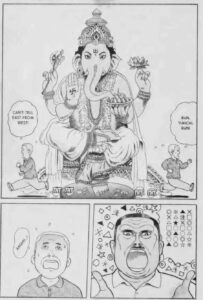
A panel from the manga ‘Stupid Guy Goes To India’ [Photo credits: artist Yukichi Yamamatsu]
If you read this story as a comedy, you miss much of the point. If you approach it as a sociological snapshot of two very different cultures of commerce, trust, and time, it becomes enlightening. Yamamatsu is not mocking India. He is genuinely puzzled, then genuinely affectionate. The Hindi phrases sprinkled throughout his panels (“Theek hai,” “Mushkil nahin,” “Yeh pustak sundar hai!”) are not mockery; they are his way of reaching out. He depicts Delhi through the eyes of someone who cannot stop observing. One afternoon, while taking a break from the lettering work, Yamamatsu steps into the street with a pocket full of marbles. He notices Indian street marbles are not perfectly round, and there are fewer variations in the game than the Japanese version. But that’s no problem. The boys on the street quickly welcome him. There’s a particularly skilled player who wins every round, hiding extra marbles in the hollow of his palm because the marbles are so small. Yamamatsu teaches them the Japanese version of the game. “Aao, khelenge!” someone calls out. The lesson requires no common language. This quiet moment is one of the book’s most beautiful: a middle-aged Japanese man and a group of Delhi street children crouching over glass marbles in the dirt, figuring out the rules of the game through gestures, laughter, and the universal understanding of who wins. Yamamatsu is not the first Japanese person to come to India with a passionate, almost irrational belief that something fundamental awaits them here. In fact, he is part of a long history.
Japanese Prince on his Journey To The West
Let’s go back to the ninth century. In Tatsuhiko Shibusawa’s wonderful novel ‘Takaoka’s Travels’, translated into English by David Boyd in 2024, we meet Prince Takaoka, a real historical figure. He was the third son of Emperor Heizei, a Buddhist monk who, at sixty-five years old, boarded a ship in Guangzhou in 865 CE and
headed for Hindustan. He never got there. He vanished into the continent and was never heard from again. History swallowed him. What Shibusawa does is imagine the journey that history forgot. At the center of this dream is a deep desire for India so intense it feels like a fever. The Prince first hears the word “Hindustan” as a small child from his father’s consort, Kusuko, a woman with extraordinary knowledge and striking beauty. She tells him that in Hindustan, rivers run backward, mountains sink into the ground, day and night are reversed, and everything is the opposite of what he knows. “What do you think, Miko? Can you imagine such a strange place?” she asks, and the boy cannot sleep for weeks. Prince Takaoka is a well-known figure in Japanese history. He is also known as Shinnyo Shinnō or the “Fallen Prince.” He left Japan for Tang China in 862 CE, then tried to travel onward to India. He is thought to have died somewhere in Southeast Asia, possibly now part of Myanmar or Thailand. His disappearance became a kind of legend in Japan, the story of a man so captivated by the idea of India that he walked into the horizon and never returned.

A panel from the manga ‘Prince Takaoka’s Voyage’ [Photo credits: artist Kondou Youko]
This is the earliest layer of the India-Japan relationship: India as the source. Not just the historical origin of Buddhism, which is significant on its own. Everything Japan understands as sacred, from temple architecture to the principles of its metaphysics, comes from the Indian subcontinent, passing through China and Korea. For centuries, India was the direction you faced for prayer. Hindustan was the birthplace of the Buddha, the land where the dharma first emerged, the spiritual compass point.
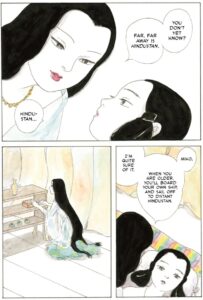
A panel from the manga ‘Prince Takaoka’s Voyage’ [Photo credits: artist Kondou Youko]
But Shibusawa offers something deeper than a simple retelling of a pilgrimage. His Prince Takaoka is not a devout man seeking enlightenment. Rather, he is, as Shibusawa describes him, “a practitioner of exoticism, in the original sense of the word.” The Prince is drawn to India the way some people are attracted to anything radically different: not out of responsibility, but from a physical need to experience the unfamiliar. He wants to be turned inside out. He seeks surprises that push him into a new existence.

A panel from the manga ‘Prince Takaoka’s Voyage’ [Photo credits: artist Kondou Youko]
In the jungle of the Malay Peninsula, the travelers discover a ball-shaped object they mistake for a mushroom. Engaku, the polymath herbalist monk, leans down to inspect it. It rolls away with the wind, releasing a fragrance of extraordinary beauty. Everyone feels a momentary intoxication. They continue deeper into the jungle and find more of these balls. Unable to resist, Akimaru grabs one and inhales deeply, only to be overwhelmed by a terrible stench that makes her vomit for twenty minutes. They learn the truth when they reach the kingdom of Panpan: the balls are excrement of baku (supernatural creatures who eat dreams of sleeping people). When the dream-eating baku receive high-quality dreams, their dung smells like paradise. When they eat bad dreams, it smells like hell. The Prince, one of history’s great dreamers, becomes the official dream supplier for the Panpan menagerie. Every morning, he wakes up unable to remember a single dream. The baku have consumed all of them. The novel subtly implies that this is the cost of nourishing another civilization with the contents of your inner life.
When Tenshin Met Tagore
Jump to 1902. A Japanese curator named Okakura Tenshin arrives in Calcutta, and everything changes. Okakura had already penned the phrase that would resonate for generations: “Asia is one.” He meant it as a cultural and spiritual statement, arguing that from the Mediterranean to the Pacific, a single civilizational
current connected India and Japan, linked through Buddhism, aesthetics, and a shared rejection of Western materialism. It was a beautiful idea but, as Rustom Bharucha illustrates in his remarkable study ‘Another Asia: Rabindranath Tagore and Okakura Tenshin’, it was also dangerously simplistic.
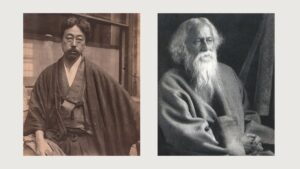
kakura Kakuzo (left), circa 1905, and Rabindranath Tagore, circa 1941 [Photo credits: Japan Forward]
In Calcutta, Okakura met Rabindranath Tagore, and they experienced something akin to mutual recognition.
Here were two of Asia’s greatest artistic minds, separated by language and geography, yet sharing a strong sense of civilizational pride and anti-colonial determination. Tagore sought voices that understood the concept of being modern without being Western, of embracing the future while preserving the past. Okakura, too, came to India with a similar spirit, believing that this encounter would fulfill something within him. They met only twice in their lives, once in Calcutta in 1902 and briefly in Boston in 1913. They did not correspond during the years in between. They did not systematically study each other’s work. Yet, as Bharucha
points out, their friendship became “almost iconic,” a symbol of cultural dialogue between Asia that people still reference, romanticize, and aspire to today.
Okakura’s “magnetic triangle” of tradition, originality, and nature was not just a theoretical idea. He showcased it to the leading figures of the Bengal School, Abanindranath Tagore and Nandalal Bose, using matchsticks arranged on a table to illustrate how the three elements must interact or else tradition reduces to mere convention. If originality does not challenge tradition, and if neither is engaged by the world of nature, the artwork becomes what Okakura termed “a reptile,” surviving dismemberment but lacking real vitality. In contrast, a strong composition is like a human body: even the smallest prick triggers a response throughout the whole system. This simple demonstration, conducted in a Jorasanko drawing room in 1902, still influences art education in Santiniketan today. Bharucha is too astute a critic to reduce their friendship to mere legend. He carefully unpacks the contradictions. Okakura’s “Asia is one” was also intertwined with Japanese nationalism, and a form of imperialism that would eventually lead Japan to devastate much of the continent it professed to love. The same Okakura who recognized Tagore’s brilliance across the Bay of Bengal was also a man whose vision of Asian unity could be interpreted , and was interpreted by some Japanese thinkers , as a justification for Japanese dominance, a cultural Pan-Asianism that served the interests of the Meiji state. Tagore, who traveled to Japan multiple times
and admired what he found there, later grew alarmed at the direction Japanese nationalism took. He spoke out publicly to Japanese audiences who did not want to hear his concerns. It’s revealing to compare Okakura with his contemporary Fukuzawa Yukichi, the Meiji reformer whose 1885 essay “Goodbye Asia” urged Japan to completely abandon its Asian neighbors and align instead with the West. For Fukuzawa, westernization was like catching measles, a contagious disease that spread according to a natural law that could not be resisted. You either opened the window and let the infection in, or you shut yourself inside and suffocated. In Fukuzawa’s view, Asia was that room. Okakura represented the opposite view yet ultimately served similar imperial interests, because an Asia led by Japan, no matter how lovingly envisioned, remained Japan-led. What Bharucha saves from this complexity is not innocence; there is no innocence to be recovered, but rather something more valuable: the record of a true aesthetic encounter. Okakura did indeed provide the Bengal School of painting with something substantial. Japanese wash techniques, the Japanese emphasis on inner spirit over outer form, and the practice of the Japanese painter Taikan, who would lie among insects to connect with
them before drawing, all influenced Bengali painting. These ideas became ingrained in Bengali art, eventually becoming indistinguishable from it. The Japanese painter Yokoyama Taikan, visiting Abanindranath Tagore’s studio in Jorasanko, is commissioned to depict the Ras-Lila, the love play of Radha and Krishna, on a full-moon night. He sketches repeatedly over several days but struggles to capture the image. Then one afternoon, he notices a dish of white flowers left by the ladies of the house near his open scroll. Some flowers have spilled onto the painting. He stares at the scene and begins to scatter flowers across the entire scroll, suddenly unlocking something in the composition: bhava, the flow of feeling, emerges. The missing emotion had been waiting to be revealed in the accidental fall of petals. What transpires between these two artists in that moment; a Bengali subject, a Japanese painter, flowers from a household shrine, is precisely the kind of connection no formal guidelines on cultural relations can ever convey, and that no political break can fully erase. Beauty, Bharucha argues, complicates power. You cannot fully understand Okakura through his nationalism alone. You must also consider the Japanese artist who found his way into Krishna through fallen flowers and the Bengali painting tradition that carries within it traces of a Japanese sensibility that arrived in Calcutta on a monsoon morning in 1902 and never really departed.
What the Manga Artist Found In Delhi Let’s come back to Yamamatsu, back to Delhi, back to 2004. The curious thing about ‘Stupid Guy Goes to India’ is how closely it mirrors everything that came before. Yamamatsu reaches India like Prince Takaoka’s ship arrived in Champa: wildly off-course and completely unprepared, yet with senses more alive than in his ordinary life back home. He is unsure of what is happening to him but documents it anyway in his precise manga panels, driven by an instinct that recognizes the encounter itself is the point, even if it resists all resolution. Delhi will not conform to his expectations. The city has its own rhythm, its own sense of time and duty, and its own social norms that make sense to its residents but confuse outsiders. Surender, his part-time assistant, is often sick at the most inconvenient times. The printer sahib engages in a complicated negotiation where each completed job introduces a new fee, deduction, or reason the original price has changed. The booksellers at Chor Bazaar are friendly. They show interest in the manga but have no intention of buying it. Yamamatsu sketches all of this without malice or understanding, and that makes it authentic. On what must have been a particularly tough workday, Yamamatsu decides to try his luck at the horse races. He heads to an off-track betting counter near Lal Qila, where the ticket system relies on handwritten slips and private odds calculated by men using binoculars from small wooden boxes. He buys racing tip sheets for ten and sixteen rupees. Following the advice of a young man who seems confident, he bets on Number 5 in every race. He wins back 850 rupees in the third race and feels briefly ecstatic. After that, he doesn’t win again. With his usual deadpan, he comments on the poor service, how staff treat customers as inconveniences, the lack of investment in facilities, and the apparent corruption, but he expresses this without anger, maintaining the tone of pure observational wonder that characterizes his view of everything. He observes that the racing scene in India reminds him of how Japanese horse racing insiders used to buy betting slips once the results were known. He is connecting a cross-cultural history of corruption through horse racing, showcasing the unexpected insights of Stupid Guy Goes to India.
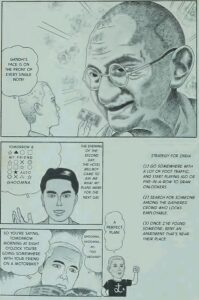
A panel from the manga ‘Stupid Guy Goes To India’ [Photo credits: artist Yukichi Yamamatsu]
There are also moments of genuine connection that quietly build this cross-cultural history. The metalware seller cannot understand what Yamamatsu is saying but eventually clears space on his truck for the manga stall, demonstrating that persistence can overcome language barriers. Noriko Nasugawa, a Japanese language teacher at an NPO, introduces him to students who might help with translation, asking for nothing in return. The students, from well-off families, find the idea of a Japanese comic artist wandering Delhi alone so remarkable that they want to help.

A panel from the manga ‘Stupid Guy Goes To India’ [Photo credits: artist Yukichi Yamamatsu]
Then there’s Surender’s wife, Suman, who staples paper pattern banners for six rupees each as a side job while Surender continues to struggle with his civil service exam. Yamamatsu notes that Suman will only eat white-backed fish like sea bream and cod; she avoids black-backed fish like mackerel and sardines for reasons she
cannot explain. Yamamatsu, who is diabetic and drinks large amounts of water to cope with Delhi’s heat, observes this preference with curiosity. He usually eats five-rupee biscuits for most of his meals. They live together in a small apartment under circumstances that would overwhelm a less cheerful person, relying on vocabulary of about forty words in each other’s languages to communicate. He isn’t the first Japanese person to come to India in search of transformation only to find himself changed in ways he cannot describe. He is simply the most recent and the most vividly portrayed. There’s a moment in the book where Yamamatsu frankly reflects that being among people, even those he cannot communicate with, even in the chaotic, crowded environment of Delhi, is better than being alone in a quiet place. “A place with people around was still better than a lonely place with no one at all.” For someone from a country where loneliness is almost an art form and social interactions can be superficial, this observation about India carries significant weight. Yamamatsu did not come to India and find what he expected. Instead, he discovered something he hadn’t realized he was searching for. This illustrates the oldest narrative in the India-Japan relationship; every encounter surpasses the plan. Dreamers Who Imagined Asia as One India and Japan have engaged in a dialogue for over a millennium and a half, a conversation that has manifested in many ways, some beautiful, some painful, and most surprising. It began with Buddhism. The ideas that emerged from the Gangetic plains transformed Japanese civilization so thoroughly that it’s hard to imagine Japan without them. Every rock garden in Kyoto, every temple bell, every concept of impermanence and the beauty of the temporary; all trace back to a meaningful connection to India. This isn’t just a metaphor; it is history. Next came sailors and adventurers: Tenjiku Tokubei and his contemporaries who made their way across stormy seas to Bengal, returning with tales that reshaped Japan’s worldview. Then artists and thinkers followed: Okakura arrived in Calcutta with his ambitious dream of Asian solidarity, meeting Tagore and igniting an aesthetic exchange that still resonates in Indian painting. There were colonialists and wars; Japan’s role in Southeast Asia, its complex involvement during the end of European imperialism, and how its version of pan-Asianism soured toward something that Asia, including India, could not easily forgive or forget.Now in contemporary times, there are trade partnerships, metro lines built with Japanese technology, anime broadcast on Delhi televisions, and manga that a fifty-six-year-old artist attempted to sell on the streets of OldDelhi, largely without success. Japanese restaurants in Hauz Khas serve ramen to young Delhiites who grew up enjoying Naruto and Attack on Titan, often without realizing they are interacting with Japanese cultural exports tied to a tradition that Yamamatsu carried in a backpack through Paharganj two decades ago.
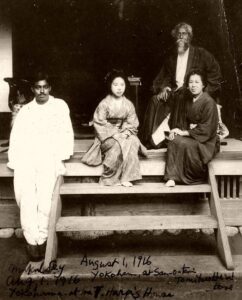
Rabindranath Tagore and Mukul Dey with Kiyo-san and another Japanese lady [Photo credits: Wikimedia Commons]
What connects Prince Takaoka’s ninth-century voyage, Tenjiku Tokubei’s seventeenth-century adventure, Okakura Tenshin’s meeting with Tagore in 1902, and Yukichi Yamamatsu’s manga journey in 2004 goes beyond geography; it’s something deeper. Japan has always looked toward India, feeling both awe and longing.
It’s a recurring Japanese belief, spanning centuries, that India offers something not found at home; a vastness, a spiritual richness, and an overwhelming, irrational, magnificent human experience.
Bibliography
•Yamamatsu, Yukichi. Stupid Guy Goes to India (Indo e Baka ga Yattekita). Trans. Kumar Sivasubramanian.
Chennai: Tranquebar / Westland, 2011. Originally published in Japan, 2006.
•Bharucha, Rustom. Another Asia: Rabindranath Tagore and Okakura Tenshin. New Delhi: Oxford University
Press, 2006. Shibusawa, Tatsuhiko
•Takaoka’s Travels (Takaoka Shinnō Kōkaiki). Trans. David Boyd. Berkeley: Stone Bridge Press, 2024. Originally
published in Japan, 1987.
• Okakura, Kakuzo (Tenshin).The Ideals of the East. London: John Murray, 1903.
•Tagore, Rabindranath. Nationalism.London: Macmillan, 1917.