
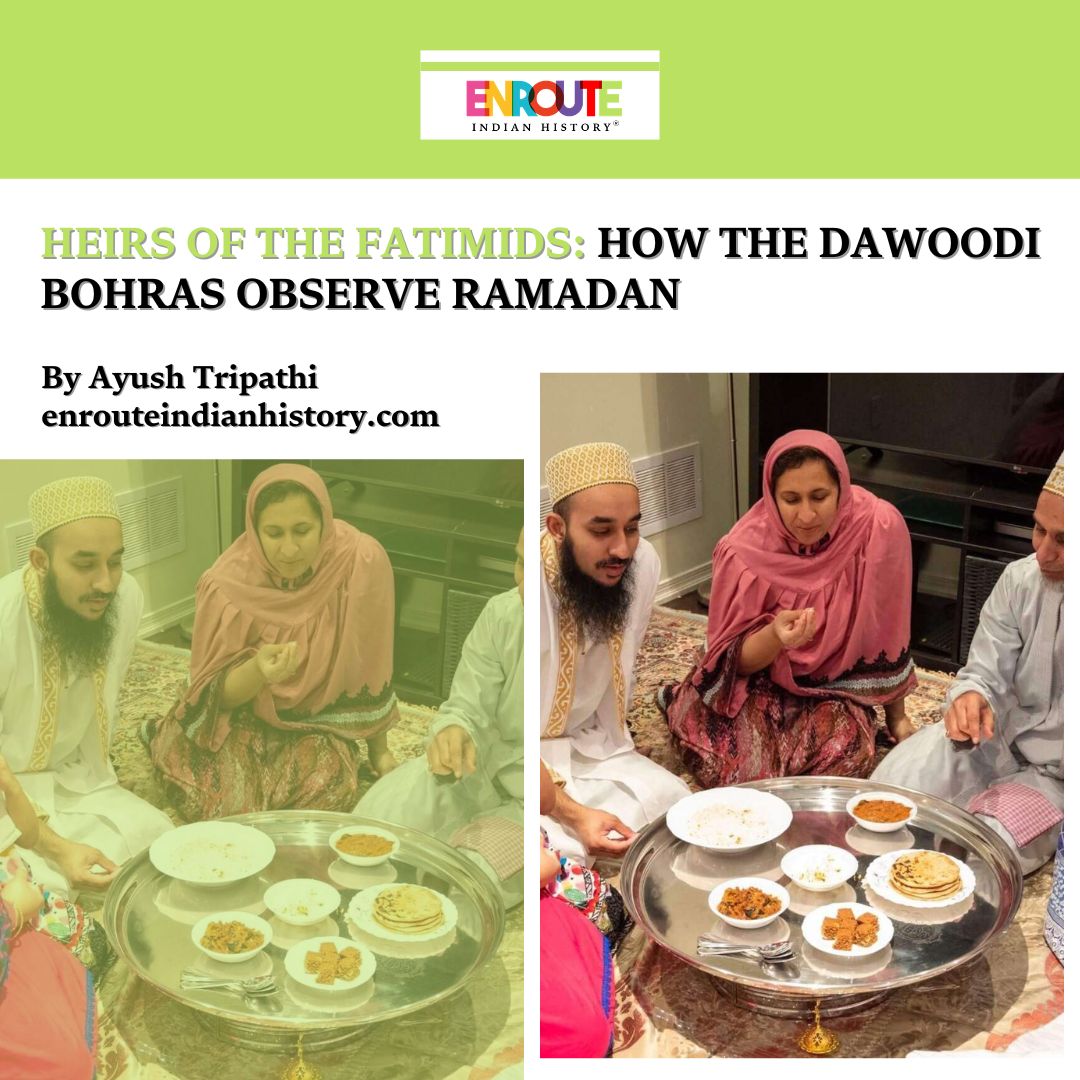
-by Ayush Tripathi
Abstract
Ramzan ayo, ramzan ayo,
mah-e-mubarak ayo re,
Ism-e-Khuda ni barakat layo,
roze-waala ayo re
‘Ramadan has come, Ramadan has come, the blessed month has come, bringing the blessings of the name of God, the month of fasting has come.’
-one of the most celebrated Ramadan madeh in the Dawoodi Bohra tradition
From Cairo’s Shadow to Surat’s Shore
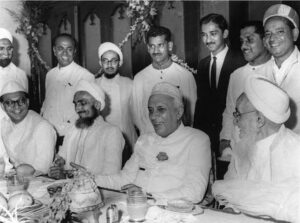
51st Al-Dāʿī al-Mutlaq of Dawoodi Bohras Syedna Taher Saifuddin with Pt. Jawaharlal Nehru in Surat, 1960 [Source: Dawat-e-Hadiyah]
The Bohras, a name that comes from the Gujarati word ‘vohoru,’ meaning trade or commerce, are primarily a business community. They originated in Gujarat, especially in cities like Surat, Ahmedabad, Bharuch, and Sidhpur, and have since spread across India and globally to East Africa, the Arabian Peninsula, North America, Europe, Australia, and Southeast Asia.
They belong to the Fatimid Tayyibi Ismaili Shia branch of Islam, tracing their spiritual lineage not only to the Prophet Muhammad (peace be upon him) and Imam Ali ibn Abi Talib but specifically through the Fatimid Caliphate of Cairo, established in 909 CE, through Imam al-Mustansir Billah, and finally through Imam al-Tayyib, the infant son of Imam al-Amir bi-Ahkam Allah, who disappeared around 1130 CE. Since that time, the Dawoodi Bohras have relied on a representative of the Imam on earth, known as the Da’i al-Mutlaq, who holds spiritual, legal, and community authority in the absence of the Imam.
The Bohras’ arrival in Gujarat was due to Fatimid missionaries who were originally in Yemen. The Da’wat was moved to Yemen from Egypt in 1171 CE when the Fatimid Caliphate fell to Saladin. The Tayyibi Da’wat provided Indian (primarily Gurajat) missionaries called “du’at” as missionaries to continue to support those who had been removed from their homes.
Syedna Yusuf ibn Sulayman established the first permanent headquarters for Da’wat in India. Sidhpur (Gujarat) was advantageous to the population of Vohora traders and was located on the trade route on the Saraswati River. Earlier Syedna Ali ibn Muhammad ibn al-Walid, the 5th Da’i, was already engaged in establishing a Da’wat in India in the 13th century when he served as Da’i. The headquarter of Da’wat was then moved to Ahmedabad and then to Surat.
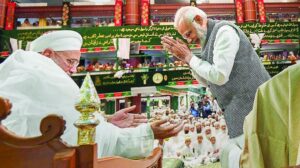
53rd al-Dai al-Mutlaq and leader of the Dawoodi Bohra community, Syedna Mufaddal Saifuddin with Prime Minister Narendra Modi in Indore, 2018 [Source : The Indian Express]
The current Da’i al-Mutlaq is His Holiness Dr. Syedna Mufaddal Saifuddin (TUS), the 53rd in an unbroken line, who continues the Fatimid intellectual tradition from Mumbai. This line of Da’is has unified the community for nearly nine centuries, helping them through significant challenges such as the collapse of the Fatimid Caliphate in 1171 CE, the Taiyebi-Hafizi schism, the harsh Inquisitions in Mughal Gujarat under Aurangzeb, and the pressures of modernity. Their global population is estimated to be around one to two million. They have a distinctive language called Lisaan ud-Da’wat, which combines elements of Gujarati, Arabic, and Urdu, and is written in a modified Arabic script known as Dawat-ni Lipi.
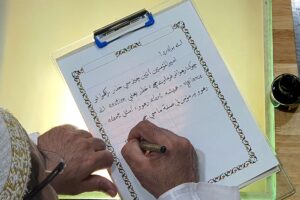
Lisan al-Dawat : The Dawoodi Bohra Language [Source : The Dawoodi Bohras website]
In Ismaili philosophy, every religious practice (shari’a) has a zahir, or outward aspect, and a batin, or inward meaning. The Bohras observe the zahir of Ramadan with a month-long fast from dawn (Fajr) to sunset (Maghrib), the nightly prayers of Tarawih, which they call Qiyam or Salat al-Layl, and the avoidance of food, drink, and marital relations during the day. However, the batin of fasting, as per Fatimid doctrine, is a fast for the soul: protecting the mind and heart from the temptations of the material world while dedicating oneself to hikma, or divine wisdom, as taught by the Imam and Da’i.
Fatimid thinkers like al-Qadi al-Nu’man (d. 974 CE), who wrote the significant Da’a’im al-Islam (Pillars of Islam), and Hamid al-Din al-Kirmani (d. c. 1020 CE) built intricate symbolic frameworks showing how every ritual element held cosmic meaning. Ramadan, the month when the Qur’an was revealed, was seen as a time when the deeper meanings of the scripture were most significant, and when the connection between the believer and the Imam — the natiq or Speaking Imam, the embodiment of divine wisdom — was strongest.
Since the Imam is in occultation, the Da’i al-Mutlaq plays a vital role during Ramadan. His bayans, or sermons, set the spiritual tone for the month. Bohras around the world gather to listen to the Da’i’s Ramadan waaz (sermon) and the nightly lectures from senior clergy (shaikhs, amils) who share his spiritual guidance.
A key aspect of Bohra practice is their method for ordering the lunar calendar. Unlike the moon-sighting method (ru’yat al-hilal) used by most Sunni communities and the practices of Iranian or Iraqi Twelver Shia, the Dawoodi Bohras follow a calculated astronomical calendar from the Fatimid tradition, called the Fatimi Taqwim. The Fatimid caliphs, known for supporting astronomy, set up observatories in Cairo and created precise mathematical tables for determining lunar months. The astronomer Ibn Yunus (d. 1009 CE), under Fatimid support, produced the Hakimi Zij, dedicated to Imam-Caliph al-Hakim bi-Amr Allah; this work was one of the most accurate astronomical texts of the medieval era. This astronomical heritage continued in Yemen during the Tayyibi period and was passed to India through the Da’i lineage.
Thus, the Bohra calendar is calculated rather than based on observation. The start of Ramadan and the date for Eid al-Fitr are announced by the Da’i al-Mutlaq weeks or even months beforehand, based on exact calculations. As a result, Bohra Ramadan can begin one or two days before or after Sunni communities in the same town, and Eid is celebrated on a fixed date instead of waiting for moon-sighting reports.
During Ramadan, the Bohra daily schedule is notably precise. They observe the five daily prayers (namaaz) at their specific times but often combine them in pairs (Fajr alone; Zuhr and Asr together; Maghrib and Isha together), following Fatimid jurisprudence outlined by al-Qadi al-Nu’man in Da’a’im al-Islam. This combination of prayers, while debated among Sunni scholars, finds strong support in certain Prophetic ahadith and was formalized in Fatimid legal thought.
The timing for sehri (the pre-dawn meal, known as Suhoor) is traditionally announced in Bohra communities not through loudspeakers or the local muezzin but by the Du’a-wala, a designated community member who would walk through the neighborhood calling out the time. In many traditional Bohra areas of Gujarat, this was accompanied by playing a small drum or striking a brass vessel. The announcement would often be a short improvised verse in Lisaan ud-Da’wat:
Uthho, uthho, mumineen,
Sehri ni waqt che,
Rabb ni yaad karo,
Fajar thi pehla kha lo
— ‘Rise, rise, O believers,
The sehri hour is here,
Remember your Lord,
Eat before dawn arrives.’
The actual breaking of fast (iftar) occurs at astronomical sunset. Bohras typically begin their fast not with the call to prayer, as Sunnis do, but slightly earlier, with dates and water, following Prophetic tradition, and then perform Maghrib prayer in congregation before having their main meal.
Sunni communities pray up to 20 rakats of Tarawih in congregation each night during Ramadan. The Bohras have a different nightly prayer called Qiyam or Salat al-Layl, based on Fatimid practice.
Like all Muslims, Bohras honor Laylat al-Qadr, the Night of Power, during the last ten nights of Ramadan, focusing particularly on the odd nights (21st, 23rd, 25th, 27th, and 29th). While many Sunni traditions celebrate the 27th of Ramadan as the most significant night of Laylat al-Qadr, Bohras distribute the importance across the last ten nights, with the 23rd being especially noteworthy. In addition, specific nights of the month carry particular prayers and historical observances — for instance, there is a special prayer for the start of the fast on the 1st night (Dua-e-Iftitah), a midpoint celebration on the 15th night, and anticipation of Eid on the 29th night.
In the Tayyibi view, the ‘Night of Power’ is not just one night of great significance but represents a metaphysical idea linked to the eternal Night of Power that exists within the living Imam, and by extension, within the Da’i during his occultation. Being present with the Da’i and receiving his dua signifies experiencing a constant Laylat al-Qadr. The Da’i’s residence, often in Mumbai but historically located in Surat, becomes a pilgrimage site during Ramadan, with thousands coming to receive his blessings and take part in community iftars.
A defining feature of Bohra Ramadan is the nightly waaz, a formal religious talk given by a trained scholar (alim) of the Da’wat, usually connected to The Aljamea-tus-Saifiyah (the Bohra Arabic Academy, with locations in Surat, Karachi, Nairobi, and Colombo). The communal, mosque-based prayer is less important than the waaz, or sermon, during Bohra Ramadan.
These waaz sessions differ from the khutba (Friday sermon) in style and content. They are conducted in Lisaan ud-Da’wat but include significant Arabic quotations, blending Qur’anic interpretation, Fatimid philosophy, historical accounts of the Ahl al-Bayt (the Prophet’s family), moral instruction, and practical community guidance.
During Ramadan, the waaz can follow a theme: the first ten nights focus on Rahma (Mercy), the middle ten on Maghfirat (Forgiveness), and the last ten on Nijaat (Salvation), reflecting the famous Prophetic saying about Ramadan’s divisions. The congregation listens intently, and the conclusion of the waaz is marked by a collective dua led by the scholar.
In Ramadan, the Bohra mosque becomes the center of community life in a way that’s different from the broader Indian Muslim experience. Bohra mosques (also called Dawat-ni Masjid) are designed with Fatimid-inspired architecture, featuring white facades, floral tilework, pointed arches, and an aesthetic that evokes the grand Fatimid mosques of Cairo, such as al-Azhar (built in 970 CE), al-Hakim Mosque (built in 1013 CE), and al-Aqmar Mosque (built in 1125 CE). The Da’i al-Mutlaq actively supports the restoration and upkeep of these architectural styles, and new Bohra mosques worldwide often include elements like Egyptian mashrabiyya (latticed wooden screens), muqarnas (honeycomb vaulting), and calligraphic decorations inspired by Fatimid designs.
Within the mosque during Ramadan, the Bohra congregation is arranged in a hierarchy reflecting the community’s structure: the Amirul Jamaat (local representative of the Da’i), the Shaikhs (knowledgeable clergy), the Mullas (teachers), and the general mukhlisin (devout followers). They often sit on the ground, on beautifully embroidered prayer rugs and takiyas (bolsters), with women in a separate but architecturally integrated section (the Zenana).
Dawoodi Bohra Folktales & Oral Narratives
Bohra folk narratives mix Qur’anic stories, Fatimid legends, Gujarati tales, and moral lessons. Grandmothers (dadi or nani) often tell these stories to children during the nights of Ramadan, after iftar and before prayers—an engaging time when children are alert yet prayerfully focused.
One tale recounts that during Ramadan, Bilal was supposed to call the sehri adhan. He was delayed because a cruel debtor had taken his garment. Nonetheless, he arrived barefoot and without his cloak. His voice resonated through the sleeping city of Madina, like a silver thread pulling hearts upward. When the Prophet heard him, tears fell from his eyes. He told his Companions, “The truth of faith has no garment finer than the naked voice of a sincere heart.” From that moment, the Bohras believed that calling to sehri was not just a duty but a treasure. Even the poorest person, if calling sincerely, is richer than any king.
The Tale of the Three Thaals is a unique Bohra story used to teach children about the theology behind the thaal, emphasizing that all people are equal before God.
A wealthy merchant in Surat had three sons. During Ramadan, he prepared three thaals for iftar: one of gold for himself, one of silver for his wife, and one of iron for the servants. An old fakir arrived at iftar time. The merchant, not wanting to share his gold thaal, sent the fakir to eat with the servants from the iron thaal. The fakir ate, thanked God, and left. That night, the merchant dreamed he was at the gate of Paradise, where the guardian told him, “Your servants entered first because they shared a single thaal with a stranger. You must wait.”
This story conveys the Bohra belief that the thaal is not merely about dining customs but reflects the divine order where everyone is equal before the Lord.
The Fox and the Crescent Moon is a nature fable meant to teach children why Bohras begin Ramadan with calculations instead of relying on moon sightings.
In a village, people waited every Ramadan for a fox to see the new moon, as they believed the fox had the sharpest eyes. However, one year, the fox was bribed by a lazy merchant to say the moon had not been seen, allowing the merchant to keep eating for one more day. The village fasted for thirty-one days, becoming weak and angry. A learned man then questioned why they trusted the fox’s eyes when God had given them mathematics. He said the moon follows God’s law, not the whims of animals. From that day on, the learned man calculated the calendar, and the village knew when Ramadan would start well in advance. This is why, children, we trust the knowledge of our Da’i over rumors because the Da’i’s insight is a gift from the Imam, and the Imam’s wisdom comes from God.
Fatima’s Lamp is a cherished Eid story shared across generations about a poor Bohra widow who had nothing for her daughter on Eid morning.
The widow woke before dawn and prayed the full Tahajjud prayer, weeping because she had no new ridaa for her daughter, no sweets for the thaal, and no Eid money to give. As she prayed, she heard knocking at her door. A stranger, an old woman with kind eyes, handed her a lamp filled with pure oil. “Light this at the first takbir of the Eid prayer,” said the stranger, “and it will never go out.” The widow followed her instructions, and the lamp burned all day. Each time she looked at it, she saw the smiling faces of her long-deceased husband. The daughter said, “But we still have no ridaa, no sweet!” The widow replied, “We have a light that does not go out. Some have gold. God gave us a lamp.” Seeing the lamp burn through Eid, neighbors brought their own thaals and gifts, filling the widow’s house by evening. It is said the old woman was Mawlatuna Fatima al-Zahra herself, visiting homes where widows pray alone before dawn.
Bohra Ramadan has a deep oral and musical devotional tradition, although the term “musical” requires careful consideration. The Bohras differentiate between sacred chanting, which is encouraged, and instrumental music, which is usually avoided in religious settings. The main forms of devotion are:
Madeh (Praise Poetry)
Madeh in Lisaan ud-Da’wat is the main way to express devotion during Bohra Ramadan. These are poems that praise the Prophet, Imam Ali, Fatima al-Zahra, Imam Husain, and the line of Imams and Da’is. They are chanted in a call-and-response style, with a leading muqri (reciter) singing a verse and the congregation replying with a refrain. The melodic mode (maqam) changes; some madeh are set in a solemn, slow Hijaz mode while others use lively Bayati or Rast modes. The Ramadan collection includes specific madeh for sehri waking, iftar, and Shab-e-Qadr.
Marsiya and Noha
These are poems that mourn the martyrdom of Imam Husain and the tragedy of Karbala. While marsiya is more closely linked to Muharram in mainstream Shia practice, Bohras incorporate marsiya elements into Ramadan, especially during the last ten nights, reflecting on themes of sacrifice, determination, and God’s will.
Du’a and Munajat
The community has many Ramadan-specific du’as, most of which come from Fatimid sources. The Du’a-e-Sahar (Dawn Supplication), recited in the final part of the night before sehri, is especially moving. It is often chanted in the mosque or at home in a plaintive melodic mode, expressing the believer’s yearning for divine mercy and the Imam’s closeness.
One of the most famous Ramadan madeh in the Bohra tradition has been chanted for generations and marks the start of Ramadan:
Ramzan ayo, ramzan ayo, mah-e-mubarak ayo re,
Ism-e-Khuda ni barakat layo, roze-waala ayo re.
‘Ramadan has come, Ramadan has come, the blessed month has come, / Bringing the blessings of the Name of God, the month of fasting has come.’
Another well-known Ramadan qasida, written in classical Arabic and linked to Fatimid court poetry, is recited on Shab-e-Qadr:
Ya Laylata al-Qadr, fi-ki nazzala al-Kitaab,
Wa fi-ki futihat abwaab al-tawba wa al-inaab.
‘O Night of Power, in you was the Book revealed,
And in you the gates of repentance and turning were opened.’
A famous munajat (intimate supplication poem) recited during the last ten nights, attributed to Imam Ali’s Sahifa supplication text, reflects the believer’s longing:
Maro rab mane maaf kare,
Mara gunaah ek-ek maaf kare,
Mawla ni dua mane pahuche,
Imam ni chadar mane dhake
‘May my Lord forgive me,
May he forgive each of my sins one by one, May the Du’a of the Master reach me,
May the Imam’s mantle cover me.’
Eid morning is celebrated with a joyous madeh that marks the shift from the solemnity of fasting to the joy of completion:
Eid mubarak, eid mubarak!
Chaand dekho, khushi karo,
Roza rakha, Allah manya,
Mawla ni meherbaani, haq ado.
‘Eid Mubarak, Eid Mubarak!
See the moon, rejoice,
you kept the fast, God accepted,
the Master’s grace — render what is due.’
No custom distinguishes the Bohras from other Muslim communities in India and beyond as clearly as the thaal. This large circular communal dining platter brings groups of six to eight people together on the floor to share meals in complete harmony. The thaal is more than just a utensil; it represents a theological statement, a social practice, and a ritual act.
The Dawoodi Bohra leaders have outlined the thaal’s spiritual importance. Its circular shape symbolizes the brotherhood in Islam and the equality of all believers before God. Sharing a single plate from which everyone eats at once physically embodies the Qur’anic idea of the brotherhood of believers. The ordered arrangement around the thaal, where the eldest or most respected person takes the first bite, mirrors the structured yet equal nature of the Da’wat.
The Da’i al-Mutlaq Syedna Mufaddal Saifuddin has stated that eating from the thaal is a form of worship, and that the blessing of shared meals grows for everyone involved. He has revived and promoted the thaal tradition as a counter to individualism, disposable dining, and the breakdown of family life.
The Bohra Thaal : Dawoodi Bohra Feast, Culinary Traditions & Etiquettes
The meal starts only when all members are seated (cross-legged or kneeling on a mat called the chokdi). The eldest member leads the Bismillah, and everyone begins together.
The most important rule of the thaal is that no food should be wasted. Every grain of rice, every drop of curry, every crumb of roti must be eaten or honorably shared. The Da’i has stressed that wasting food is not just unwise; it is spiritually wrong. The thaal is expected to be licked clean, showing respect, gratitude, and seriousness, not poor manners.
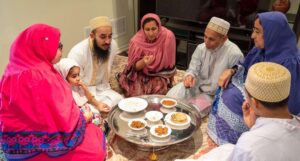
Bohra Thaal [Source : The Indian Express]
A Bohra meal traditionally starts with a pinch of salt. The Bohras believe that salt clears the gut, cleanses the palate and is traditionally believed to be a remedy for over 70 different types of diseases. This practice is often performed using a small container called a ‘neemak daani’ and is typically passed around the thaal to all diners, often initiated by the youngest person present.
What makes it yet more interesting is, unlike the conventional pattern of eating, here a meal starts with desserts and then goes on to the savouries. In Bohra dialect, desserts are called ‘mithaas’ and the savouries are termed ‘kharaas’. A pinch of salt is often added to the sweet dishes to enhance the sugar-tasting flavors by blocking bitterness and increasing the ability of tongue receptors to detect sweet flavors. Traditional sweets like Malido and various kalamra (yogurt-based sweet) recipes incorporate a pinch of salt along with ingredients like jaggery, nuts, and ghee.
The starters are then followed by the main course that includes biryani, kari-chawal, dal-chawal et al. The meal ends, with various flavourings and nuts within and finally ends with a pinch of salt (again) and mouth-freshening paans.
Unlike many communal meals in India where conversation is constant, the Bohra thaal encourages mindful eating. Light conversation is allowed, but the meal is also a time for spiritual reflection, and excessive talking is discouraged.
Once the meal ends, all participants recite a specific du’a (after-meal prayer) together, thanking God for the food and including a special prayer for the Da’i al-Mutlaq’s long life and health.
There is common confusion and often a mistaken claim comparing the Bohra thaal to the Mandi tradition of communal eating in Hyderabad’s Muslim culture, which originates from the Yemeni-Arab culinary customs brought by the Nizams’ courtiers and Arabian migrants.
Mandi is a Yemeni dish and communal dining format. The name comes from the Arabic word ‘nada,’ meaning dew, which refers to the moist, tender meat cooked slowly in an underground oven. In Hyderabad, the Mandi communal meal developed during large wedding feasts, gatherings, and charitable invitations. Groups of men sit around large trays of rice and meat on the floor, consuming the meal quickly, often while standing or kneeling, before the next group arrives. It is essentially a feast format for large crowds.
In contrast, the Bohra thaal is not geared for mass feeding. It is meant for a small group of about six to eight people who enjoy a multi-course meal together at a relaxed pace, following specific ritual etiquette. The thaal combines spiritual practice with culinary enjoyment.
The Mandi platter typically serves a single meal: the rice and meat dish is the entire meal, usually with just a basic salad or raita. The Bohra thaal, however, comprises a structured multi-course sequence that reflects a complete nutritional and spiritual philosophy.
In large Mandi feasts, food waste is common and expected. Vast amounts are prepared, with leftovers typically given away or thrown out. The most crucial rule of the Bohra thaal is zero waste. The difference is striking.
Bohra cuisine is one of the most unique and sophisticated regional Muslim cuisines in India. It is arguably the most historically rich, blending three culinary traditions: the mercantile Gujarati vegetarian tradition, the Arabic coastal seafood and meat customs developed through centuries of trade with Oman, Yemen, and the Persian Gulf, and the Fatimid court tradition upheld in Yemeni Da’wat households and later brought to Surat and Ahmedabad.
Medjool Dates: Breaking fast with dates is particularly important among Bohras. They have a long history of trade with regions in Oman and Basra that produce dates. Premium Medjool dates, Ajwa dates (thought to be the Prophet’s preferred type), and amber-colored Safawi dates are prominently featured on the iftar table.
Lagan nu Sheer (Lagan Sheer Khurma): This rich vermicelli pudding is made with full-fat milk, dates, cardamom, saffron, and dry fruits. It is the classic Bohra sweet for Ramadan iftar, appearing on nearly every thaal at Maghrib. The Bohra version is more aromatic and contains more dates than the Hyderabadi sheer khurma, reflecting the date trade connections of the Surat merchants.
Kaari (Bohra Curry): This is the main Bohra curry, characterized by its tangy, tamarind-based gravy. It is often prepared with meat, fish (especially pomfret and surmai in coastal areas), or vegetables. It differs from Mughal korma-based curries in Lucknow and coconut-heavy curries in the Deccan. The Bohra kaari has a distinct tartness from kokum or raw mango, mild sweetness from tomato and onion, and a blend of spices that shows both Gujarati and Arabian influences.
Khichdi and Dal-Bhaat: These are simple comfort foods for sehri, the pre-dawn meal that usually includes lighter, energy-sustaining foods. Bohra families often enjoy khichdi (a rice and lentil porridge with ghee and spices), dadhi (yogurt), and achaar (pickle) during sehri. This tradition reflects both Gujarat’s agricultural food practices and the Prophetic emphasis on moderation.
Roti and Bhakri: Bohra breads include wheat rotis and traditional bhakri (millet flatbread). The latter is a staple in Gujarati cuisine and has become part of the community’s food culture. During Ramadan, the thaal typically features both types of bread.
Haleem: This slow-cooked wheat-and-meat porridge is a Ramadan staple for many South Asian Muslim communities. Bohra haleem is called Harees or Harisa and comes from the Arabic harees, a dish noted in medieval Arab cookbooks and still enjoyed in Oman and the UAE. Bohra harees uses whole wheat grain, meat (usually goat or lamb), ghee, and aromatics. It is simpler and less spicy than Hyderabadi haleem, reflecting its older Arab roots.
Eid Feast Dishes
Dabba Gosht: This festive Bohra meat dish is cooked in a sealed box (dabba) with a unique spice mix, layered with potato and onion. It is a signature dish served during Eid celebrations.
Dum Biryani (Bohra style): The Bohra biryani garners strong culinary loyalty. Unlike Lucknowi biryani (which has a light stock base), Hyderabadi biryani (where raw marinated meat cooks with rice), or Kolkata biryani (which includes potato and boiled egg), Bohra biryani is prepared using the dum method with a specific spice mix containing dried plums (aloo bukhara), fried onions, and plenty of saffron. The meat is cooked separately first in a masala, then layered with par-cooked rice and sealed with dough before the final dum cooking.
Khaari Boondi and Meethi Boondi: These fried chickpea flour droplets come in two varieties — one savory and one sweet. They are prepared in large quantities and served as snacks and accompaniments throughout Eid festivities
Lagan nu Custard: This is a unique Bohra dessert — a baked caramel custard made in a large round lagan (baking dish) with full cream, eggs, sugar, cardamom, and nutmeg. It has no direct equivalent in other South Asian Muslim desserts and may reflect European Portuguese influence on Surat during the 16th to 18th centuries.
Sabudana Kheer: This sweet pudding made from sago pearls with milk, jaggery, and coconut comes from Gujarati culinary tradition and is maintained in the Bohra repertoire.
Bohra Clothing Traditions
Bohra dress is one of the most recognizable aspects of the community, carefully upheld and promoted by the Da’i al-Mutlaq. During Ramadan and Eid, the visual aspect of Bohra dress is especially prominent.
The Topi (Bohra Cap): The Bohra men’s topi is a distinct white cap with gold embroidery and no brim. It is more structured than the typical Indian Muslim topi and serves as a quick visual identifier of a Bohra man. During Ramadan and Eid, special topis are worn. Some feature elaborate embroidery, while others are cream and gold, or belong to the community’s white-and-gold color scheme that represents purity and divine light.
The Kurta-Saya: Men wear a full-length white kurta, which differs from the collarless kurta worn by most South Asian Muslim men. The Bohra kurta has a unique collar (Chinese or Mandarin) with a straight cut, often made from fine white cotton or Egyptian poplin, reflecting Fatimid Egyptian heritage. For Eid prayers, men dress in white from head to toe.
The Ridaa (Women’s Dress): The ridaa (also spelled rida) is the two-piece garment worn by Dawoodi Bohra women, consisting of a floor-length skirt (izaar) and a matching upper garment that covers the body and drapes over the head. The ridaa is unique among Muslim dress and should not be confused with the Arabic abaya, the Iranian chador, or the South Asian niqab. The ridaa is colorful and patterned, worn proudly as a symbol of Bohra identity.
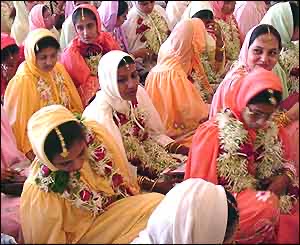
Dawoodi Bohra women in traditional attire [Source : BBC]
The visual aspects of the ridaa communicate community identity, Fatimid aesthetics, and women’s craftsmanship. The ridaa always features two-tone or patterned designs, never plain or monochrome. Floral prints in pastel shades (pink, mint green, lavender, sky blue, cream, peach) are most common for everyday and Ramadan wear. For Eid, more vibrant colors like emerald green, sapphire blue, deep violet, and magenta are favored. White is worn occasionally but is usually associated with mourning, making it uncommon during celebrations.
Floral patterns dominate the ridaa design and convey multiple meanings. The rose (gulab) motif, prevalent in Sufi-Ismaili poetry, symbolizes the beloved (the Imam). The jasmine (mogra) is a symbol of purity linked to the Prophet’s family. Arabesque vine patterns are derived from the Fatimid decorative style found in the carved plasterwork and painted ceilings of the al-Aqmar Mosque and the preserved Fatimid woodwork in the Islamic Museum of Cairo.
For formal occasions and Eid, geometric patterns join the floral designs. Six-pointed stars (Seal of Solomon), eight-pointed stars (linked to Imam Ali in Ismaili iconography), and interlaced geometric bands echo the tilework and stone carvings of Fatimid architecture. These patterns are intentional, forming the visual language of a theological tradition expressed through textiles.
Embroidery — Zardozi and Karchob: High-end Eid ridaas feature embroidery on the borders (chamri) and necklines, using techniques such as zardozi (gold and silver wire embroidery), karchob (frame embroidery), and appliqué work. The embroidery motifs often include calligraphy (the names Allah, Muhammad, Ali in styled Arabic), floral designs (roses and vines), and geometric borders.
Creating special embroidered ridaas for Eid is a cottage industry in Bohra neighborhoods in Surat, where skilled women pass their craft from mother to daughter. A key feature of the authentic ridaa is the white lace (chamri) or embroidered border along the skirt and upper piece hem. This chamri is considered essential — a ridaa without it is deemed incomplete. The chamri also serves a practical purpose, adding weight to the hem so that the garment drapes properly over the head and shoulders.
The upper piece of the ridaa includes a section to cover the head, but many women also wear a matching or coordinating dupatta (scarf) over their heads. It is a requirement to cover all hair during prayer and in the mosque. The specific draping style, unique to the Bohra community, differs from the pin-based wrapping of the Hijab. Young girls are taught this method as part of their community upbringing.
For the first few centuries of the Bohra community in Gujarat, they were made up of merchants who were strictly low profile. The outward appearance of the Bohra was a consciously chosen expression of the doctrine of taqiyya (the ability to dissimulate one’s beliefs as a means of escaping persecution), so they could maintain the appearance of being ordinary Sunni Muslims by outwardly being the same as all.
Historical Genesis of Contemporary Dawoodi Bohra Identity
The Bohras’ most devastating historical crisis in India was during the orthodoxy campaign of the Mughal Emperor Aurangzeb, and due to the influence of Sheikh Ahmad Sirhindi, who represented the Naqshbandi Sufi order. Sirhindi supported a cleansing of Indian Islam from Shia and Ismaili “heterodoxy.”
Beginning in the late 17th century and culminating between 1685 and 1690, the Bohras faced a systematic campaign of persecution under Aurangzeb. The 30th Da’i al-Mutlaq, Syedna Qutbuddin Shaheed, was killed in Ahmedabad in 1631 CE under conditions the Bohras see as a re-enactment of Karbala on Indian soil. His son and successor, Syedna Shaikh Adam Safiyyuddin, was forced into hiding. Many Bohra mosques were converted for Sunni use. The Bohras were pressured to conform to the Sunni practice of prayer and to abandon their unique customs.
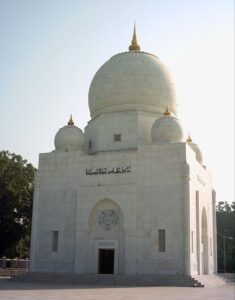
Mazar-e-Qutbi (colloquially called “Chhoti Karbala”) in Ahmedabad [Source: Wikimedia Commons]
The way the Bohras responded to this crisis has important implications for understanding their practices of Ramadan. Under persecution, the Bohra customs of Ramadan, such as the nightly waaz, communal thaal, unique ridaa, and Lisaan ud-Da’wat devotional poetry, became essential tools for expressing community solidarity and preserving identity. As the Bohras turned inward, their masjids and homes became the two strongholds of their community.
Surat, the major port city of Gujarat, served as the main port for the Mughal Empire until its decline in the early 18th century. It was a center of Bohra commercial and cultural life. The Bohra community in Surat was key to the textile trade, especially in silk and calico cloth sent to the Persian Gulf, Ottoman territories, and East Africa. Their prosperity enabled them to build impressive mosques, charitable structures like water fountains, and educational institutions.
During this time, Surat was one of the most diverse cities in Asia. It was a hub for Mughal nobles, English and Dutch traders, Arab merchants, Parsi shipbuilders, and Bohra merchant princes. The Bohras navigated this vibrant landscape with skill and discretion. Their Ramadan celebrations were grand, with wealthy Bohra families hosting community iftars in their mansions, women preparing elaborate meals, and the Da’i or his representatives leading evening sermons at the Jami’a Masjid.
The late 19th and early 20th centuries presented new challenges. The Sunni Reform movement and legal disputes during British rule questioned the authority of the Da’i al-Mutlaq. A reformist group within the community, later known as the Progressive Bohras or ‘Anjuman-e-Islah al-Bohrain,’ challenged the Da’i’s authority and aimed to update community practices. These conflicts escalated to the Bombay High Court and eventually to the Privy Council in London, notably in the case of Tyabji vs. Tyabji and related cases in the early 20th century.
The court’s decisions were significant, as they generally upheld the Da’i’s control over community property and religious practices. This reinforced the Bohra way of life, including their distinct customs during Ramadan, against attempts at reform. The community emerged from this period with a stronger organizational framework and a clearer sense of their uniqueness compared to the broader Muslim community.
Chand Raat of Dawoodi Bohras & Culmination of Sacred Fasting
Eid al-Fitr is known in advance for the Bohras, as they follow a calculated calendar. However, they still celebrate Chand Raat (Moon Night) as a special occasion. On this night, women and girls decorate their hands with mehendi (henna), children receive new clothes, sweets are prepared, and the whole community is filled with joyful anticipation.
In Bohra neighborhoods in Surat, Mumbai, and other strongholds, Chand Raat comes alive with lights, decorated mosques, and devotional songs from speakers, now often replaced with digital broadcasts of the Da’i’s recordings. Shops selling ridaas, topis, and Eid gifts stay open late.
The Eid prayer (Salat al-Eid) among the Bohras follows the Fatimid format, which is different from the Sunni and Twelver Shia formats regarding the number of takbirs and recitation details. The Amirul Jamaat (community representative) or a senior scholar leads the Eid prayer, with the entire community dressed formally in a mosque or open space if necessary.
A distinctive aspect of the Bohra Eid prayer is the communal takbir chanting before the prayer. The congregation recites Allahuakbar, Allahuakbar, la ilaha illallah, wallahuakbar, Allahuakbar wa lillahil hamd together in a celebratory melody. This communal sound creates an emotionally charged atmosphere for Bohra Eid, offering a distinct character absent from the more structured Sunni Eid prayers.
After the prayer, Bohras embrace three times (the Islamic triple embrace) and exchange the greeting “Taqabbalallahu minna wa minkum,” meaning “May God accept from us and from you.” They also give a specific Bohra blessing: “Mawla tumne qubool kare,” which means “May the Master accept you.” This mention of the Da’i’s blessing in the Eid greeting is unique to the Bohras and highlights the central role of the Da’i in their religious life.
When a Bohra family sits down to break their fast on a Ramadan evening, they arrange their dishes on the thaal with care. They start with a date and a prayer, eat together, waste nothing, and sing their madeh into the night air. They wear their ridaas and topis as they head to the mosque. They are not just observing a religion; they are living out a civilization. That civilization’s moon, first calculated in the observatories of Fatimid Cairo, still rises with the same precision, beauty, and unwavering permanence over every Bohra home in the world.
References
- Daftary, F. (1990) The Isma’ilis: Their History and Doctrines. Cambridge: Cambridge University Press.
- Kennedy, E.S. (1956) ‘A Survey of Islamic Astronomical Tables.’ Transactions of the American Philosophical Society, New Series, 46(2), pp. 123–177.
- Asani, A.S. (2002) Ecstasy and Enlightenment: The Ismaili Devotional Literature of South Asia. London: I.B. Tauris in association with the Institute of Ismaili Studies.
- Virani, S.N. (2007) The Ismailis in the Middle Ages: A History of Survival, a Search for Salvation. New York: Oxford University Press.
- Misra, S.C. (1964) Muslim Communities in Gujarat: Preliminary Studies in their History and Social Organisation. Baroda: Maharaja Sayajirao University of Baroda.
- Lokhandwalla, S.T. (1955) ‘The Bohras: A Muslim Community of Gujarat.’ Studia Islamica, 3, pp. 117–135.
- Nanji, A. (1978) The Nizari Ismaili Tradition in the Indo-Pakistan Subcontinent. Delmar, NY: Caravan Books. [Cited comparatively; Nanji’s treatment of Ismaili esotericism applies across Nizari and Tayyibi branches in several respects.]
- Richards, J.F. (1993) The Mughal Empire. Cambridge: Cambridge University Press. [The New Cambridge History of India, I.5.]
- Bly, E. (1972) ‘A Grammatical Sketch of Lisan al-Da’wat.’ Annual of Urdu Studies, 3(1), pp. 1–24.
- Commissariat, M.S. (1938) A History of Gujarat. 3 vols. London: Longmans, Green & Co.
- Das Gupta, A. (1979) Indian Merchants and the Decline of Surat: c. 1700–1750. Wiesbaden: Franz Steiner Verlag.
- Walker, P.E. (1993) Early Philosophical Shiism: The Ismaili Neoplatonism of Abu Ya’qub al-Sijistani. Cambridge: Cambridge University Press.
- Dawat-e-Hadiyah (2016) Al-Thaal al-Fatimi: The Fatimid Plate — Its Meaning and Etiquette. Mumbai: Dawat-e-Hadiyah Official Publications. [Community publication, limited circulation.]
- Engineer, A.A. (1980) The Bohras. Vikas: New Delhi. [Note: Engineer was a dissident reformist Bohra; his work is valuable for historical data though his ideological framing requires critical reading.]
- Freitag, U. (2003) Indian Ocean Migrants and State Formation in Hadhramaut: Reforming the Homeland. Leiden: Brill.
- Halm, H. (1997) The Fatimids and Their Traditions of Learning. London: I.B. Tauris in association with the Institute of Ismaili Studies.
- Perry, C. (trans.) (2001) Medieval Arab Cookery. Totnes: Prospect Books. [Translation of several medieval Arab culinary manuscripts including Kitab al-Tabikh by Muhammad bin Hasan al-Baghdadi.]
- Stern, S.M. (1951) ‘The Succession to the Fatimid Imam al-Amir, the Claims of the Later Fatimids to the Imamate, and the Rise of Tayyibi Ismailism.’ Oriens, 4(2), pp. 193–255.
- Walker, P.E. (1999) Hamid al-Din al-Kirmani: Ismaili Thought in the Age of al-Hakim. London: I.B. Tauris in association with the Institute of Ismaili Studies.