

By Anukriti Upreti
Fossils contain a plethora of information about the Earth, and a lot is still unknown to us. However, there have been several discoveries that have significantly changed our understanding of Earth and helped us discover things that existed on Earth long before Homo sapiens developed. One such discovery is the whale fossil found in the Himalayan region of Himachal Pradesh in 1997 by geologist Ashok Sahni and his team. The discovery is significant as on one hand it shows how whales evolved over time from terrestrial animals to marine animals and how the finding of Himalayacetus subathuensis adds to the existing studies in this field. On the other hand, it added to the theory that the Himalayas were preceded by the Tethys Ocean, which existed during the Mesozoic and early Cenozoic eras, separating the Indian subcontinent from modern-day Asia. Moreover, this discovery led to several more discoveries in the Himalayan region, culminating in a geo-tourism site at Danghirai, Kasauli, Himachal Pradesh, by another passionate geologist, Ritesh Arya. This article explores the significance of this discovery in understanding the history of whale evolution and highlights the importance of fossils in studying the Earth’s past and understanding the present.
Himalayacetus subathuensis is the oldest ancestor of whales (as we know today) known till date. Fossil records suggest that it existed approximately 53 million years ago. Thus, its discovery extends the existing time period of Cetacea. It is a new pakicetid archaeocete that was found in the Subathu Formation of northern India. The fossilized jaw element was found in the region along with various oyster fossils. The dentary has a small mandibular canal, indicating a lack of auditory specializations seen in more advanced cetaceans, and it has Pakicetus-like molar teeth, suggesting that it fed on fish. This Pakicetid was approximately 100 m lower stratigraphically and 3.5 million years older geologically than the Kuldana–Kalakot-equivalent upper Subathu red bed interval producing Pakicetus elsewhere. This not only extends the fossil record of Cetacea back in time but also reinforces the idea that whales originated on the margin of Tethys. (Bajpai and Gingeric, 1998)
This discovery also suggests the early evolution of whales from terrestrial animals into marine animals, as Ashok Sahni, chairman of the Centre of Advanced Studies in Geology of the Panjab University, said, “It is generally agreed that whales originated from a group of prehistoric meat-eaters called Mesonychians, ancient ancestors of both modern carnivores like the lion and grass-eaters like the horse. However, modern whales did not emerge in a flash. Actually, it took some 13 million years”. In its 1998 report, India Today wrote that there are many missing links in the evolution of whales from a dog-like creature to a bear and crocodile-like creature to the first sea-going whale. Earlier discoveries from Pakistan and India, led by J.G.M. Thewissen, found various fossils in Kuldana–Kalakot-equivalent upper Subathu region. However, the discovery of a dog-like whale from Himachal Pradesh provides new insights into the evolution of whales.

Sunil Bajpai with a fossil from his laboratory. Photo courtesy, The mint, 2021
Bajpai has listed some differences between the earlier Pakicetid and the Himalayaectus, which helps us understand the evolution of whales. The new fossil found suggests that “Himalayacetus came from a shallow oyster-bearing marine deposit, whereas Pakicetus and the other oldest pakicetids known previously came from continental red beds and were found in association with land mammals .” Thewissen et al. also argued that Pakicetus and Nalacetus were reported to have oxygen isotopes of Eocene freshwater rather than marine values, and they concluded that pakicetids, the geologically oldest whales, were not marine. ‘The origin of whales is commonly explained by the availability of fish as food in highly productive shallow marine waters of eastern Tethys, and early pakicetids are likely to have fed on fish in freshwater rivers, mixed estuaries, and shallow marine seas’ (Bajpai and Gingeric, 1998). This shows that with the evidence of Himalayacetus, we found that whales adapted much more to the marine environment than their early ancestors.
Dental fossils help us understand the evolution of whales. The teeth structure of Sinonyx, which is considered a primitive predecessor of Whales and the Pakicetus highlights how the animal evolved. Later, whales that adapted more to the marine environment developed simple serrated triangles, like those of carnivorous sharks, which they required for hunting fishes. Thus, paleontological evidence shows a series of adaptations of whales from terrestrial to marine environments. These changes affect the shape of the skull, the shape of the teeth, the position of the nostrils, the size and structure of both the forelimbs and the hindlimbs, the size and shape of the tail, and the structure of the middle ear as it relates to directional hearing underwater and diving (Sutera,2000). Sahni then predicted that the fossils from the lower Himalayas would explain how the walking whale began to swim. His prediction was correct, as we found various marine fauna fossils in the region. “Oysters, fish and crocodiles have been fossilised in almost every rock here,” says paleontologist Raminder Singh of Panjab University.
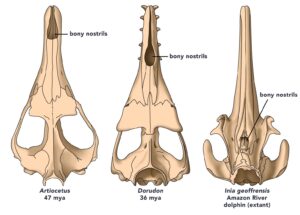
Image showing how the position of the nostrils changed with the evolution of whales. Image courtesy, © UC Museum of Paleontology Understanding Evolution
Besides, this discovery further strengthens the existing knowledge of the Tethys Sea which existed before the formation of Himalayas. Later paleontological studies in the region uncovered many marine fossils from Himachal Pradesh which are still ongoing by passionate geologists and researchers. The remnants of the Tethys Sea were discovered in various fossils found in Ladakh, Kargil, and Himachal Pradesh by Dr. Ritesh Arya, a distinguished geologist and Guinness World Record Holder, who began his journey of fossil collection during his graduation days in 1987. He has uncovered fossils of oysters, gastropods, and other marine deposits. One of his major contributions to fossil studies was to explain how fossils tell us not only about the earth’s past but also about its present. He tried to understand the relationship between fossils and the occurrence of underground water in a paper titled ‘Conceptual paper to explain the occurrence and movement of groundwater resources in the entire Hindu Kush Himalayas’ presented at the International Geological Congress China 1996.
Later, in 2023 a museum was founded to collect all the fossils collected by him and his team since 1987. The Tethys Fossil Museum was inaugurated by geologists such as Sahni and stands today as a repository of the long history of the earth and its transformations. The Museum is built at Danghirai, a place where evidence of a beach was found, and the name of the museum also shows the importance of understanding the long history of the formation of the Himalayas. Thus, the discovery of Himalayacetus subathuensis from Himachal Pradesh not only tells us a lot about the evolution of whales, but it also gives us a new dimension to think about the topography of present-day Himachal Pradesh as a marine environment, which is quite different from the present-day geographical conditions of the region.
References:
1. Bajpai, S., & Gingerich, P.D. (1998). A new Eocene archaeocete (Mammalia, Cetacea) from India and the time of origin of whales. Proceedings of the National Academy of Sciences, 95(26), pp.15464–15468. doi:https://doi.org/10.1073/pnas.95.26.15464.
2. Parihar, R. (1997). The Whale that walked, India Today, 25 Aug.
3. Pyenson, N.D. (2017). The Ecological Rise of Whales Chronicled by the Fossil Record. Current Biology, 27(11), pp.R558–R564. doi:https://doi.org/10.1016/j.cub.2017.05.001.
4. Seethalakshmi, S., and Nandan, R. (2021). It’s possible that whales and horses originated in India (Mint, April 1).
5. Youtu.be.(2025).Available at: https://youtu.be/CCVywXwuOmc?si=lmcHBfoGF-V9dxFo [Accessed 16 Sep. 2025].