

By Shreya Kamboj
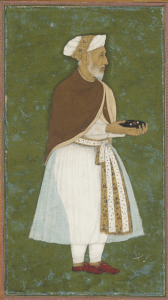
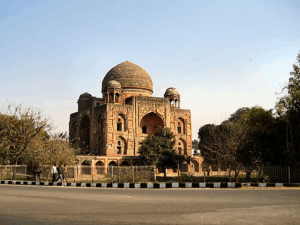
On the busy Mathura Road in Delhi, countless commuters drive past a grand, recently restored mausoleum, yet few are aware of its profound symbolic significance. This is the tomb of ‘Abd-ur-Rahim Khan-i-Khanan, a monument that holds the distinction of being the first major Mughal tomb built in honor of a woman, his wife Mah Banu. The man who commissioned this tribute was as complex and historically significant as the structure itself. Among the powerful nobles of the Mughal Empire, ‘Abd-ur-Rahim Khan-i-Khanan (1556–1627) occupies a unique position as a man defined equally by the sword and the pen. As a leading general and the son of Akbar’s regent, Bairam Khan, Rahim was not just a recipient of culture but a significant patron and creator in his own right, shaping the aesthetic landscape of his era (Lefèvre 2014).
Rahim’s patronage and literary work served as a dynamic cultural interface. During Akbar’s reign, his bicultural court, which celebrated both Persian traditions and the vernacular arts of Brajbhasha, synchronized with the emperor’s project of cultural integration, marking him as an ideal Akbari grandee (Busch 2010). The political dimension of this patronage grew more explicit in his later career. As historian Corinne Lefèvre suggests, the commissioning of his chronicle, the Ma’asir-i Rahimi, during his political troubles under Jahangir can be seen as a deliberate action in response to the accusations floating against him (Lefèvre 2014; Truschke 2018). Thus, by analyzing the Persian and Brajbhasha spheres he cultivated, this essay will trace how his cultural work was connected to his political fortunes across two reigns.
A Life of Triumph and Turmoil
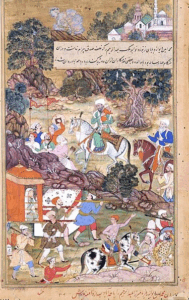
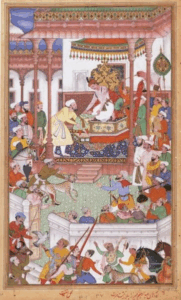
‘Abd-ur-Rahim’s life was a dramatic arc of immense privilege, spectacular success, and devastating political downfall. After his father’s assassination, the young Rahim was brought to the imperial court and raised under Akbar’s personal mentorship. This upbringing not only secured his position within the highest echelons of the Mughal nobility but also immersed him in the uniquely multicultural and intellectually vibrant environment that Akbar was cultivating. He was married to Mah Banu, the sister of another powerful noble, Mirza Aziz Koka, further solidifying his ties to the imperial inner circle (Truschke 2018).
Under Akbar, Rahim’s career flourished. He proved himself to be a highly capable military commander, leading successful campaigns that were crucial for the consolidation of the empire, most notably the conquest of Gujarat and his extensive service in the Deccan (Truschke 2018). His service earned him his father’s illustrious title, Khan-i-Khanan (Lord of Lords), the highest honor for a noble. During this period, his political life was in perfect harmony with his cultural pursuits. His status as a top general and administrator provided him with the immense wealth needed to fund his large-scale patronage, and his activities as a poet and patron aligned seamlessly with the syncretic ideals of Akbar’s court (Lefèvre 2014; Busch 2010).
The accession of Emperor Jahangir in 1605, however, marked a sharp and perilous turning point in Rahim’s fortunes. His deep connections to the old Akbari nobility and his immense personal prestige made him an object of suspicion for the new emperor. His political standing was irrevocably damaged when he chose to support the rebellion of Prince Khurram (the future Shah Jahan) against Jahangir. This act of “insurgence and ingratitude,” as the emperor saw it, led to his complete fall from grace (Truschke 2018). He was stripped of his titles, his property was confiscated, and in a particularly brutal act of retribution, Jahangir had two of his sons executed (Truschke 2018). Though he was eventually recalled to court and pardoned before his death in 1627, he never regained his former power. This turbulent later career provides the crucial context for understanding his cultural legacy, as his patronage during this period can be seen as an effort to publicly reassert his value and honor in the face of political ruin (Lefèvre 2014).
The Lure of the “Indian Eldorado”: Rahim’s Persianate Court
‘Abd-ur-Rahim’s court was a primary node in the vast network of circulation that connected the Safavid and Mughal worlds, establishing itself as a premier destination for Iranian poets, scholars, and literati. For these men, Mughal India represented an “Indian Eldorado,” a land of immense opportunity and unparalleled generosity, especially when compared to the often-unstable political climate of Safavid Iran (Lefèvre 2014). This westward flow of talent was driven by a combination of “push” factors, such as political disfavor at the Safavid court, and powerful “pull” factors, chief among them the legendary munificence of patrons like Rahim (Lefèvre 2014). The sheer scale of this migration is meticulously documented in Rahim’s own chronicle, the Ma’asir-i Rahimi, which lists dozens of poets, a great majority of whom were Iranian immigrants who found permanent or temporary shelter under his patronage (Lefèvre 2014). A prime example was the poet Naziri of Nishapur, one of the most celebrated Persian stylists of the age, who flourished for years under Rahim’s support.
However, as Corinne Lefèvre argues, it is crucial to understand that in most respects, Rahim’s cultural activities remained within the boundaries set by the Mughal dynasty, broadly following the lines drawn up by Emperor Akbar (Lefèvre 2014). It was Akbar who first established large-scale imperial patronage of Persian literati, the translation of Sanskrit classics, and the inclusion of Hindavi poets at court. In this sense, Rahim’s patronage largely represents a picture of conformity to a pre-existing imperial model. Yet, it is precisely within this framework of conformity that his unique contribution becomes clear. According to Lefèvre, Rahim’s deep and personal engagement with Brajbhasha was his “only truly distinguishing characteristic” when compared to other high-ranking Mughal nobles of his time (Lefèvre 2014). While others may have patronized vernacular poets, none engaged with the tradition with the same level of literary mastery and personal investment. He was not just a patron but a celebrated poet in his own right, writing under the pen name ‘Rahim.’ His dohas often focused on niti (practical wisdom and ethics), blending courtly refinement with vernacular accessibility. For instance, he offered astute observations on human nature and conduct:
Bade badai na kare, bol na bole bol. Rahiman heera kab kahe, lakh taka mero mol.
(The great do not praise themselves, nor do they speak boastful words. Says Rahim, when does a diamond ever say, ‘My value is a hundred thousand takas’?)
By composing and performing such verses, Rahim demonstrated a profound personal investment that went far beyond transactional patronage.
Rahim’s Legacy
Ultimately, ‘Abd-ur-Rahim Khan-i-Khanan’s life and work show him to be much more than a powerful noble. Through his extensive and dual patronage, he created a unique cultural space that served as a bridge between the literary worlds of Iran and India. His support for both Persian and Brajbhasha poets, combined with his own skillful writing, helped foster a blended culture that was both a remarkable artistic achievement and a reflection of his political world. This project flourished under Akbar’s inclusive ideals but became a way for Rahim to shape his own legacy during his difficult years under Jahangir. Celebrated in multiple traditions, his life story reveals the deep connection between cultural pursuits and political survival that defined the Mughal elite.
References
1. Busch, A. (2010). ‘Hidden in Plain View: Brajbhasha Poets at the Mughal Court’. Modern Asian Studies 44, 2. pp. 267–309.
2. Lefèvre, C. (2014). ‘The Court of ‘Abd-ur-Rahim Khan-i Khanan as a Bridge between Iranian and Indian Cultural Traditions’ in ‘Culture and Circulation Literature in Motion in Early Modern India’ edited by Thomas de Bruijn and Allison Busch.
3. Rizvi, A. (1975). ‘Religious and Intellectual History of the Muslims in Akbar’s Reign’. Munshiram Manohar Publishers Pvt. Ltd.
4. Truschke, A. (2018). ‘‘Abd-ur-Rahim Khan-i-Khanan’ in ‘Islam, Judaism, and Zoroastrianism’ edited by Zayn R. Kassam, Yudit Kornberg Greenberg, Jehan Bagli. Springer.