
By Prishnika Mazumdar
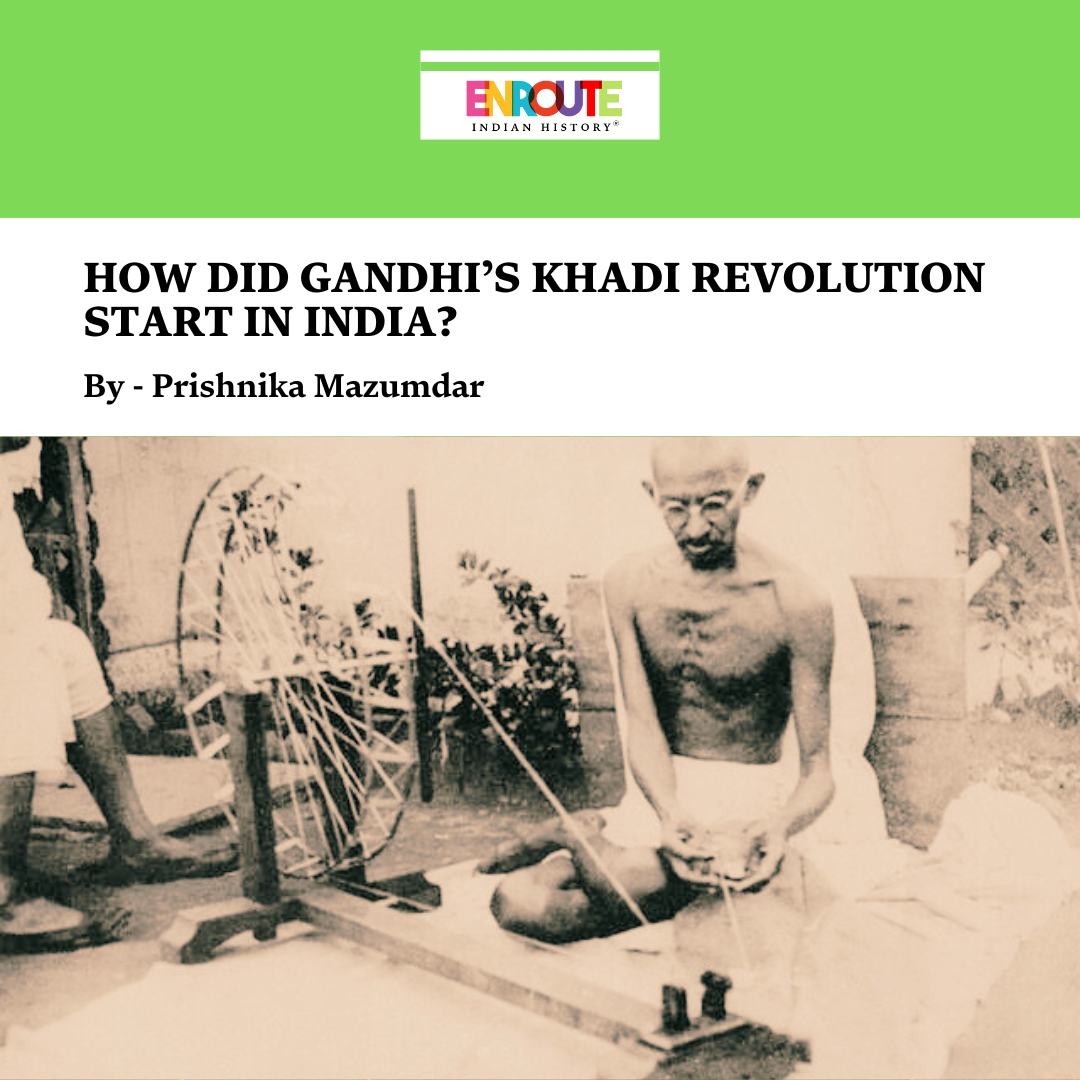
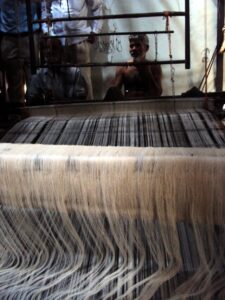
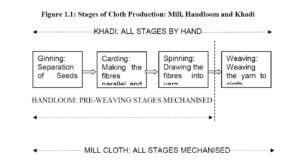
Historically, India has been rich, both in material resources and its spiritual contributions to the world. Among these contributions, Indian textile tradition holds a special place. For centuries, Indian textiles dominated global markets. Within this legacy, Khadi stands out as a fabric, a national symbol, a means to livelihood and as a sustainable alternative. So, what is Khadi? Khadi is any cloth woven on a handloom from cotton, silk or wool, which is spun into yarn on a spinning wheel or from a mixture of any two or all such yarn (Assam Handloom & Textiles, n.d.). In this article, we will try to understand the journey of Khadi by first placing it within the broader textile sector during the colonial era, when it was neglected, to the time of the freedom struggle, when it became a national symbol, the post-independence era of renewed attention towards Khadi and finally we will try to make sense of the international attention that it is receiving now.
Decline of Indigenous Textiles during the British Raj
The story of Indian textiles goes back five millennia. They were sold in large volumes in the Indian Ocean region from at least the twelfth century. Even after the arrival of the Europeans in the subcontinent, such textiles were at the top of manufactured goods in world trade from the sixteenth century until the industrialisation of Europe (Deshpande, 2022).
However, after Britain’s industrialisation, Indian textiles lost their dominant position in the global market. And soon, India was remoulded as a supplier of raw materials for British mills and as the world’s biggest market for the products of those mills (Deshpande, 2022). Since then, the destructive impact of economic contact with Europe has been highlighted by many scholars. Herein, we observe that the Indian textile artisan faced intense competition from British yarn and cloth in the nineteenth century, plus there was a decline in total industrial employment in India between 1881 and 1931. Cotton textiles, the largest industry in the region, suffered particularly in attempts to cope with competitive imports from mills in England. This meant that hand tools were pitted against machinery, and in this battle, hand tools lost both employment and income (Roy, 1999).
Besides, prejudices during the colonial period established a hierarchy that privileged the manufacturing sciences and devalued other practices. Among these other practices were the non-Western methods of textile production, which were reduced to the status of being “unscientific.” Such labelling, which was applied to entire artisanal economies in India, was not new. In fact, it could be traced back to the industrialisation in Europe, when intellectuals began to think of the economy as a separate realm, different from the household and populated by male income earners (Rai, 2018).
This new philosophy saw factories and industries as a means to achieve socio-economic developmental goals through the application of technology. When this model was applied to the European colonies, it made the domestic work performed by weavers largely invisible. Santosh Kumar Rai notes that such ideological erasure of handloom work did not necessarily mean its actual disappearance (Rai, 2018). Tirthankar Roy, a historian, brings forth the creative impact of economic contact between India and Europe. As the Suez Canal opened in 1869, long-distance trade led to rapid and almost continuous growth of external and internal trade. India was integrated into an expanding world trade and payments system (Roy, 1999). However, the push that Khadi received during India’s freedom struggle was greater than of the previously mentioned factors.
The Revival of Khadi during the Freedom Struggle
During India’s struggle for independence, Mahatma Gandhi became one of the strongest and most effective cultural critics of colonial technology. To counter colonial technology and unite the nation, he found a potent symbol of resistance and self-reliance in Khadi. In doing so, he placed trust in alternative traditional techniques (Prasad, 2006).
Mahatma Gandhi was against mass production, instead, he advocated for production by the masses. He encouraged people to spin and weave their clothes so as to make themselves self-reliant. Therefore, Khadi became a symbol of Indians reclaiming their resources and using these resources to fulfil their needs locally. As a part of the Swadeshi movement (1905 to 1911) and later the Civil Disobedience movement (1930 to 1931 and 1932 to 1934), British goods were boycotted and destroyed while Indian-made goods were promoted. These movements contributed to the revival of small-scale and cottage industries (Lambah, 2024).
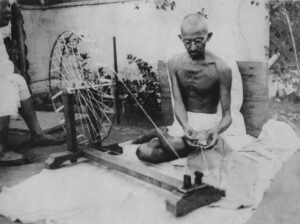
The simple, hand-spun and handwoven cloth became a powerful symbol of India’s struggle for independence, and was just as important in Gandhi’s efforts to revive village life by promoting self-reliance and improving the lives of the poorest people. In the years since independence, governments have tried to tap into Khadi’s potential to provide livelihoods.
Policy Initiatives to Support Khadi
Recent government initiatives aimed at promoting Khadi have attempted to reposition this traditional fabric as a global commodity while aligning it with the goals of sustainability, rural empowerment, and ethical consumerism. The Government of India, particularly through the Khadi and Village Industries Commission (KVIC), has made several interventions in production and marketing to ensure that Khadi remains economically viable and globally competitive.
A central pillar of this strategy is the Modified Market Development Assistance (MMDA) scheme, which provides production-linked incentives to artisans and Khadi institutions. Between 2017 and 2021, KVIC spent more than 55% of its total expenditure under MMDA (Comptroller and Auditor General of India, 2023). Besides, the government has backed infrastructure development through initiatives like the Khadi Reform and Development Programme (KRDP), supported by the Asian Development Bank. These efforts aim to modernise production centres, strengthen quality assurance mechanisms, and integrate technology into the Khadi supply chain (Comptroller and Auditor General of India, 2023).
Marketing and branding have also received attention. The government has registered the “Khadi India” trademark in multiple jurisdictions to prevent misuse and to enhance the global appeal of authentic Khadi. However, the CAG audit notes that enforcement remains inconsistent. There was significant revenue loss due to unlicensed vendors and limited legal follow-up against infringements (Comptroller and Auditor General of India, 2023).
The government’s larger vision of positioning Khadi as a sustainable global brand is also visible in recent policy statements and strategic collaborations. For instance, the Ministry of Micro, Small and Medium Enterprises (MSME) declared Khadi a “zero-carbon footprint” fabric (IndBiz, 2023). KVIC has also partnered with designers and e-commerce platforms to introduce Khadi in luxury and lifestyle segments.
NITI Aayog has placed Khadi as a strategic sector under the Atmanirbhar Bharat Abhiyan (self-reliant India campaign). Initiatives include mainstreaming Khadi into public procurement, uniforms, and state-sponsored livelihood schemes (NITI Aayog, n.d.). Complementing these initiatives are skill-based programmes such as the PM Vishwakarma Yojana and Khadi Gramodyog Vikas Yojana. These policy initiatives aim to enhance the capacity of rural artisans, encourage innovation, and increase production efficiency. By doing so, these schemes support the economic viability of Khadi (Business Standard, 2023).
Nonetheless, some challenges remain. The CAG report notes shortcomings in procurement transparency, a lack of robust data use for decision-making, and delays in infrastructure projects like the Khadi Plazas. All of these point towards a gap between policy and execution (Comptroller and Auditor General of India, 2023).
These challenges, however, have not prevented Khadi from gaining international recognition. The following section will try to understand the potential of Khadi as a product for global use and the complications that come with such use.
Khadi as a Global Commodity
At the 41st India International Trade Fair in 2022, the Khadi India Pavilion received international attention. The Pavilion was visited by Thailand’s Ambassador to India, H.E. Ms Pattarat Hongtong and Oman’s Ambassador to India, Mr. Issa Alshibani. Both ambassadors appreciated the variety of Khadi products and their quality at the Khadi India Pavilion. This was only one case of Khadi receiving international attention and appreciation (Press Information Bureau, 2022).
Khadi has the unique quality of keeping its wearer warm during the winters and cool during the summers. The more we wash it, the better it looks and feels (Assam Handloom & Textiles, n.d.). It is gaining popularity among designers and a younger generation of fashion enthusiasts who look for sustainable fashion. For example, Shruti Sancheti, founder of luxury fashion brand Pinnacle, says, “I have used a lot of fresh colours and motifs and better thread counts to make my garments more contemporary, fluid and relevant for today’s generation. I love the quiet restrained luxury it offers to my design sensibilities and serves as a perfect base for handcrafted pieces” (Amarnath, 2021)
This attention, however, has been accompanied by its own set of complications. Herein, popularity has come with the risk of decontextualisation and misuse of the Khadi brand name internationally. In such cases, the Indian Government has intervened with steps to prevent misuse. “Khadi Mark,” as noted in the previous section, was introduced to ensure genuineness in international markets. Registration under the trademark has already been achieved in countries such as Germany, the United Kingdom, Australia and others, with the proposal being under process in many others (IndBiz, 2023).
Conclusion
Khadi has immense potential as a sustainable alternative to mass-produced textiles and as a means of livelihood for many Indians. As recent government initiatives have attempted to reposition Khadi within global markets, there is an opportunity to present it as an alternative to the excesses of industrial fashion. Khadi has had a splendid journey from being neglected during the colonial era to becoming an emblem of resistance and self-reliance during India’s freedom struggle, but this journey is far from over, and there is still a long way to go.
References
1. Assam Handloom & Textiles. (n.d.) Khadi Production. Available at: https://hts.assam.gov.in/portlets/Khadi-production-0 (Accessed: 3 July 2025).
2. Comptroller and Auditor General of India. (2023) Report No. 9 of 2023: Compliance Audit on KVIC. New Delhi: Government of India.
3. Lambah, K. (2024) How Mahatma Gandhi wove the fabric of our nation’s identity. Indian Express. Available at: https://indianexpress.com/article/research/how-mahatma-gandhi-wove-the-fabric-of-our-nations-identity-9599477/ (Accessed: 3 July 2025).
4. IndBiz. (2023) Indian Govt Aims to Position Khadi as a Global Brand. Available at: https://indbiz.gov.in/indian-govt-aims-to-position-Khadi-as-a-global-brand/ (Accessed: 6 July 2025).
5. NITI Aayog. (n.d.) Policy for Promotion of Khadi and Village Industries. NITI for States. Available at: https://www.nitiforstates.gov.in/policy-viewer?id=SNC497T000164 (Accessed: 4 July 2025).
6. Prasad, C.S. (2006) Exploring Gandhian Science: A Case Study of the Khadi Movement. Ahmedabad: Centre for Social Studies.
7. Rai, S.K. (2018) ‘Colonial Knowledge Economy: Handloom Weavers in Early Twentieth-Century United Provinces, India’, The Indian Economic and Social History Review, 55(3), pp. 327–354. https://doi.org/10.1177/0019464618782200.
8. Roy, T. (1999) Traditional Industry in the Economy of Colonial India. Cambridge: Cambridge University Press. (Cambridge Studies in Indian History and Society).
9. Deshpande, N. (2022) India at 75: Khadi was an integral part of the freedom struggle – where is handspun fabric today? Scroll.in. Available at: https://scroll.in/article/1030276/india-at-75-Khadi-was-an-integral-part-of-the-freedom-struggle-where-is-handspun-fabric-today (Accessed: 4 July 2025).
10. IndBiz. (2023) Indian Govt Aims to Position Khadi as a Global Brand. Available at: https://indbiz.gov.in/indian-govt-aims-to-position-khadi-as-a-global-brand/ (Accessed: 6 July 2025).
11. Times of India. (2021) Can Khadi be India’s trump card in global luxury business? Available at: https://timesofindia.indiatimes.com/life-style/fashion/buzz/can-khadi-be-indias-trump-card-in-global-luxury-business/articleshow/86687836.cms (Accessed: 6 July 2025).
12. Press Information Bureau. (2022) Khadi Fest 2022 launched to promote Khadi as a global product. Available at: https://www.pib.gov.in/PressReleaseIframePage.aspx?PRID=1877006 (Accessed: 6 July 2025).
Image Sources
1. Handloom Khadi weaving at Ponduru, Srikakulam, Andhra Pradesh
Wikimedia Commons (n.d.) Handloom Khadi weaving at Ponduru, Srikakulam, Andhra Pradesh. Available at: https://commons.wikimedia.org/w/index.php?search=khadi+weaving&title=Special%3AMediaSearch&type=image (Accessed: 5 July 2025).
2. Image explaining stages of Cloth Production
Prasad, C.S. (2006) Exploring Gandhian Science: A Case Study of the Khadi Movement. Ahmedabad: Centre for Social Studies.
3. Mahatma Gandhi working on a Charkha to encourage the use of Khadi
Wikimedia Commons (n.d.) Mahatma Gandhi working on a Charkha to encourage the use of Khadi. Available at: https://commons.wikimedia.org/w/index.php?search=khadi&title=Special%3AMediaSearch&type=image (Accessed: 5 July 2025).