

By Prishnika Mazumdar
Simply understood, a manuscript is a handwritten document that may be written on paper, bark, palm leaves, or cloth. Before the development of print technology, they were the dominant medium of recording information. For us, manuscripts are primary sources of understanding history. Many of the manuscripts that survive were often composed under the patronage of royal courts and religious institutions. In Assam, manuscript writing began to grow remarkably after the 13th century CE when the Ahom people, led by Sukapha, entered the region. They brought with them the tradition of maintaining chronicles called buranji, which literally means a store that teaches the ignorant. By the 15th and 16th centuries, when the Neo-Vaishnavite movement gained traction in Assam, manuscript writing had already become an integral part of literary and religious traditions. Manuscripts then found a special place in the Neo-Vaishnavite Satras or monasteries where they were read and performed.
What was the Neo-Vaishnavite Movement?
2011 census data shows that Hindus constitute 61.47% of Assam’s total population (Census 2011: Religion-Assam, nd). Neo-Vaishnavism is a dominant form of Hinduism, particularly among the Assamese people. The Neo-Vaishnavite movement of Assam emerged in the fifteenth and sixteenth centuries as a socio-religious reform movement led by Srimanta Shankardeva (1449-1568). Shankardeva introduced a path of devotion centred on equality, simplicity, and devotion to one God, Lord Krishna. His path came to be known as Eka-Sarana-Naam-Dharma, a faith based on the worship of one god and the rejection of ritualism, animal sacrifice, and caste discrimination (Nath, 2020). The movement shared similar characteristics with the larger Vaishnavite movement (Sharma, 1966). It is best understood within the broader context of the Bhakti (devotion) movement that swept across India between the 12th and 16th centuries (Pathak, 2019).
When Shankardeva, the leader of the movement, was 32, he set out on a pilgrimage to holy places like Puri, Mathura, Dwarka, Vrindavan, Gaya, Rameswaram, Ayodhya, and others. After travelling for 12 years, he returned to Assam and, inspired by the teachings of Vaishnavism, shaped a new form of the faith that was adapted to the traditions and beliefs of the Assamese people. He used art and literature to spread his message. He composed bargeets (devotional songs), Ankia Naat (plays), and writings such as the Kirtan Ghosa. These works, written in the vernacular Assamese, made religious teachings accessible to the common people and provided a cultural foundation (Pathak, 2019).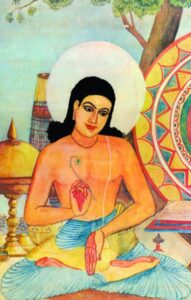
Two of the most important institutions that arose from the movement were the satras and the namghars. Satras were monastic and cultural centres established to propagate the teachings of Shankardeva. They became centres of learning, art, and manuscript production, where works on religion, philosophy, music, and drama were composed and preserved. From Majuli to Barpeta, satras nurtured Assamese cultural life and safeguarded manuscripts of immense historical value. Today, Assam has more than 500 satras, each associated with manuscripts, artefacts, and antiques that trace the development of Assamese Vaishnavism. Among these Satras, three emerged as the most influential: Bordowa Satra, the first Satra established in the mid-15th century by Shankardev at his birthplace, Barpeta Satra, established by Madhavdev (Shankardev’s disciple and spiritual successor) in 1583 AD, and Auniati Satra, about which we will read in greater detail later in the article (Nath, 2020).
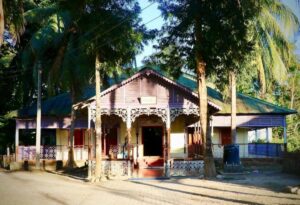
The namghar, literally “house of prayer,” was another institution central to Neo-Vaishnavism. The first namghar was built by Shankardeva himself around 1503 CE. These structures served as village prayer halls where people of all castes and communities could gather for congregational prayers, discussions, and performances of devotional plays and songs (Nath, 2020). Many of these performances and prayers were based on manuscripts. Manuscripts in the Neo-Vaishnavite movement were central to preserving and transmitting its teachings. Shankardeva and his disciples wrote and copied numerous texts. We expand on the tradition of manuscript writing in the following section.
What was the Role of Manuscripts in the Neo-Vaishnavite Movement?
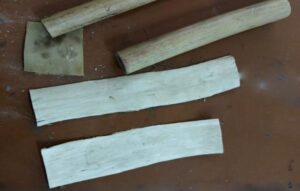
Manuscripts became the lifeblood of the Neo-Vaishnavite movement in Assam. Known locally as puthis, these manuscripts were usually written on sancipat (the bark of the agar tree, Aquilaria agallocha) or tulapat (paper made from cotton pulp). Both surfaces provided durability, but sancipat was especially prized for its smooth texture and longevity (Vaidhya & Amritanand, 2019). The manuscripts were hand-written with black ink made from natural resins and minerals, often applied with reed pens, and many were richly decorated with miniature paintings (Baruah, 2019).
The process of manuscript preparation was highly detailed. To understand this process, we can briefly take the example of how sancipat manuscripts were produced: strips of bark were carefully removed, dried, treated with paste and natural dyes, and polished until smooth. They were then cut into uniform sizes and used for writing. The Katha Guru Carita mentions that Shankardeva himself collected Sanci bark for manuscripts, and his disciple Madhavdeva also procured writing materials, including inks made from vermilion, yellow arsenic, and indigo, showing how much importance they placed on this literary tradition (Goswami, Saikia, and Gogoi 2021).
The manuscripts once produced were carefully housed in sacred spaces within the satras and namghars. Inside the monikut, or sanctum, of a namghar, manuscripts were placed on a wooden throne known as the thapona. They were usually covered with a woven gamosa and placed under a canopy, signifying their sanctity (Vaidhya & Amritanand, 2019). These were treated as embodiments of the faith, and often worshipped during rituals. Therefore, they were sacred objects and cultural artefacts that sustained the religious and artistic vision of Neo-Vaishnavism. To this day, manuscripts are treated with great reverence, and their recitations are a part of collective prayers.
The preservation of manuscripts within the satras was meticulous. They were kept wrapped in cloth, often with layers of protective coverings to guard against moisture and insects. Scribes (likhak) and illustrators (khanikar) were trained within the satra system. This ensured continuity in the practice of manuscript production across generations. (Vaidhya & Amritanand, 2019). This explains the survival of thousands of manuscripts, many of which are still found in satras like Auniati, Dakhinpat, and Garamur in Majuli, or in Barpeta and Bardowa. Some manuscripts have been transferred to museums and libraries for conservation, but many remain part of the living heritage of Assam, still read, displayed, and revered in their original contexts (Baruah, 2019).
In terms of content, the manuscripts encompassed a wide range of religious and literary works. Shankardeva and his disciples composed and copied texts such as the Bhagavata Purana, Kirtan Ghosa, Gunamala, and Naam Ghosa. They also produced Choritra Puthis (hagiographies), dramas (Ankia Naat), and lyrical songs (Borgeets). Sattriya, a major Indian classical dance form, also originated in the Satra, where mostly male monks performed it as a part of Ankia Naat.
Many manuscripts included translations or adaptations of Sanskrit scriptures into Assamese or Brajabuli so that the common people could understand them (Vaidhya & Amritanand, 2019). This was in keeping with the egalitarian spirit of Neo-Vaishnavism, which aimed to make religion accessible beyond the elite. The manuscripts were not confined to silent reading but were used in communal performances such as bhaonas (religious dramas) and naam-kirtan (congregational singing). These manuscripts then served as storehouses of knowledge and tools of cultural transmission for a largely illiterate audience.
One of the most striking features of these manuscripts was their visual richness. Many were illustrated with colourful miniatures depicting episodes from the Bhagavata Purana or other Vaishnavite texts. These chitra-puthis used local styles that developed into a recognisable school of Assamese manuscript painting. The illustrated manuscripts from Auniati Satra in Majuli, for example, contain exquisite depictions of Krishna’s life that combine bold lines, vibrant colours, and stylised figures.
For example, the Bhagavata Purana Book-X (Adi Dasam) is an illustrated manuscript that tells the story of Krishna’s birth and the miracles he performed. It also shows pictures of Vishnu’s earlier incarnations. The manuscript, written by Srimanta Shankardeva, was made on sancipat and today has 128 folios, each measuring 58 cm by 21 cm. This particular copy was prepared in 1771 CE. The whole tenth book of the Bhagavata Purana was translated into Assamese verse in three parts: Adi Dasam by Shankardeva, and Majh Dasam and Sekh Dasam by Ananta Kandali, who translated other religious texts as well. While other copies of this manuscript once existed, they have not survived (Laskar and Ansari, 2019).
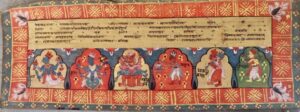
This manuscript is preserved in the Auniati Satra of Majuli. The Satra was founded in 1653 AD by the Ahom king Sutamla (Jayaddhwaj Singha) under the guidance of the saint Niranjan Deva and has since held a high place among the royal Satras of Assam. Its name comes from the betel creeper “Auni Paan” that grew on the slightly elevated land, known as “Ati.” Over time, Auniati became not only a centre of devotion and Satra culture but also a crucial hub for the preservation of manuscripts and cultural artefacts, safeguarding centuries-old religious texts, plays, and historical records that form a vital part of Assam’s heritage (Auniati Satra, n.d.).
Manuscripts of Assam, mostly written on sancipat and tulapat, preserved the teachings of Srimanta Shankardeva and his disciples, and helped spread Neo-Vaishnavism among the people through prayer, song, and performance. Today, they remain as symbols of Assam’s cultural identity. However, many manuscripts are at risk of damage from moisture, insects, careless handling, or simply the passage of time. Without proper preservation, we risk losing these unique windows into our past. It is therefore vital to conserve them through protective storage, digitisation, and careful restoration, so that future generations can continue to learn from and cherish this rich legacy.
References
1. Auniati Satra (n.d.) About Auniati Satra. Available at: https://www.auniati.org/about.php (Accessed: 27 August 2025).
2. Hazarika, D., Hazarika, D., Hazarika, S. and Dutta, K.N. (2024) ‘Paal Naam: A Historical Analysis of the Congregational Prayer Festival in Assamese Satra Tradition’, International Journal of Scientific Development and Research (IJSDR), 9(12), pp. 58–62.
3. Laskar, I. and Ansari, S. (2019). Illustrated Manuscripts at Auniati Satra of Majuli Island, Assam. International Journal of Research in Social Sciences, 9(3), pp. 1–7.
4. Baruah, M. (2019). Manuscript Painting of Assam: Historical and Contemporary Perspectives. Sahapedia. Available at: https://www.sahapedia.org/manuscript-painting-of-assam-historical-and-contemporary-perspectives [Accessed 25 Aug. 2025].
5. Baruah, M. (2019). Manuscript Painting of Assam: A Conversation with Chittaranjan Borah. Sahapedia. Available at: https://www.sahapedia.org/manuscript-painting-of-assam-conversation-chittaranjan-borah [Accessed 25 Aug. 2025].
6. Vaidhya, R.K. & Amritanand, N. (2019). Manuscripts in Religio-Cultural Context: Puthis of Assam. IJELLH, 7(2), pp. 403–410.
7. Nath, H. J. (2020). Neo-Vaishnavite Movement and the Role of Satra and Namghar in Assam: A Historical Analysis. International Journal of Creative Research Thoughts, 8(3), pp. 188–193.
8. Pathak, G. (2019). Reaching the Unreached: Srimanta Sankardeva and Neo-Vaishnavite Movement in Assam. Kanya Mahavidyalaya, Gauhati University.
9. Census 2011: Religion-Assam (nd). Assam religion data from Census 2011. Available at: https://www.census2011.co.in/data/religion/state/18-assam.html (Accessed: 25 August 2025).
Image Sources
1. Wikipedia (2016). Imaginary Portrait of Shankardeva by Bishnu Prasad Rabha. Available at: https://en.wikipedia.org/wiki/File:Sankaradeva.jpg [Accessed 25 August 2025].
2. Laskar, I. and Ansari, S. (2019). Entrance to Namghar in Auniati Satra, Majuli. In: Illustrated Manuscripts at Auniati Satra of Majuli Island, Assam. International Journal of Research in Social Sciences, 9(3), pp. 1–7. Available at: https://www.heritageuniversityofkerala.com/JournalPDF/Volume9/65.pdf [Accessed 28 August 2025].
3. Laskar, I. and Ansari, S. (2019). Folios of Sancipat cut in almost uniform sizes. In: Illustrated Manuscripts at Auniati Satra of Majuli Island, Assam. International Journal of Research in Social Sciences, 9(3), pp. 1–7. Available at: https://www.heritageuniversityofkerala.com/JournalPDF/Volume9/65.pdf [Accessed 28 August 2025].
4. Laskar, I. and Ansari, S. (2019). Image of Bhagvata Purana Book X. In: Illustrated Manuscripts at Auniati Satra of Majuli Island, Assam. International Journal of Research in Social Sciences, 9(3), pp. 1–7. Available at: https://www.heritageuniversityofkerala.com/JournalPDF/Volume9/65.pdf [Accessed 28 August 2025].