

How Haider Turns Kashmir’s Winter into a Politics of Silence and Suspended Time
- December 11, 2025

By Ramyani Banerjee
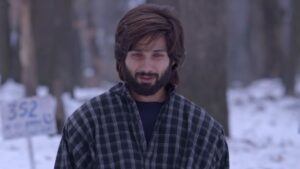
Shahid Kapoor in and as Haider (Bhardwaj, 2014) .
Image Source:- Team Cutting Shots (2024), 4 October Available at: https://cuttingshots.com/vishal-bhardwaj-recalls-how-shahid-kapoor-impressed-him-in-this-scene-from-haider-the-way-he-was-crying-i-didnt-have-the-heart-to-shout-cut/ (Accessed 13 Nov, 2025)
Winter as Political and Emotional Landscape:-
Long before Haider himself utters a word, the film announces its truth in the language of winter. The opening frames—snow drifting over abandoned houses, fog swallowing entire stretches of valley, trees standing like skeletal witnesses—pull the viewer into a world where warmth has drained away not just from the landscape, but from history itself. It is in this frozen geography that Haider reappears in his homeland, a lone figure navigating a terrain thick with secrets, silences and long-buried grief. His personal search for answers begins in a place where countless others have vanished without any trace, where enforced disappearances have carved themselves into the collective memory as sharply as frostbite.
The valley’s persistent whiteness, punctuated by the contrast of black or grey pherans, red bloodstains, or the earthy browns of crumbling architecture, forms an aesthetic of mourning—an ecology of absence. Snow-covered rooftops, muted colour palettes, barren orchards, and thick winter fog become more than visual choices; they externalize the psychic landscape of trauma, mirroring the region’s eroded sense of safety and the emotional numbness that follows prolonged conflict.
Ecocritically and phenomenologically, winter is the season where the world withdraws into itself: life retreats beneath surfaces, time thickens, and perception slows under the weight of cold air. Environmental phenomenologists likewise argue that cold climates generate altered states of temporality and embodiment—what Arnold Berleant describes as an atmosphere where sensory engagement becomes muted, suspended, and contemplative. (Berleant 1992). And Bhardwaj seizes these associations with intention.
In Kashmir, the late 20th and early 21st centuries were more than troubled decades—they were years marked by recurring crackdowns, armed violence, unexplained disappearances, and the tightening grip of militarization. For many, these decades felt suspended, as though history had frozen midway. Layer upon layer of political violence, forced migrations and unresolved tragedies accumulated like sediment beneath the snow, creating a collective memory in which resolution was always deferred, always just beyond reach.
It is this sense of frozen time—of life held in pause—that Haider draws upon so powerfully in its winter-infused world. Thus, the film highlights the region’s ongoing turmoil, noting the persistent militarization and the toll of violence on civilian populations. The fog blurs boundaries between visibility and invisibility—resonating with a region marked by violence. The snow and fog of Bhardwaj’s mise-en-scène do not merely serve dramatic purposes; they make Kashmir’s winter emblematic of repression, fear, and the immobilization of agency.

Haider (Shahid Kapoor) and Ghazala (Tabu) stand side by side, but there is distance—physical and emotional. This particular scene, with warm earth tones in their clothing represents a threshold moment in their relationship—still tense, still clouded with secrets, but not yet broken. The warm palette underscores a past intimacy that still flickers beneath the surface. This is the phase where Haider’s suspicions are growing, Ghazala’s guilt is unspoken, and their relationship hangs in a fragile balance.
Image Source:- Scroll.in, 2 October. Available at: https://scroll.in/reel/681740/haider-movie-review-desperately-seeking-hamlet-in-the-valley-of-kashmir (Accessed: 14 Nov, 2015)
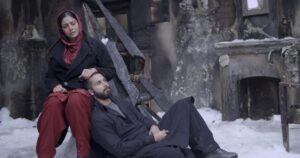
If you look closely and compare, now there is snow-covered ground, grey, desaturated colour palette. There are charred ruins behind them, Ghazala dressed in dark, heavy fabrics and Haider resting against her in exhaustion and grief. Winter drains all the colours from the frame, leaving only coldness, absence, and stillness—visual metaphors for the truth Haider uncovers and the emotional devastation that follows. In this scene, Haider seeks comfort, but the comfort is hollow; Ghazala offers warmth, but she herself is frozen with guilt and fear.
Image Source:- Bhardwaj, Vishal. Haider. UTV Motion Pictures, 2014
Memory, Loss, and the Haunting Past:-
Bhardwaj’s decision to situate Hamlet in this frozen landscape of Kashmir intensifies the sense of existential and political stasis: Haider, like Hamlet, is trapped not only by familial betrayal but also by structural and systemic violence that renders action both morally and pragmatically fraught. Grief numbs the action, and uncertainty freezes the decision-making. The narrative’s insistence on winter reinforces the spectral weight of memory, where the past is neither fully visible nor easily forgotten. Snow covers the ground anew each day, just as a trauma resurfaces repeatedly, refusing closure. It masks violence under a veneer of purity while simultaneously making the footprints and traces visible. This duality reflects the broader historical memory of Kashmir, where disappearances, political disappearances, and narratives of loss leave indelible marks on the social fabric.

Haider (Hamlet) and Arshiya’s (Ophelia) closeness in this frame feels almost sacred against the harshness around them. The snowfall creates a sense of pause, as if the world has momentarily stopped. This mirrors the characters’ inner desire to hold onto a fleeting moment of warmth and safety despite everything collapsing around them. Winter becomes a cocoon—brief, fragile, suspended.
Image source:- Bhardwaj, Vishal. Haider. UTV Motion Pictures, 2014
Gaston Bachelard’s The Poetics of Space offers a compelling framework for reading the film’s winter aesthetic. Bachelard proposes that environments are not passive surroundings but extensions of interior psychic states. Space holds memory; atmosphere materializes emotion. In Haider, the snow-covered homes, empty courtyards, and fog-blurred interiors externalize the protagonist’s fractured psyche. The coldness of the outside mirrors the coldness within—a home emptied of its father, a family fractured by betrayal, a community frozen by fear. The “houses” in the film feel less like shelters and more like containers of absence, echoing Bachelard’s notion that domestic spaces often hold the residue of trauma and longing.
An article on Haider emphasizes the film’s emotional depth and the ethical weight of its adaptation, noting that Bhardwaj “renders the political intimate and the intimate political” through careful cinematography and narrative pacing. Winter, in this sense, operates as a connective tissue between external reality and inner subjectivity. The desolate landscapes mirror Haider’s internal state, while the recurring motifs of frost and fog suggest the opacity of truth and the difficulty of moral clarity in conditions of protracted conflict.
The Aesthetics of Stillness and Silence:-
Though set in Kashmir, Haider’s visual language resonates strongly with Nordic cinema’s tradition of winter melancholia, where cold landscapes reflect inner emotional desolation. And as we see, a key element of Haider’s winter aesthetic is its invocation of stillness. Here, we must also remember that Haider’s personal vendetta is inseparable from the collective experiences of the region: the film portrays a society in which the mechanisms of governance, law, and justice have been rendered ineffective by structural violence. The visual and narrative strategies of the snow and fog operate metaphorically as a political freeze: actions are constrained, voices are silenced, and histories are overwritten by state narratives.
Nowhere is this visual language more striking than in the “Aao Na” sequence, where Haider watches three men digging graves in a snow-filled cemetery. The scene is at once surreal and brutally literal. The stillness of the white landscape amplifies the thud of shovels breaking into frozen earth. The skeletons buried beneath the snow become a chilling reminder of the region’s suppressed histories—lives rendered invisible, deaths unacknowledged. The moment works like a visual thesis statement: Kashmir’s silence is not empty. It is dense, heavy, and violently maintained.
Cinematographically, Bhardwaj frequently frames characters in static tableaux, with minimal movement and expansive shots that foreground the frozen environment. Just as the snow renders landscapes inert, the characters’ movements and choices are constrained by circumstances that are often beyond their control. The film’s spatial and temporal stillness, therefore, is a formal analogue for the region’s political stasis and the protagonist’s psychic entrapment.
This aesthetic of stillness also facilitates a meditation on the ethics of witnessing. Bhardwaj’s approach echoes the postcolonial emphasis on the embodied nature of trauma: political violence is not only narrated but also felt, its coldness registering on the body as well as the psyche. Through this interplay of environment and interiority, Haider exemplifies a cinema of affect, where aesthetic choices are inseparable from political critique.
Conclusion:-
From a narrative perspective, winter functions as a structuring principle that aligns temporal, emotional, and political dimensions. The season’s persistence throughout the film mirrors the inescapability of grief and the enduring impact of historical violence. Characters are continually negotiating frozen spaces—both literal and metaphorical—where choices are constrained and moral clarity is obscured. By immersing audiences in the sensory realities of coldness and stillness, Bhardwaj cultivates empathy for the experiences of those living under prolonged political repression, where ordinary life is marked by absence, surveillance, and enforced stasis. Snow, fog, and frost do more than shape the film’s atmosphere—they press visibly upon the narrative, making the weight of disappearance, betrayal, and political paralysis almost physically tangible.
References:
1. Bachelard, Gaston. The Poetics of Space. Beacon Press, 1994.
2. Berleant, A. The Aesthetics of Environment. Philadelphia: Temple University Press. 1992
3. Basak, S. and Ghosh, A., 2021. The Tragedy of Kashmir: An Interpretation of Vishal Bhardwaj’s film Haider (2014) and Basharat Peer’s memoir Curfewed Night (2008). International Journal of Scientific and Research Publications, 11(1), pp.787–793. DOI: 10.29322/IJSRP.11.01.2021.p10996.
4. Bhardwaj, Vishal. Haider. UTV Motion Pictures, 2014
5. Ghosh, A. ‘Haider: Rewriting Shakespearean Ghosts into Postcolonial Specters in Kashmir’, in Kashmir’s Necropolis: Literary, Cultural, and Visual Texts. Lanham: Lexington Books, 2023. pp. 57–72.
6. Haulussy, Legolas. The Anglo-Saxon. “Haider: A Masterpiece of Artistry, Ambition and Emotional Depth.” Medium, 2019. https://theanglosaxon.medium.com/haider-a-masterpiece-of-artistry-ambition-and-emotional-depth-4b3963727929
7. Walsh, B. (2018) ‘Resisting Hamlet: Revenge and nonviolent struggle in Vishal Bhardwaj’s Haider’, Literature/Film Quarterly, 46(2). Available at: https://www.jstor.org/stable/48678562
8. Waade, Anne Marit (2017). Melancholy in Nordic Noir: Characters, Landscapes, Light and Music. Critical Studies in Television, 12(4), pp. 380–394. DOI: 10.1177/1749602017729629
9. Pandey, V. (2014) Haider: Why is ‘Indian Ham
10. Zutshi, Chitralekha. (2025) ‘Visualising Kashmir, the Self, and History’, The India Forum, 15 September. Available at: https://www.theindiaforum.in/tiffin/visualising-kashmir-self-and-history (Accessed: 12 Nov, 2025).