
By Aryan Singh
If you’ve grown up in Delhi, chances are you’ve strolled past India Gate, walked along Rajpath — now called Kartavya Path — or stood in awe watching the Republic Day parade where at its beginning, the President’s horse-drawn cavalcade glides down from Rashtrapati Bhavan, flanked by the North and South Blocks, their symmetry stretching like the wings of a great bird. This hilltop is more than just stone and lawns — it is the very heart of India’s power, where the head of state resides, the government functions, and the destiny of the nation is shaped.
But Raisina Hill wasn’t always the seat of a free India. Once, it was the proud citadel of the British Raj — the nerve centre of an empire that claimed the sun never set on its dominion. At the heart of that empire lay British India, the so-called “Jewel in the Crown” — a land rich in resources, soldiers, and wealth that fuelled Britain’s wars and lined its coffers, often at the cost of Indian lives. (Shashi Tharoor) Bound by the chains of colonial rule, we fought in their battles, not our own. Yet, history turned. After World War II and the thundering rise of a united freedom movement, the empire’s grip began to falter. And from the commanding heights of Raisina Hill, once the Viceroy’s fortress, a new sun rose — heralding the birth of an independent India on 15th August 1947, a new dawn and the end of colonial rule for which our freedom fighters laid their lives.
This article will delve into the history of Raisina Hill, its design, and its connection to the Independence Day celebrations on August 15, 1947.
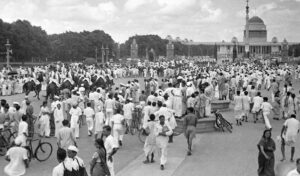
Source: Ministry of Housing Affairs, on the day of independence, 15th August 1947
The capital of India, as we know it today, is New Delhi — but that wasn’t always the case. Under British rule, power shifted with the seasons: Calcutta served as the de facto capital, while Shimla became the summer escape. All that changed in 1911, when King George V and Queen Mary had a grand Coronation Durbar in Delhi, marking the King’s new title as Emperor of India. However, this shift in capital to Delhi was due to several factors. Calcutta had erupted in rage after the 1905 partition of Bengal by Lord Curzon, and the British knew Bengal would not welcome the King. (Subhadra Sengupta) There were administrative reasons as Calcutta was too far to the east, while Delhi’s central location offered a strategic advantage for governing the vast subcontinent. Yet, there was more at play than just geography. By moving the capital to Delhi — once the heart of the Mughal Empire and the flashpoint of the 1857 revolt — the British sent a clear message: the age of the Mughals was over, and India would now be ruled under the imperial crown of Britain.
Source: Ministry of Housing Affairs, Delhi Durbar of 1911
At first, the British planned to build the new capital in North Delhi, but they soon realized the area was too crowded and had no room for the city to grow. So, Viceroy Lord Hardinge formed a Town Planning Committee in 1912 to find a better location. The team explored different parts of Delhi — sometimes even riding on elephants — looking for the perfect spot. In the end, they chose the quiet villages of Raisina and Malcha, and acquired land from 300 families from villages that would soon be transformed into the grand new capital of British India. Lord Hardinge wanted the work to be completed in 4 years, but it got delayed due to World War 1 and the work was finally completed in 1929, and the official inauguration took place in 1931. (First Post, 2011)
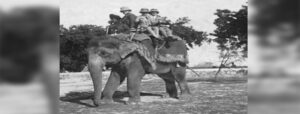
Source: Ministry of Housing Affairs, Town Planning Committee, searching for a place to develop capital
The British appointed two master architects — Sir Edwin Lutyens and Sir Herbert Baker — to design and shape the heart of the new capital. Their canvas was Raisina Hill, a rocky outcrop standing 226 meters above sea level, about 18 meters higher than the land around it. The hill was levelled, and a railway line was constructed to transport the soil and debris and facilitate the transfer of heavy building material such as sandstone and marble from Rajasthan. At the top of the hill rose the Viceroy’s House — a palace of power and prestige. With 340 rooms spread across four sprawling floors, it was the largest residence ever built for a head of state. The dome of the Viceroy house has a decorative railing like a Stupa at Sanchi. There are carved elephants & horses everywhere, and lion sculptures and chhajjas placed above windows. Flanked by the imposing North and South Blocks and the stately Council Chamber (now Parliament), the project cost a staggering £4 million — a fortune in its day — and stood as the crowning jewel of British imperial architecture in India. (Ministry of Housing Affairs)
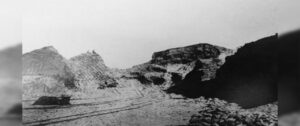
Source: Ministry of Housing Affairs, Raisina Hill, before construction
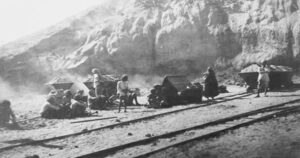
Source: Ministry of Housing Affairs, Construction Work at Raisina Hill
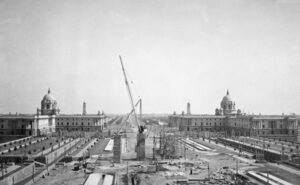
Source: Ministry of Housing Affairs, Making of Capital
Lord Irwin took up residence in the brand-new Viceroy’s House in 1929, and by 1931, it was formally inaugurated with all the pomp of the British Raj. But outside its grand gates, India was in the throes of the freedom struggle — the Civil Disobedience Movement was at its peak, the Congress Party was leading mass protests, and most of its leaders were behind bars. Just two days after the grand opening, the scene shifted dramatically: Mahatma Gandhi walked through those imposing doors, straight from Yeravada Jail, at Lord Irwin’s invitation for talks — a moment when the empire’s most powerful seat met the voice of India’s defiance.
The Day of Independence
The period from 1920 to 1947 was the most significant in the history of British India. It began with the Gandhian Revolution of non-violence and culminated in Indian Independence. The famous slogan of Do or Die in the Quit India movement and non-cooperation by people, which caused such an unprecedented upsurge among the masses that the British Raj could be sustained only at the point of a sword. (Durga Das, 1981)
The two World Wars drained the British treasury dry, emptying coffers they had stuffed for over two centuries by plundering India. The once-mighty empire could no longer afford to keep its grip on distant colonies. Adding to the strain, the United States — now a global power — pressed hard for the end of colonial rule, pushing Britain to dismantle its overseas possessions. The age of the empire was crumbling, and the call for freedom grew impossible to ignore. (Durga Das, 1981)
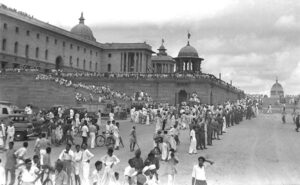
Source: Ministry of Housing Affairs, Thousands of people near Vijay Chowk on 15th August
Finally, the auspicious day came, and Nehru called the constituent assembly in the afternoon of 14th August 1947 and continued the sitting till midnight when the clock struck midnight. He gave his famous “Tryst with Destiny” speech, and the cry of ‘Mahatma Gandhi ki jai’ echoed throughout the central hall. Thousands of Indians flocked to imperial buildings on 15th August 1947 to celebrate their freedom, as you can see above in the picture, people are standing on the imperial structure of Raisina Hill.
Oral accounts from those who stood there capture the magic of that moment of freedom. The British Union Jack still fluttered over the North and South Blocks and the Council Chamber. The crowd murmured in protest, restless for the change they had fought for. Then, in a flash of defiance, a few dhoti-clad men scrambled up the towering minarets. Within minutes, the Union Jack came down, and in its place, the tricolour of a free India soared proudly against the sky. (Economic Times, 2021)
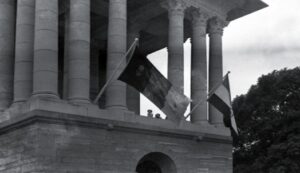
Source: Ministry of Housing Affairs, The Tricolor was unfurled at North Block
That morning, the Viceroy’s House — newly renamed Government House — sent forth a historic motorcade from the heights of Raisina Hill. Inside were the leaders of independent India. At the front, a sleek limousine carried Jawaharlal Nehru, who smiled and waved to the roaring crowds. Behind him came cars bearing Sardar Vallabhbhai Patel, Dr. Rajendra Prasad, Maulana Abul Kalam Azad, and others — each greeted with thunderous cheers.
When the procession of leaders passed, the crisp ranks of the Governor-General’s Bodyguard trotted smartly down the hill. Then, in a flourish of ceremony, the grand coach of Lord and Lady Mountbatten appeared. The crowd erupted with chants of “Mountbatten ki jai!”, reaching out to shake his hand — a final, curious echo of the empire on the very day India stepped into freedom. (Economic Times, 2021)
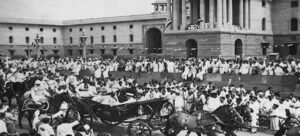
Source: Ministry of Housing Affairs, Cavalcade of Mountbatten on Aug 15, 1947
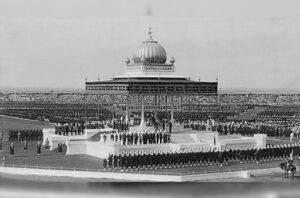
That evening, the celebrations moved to Princess Park, near India Gate, for a ceremony known as the Flag Salutation. In rare photographs from the day, Jawaharlal Nehru stands beside Lord Mountbatten, surrounded by a sea of jubilant faces. The crowd, hands raised in salute, looked on with pride as the leaders honoured the tricolour — a powerful moment that marked the close of India’s first day as a free nation. (Economic Times, 2021)
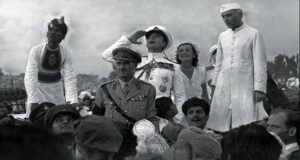
Source: Ministry of Housing Affairs
In 1948, C. Rajagopalachari succeeded Lord Mountbatten to become the first Indian Governor-General of independent India — and the first Indian to call Rashtrapati Bhavan home. True to his simple, Gandhian lifestyle, he chose to live in just a few modest rooms in the family wing, leaving the grand Viceroy’s apartments, once occupied by Mountbatten, unused. Those lavish chambers were instead converted into guest suites for visiting heads of state — transforming a symbol of imperial luxury into one of democratic hospitality. (Subhadra Sen Gupta, 2019)
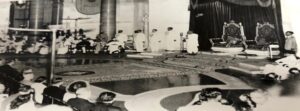
Source: Rashtrapati Bhavan archives, Swearing of C Rajagopalachari
References
1. Das, Durga. India from Curzon to Nehru and After. 1981.
2. Modi, Diksha. “Raisina Hill: What Existed before Rashtrapati Bhavan and Who Owned the Land?” News18, 22 Apr. 2025, www.news18.com/viral/raisina-hill-what-existed-before-rashtrapati-bhavan-and-who-owned-the-land-ws-dkl-9309122.html. Accessed 10 Aug. 2025.
3. Pallavi Polanki. “From Raisina to Raisina Hill: A 100-Year History of New Delhi.” Firstpost, 12 Dec. 2011, www.firstpost.com/india/from-rasina-to-raisina-hill-a-100-year-history-of-new-delhi-153293.html. Accessed 10 Aug. 2025.
4. “Rashtrapati Bhavan | Description & Facts | Britannica.” Www.britannica.com, www.britannica.com/topic/Rashtrapati-Bhavan.
5. “Central Vista History | Evolution of the Central Vista.” Centralvista.gov.in, 2016, centralvista.gov.in/evolution-central-vista.php.
6. Dasgupta, Reshmi. “View: Independence Day Is a Historic Event, Retaining It as an Official Celebration Won’t Do.” The Economic Times, Economic Times, 13 Aug. 2021, economictimes.indiatimes.com/news/india/independence-for-aug-15-celebrations/articleshow/85312928.cms?from=mdr. Accessed 10 Aug. 2025.
7. “RASHTRAPATI BHAVAN: SUBHADRA SEN GUPTA: Free Download, Borrow, and Streaming: Internet Archive.” Internet Archive, 2019, archive.org/details/RASHTRAPATIBHAVANSUBHADRASENGUPTA/RASHTRAPATI%20BHAVAN%20-%20SUBHADRA%20SEN%20GUPTA?q=raisina+hill. Accessed 10 Aug. 2025.