


By Ramyani Banerjee
Discovery and a Name That Sings
In the dry terrain in the Pranhita-Godavari region near Pochampally, a village straddling Telangana and Maharashtra in central India, fragments of the deep past were resting undisturbed until the late 1950s. Here, in clay and sandstone layers of what is known as the Lower Kota Formation (a geological layer of rocks that preserves remains of ancient life), scientists from the the Geological Studies Unit (GSU) of the Indian Statistical Institute (ISI) uncovered the bones of Barapasaurus tagorei—- a sauropod (a group of long-necked, plant-eating dinosaurs) that lived during the Early to possibly Middle Jurassic period (about 200–150 million years ago). The genus name Barapasaurus that was coined by S.L Jain and his colleagues in 1975; means “big- legged lizard,” derived from “bara” (meaning “big”) and “pa” (“leg”) in several Indian languages— coupled with the Greek “sauros” (lizard). The bones were recovered largely in 1960–1961, after the first finds in 1958. Moreover, the specific epithet tagorei honours
Rabindranath Tagore because initial fieldwork began in the centenary year of his birth. Today, Barapasaurus tagorei stands as both a marvel of evolution and a symbolic gesture: a fossilized reminder that Tagore’s legacy, like the bones of the giant itself, endures across epochs.
A Skeleton Almost Whole — Except for the Head
Barapasaurus is special not just because it was one of the earliest dinosaurs discovered in India, but because its fossils are surprisingly well-preserved for such an ancient creature of the Early Jurassic period. Scientists have found many important parts of its body, such as the leg bones, backbone, tail bones, hip bones, and even some teeth. However, the skull is missing, which makes it difficult to fully picture what the dinosaur’s head looked like. This absence makes every other preserved bone all the more precious, as each one helps fill in the story of this dinosaur’s
life.
As mentioned earlier, the fossils of Barapasaurus were found in the Lower Kota Formation. Since this site has no volcanic ash layers—which scientists usually use to get accurate dates through radiometric methods (a scientific method used to calculate a rock’s age by measuring radioactive elements)—scientists have had to rely on indirect methods, such as comparing the fossils found here with those in other rock layers which are well-dated and documented. This method is called biostratigraphy. In recent years, careful study of the bones has given scientists
a clear enough idea of Barapasaurus’s size, body proportions, and how it may have moved. Even though its face is left to imagination, the fossil that remains allows us to connect with this creature’s past.

Barapasaurus tagorei. Getty Images. (2025) [online image catalogue]. Available at:
https://www.gettyimages.in/search/2/image?phrase=barapasaurus (Accessed: 12 September 2025).
Size, Posture and Everyday Life
In terms of size, Barapasaurus is now estimated at about 12 to 14 metres in length and some 7 tonnes in mass. That puts it in the mid-range among sauropods— large enough to dominate a Jurassic floodplain, but not the most gargantuan of sauropods to come. One of its leg bones, the femur, could grow to more than one and a half metres long. This shows how strong its legs had to be to carry such a massive body. Unlike many later dinosaurs that had lighter, hollow bones, Barapasaurus had heavier and more solid vertebrae. This tells us that its body was built more for strength than for lightness.
From the shape of its bones, scientists believe that Barapasaurus walked on four thick, pillar-like legs. It probably moved slowly and steadily, not built for speed but for endurance. Its way of life was shaped by its enormous size: eating plants at low and middle heights, digesting them slowly with a long digestive system, and saving energy by moving carefully rather than quickly. Reflecting on this, fossils like those of Barapasaurus reveal how life once adapted to survive in very different worlds. They remind us that strength, endurance, and balance with nature were as important in the past as they are today.
The Enigma of Its Age
Dating the Kota Formation is a very complex problem. Lacking volcanic layers that could be radiometrically dated, stratigraphers have relied on biostratigraphic inference and comparisons with other sequences. Most scientists place the lower Kota into the Early Jurassic — broadly Sinemurian to Pliensbachian, roughly 200–150 million years ago — but some analyses have proposed younger, even Middle Jurassic ages for portions of the formation. That chronological ambiguity matters. If Barapasaurus truly belongs to the early Jurassic, it occupies a pivotal, early role in the sauropod story; if the horizon proves younger, its relative significance shifts. Either way, the animal remains an essential data point for reconstructing early sauropod diversification on the Gondwanan landmasses.
Although it is an early and relatively unspecialised sauropod, Barapasaurus exhibits many of the structural features that later giants would elaborate upon. These include:
● Long neck vertebrae: Although the very front neck bones are missing, the preserved ones from the back part of the neck and the beginning of the back show that they were long and stretched out. This kind of neck would have helped Barapasaurus reach food at different heights — from low bushes to taller trees.
● Quadrupedal posture with columnar limbs: The leg bones are very thick and sturdy, built to support a heavy body. Unlike some earlier dinosaurs that walked with a more spread-out or partly upright stance, Barapasaurus always walked fully on four legs.
● Reinforced vertebral column: The backbones (dorsal vertebrae) show special interlocking joints (called hyposphene–hypantrum) that make the spine more rigid and stable. Some parts of the bones also show signs of being hollow inside (incipient pneumaticity), which reduced weight — an early step toward the lighter skeletons seen in later giant sauropods.
● Sacral structure: Four sacral vertebrae (the part of the spine attached to the hip bones) are present. This is more than in earlier, simpler dinosaurs and gave extra support to carry the large torso.
● Teeth morphology: The teeth were shaped like spoons, wide at the base. The outer front surface and the inner back surface of the enamel (the hard coating of the tooth) had grooves, and the cutting edges (called carinae) had small bumps (tubercles). These features suggest the dinosaur was a plant-eater. The teeth were good for nipping and
cropping vegetation, but not as specialized for chewing as in later sauropods. The largest tooth found is about 5.8 cm tall.
Barapasaurus did not live in isolation. Its habitat, the Lower Kota Formation, also preserves fossils of other early vertebrates: another sauropod (Kotasaurus), early mammals (Kotatherium, Indotherium, Indozostrodon) and in upper parts, reptiles like turtles, rhynchocephalians, lepidosaurs, pterosaurs. The flora is inferred to have included trees large enough for logs (as seen in the bone bed), maybe conifers, cycads, ferns—typical of Jurassic floodplain ecosystems. Such habitats would have offered Barapasaurus a buffet of plant matter, though its feeding height was
limited compared to some later sauropods, due to its relatively shorter trunk.
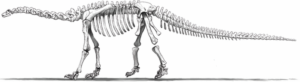
Illustrated outline of the left side of the mounted Barapasaurus tagorei skeleton, displayed in a modern stance with
its tail raised, at the Geology Museum of the Indian Statistical Institute (ISI). Bandyopadhyay, S., Gillette, D. D.,
Ray, S. & Sengupta, D. P., 2010. Osteology of Barapasaurus tagorei (Dinosauria: Sauropoda) from the Early zurassic of India. Palaeontology, 53(3), pp.533-569.
A Transitional Beast: Primitive or More Advanced?
One of the most fascinating findings from a detailed 2010 bone study is where Barapasaurus fits in the dinosaur family tree. In scientific terms, its position is tricky. Early studies showed that Barapasaurus had a mix of features — some that looked like its more primitive ancestors (prosauropods) and others that matched the giant plant-eating dinosaurs we usually think of as “true” sauropods. Because of this mix, researchers have debated for decades about how to classify it, sometimes linking it to certain early sauropod groups like cetiosaurs or the uncertain family called “Vulcanodontidae.”
Modern studies that carefully re-examined the bones now suggest that Barapasaurus was one of the earliest sauropods. It carried traits that were in-between — not fully primitive, but not yet the specialized features of the massive, column-legged giants that came later in the Mesozoic era. To put in simple words: Barapasaurus shows us how those later giants evolved from smaller, lighter ancestors. It is both a creature in its own right and a snapshot of evolution in progress.
Life and Death in the Early Jurassic of India
The geological and taphonomic context gives texture to the life of Barapasaurus. Around 185 million years ago, India was part of the supercontinent Gondwana. Far from being a marginal land, the fossil evidence shows that India may have been a central stage in the early history of sauropods — the long-necked, plant-eating dinosaurs that would later dominate the Earth. Alongside Barapasaurus, its close relative Kotasaurus has also been discovered here. Together, they suggest that some of the evolutionary “experiments” that made sauropods so successful — such as lighter bones and efficient feeding strategies — may have first taken shape in this region.
The fossils do not appear alone. Gigantic fossil tree trunks were found in the same deposits, painting a picture of a forested environment with towering vegetation. Imagine herds of Barapasaurus moving through these wooded landscapes, feeding on lush greenery. Yet life here was not without danger. Sudden floods or seasonal torrents likely swept through the region, carrying trees, sediment, and even dinosaurs together. Many individuals may have perished in such events. Their scattered and disarticulated bones hint at scavengers or water currents rearranging their remains before burial.
This evidence shows us that Barapasaurus lived in a world of contrasts: rich vegetation offering abundant food, but also unpredictable environments with floods, droughts, and shifting river channels. Surviving in such conditions demanded remarkable adaptations — massive but partly hollow bones to balance strength with lightness, feeding systems suited for varied plants, and perhaps social living to navigate food scarcity or threats together. Though scientists cannot say for certain whether they moved in organized herds, the discovery of multiple individuals at one
site suggests they were not solitary wanderers. Each fossil, each bone fragment, therefore, is not just a remnant of a creature, but a vital clue to how life itself evolved resilience, cooperation, and innovation in deep time.
Why Barapasaurus Matters
In the early Jurassic world, most dinosaurs were still small, swift creatures, moving on two legs as hunters or grazers. But in the Kota Formation of India, Barapasaurus marked a strong step forward: it experimented with size, with the strength to carry massive weight, with the skeletal reinforcements that later became standard in true giants. It stands as one of the earliest sauropods — the great long-necked, plant-eating dinosaurs that would come to dominate prehistoric landscapes.
This makes Barapasaurus far more than just another fossil. It shows us that India was not a marginal stage in dinosaur evolution, but an active site where crucial evolutionary experiments were unfolding. Its story reminds us that dinosaur evolution was not a single, linear march toward gigantism. What was being tested in India was as vital as what was happening in Africa, South America, or elsewhere.
There is also something deeply moving about this fossil. Imagine these colossal animals moving under dense Jurassic forests, wading through rivers, surviving floods and storms. Some perished, and their remains sank into mud that turned to stone — and those fragments have endured for almost 200 million years to reach us. Each bone carries not just anatomy, but memory: the chance of survival of life’s story across unimaginable times.
Today, the fossils of Barapasaurus are carefully preserved in Indian institutions, and mounted displays have inspired countless students and visitors. Detailed studies — including a full monograph describing its skeleton — have given us clearer knowledge of its anatomy and significance. Whereas fossils are usually named after places, discoverers, or features of anatomy, associating this one with Tagore anchors it in India’s own cultural pride. It resists the old
colonial habit of treating Indian discoveries as anonymous “raw material” for Western science, and instead gives it a distinctly Indian identity. The choice of epithet was a cultural homage, linking one of India’s earliest discovered dinosaurs to Nobel Laureate Rabindranath Tagore whose ideas of creativity and universality continue to shape modern Indian identity. Just as Tagore stretched the imagination of generations through poetry and philosophy, this dinosaur stretches our understanding of life’s possibilities– reminding us that India’s contributions to science and culture are intertwined.
REFERENCES:
● Bandyopadhyay, S., Gillette, D.D., Ray, S. & Sengupta, D.P., 2010. Osteology of Barapasaurus tagorei (Dinosauria: Sauropoda) from the Early Jurassic of India. Palaeontology, 53(3), pp.533–569. https://doi.org/10.1111/j.1475-4983.2010.00933.x Accessed: Sep 11, 2025
● India Today (2019) Rabindranath Tagore has a dinosaur named after him. Did you know? India Today, 23 October. Available at: https://www.indiatoday.in/trending-news/story/rabindranath-tagore-has-a-dinosaur-named-after-him-did-you-know-1612198-2019-10-23 (Accessed: [Sep 11, 2025]).
● Paul, G.S., 2010. The Princeton field guide to dinosaurs. Princeton, NJ: Princeton University Press, p.173.